Big Data Analytics in Healthcare: A Prescription for Better Care and Lower Costs

Vishal Panchal
Hospitals today walk a tightrope: delivering the best possible patient care while keeping costs manageable is a relentless challenge. With mounting pressure on budgets and resources, both doctors and administrators must find more innovative ways to achieve more with less. But this isn’t just a numbers game; it’s about every life in the system.
Imagine the power of anticipating patient risks before symptoms appear, or instantly adjusting staffing levels based on real-time demand. These are not distant dreams; they’re real outcomes that big data analytics is delivering in 2026. Recent industry studies reveal that many healthcare organizations are now using analytics tools to optimize care and costs. Yet only20% of executives fully trustthe data their teams rely on.
So, why don’t healthcare professionals trust analytics?
It is due to the quality of recommendations from data analytics solutions and dashboards that often lack conviction. Additionally, big data analytics in healthcare is usually hindered by issues of data quality, compliance concerns, and information security. One possible solution is to understand howbig data analytics servicescan be integrated into your healthcare system, operations, and processes. This article does that by cutting through the noise on the internet about big data analytics in the healthcare sector. It covers everything from what big data analytics is, its usage in healthcare, its benefits, challenges, and solutions.
So, let’s get started.

What Is Big Data Analytics in Healthcare?
Big data analytics in healthcare refers to collecting, analyzing, and leveraging vast and complex data, including consumer, patient, physical, andclinical data management, that is too extensive or intricate to be comprehended by traditional data processing methods. This approach utilizes machine learning algorithms and advanced analytical tools to transform raw healthcare data into actionable insights.
Every day, hospitals generate massive amounts of data from:
- Electronic Medical Records (EMRs)
- Medical imaging systems
- Billing and claims information
- Wearable health devices
- Lab results and prescriptions
- Patient feedback and satisfaction scores
These data points may not say much. But when analyzed together, they tell a powerful story—about a patient’s health, hospital operations, or even population-level trends.
Types of Big Data Analytics in Healthcare
To make sense of it all, hospitals use different types of analytics:
- Descriptive Analytics:Looks at what has happened — helping healthcare leaders understand trends, usage patterns, or outcomes from historical data.
- Predictive Analytics:Anticipates what might happen — like which patients are at risk of readmission or developing complications. This is where big data truly shines in preventive care.
- Prescriptive Analytics:Recommends what should happen next — guiding clinicians on the most effective treatment plans, or helping administrators optimize staffing and inventory.
When used responsibly and strategically, big data analytics in healthcare become more than just numbers; they become a decision-making ally. One that supports every role in the hospital, from the frontline nurse to the CIO.
Key Applications and Use Cases
Here are some key applications and use cases for big data analytics in the healthcare industry.
Predictive Analytics and Patient Outcomes
Healthcare providers leverage predictive analytics to identify patients at risk of developing specific diseases or medical conditions by analyzing medical history, lab results, demographics, and real-time monitoring data. Machine learning algorithms trained on large patient datasets can predict disease onset, progression, and treatment responses, enabling early intervention and personalized care plans.
Clinical Decision Support
Big data analytics enhances clinical decision-making by providing healthcare professionals with comprehensive patient insights and evidence-based recommendations. Analytics systems enable doctors to compare and evaluate different treatment options, accurately identify rare diseases, and detect potential health issues at early stages.
Population Health Management
Healthcare organizations utilize big data to analyze population-level health trends, identify geographic markets with high growth potential, and optimize resource allocation across patient populations. This approach enables proactive health management and targeted interventions for specific demographic groups.
How Big Data Analytics Is Addressing Rising Healthcare Costs
Hospitals don’t just face rising costs—they face increasing pressure to do more, faster, and better. Behind every budget challenge is a deeper human story: overworked staff, delayed treatments, and patients who deserve more personalized care.
That’s where big data analytics in healthcare is stepping in—not with noise, but with clarity.
What’s driving the cost crisis?
- Avoidable readmissions
- Underused or overused resources
- Delayed diagnostics and treatments
- Fragmented systems and data silos
How big data and analytics in healthcare change the game:
- Tracks and predicts patient risk early
- Helps allocate staff and resources in real-time
- Reduces unnecessary procedures and tests
- Enables smarter, faster decision-making
With predictive analytics in healthcare using big data, hospitals can finally shift from reactive care to proactive planning, improving outcomes and lowering costs without compromising compassion. Because better decisions aren’t just cheaper—they’re lifesaving!
How Predictive Analytics Helps Hospitals Stay Ahead?
In healthcare, every second counts. And often, the most significant breakthroughs don’t come from a new machine or medicine—but from a quiet signal in the data. That’s where predictive analytics in healthcare using big data is creating real, measurable impact.
Instead of reacting to emergencies, hospitals are now using predictive models to anticipate them—giving clinicians a head start when it matters most.
What Can Predictive Analytics Do?
With the correct data in place, predictive models can help healthcare teams:
Spot patient deterioration early– Before vital signs visibly change, data from monitors, labs, and notes can flag a patient at risk—like detecting early signs of sepsis or a sudden drop in oxygen levels.
Reduce avoidable hospital readmissions –Predictive tools analyze past admissions, comorbidities, medications, and lifestyle factors to identify which patients are most likely to return. This allows hospitals to intervene sooner—with follow-up calls, care plans, or home visits.
Forecast staffing needs –Historical patterns, seasonal trends, and patient inflow data help optimize shift schedules—ensuring there’s always enough support, without overworking the team.
Anticipate disease outbreaks– Population-level data combined with environmental and geographic inputs can forecast surges in flu, COVID-19, or chronic illness spikes—allowing health systems to prepare supplies, capacity, and communications ahead of time.
Predictive Dashboards in Healthcare – Turning Insights into Action
Predictive analytics becomes truly powerful when it’s visualized in real time, right where healthcare teams need it most. With intuitive, data-rich dashboards, hospitals can translate complex predictive models into clear, actionable intelligence for clinicians, care coordinators, and administrators.
These dashboards bring data to life, offering an at-a-glance view of high-risk patients, resource utilization, upcoming care needs, and operational bottlenecks.
More than just charts, they’re decision-support tools, combining real-time patient data with machine learning models to surface what matters now.
How Predictive Dashboards Turn Data into Actionable Insights
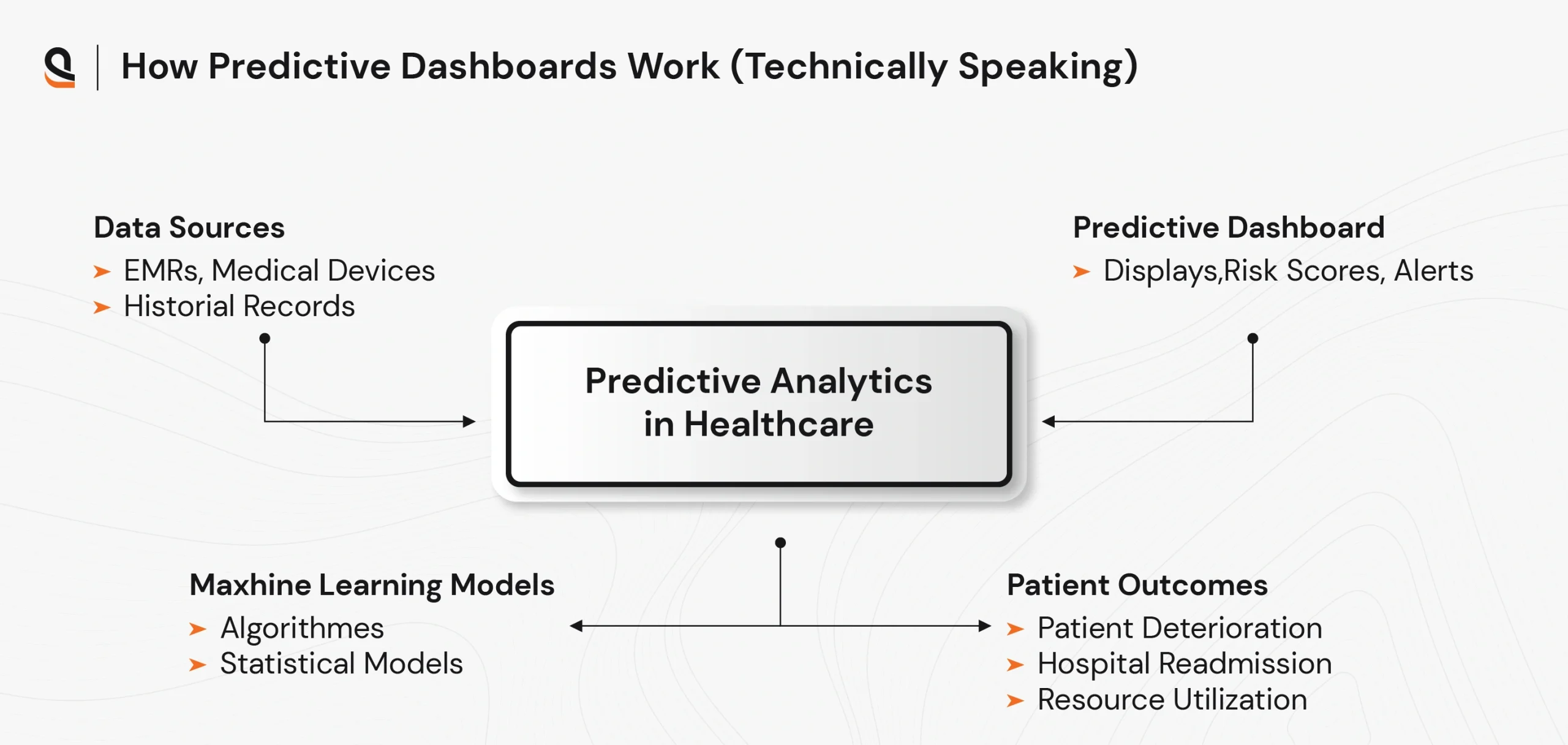
Behind the scenes, these dashboards are powered by:
- Data ingestion pipelines that unify inputs from EMRs, devices, labs, and historical records
- Machine learning models running in real-time to calculate risk scores and forecast events
- Role-based data visualization layers that customize views for doctors, nurses, and admin staff
- Integrations with hospital systems like HIS, PACS, and scheduling tools for seamless workflow alignment
The front-end uses clean UI components to display insights, risk scores, alerts, and trends — with drill-down features for detailed patient-level or unit-level exploration.
So, why does it matter to you?
Predictive dashboards don’t just improve visibility—they drive smarter, faster decisions that can lower mortality, reduce burnout, and streamline costs.
With real-time predictions visible across roles, healthcare teams can finally move from reactive care to proactive prevention—exactly when it counts most.
Benefits of Big Data Analytics in Healthcare
Thepower of big data analytics in healthcarelies in its ability to bring clarity to complexity. It doesn’t just help you see what’s happening—it tells you why it’s happening and what to do next.
For hospitals trying to strike a balance between rising patient expectations and tighter budgets, this becomes an invaluable asset. Let’s look at the tangible benefits that are already reshaping how care is delivered:
Cost Reduction
Big data helps hospitals uncover hidden inefficiencies that drive up costs:
- Reduces unnecessary tests and duplicate diagnostics by cross-referencing patient records and lab data
- Optimizes treatment pathways by identifying the most effective interventions for similar patient groups
- Cuts emergency costs by enabling early intervention for high-risk cases
- All of this translates to smarter spending—and fewer financial surprises.
Improved Patient Outcomes
At the heart of every health system is the patient. Big data ensures care is timely, personal, and precise:
- Accelerates diagnosis with real-time pattern recognition and AI-powered alerts
- Enables personalized treatment plans based on historical and genetic data
- Improves chronic disease management through predictive modeling and remote monitoring
The result? Healthier patients, faster recoveries, and reducedreadmissions using AI.
Informed Decision-Making
Whether it’s the ICU or the boardroom, decisions in healthcare carry weight. Big data analytics gives leaders and clinicians the visibility they need:
- Dashboards show real-time patient status, resource strain, and risk scores
- Data-driven insights guide protocol changes and policy decisions
- Historical trends reveal what’s working and what needs adjustment
- This turns instinct-based decision-making into insight-led strategy.
Resource Optimization
From staffing to inventory, hospitals run on complex logistics. Big data makes the moving parts more predictable:
- Forecasts bed occupancy and ER volumes so that resources can be aligned in advance
- Predicts supply chain needs to prevent shortages or overstocking
- Supports smarter scheduling to avoid staff burnout and underutilization

Key Challenges of Big Data Analytics in Healthcare and How to Overcome Them
While the benefits of big data analytics in healthcare are compelling, adopting it across hospital systems isn’t always straightforward. There are real barriers — technical, organizational, and ethical —that healthcare providers must navigate. However, with the right strategy, these challenges can be transformed into opportunities for more innovative and scalable solutions.
1. Data Privacy and Compliance
Handling sensitive patient information means compliance isn’t optional. Healthcare organizations must comply with regulations such as theHIPAA rule, GDPR, and local data protection laws.
We suggest:
- Adopt cloud platforms with built-in healthcare-grade security protocols
- Use data anonymization and encryption for all personally identifiable information
- Implement role-based access controls on all big data systems
Secure data handling and stronghealthcare data privacypractices build trust with both patients and partners—and are essential for unlocking the full value of big data in healthcare.
2. Integrating Big Data with Legacy Systems
Many hospitals still rely on outdated infrastructure and siloed systems. This makes it challenging to collect, unify, and analyze data in real-time.
We suggest:
- Use interoperability frameworks like HL7 FHIR to connect old systems with new analytics tools
- Invest in data lakes or middleware platforms that centralize inputs from EMRs, devices, labs, and billing systems
- Consider cloud-based big data analytics platforms that can layer over legacy systems without complete replacement
Integration doesn’t mean starting over; it meansupgrading wisely.
3. Lack of Skills and Data Literacy
Advanced big data analytics in the healthcare industry often requires data scientists, AI specialists, and analysts—roles many hospitals struggle to fill.
We suggest:
- Partner with external vendors offering AI and data analytics-as-a-service
- Train internal teams with low-code/no-code analytics platforms
- Promote data literacy across roles so that clinicians and administrators can confidently act on insights
When analytics are accessible, they empower the entire organization, not just the IT team.
4. Lack of Strategic Partnerships
Going it alone in a rapidly evolving field like predictive analytics in healthcare using big data can be overwhelming and costly.
We suggest:
- Collaborate with technology vendors,cloud solutionproviders, and AI specialists
- Join healthcare data collaboratives or research networks to share insights and best practices
- Build long-term relationships with partners who understand the balance of compliance, performance, and patient-centricity
Strategic partnerships help hospitals scale faster and smarter.
Embracing big data and analytics in healthcare isn’t without its challenges. However, with a clear roadmap and the right tools, providers can overcome these barriers and unlock a future where decisions are made faster, care is improved, and costs are better controlled.
How can AQe Digital help you with a Custom Big Data Analytics Solution?
Big data analytics in healthcare isn’t just about handling large volumes of information; it’s about turning that information into decisions that improve lives.
But making that shift from disconnected data to real-time, decision-ready insight takes more than technology. It requires experience, a straightforward approach, and a profound understanding of both the clinical and operational realities of healthcare.
Recently, we assisted apharmaceutical client in Abu Dhabi, which was struggling with data silos, inefficient workflows, and compliance challenges. Here, we identified that the challenge wasn’t a lack of data; it was the lack of connection between it all.
By designing a centralized analytics framework with predictive dashboards, we helped uncover insights that were previously buried in spreadsheets and siloed systems. The results? A staggering 15% reduction in operational inefficiencies and a 20% acceleration in reporting cycles. This led them to better forecasting and faster decisions, ultimately resulting in more confident teams.
A Few Takeaways as You Move Forward
If you’re exploring how to bring big data analytics into your healthcare operations, here are a few guiding thoughts:
Start with a clear purpose —Focus on one area where predictive analytics could create immediate value, such as readmission risk or resource forecasting.
Don’t wait for perfect data —Even with fragmented systems, it’s possible to start building models and gaining insight.
Think visually —Real-time dashboards and AI capabilities can bridge the gap between data science and day-to-dayclinical decisions support.
Work with those who understand both healthcare and data —Because the real value lies in how insights are applied, not just in how they’re built.
If you are looking for a customized solution to integrate big data analytics into healthcare operations,contact us now.