How Can Application Modernization Services Boost Business Agility For Your Business?

Nirav Oza
Outdated systems are costing businesses more than they realize. While competitors move to cloud-native, AI-driven, and scalable platforms, many organizations remain tied to legacy systems. 70% of the software used by Fortune 500 companies was developed 20 years ago.
Such systems are expensive to maintain, slow to adapt, and prone to security risks. However, application modernization services can help you adopt innovations faster, reduce security risks, and reduce operational costs.
As a CTO or CIO, you may have known the cost of delay in application modernization, but some questions need answers. Questions like,
- What is application modernization, and why does it matter now?
- What are its benefits?
- What are the key strategies?
- Which technologies power modernization?
- How can you tell it’s time to modernize?
This guide answers all your questions by focusing on what is application modernization, its benefits, limitations of legacy systems, 7R strategies to overcome them, and how to select the right plan.
What is Application Modernization?
Application modernization is a process of updating legacy systems and software to ensure they meet the organizational goals. It is a process where you update applications, methods, and data to leverage a new tech stack, such as microservices and cloud computing.
In 2025, with cloud-native adoption and AI-driven solutions, application modernization is set to accelerate. It has become a strategic necessity for CTOs and enterprises seeking to stay competitive. Generative AI usage in application modernization services is transforming the entire market. A McKinsey report says that generative AI and agentic AI will accelerate modernizations by-%
If you are looking to modernize your applications, leveraging application modernization services can be a competitive advantage in the market.
What is Application Modernization Service?
An application modernization service is designed to help you update and transform legacy systems into modern, scalable entities. It leverages a modern tech stack to ensure improved performance and enhanced user experience.
It involves,
- Detailed analysis of the legacy systems
- Based on the analysis, create a modernization strategy
- Updating the outdated systems through migration
- Ensure faster response and application capabilities to handle large amounts of data.
- Ensuring data security through stronger encryption and penetration testing
- Improving system agility and adoption of the modern tech stack
- Cost optimization, ensuring lower maintenance costs and efficient resource use.
What Are the Application Modernization Benefits?
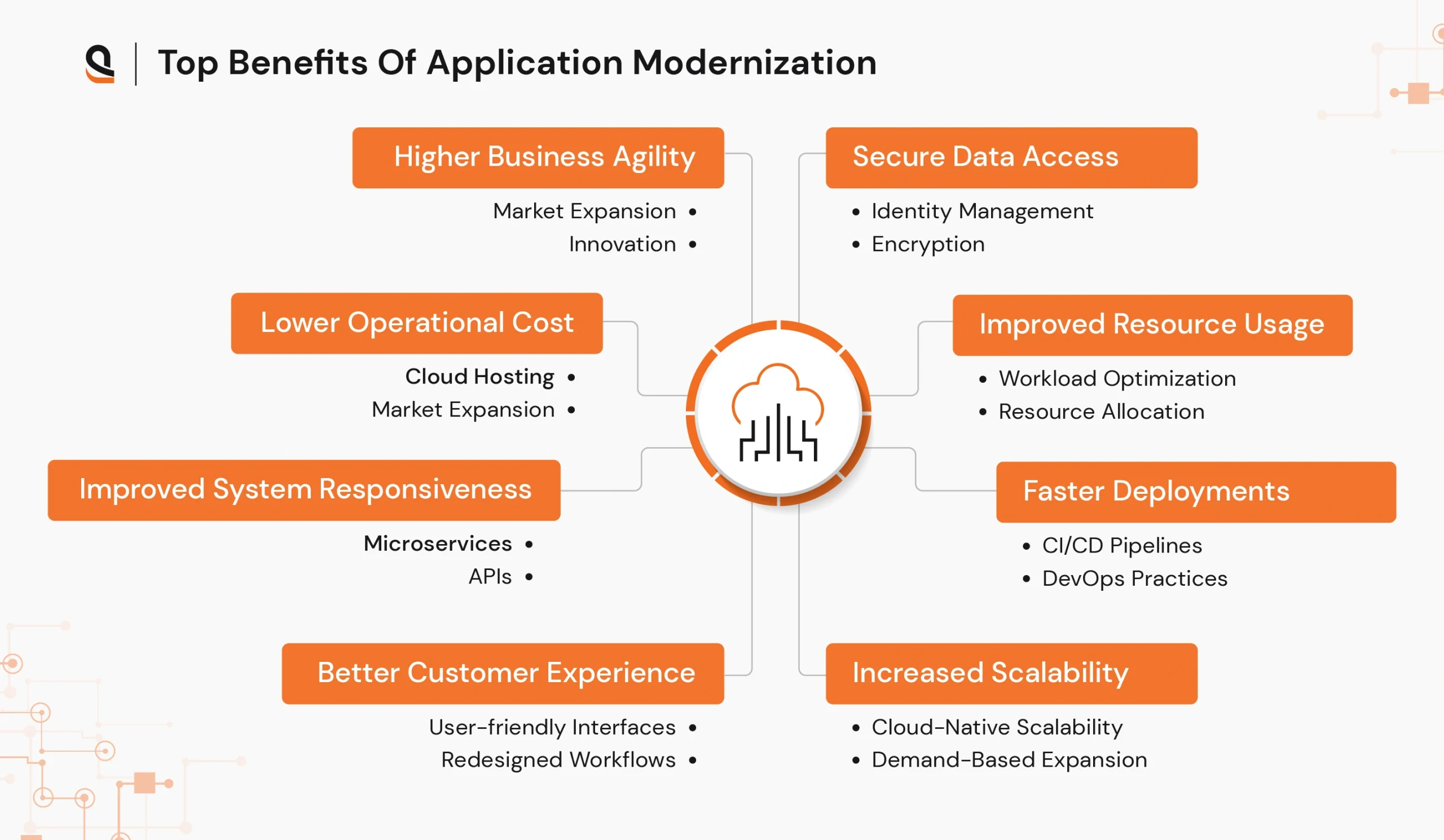
Application modernization offers several key benefits, including efficiency, cost savings, improved security, enhanced customer experience, and business agility.
1. Lower Operational Cost
Expert application modernization services can help you reduce operational costs by modernizing your systems. Modernized applications are hosted on cloud infrastructure, which allows you to optimize the cost as per usage. Plus, you can minimize the cost of data maintenance and processing through managed cloud services.
2. Improved Resource Usage
Legacy applications often run inefficiently, consuming unnecessary compute, storage, and network resources. Through business application modernization, organizations can optimize their workloads, improve utilization, and free up resources for innovation. Modern systems ensure better allocation of IT budgets and human capital, while improving overall productivity.
3. Faster Deployments
With modernized applications, businesses can leverage CI/CD pipelines and DevOps practices to accelerate software delivery. This enables faster deployments with fewer errors, allowing organizations to respond quickly to market demands. As part of the application modernization process, companies can automate builds, testing, and releases.
4. Improved System Responsiveness
Modern applications built using microservices, APIs, and scalable cloud infrastructure respond faster to user requests and business requirements. This enhanced performance directly contributes to greater efficiency, making it easier to adapt to new application modernization trends such as real-time analytics and AI-driven decision-making.
5. Better Customer Experience
Customer expectations are higher than ever. By replacing clunky, outdated systems with user-friendly, modern applications, businesses deliver seamless, engaging, and responsive digital experiences. A strong application modernization consulting services partner can help companies redesign workflows and interfaces to ensure customers interact with systems effortlessly.
6. Increased Scalability
With legacy systems, scaling to handle increased demand can be complex and costly. Application modernization services enable organizations to take advantage of cloud-native scalability, allowing systems to expand or shrink automatically based on demand. This ensures businesses remain resilient during peak usage without over-investing in infrastructure.
7. Higher Business Agility
A modernized IT environment allows businesses to innovate faster, pivot quickly, and take advantage of new opportunities. By addressing application modernization challenges early and aligning with a clear application modernization roadmap, organizations gain the agility to support mergers, acquisitions, new product launches, and market expansions with minimal disruption.
8. Secure Data Access
Legacy systems are often vulnerable to security breaches due to outdated protocols. Through legacy application modernization services, organizations can adopt modern security practices such as identity and access management, encryption, and compliance monitoring. This not only protects sensitive data but also builds trust with customers and stakeholders.
Now that you know what application modernization is, it’s essential to understand why you need it. As a CTO, your organization may face challenges of technical debt management and outdated legacy systems. But are these triggers enough to modernize applications, and what are the key signs that indicate it’s time to modernize applications?
Why Application Modernization Matters In 2025?
Every business needs to innovate at some point in its lifecycle. It can be due to outdated legacy systems, the need for integration of new technologies, or adapting to the changing customer demands. A key challenge that you may face as a CTO is to overcome the limitations of legacy systems.
What Are The Key Legacy System Limitations?
Some of the key limitations of legacy systems include higher maintenance costs, scalability issues, integration bottlenecks, and security vulnerabilities. Legacy systems can cause disruptions, delays, and errors. Plus, it has limitations in integrating with modern tools and technologies. These systems are built based on technologies used in the past and now, with innovations, most of them have become obsolete.
Such outdated technologies at the core of your system can cause security issues, slower performance, and inefficient operations. Leveraging legacy application modernization services, you can overcome these limitations and improve performance.
How Can Application Modernization Help Overcome The Limitations of Legacy Systems?
Application modernization services can help you overcome shortcomings of a legacy system through improvements in performance, user experience, cost optimization, and increased agility. Leveraging business application modernization, you can ensure your systems can meet the demands of a dynamic market.
Here are some benefits of modernizing your legacy systems.
- Migration for Performance- Application modernization process helps you migrate legacy systems to the cloud. This migration helps improve not just capacity but also enables speed and scalability. It ensures optimal performance for your systems.
- Cost Reduction- Migration to the cloud helps you reduce the cost of operations. Cloud services offer a pay-per-use model where you only need to pay for the instances you use. This means lower infrastructure cost.
- Business Agility- Modern application development needs to be flexible and adaptable to the changing market dynamics. Legacy systems may not be able to cope with such a demand due to limitations of integrations and outdated tech. This is where application modernization becomes crucial, helping you to add new features as per demand, flexibly.
- Security and Compliance- Legacy applications can have outdated security patches and mechanisms that are unable to address current cyber threats. Application modernization ensures your apps are secure and have updated mechanisms to handle any cyberattack.
While there are many benefits of application modernization, knowing when to modernize is equally essential.
What Are The Signs You Need Application Modernization?
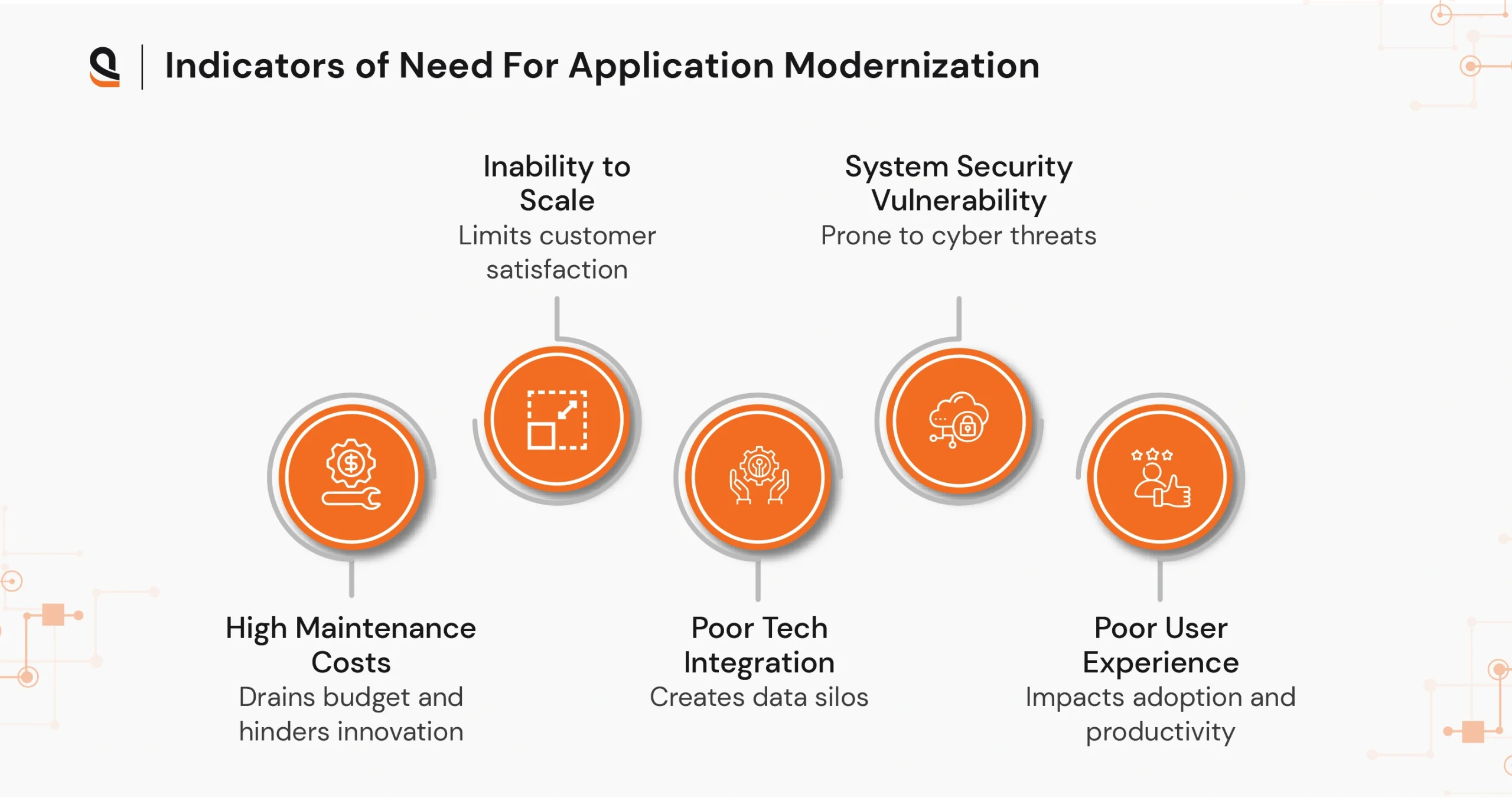
Here are some of the key signs you need to focus on and decide whether you need application modernization services for your organization.
1. Your maintenance cost is high.
If your organization is spending more resources fixing bugs, managing downtime, or patching legacy systems than building new features, it is a clear indicator that modernization is overdue. Escalating costs not only strain budgets but also hinder innovation.
2. Your systems can’t scale as the business grows.
Applications that cannot handle increased workloads or adapt to evolving business demands signal a critical need for modernization. Poor performance, frequent crashes, or slow response times limit customer satisfaction and operational efficiency.
3. You can’t integrate modern tech seamlessly.
Legacy systems often struggle to integrate with modern platforms, APIs, or cloud services. When data silos or complex manual workarounds become the norm, modernization ensures smoother interoperability and streamlined workflows.
4. Your system security is vulnerable.
Outdated applications are more prone to cyber threats due to unsupported software or outdated compliance updates. If regular security patches are no longer available, modernization becomes essential to safeguard business continuity.
5. You need to improve the user experience.
Clunky interfaces, slow navigation, and a lack of mobile compatibility frustrate end-users. When usability impacts adoption or productivity, modernization can deliver intuitive, efficient, and accessible applications that meet modern expectations.
Now that you have the reasons defined for application modernization, it’s crucial to understand core technologies and components of the entire process.

What are the key components and technologies you need for application modernization?
Modernizing your application is not a single-step process and requires multiple components and technologies. Here are some of the key elements and technologies that application modernization services leverage to modernize your systems.
1. Cloud Modernization and Cloud-Native Applications
Cloud migration is a key component of the entire application modernization process. It helps you migrate workloads to a scalable cloud infrastructure. Leveraging cloud migration, you can enable system elasticity. Plus, you can leverage a modern application development approach to build new apps entirely on the cloud.
Cloud-native development allows you to design, develop, and deploy apps with on-demand infrastructure and cost efficiency.
2. Microservices and Containerization
A crucial component of the application modernization process is to break down the existing legacy system into several independent services. These are microservices that communicate with each other through customized APIs. Breaking down your legacy monolithic architecture into microservices can help you not only improve performance but also scale the system seamlessly.
However, there are complexities of managing multiple microservices. This is where you can leverage containerization. Each container is a packaged service with everything you need to deploy it. Using orchestration tools like Kubernetes, application modernization services can manage containers and help you modernize your systems.
3. DevOps Integration
DevOps is a cornerstone of modern application development because it integrates continuous testing, deployment, and monitoring into the application modernization process. By fostering closer collaboration between development and operations, DevOps accelerates delivery cycles and reduces system errors.
With CI/CD pipelines, businesses deploying legacy application modernization services can introduce frequent updates without disrupting end users.
4. Artificial Intelligence (AI) and Machine Learning (ML)
AI and ML are reshaping application modernization trends. Whether applied to predictive analytics, fraud detection, or enhanced customer experiences, they provide enterprises with intelligent capabilities that extend beyond modernization alone.
By embedding AI into applications, businesses can optimize infrastructure, predict failures, and automate decision-making.
5. Data and Analytics Modernization
Legacy systems often suffer from data silos, limited storage, and slow processing. Through application modernization services, organizations move to cloud-based data lakes, advanced analytics tools, and predictive intelligence platforms.
Modernizing data and data analytics makes applications data-driven, real-time, and actionable. This not only strengthens business intelligence but also fuels innovations such as IoT and AI adoption, which are two major drivers in application modernization trends.
6. Security Technologies and Practices
Security is among the biggest application modernization challenges. As cyber risks continue to evolve, modernized applications must embed zero-trust frameworks, advanced encryption, IAM solutions, and secure API gateways into their architecture.
Many legacy application modernization services recommend adopting “security-by-design” approaches, where app security practices are woven directly into the application modernization process rather than added afterward. This ensures compliance, resilience, and trustworthiness in mission-critical business systems.
7. Specialized Modernization Tools
Dedicated application modernization tools play an essential role in automating assessments, migrations, and re-platforming efforts. These tools reduce manual workload and simplify complex modernization initiatives.
From automated code refactoring tools to container orchestration platforms, the right technologies empower enterprises to overcome application modernization challenges faster and more effectively. With expert guidance from application modernization consulting services, companies can streamline execution and achieve smoother transformation outcomes.
Now that you know key components and technologies, it’s time to understand how to modernize legacy applications. However, before you create an application modernization roadmap, you need to understand the most effective approaches and strategies to use.
What Are The Best Application Modernization Strategies?
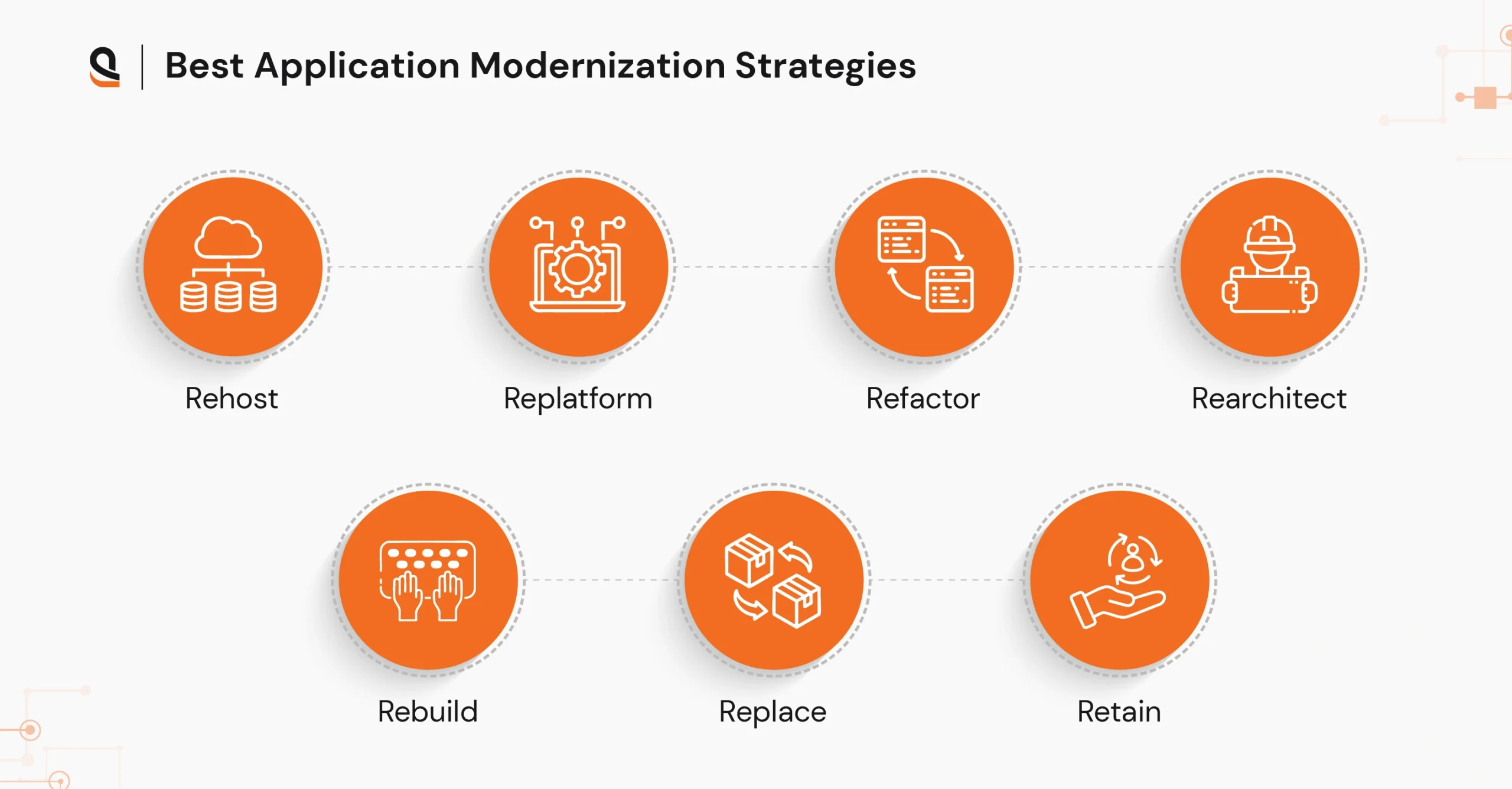
Choosing the best application modernization strategies requires careful evaluation of existing applications and business needs. It helps determine strategies that align with your business goals. Some of the common strategies include rehosting, replatforming, refactoring, rebuilding, and replacing.
Let’s understand these application modernization strategies one by one,
1. Rehosting (Lift and Shift)
The rehost approach, also known as the lift and shift strategy, involves migration of application resources from an on-premise data center to a cloud database. The application codebase will remain the same, but the underlying infrastructure will be migrated to cloud infrastructure as a service (IaaS).
Key benefits of the rehosting strategy
-
- ➡️ Helps migrate apps “as-is” with minimal changes.
➡️ Needs fewer engineering hours and quicker execution.
➡️ Reduces risks and ensures less disruption by preserving existing architecture.
➡️ Helps migrate many workloads rapidly under deadlines.
➡️ Offers instant cloud benefits like elasticity, availability, and resilience on day one.
- ➡️ Helps migrate apps “as-is” with minimal changes.
When to use rehosting?
Rehosting works best when speed is the priority and applications do not require immediate refactoring. It is a practical choice for organizations with large legacy workloads, approaching data center contract expirations, or under pressure to meet regulatory or business deadlines.2. Replatform
The replatform approach involves moving applications to the cloud with minor optimizations, such as upgrading middleware, database versions, or runtime environments, without altering the core codebase.
Key benefits of the replatform strategy
-
- ➡️ Optimizes performance with minimal code changes.
➡️ Leverages managed cloud services to reduce operational overhead.
➡️ Provides better scalability and cost-efficiency compared to rehosting.
➡️ Allows incremental modernization without significant disruptions.
- ➡️ Optimizes performance with minimal code changes.
When to use replatform?
Ideal when applications need moderate improvements, such as database upgrades or OS changes, but a complete rewrite isn’t feasible. It balances speed with long-term cloud benefits.3. Refactor
Refactoring involves reworking the application code to better align with cloud-native features while preserving existing functionality.
Key benefits of the refactor strategy
- ➡️ Offers advanced cloud capabilities such as auto-scaling and containerization.
➡️ Improves long-term efficiency and resilience.
➡️ Reduces technical debt and enhances application maintainability.
➡️ Position workloads for future innovation and agility.
When to use refactor?
Best suited when the existing application has scalability or performance limitations that prevent it from taking full advantage of the cloud.4. Rearchitect
Rearchitecting involves redesigning the entire application to be cloud-native, often by breaking it into microservices.
Key benefits of the rearchitect strategy
➡️ Maximizes cloud benefits like elasticity, scalability, and resilience.
➡️ Enables faster innovation cycles through a microservices architecture.
➡️ Improves performance, fault tolerance, and resource optimization.
➡️ Supports DevOps integration for continuous delivery.
When to use rearchitect?
Recommended when legacy applications cannot meet business demands and need modernization to support growth, agility, and long-term scalability.5. Rebuild
Rebuilding means discarding the existing application and developing it from scratch using modern cloud technologies.
Key benefits of the rebuild strategy
➡️ Creates applications fully optimized for cloud environments.
➡️ Eliminates legacy constraints and outdated architectures.
➡️ Offers complete flexibility to redesign features and functionality.
➡️ Enhances agility and long-term maintainability.
When to use the rebuild strategy?
Ideal when existing applications are outdated, poorly documented, or no longer aligned with business objectives.6. Replace
Replacing involves retiring the existing application and substituting it with a commercial off-the-shelf (COTS) SaaS solution.
Key benefits of the replace strategy
➡️ Immediate access to modern functionality without redevelopment.
➡️ Reduces IT maintenance and operational costs.
➡️ Ensures faster implementation with vendor support
➡️ Aligns with industry best practices and compliance standards.
When to use the replace strategy?
Suitable when existing applications no longer deliver value, and SaaS alternatives can meet the organization’s needs effectively.7. Retain
Retaining or encapsulating involves keeping applications in their current environment but exposing their functionality via APIs for integration with modern systems.
Key benefits of the retain strategy
➡️ Preserves investments in stable, business-critical systems.
➡️ Enables integration with newer applications without disruption.
➡️ Provides a phased modernization path through APIs.
➡️ Minimizes risk by leaving the core application untouched.
When to use the retain strategy?
Effective when legacy applications are stable, still valuable, and too costly or risky to modernize immediately.Apart from the use cases and benefits, you also need to understand the factors that drive the selection of a specific strategy for the application modernization process.

Key Drivers to Consider For Selecting The 7R Application Modernization Strategies.
| Strategy | Primary Drivers | Typical Timeline | Sample KPIs |
| Rehost (Lift & Shift) | Time: Fast migration Cost: Low upfront investment Risk: Low technical risk Compliance: Maintains existing compliance posture | 3-6 months Assessment: 1-2 months Execution: 2-4 months | Latency: Minimal improvement Release Frequency: No change Deployment Frequency: Baseline establishment MTTR: Potential improvement due to cloud infrastructure |
| Replatform (Lift, Tinker & Shift) | Time: Moderate migration speed Cost: Medium investment for containerization Risk: Low-medium risk Compliance: May require minor compliance adjustments | 4-8 months Planning: 2-4 months Implementation: 6-12 months Testing: 2-3 months | Latency: 10-20% improvement Release Frequency: 2-3x increase Deployment Frequency: Weekly to daily Change Failure Rate: 10-15% reduction |
| Refactor (Code Modernization) | Time: Longer development cycles Cost: High development investment Risk: Medium-high technical risk Compliance: Requires compliance re-validation | 6-12 months Often requires an iterative approach Complex applications may take longer | Latency: 30-50% improvement Release Frequency: 5-10x increase Lead Time for Changes: Reduced by 40-60% Code Coverage: 80%+ target |
| Rebuild (Greenfield Development) | Time: Longest development timeline Cost: Highest investment Risk: High risk but high reward Compliance: Full compliance redesign needed | 12+ months Can extend to multiple years for complex enterprise applications | Latency: 50-80% improvement Release Frequency: 10x+ increase Deployment Frequency: Multiple times per day System Uptime: 99.9%+ target |
| Replace (Commercial Off-the-Shelf) | Time: Fast implementation Cost: License costs vs. development savings Risk: Low technical risk, high vendor lock-in risk Compliance: Depends on vendor compliance certifications | 3-9 months Depends on customization and integration requirements | Latency: Vendor-dependent Release Frequency: Vendor release schedule Time to Market: Fastest option Integration Success Rate: 95%+ target |
| Retain (Status Quo) | Time: No immediate time investment Cost: Ongoing maintenance costs Risk: Increasing technical debt Compliance: May face compliance gaps over time | Ongoing No active modernization timeline | Latency: Gradual degradation Release Frequency: Decreasing over time Maintenance Cost: Trending upward Security Incidents: Potential increase |
| Retire (Decommission) | Time: Fast decommissioning Cost: Cost elimination Risk: Data loss risk, business continuity risk Compliance: Data retention compliance requirements | 2-6 months Includes data archival and process transition | Latency: N/A Release Frequency: N/A Cost Savings: Immediate reduction Business Impact: Zero post-retirement |
How AQe Digital Can Help You Modernize Your Applications?
Application modernization offers you a gateway to cloud-native ecosystems that enable agility, security, and innovation. Adopting the right 7R strategy, leveraging modern technologies like cloud, microservices, AI, and DevOps, and addressing challenges proactively, you can transform outdated applications. However, creating an application modernization roadmap can be complex. Additionally, you must be aware of application modernization trends to ensure your strategy aligns with current market demands.
This is where AQe Digital can help by offering end-to-end application modernization services.
Our approach combines consulting expertise, modern tech stacks, and zero-disruption execution models. We ensure a smooth transition from legacy systems to scalable, secure, and future-ready applications.
Why Choose AQe Digital?
- ✅ Tailored Roadmaps – Modernization strategies designed around your unique business needs.
- ✅ Deep Technical Expertise – Cloud, microservices, DevOps, and AI integration.
- ✅ Minimal Business Disruption – Phased rollouts and parallel runs for continuity.
- ✅ Measurable Outcomes – Reduced costs, faster deployments, improved scalability.
- ✅ Proven Track Record – From mobile app modernization for the healthcare industry to automotive system modernizations, we’ve delivered transformation across industries.
