Telemedicine App Development: Features, Benefits, and Step-by-step Development Process

Vishal Panchal
The rapid shift toward virtual healthcare didn’t just start during the COVID-19 pandemic. It accelerated because people needed safer, faster, and more convenient medical interactions.
And even though the immediate urgency has passed, one thing is clear: patients still prefer the ease of virtual consultations for non-urgent care. This behaviour change has proven that our healthcare ecosystem can evolve quickly when powered by innovation, smarter digital solutions, and the right technology.
The telemedicine mobile app aims to create a seamless digital bridge between patients and providers. Modern platforms enable video consultations, secure chat, real-time reports, remote monitoring, and instant access to medical records, making healthcare more accessible than ever.
As demand grows, telemedicine software development has become a strategic priority for healthcare organizations seeking to boost efficiency, expand patient reach, and deliver care beyond physical boundaries.
With global healthcare moving toward hybrid and digital-first models, businesses now need robust, feature-rich telemedicine solutions built around user experience, compliance, and scalability. According to a report by the American Hospital Association, around 76% of U.S hospitals use apps to diagnose and treat patients.
In this blog, we’ll explore everything you need to know, including key benefits, essential features, and the step-by-step process to develop a high-performing telemedicine app.

What Is Telemedicine App Development?
Telemedicine app development is the process of creating digital healthcare platforms that allow medical professionals to deliver clinical services remotely. Through secure video calls, real-time chat, digital prescriptions, or automated care workflows.
At its core, it’s about removing unnecessary barriers between patients and healthcare providers and giving people access to medical expertise anytime, anywhere. You can check this telemedicine app case study for a more precise and broader understanding.
These platforms go far beyond basic communication. Modern telemedicine app development solutions integrate telehealth technology, EMR connectivity, remote patient monitoring tools, and data-driven features that keep both patients and providers engaged throughout the care journey.
For healthcare organizations, telemedicine solutions become a powerful blend of accessibility and efficiency. They support better patient outcomes, reduce operational load, and standardize care delivery across urban clinics and remote locations alike.
Features Required in a Telemedicine Mobile App
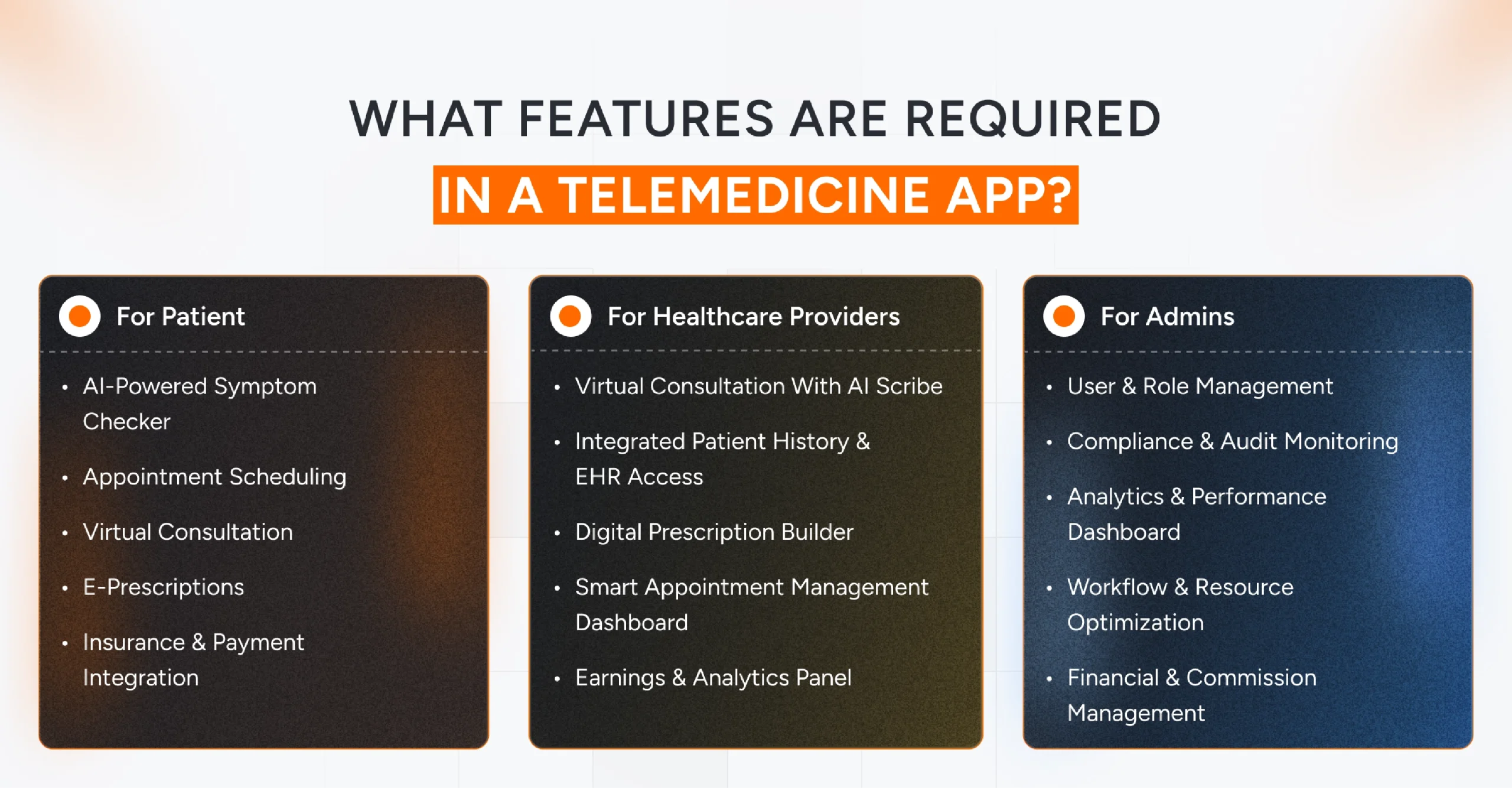
Building a powerful telehealth platform is about weaving together the right capabilities that elevate the entire care experience. In telemedicine app development, the features you choose directly influence usability, clinical accuracy, and long-term scalability.
Patient Panel Features
AI-Powered Symptom Checker & Smart Triage
A conversational AI assistant guides patients through describing their symptoms, evaluates severity, and directs them to the right specialist. This reduces waiting time, lowers admin load, and ensures patients receive the appropriate care path instantly.
Appointment Scheduling
Patients can view real-time doctor availability, sync across time zones, and book appointments without delays. Automated reminders help reduce no-show rates and streamline scheduling.
Virtual Consultation
HD-quality video/audio calls, along with secure chat, empower patients to talk to specialists instantly. Whether it’s a routine check-in or urgent medical advice, communication stays seamless and confidential.
E-Prescriptions with Medication Tracking
The app can auto-generate prescriptions, send reminders, connect with pharmacies, and allow quick refill requests. This keeps patients compliant and reduces prescription-related errors.
Personal Health Dashboard
A visual dashboard displays vitals, medical history, lab reports, and consultation summaries in a single consolidated view. It helps patients stay informed and engaged with their care journey.
Insurance & Payment Integration
Integrating secure payment gateways and automated insurance verification ensures smooth billing. Patients can easily complete transactions, upload documents, and track invoices.
Doctor / Healthcare Provider Panel Features
Virtual Consultation with AI Scribe
Doctors can conduct consultations while an AI-powered scribe automatically captures key notes, symptoms, and follow-up instructions. This eliminates manual documentation and frees providers to focus entirely on patient care.
Integrated Patient History & EHR Access
Instant access to medical records, lab results, and past diagnoses improves accuracy and reduces the need to switch between multiple systems.
Digital Prescription Builder
Customizable templates and intelligent suggestions help doctors quickly and safely generate and share digital prescriptions.
Smart Appointment Management Dashboard
A color-coded dashboard displays daily appointments, cancellations, and follow-ups in real time. Automated reminders help doctors manage time efficiently.
Earnings & Analytics Panel
Doctors get a transparent financial overview, including consultation counts, revenue, pending payouts, and performance insights, helping them optimize schedules for better productivity.
Administrative Features
User & Role Management
Admins can assign roles and manage permissions for doctors, patients, and support teams. This maintains transparency and secures the platform at every access point.
Compliance & Audit Monitoring
Real-time tracking helps maintain compliance with HIPAA Rules, GDPR, and HITECH. Automated logs record every interaction, ensuring traceability and regulatory confidence.
Analytics & Performance Dashboard
An intelligent dashboard helps administrators monitor consultation trends, user activity, revenue generation, and engagement, all of which are essential for data-driven decisions.
Workflow & Resource Optimization
Centralized monitoring of queues, doctor availability, and ongoing consultations keeps operations smooth. AI-based forecasting predicts patient loads to optimize staffing and resource allocation.
Financial & Commission Management
Automated settlements, commission calculations, and refund management streamline financial workflows while maintaining complete billing transparency.
A well-designed telemedicine mobile app is the backbone of digital-first healthcare. These features bring reliability, automation, and a high-quality user experience, setting the foundation for scalable telemedicine operations that grow with patient needs.
Benefits of Telemedicine Mobile App To Patients and Healthcare Professionals
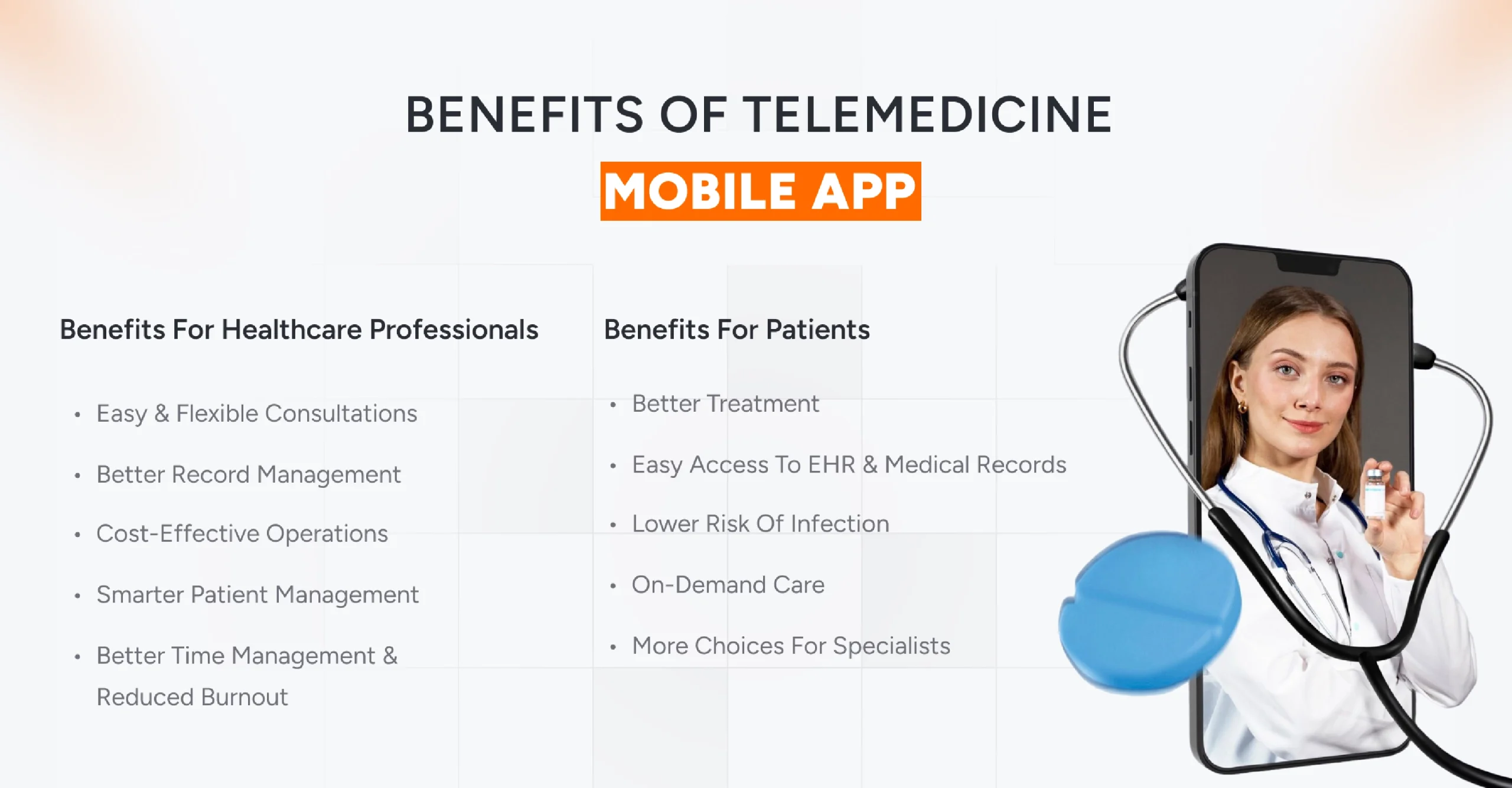
With the reliable healthcare software development services, organizations can transform fragmented processes into a unified, patient-centric ecosystem powered by automation, data, and seamless communication. Backed by robust telemedicine software development, these apps unlock powerful benefits that improve clinical efficiency and optimize patient outcomes.
Benefits for Healthcare Professionals
Telemedicine apps give clinicians the tools they need to consult more quickly, manage workloads more effectively, and deliver high-quality care without unnecessary friction.
Here’s how they empower healthcare professionals:
1. Easy & Flexible Consultations
Telemedicine simplifies the consultation experience by allowing providers to meet patients virtually at their scheduled time with instant access to medical records.
Key advantages:
- Conduct secure consultations without location constraints
- View patient history during sessions for more accurate decision-making
- Reduce appointment delays and streamline daily workflow
2. Better Record Management
Instead of juggling multiple systems, doctors can access consolidated medical data from a single app.
What this enables:
- Quick access to past reports, prescriptions, and treatment history
- Faster diagnosis with comprehensive and organized patient information
- Easy sharing of records when collaborating with specialists
3. Remote Monitoring for Continuous Care
Advanced telemedicine platforms integrate IoT devices and wearable data, giving clinicians real-time insights into patient health.
Benefits include:
- Early detection of abnormalities
- Ability to intervene before complications escalate
- Improved chronic disease management with automated alerts
4. Cost-Effective Operations
Telemedicine reduces unnecessary clinic visits and optimizes provider time, helping professionals manage more patients in less time.
This results in:
- Lower operational expenses
- Reduced admin burden due to digital workflows
- Increased consultation capacity without extra infrastructure
5. Smarter Patient Management
Telemedicine solutions centralize everything, including prescriptions, follow-ups, disease progression, and communication.
Professionals can:
- Update patient details seamlessly
- Manage follow-up schedules more efficiently
- Track treatment progress through digital tools
6. Better Time Management & Reduced Burnout
Research shows that clinicians experience high stress and fatigue related to workload. Telemedicine helps alleviate these challenges by automating repetitive tasks.
Core improvements:
Automated booking, reminders, and digital records reduce manual work
Notifications ensure no patient details or updates are missed
AI-powered scheduling helps practitioners stay organized
Benefits for Patients
A well-built telemedicine mobile app reshapes the patient experience by removing the traditional barriers of distance, long queues, and limited access to specialists.
1. Complete Satisfaction & Better Treatment Experience
One of the most significant advantages for patients is the comfort and confidence that comes with timely access to healthcare. Telemedicine apps make it easier to communicate with doctors through secure calls, messages, and digital follow-ups.
What patients gain:
- Round-the-clock access to medical support
- Real-time responses to queries
- More personalized and prompt care delivery
2. Easy Access to EHR & Medical Records
A telemedicine mobile app allows patients to view their updated Electronic Health Records (EHR) from anywhere, eliminating confusion about past prescriptions or treatment changes.
Key improvements:
- Instant access to updated medical reports
- Transparency regarding changes made by healthcare providers
- Faster decision-making during follow-ups
3. Lower Risk of Infection
Avoiding crowded hospital visits drastically reduces exposure to infections, especially for patients with chronic conditions or weakened immune systems.
Patient benefits include:
- Safer consultations from home
- Reduced contact with contagious environments
- Continuous care even during outbreaks or travel restrictions
4. More Choices & Easy Specialist Discovery
Telemedicine apps break geographical boundaries and give patients the freedom to select the right specialist based on expertise, availability, and consultation preference.
This results in:
Wider range of vetted experts
Ability to choose specialists outside their city or region
Better decision-making with transparent doctor profiles
5. High Accessibility & On-Demand Care
With telemedicine, patients no longer need to drive to a clinic, wait in long lines, or adjust their schedule around hospital timings.
Enhanced convenience includes:
- Accessing doctors from remote or rural areas
- No travel or long waiting times
- Ability to book, cancel, or reschedule appointments instantly
When supported by the right telemedicine app development solutions, these apps ensure that every interaction feels seamless, personalized, and remarkably efficient.
How to Develop a Telemedicine App?
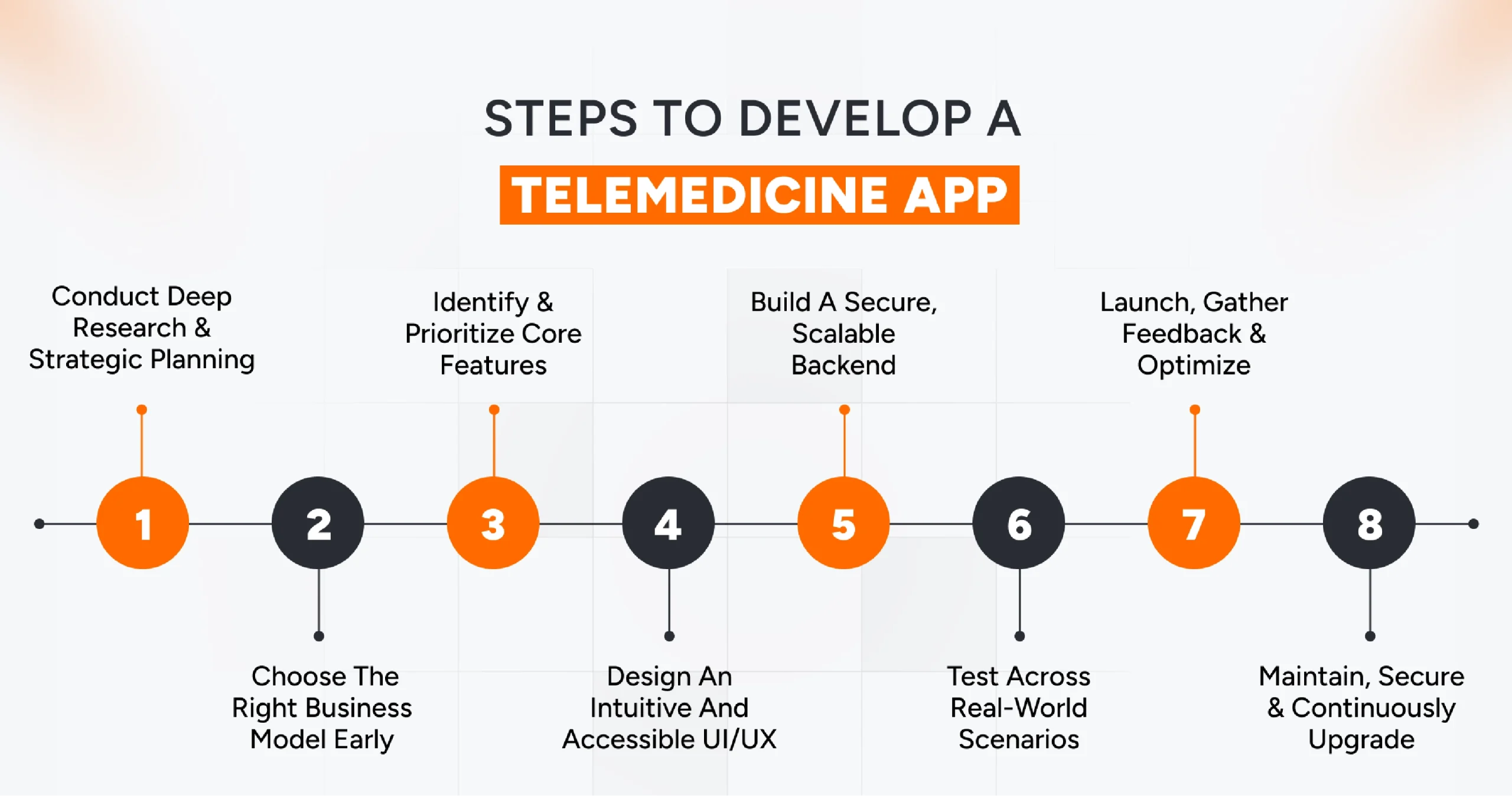
Building a successful telemedicine mobile app is about solving real healthcare challenges. The process of telemedicine app development demands a structured roadmap backed by user insights and technical precision.
Below is a step-by-step process to develop a telemedicine app:
1. Conduct Deep Research & Strategic Planning
Before a single screen is designed, you need clarity on the market, audience, compliance rules, and real-world use cases. This step shapes your entire telemedicine product vision.
What this stage includes:
- Studying user needs across doctors, admins, and patients
- Reviewing competitors and identifying feature gaps
- Aligning with compliance frameworks like HIPAA, GDPR & local health standards
- Mapping the scope of your telemedicine software development plan
2. Choose the Right Business Model Early
Your monetization strategy affects your feature mix, target audience, and long-term growth.
Popular approaches include:
- Pay-per-visit consultation
- Subscription tiers for individuals, clinics, or enterprises
- Partnership-driven models with hospitals, insurers, or pharmacies
- Commission-based structures for specialist consultations
The goal is to align revenue with genuine value, not force users into complex billing loops.
3. Identify & Prioritize Core Features
Feature clarity determines development success. Start with must-haves and scale gradually.
Essential features to include:
- HD video consultations & secure chat
- Appointment scheduling with reminders
- EHR/EMR integration
- Prescription management & digital pharmacy tie-ins
- Payment processing
- Role-based access for patients, providers & admins
To stand out, modern telemedicine app development solutions also integrate:
- AI-powered triage tools
- Remote patient monitoring (RPM)
- Clinical decision support systems
- Smart dashboards for analytics
4. Design an Intuitive and Accessible UI/UX
Your interface must work for everyone, even users who aren’t digitally savvy.
UI/UX must focus on:
- Clear navigation paths
- Minimal steps to book or conduct a consultation
- Accessibility for older or differently-abled users
- Clean dashboards that don’t overwhelm doctors
- Consistent visual hierarchy across all screens
5. Build a Secure, Scalable Backend
The backend is the “brain” of your telemedicine mobile app. It handles workflows, data storage, load distribution, and integrations.
Backend development should include:
- Scalable microservices architecture
- Encrypted data storage
- API integrations with EHRs, payment systems & third-party tools
- Real-time streaming engines for video calls
- High-availability infrastructure to support peak loads
6. Implement Compliance, Privacy & Security Frameworks
Healthcare apps must operate under strict security controls.
Strengthen your telemedicine app development process with:
- End-to-end encryption
- Multi-factor authentication
- Role-based data access
- Compliance with HIPAA, GDPR, HL7 & other regional laws
- Automated audit logs
7. Test Across Real-World Scenarios
Testing should go beyond basic QA. Include doctors and real patients in this stage for organic feedback.
Create simulations for:
- Peak consultation hours
- Poor internet connections
- Multi-device access
- Emergency patient scenarios
- High data transfer loads
8. Launch, Gather Feedback & Optimize
Start with a soft launch to detect friction points. An agile improvement cycle keeps your product ahead of the competition.
Once feedback flows in, optimize:
- UI issues
- Bugs
- Feature gaps
- Load management
9. Maintain, Secure & Continuously Upgrade
Post-launch success depends on:
- Frequent security patches
- Feature improvements
- Performance tuning
- Integrating new healthcare standards
- Expanding AI-driven functionalities
A strategic approach to telemedicine app development, backed by the right solutions and strong software development practices, ensures you build a platform that delivers real clinical impact.
Latest Technologies That Can Be Used in Telemedicine App Development
Modern telemedicine app development solutions are powered by a stack of advanced technologies that make remote care more innovative, faster, and more accessible.
Here are the latest innovations reshaping telehealth:
1. Artificial Intelligence (AI) & Machine Learning (ML)
AI and ML have become the secret sauce behind next-gen telemedicine platforms. You can integrate AI-driven symptom checkers, predictive analytics, automated clinical documentation, intelligent triage workflows, and personalized care plans into your telemedicine mobile app.
These capabilities help clinicians make faster decisions, improve diagnostic accuracy, remove repetitive administrative tasks, and ultimately create smoother, more satisfying patient experiences.
2. Cloud Computing
Cloud technology is the foundation that keeps telemedicine app development solutions flexible, secure, and globally scalable. It enables fast video consultations, real-time data syncing, robust storage, seamless EMR access, and large-scale analytics.
With cloud infrastructure, healthcare organizations can onboard more users, add new features, and expand to new regions without worrying about performance dips or downtime.
3. Internet of Things (IoT)
IoT is transforming telemedicine into a continuous care ecosystem. By integrating wearables, at-home medical devices, and smart sensors, healthcare teams can monitor patient vitals, chronic conditions, medication adherence, and lifestyle patterns in real time.
This constant data flow helps providers intervene earlier, personalize treatments, and reduce unnecessary hospital visits, turning your telemedicine mobile app into a proactive health management tool.
4. Extended Reality (XR) for Immersive Care (Optional Add-On)
Although emerging, XR technology is gaining traction in remote physical therapy, patient education, and guided procedures. It brings a more interactive, hands-on feel to digital care, helping clinicians assess movement, demonstrate exercises, and simplify complex medical explanations.
5. Blockchain for Secure Data Exchange (Optional Add-On)
Blockchain adds another layer of trust and traceability by enabling tamper-proof medical records, transparent audit trails, and secure data sharing across providers. For telemedicine models that involve multi-party data exchange, this technology enhances security while streamlining collaboration.
Conclusion
A well-built telemedicine mobile app empowers providers to deliver continuous, high-quality care while reducing costs and removing geographic barriers. With the right telemedicine app development solutions, healthcare businesses can create a seamless, scalable, and secure digital ecosystem that patients trust.
AQe Digital brings deep expertise in telemedicine software development, compliance, UX engineering, and AI-powered integrations, making us the ideal partner for your digital healthcare transformation. If you’re ready to elevate your care delivery model, feel free to contact us for expert consultation.