A Dedicated Predictive Analytics Software Guide 2026 For Your Business

Joy Chauhan
What makes Netflix, Spotify and Amazon special? How are they different from any other tech giant? Answer is simple- they know how to leverage predictive analytics software. Using advanced machine learning development in predictive analytics software you can also transform customer experience like Amazon or Netflix. However what matters is implementation.
If you can implement predictive analytics software aligning with your business goal you can get deeper insights that help in coping with the dynamic market. However if you are stuck at questions like,
- What is predictive analytics software?
- What are its key components and features?
- How to implement it?
This guide helps you find the answers on predictive analytics software, its features, and use cases for your operations. Let’s start with the basics first!
What is Predictive Analytics?
Predictive analytics is the process of analyzing historical data using statistical modeling and machine learning to forecast future outcomes and trends. It goes beyond just knowing the data at the core of historical patterns and helps businesses understand the future demand.
If you are a business looking to optimize inventory management, ensure optimal stock levels, and improve logistics operations, predictive analytics is crucial. With predictive analytics in manufacturing, businesses can anticipate failures early, minimize downtime, and drive stronger ROI.
How do Predictive Analytics Systems Work?
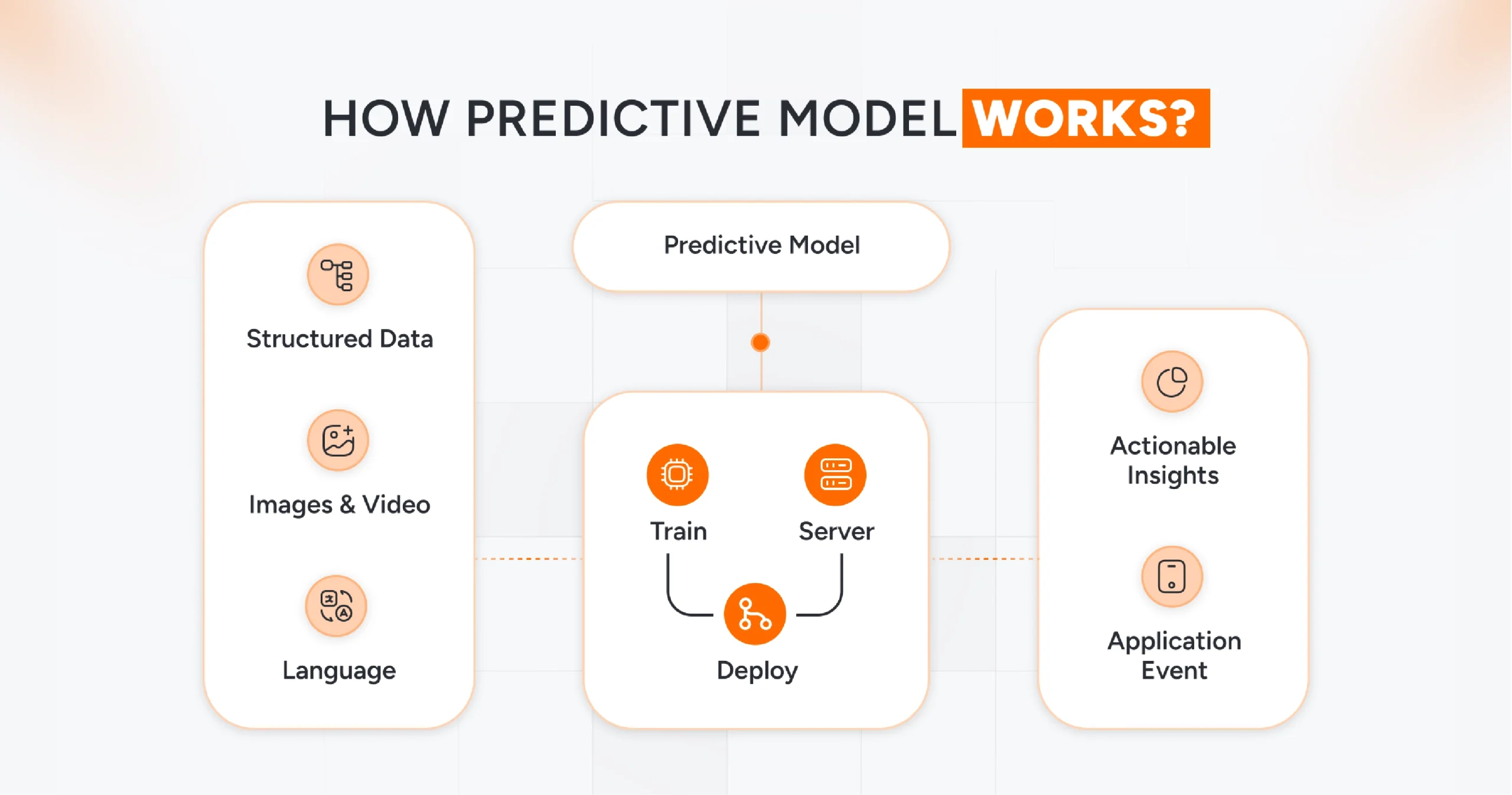
Predictive analytics systems use historical data to identify patterns in operations and provide recommendations about future outcomes. Here are three core steps to this process,
- Data Analysis: Customized algorithms analyze historical and current data to identify patterns, trends, and relationships.
- Statistical Modeling & ML: Based on the identified patterns, algorithms build models that analyze data and patterns to forecast future scenarios.
- Demand Forecasting: Models predict future outcomes, such as a machine’s likelihood of malfunctioning, customer behavior, or machine downtime.
What Are Key Components of Predictive Analytics Systems?
Predictive analytics software combines data mining, machine learning, and statistical modeling on large, diverse datasets to forecast future outcomes and behaviors, and operationalizes those predictions into products and processes.
They differ from descriptive analytics (what happened) and prescriptive analytics (what to do next) by focusing on what is likely to occur and with what probability.
Here are some of the significant components of predictive analytics systems,
- Problem framing clarifies the target outcome, success metrics, and constraints, and ensures that the correct data, models, and evaluation criteria are chosen from the start.
- Data ingestion and integration bring together data from warehouses, lakes, streams, and external APIs to ensure sufficient coverage and signal diversity for learning.
- Data preparation cleans, imputes, normalizes, and handles outliers so models learn from high‑quality, consistent inputs rather than noise or errors.
- Feature engineering creates informative variables from raw fields’ aggregations, interactions, and time‑based features to expose patterns that models can exploit and improve lift.
- Modeling layer: Applies statistical methods and ML algorithms (regression, decision trees, ensembles, neural nets, time series) to map features to future outcomes.
- Training and validation: Tunes hyperparameters, performs cross‑validation/backtesting, and selects models using appropriate metrics to avoid overfitting and quantify generalization.
- Deployment and serving: Operationalizes scoring via batch jobs or real‑time APIs, enabling predictions to influence workflows, products, and user experiences.
- Monitoring and feedback: Tracks data drift, calibration, and business KPIs, then feeds outcomes back for retraining to keep performance table as conditions change.
- Model governance: Documents lineage and assumptions, manages approvals, and enforces risk controls to maintain trust, reproducibility, and regulatory readiness.
- Security and compliance: Protect data and models with access controls, encryption, and privacy safeguards, enabling predictive insights to be used safely at scale.

What is Machine Learning in Predictive Analytics?
Machine Learning (ML) in predictive analytics refers to the use of algorithms to analyze historical data, identify patterns, and improve decision-making. This is in contrast to the traditional approach of using empirical data and relationships between specific entities to get insights. It offers greater depth of understanding than static rules.
ML models can analyze large volumes of data, identify trends, and automatically refine insights for optimal efficiency.
Here is how ML models power predictive analytics,
1. Set Clear Objectives
The first step to building your predictive analytics software is to determine what problem it will address. For example, if you are a retail business, inventory management can be a hassle. The objective of building such software is to predict inventory shortages and restock them promptly and efficiently.
2. Gather Data
The next step is to gather relevant data according to the objective of your predictive analytics software. This includes collecting data from multiple sources, cleansing, and processing it. From customer data to information received across channels, every piece of data gathered is used to train the AI model.
3. Learns from data
Machine learning algorithms are trained on the data collected across platforms, channels, and other sources. This serves as experience for the system, which develops an understanding of historical data, transaction records, and other relevant customer information.
4. Pattern Recognition
Once trained, ML algorithms begin identifying patterns and correlations hidden in the data. These insights help create a robust predictive model that understands relationships between variables across systems and channels.
5. Generate Predictions
Based on these learned patterns, the model starts forecasting future outcomes, including equipment failure, customer churn, sales demand, and inventory shortages. These predictions are continuously refined as the model ingests new data.
6. Real-Time Decision-Making
The predictive model integrates with your business systems to assist with real-time decision-making. For example, it can alert teams before stock runs low, flag operational anomalies, or recommend the best action for customer engagement.
7. Continuous Improvement
Predictive analytics systems evolve as data continues to grow. As more information flows in, the model retrains, improves accuracy, and adapts to new business conditions, ensuring predictions stay relevant, precise, and actionable.
Now that you know how it works, here are some use cases to clarify how you can leverage Machine Learning in predictive analytics.
What Are The Industry-Wise Use Cases of ML-Based Predictive Analytics?
Machine Learning in predictive analytics has different user cases across industries. This includes fraud detection, risk management, demand forecasting, and personalized marketing in retail. Some of the significant applications are,
Healthcare Use Cases
Using Machine Learning in predictive analytics can help healthcare service providers with disease outbreaks by analyzing patient data. In particular, organizations such as the Centers for Disease Control and Prevention (CDC) and the World Health Organization (WHO) can leverage such models to predict specific disease outbreaks.
- Diagnosis Accuracy- In addition to disease forecasting, healthcare practitioners can leverage ML models to analyze patient data, symptoms, lifestyle changes, and more. This will help doctors offer accurate diagnoses to patients.
- Personalized Care- Clinicians can use predictive software to suggest specific healthcare plans for patients based on risk factors, health data, and symptoms.
- Medical Billing Automation- Due to the highly regulated healthcare insurance sector in countries like the US, clinicians need more accuracy and speed. This is where predictive analytics software can help analyze patient treatments and generate automated insurance claim documents.
- Predicting Readmissions- Predictive analytics identifies patients at risk of readmission, enabling preventative care and personalized discharge protocols.
- Disease Onset Prediction- Hospitals use Machine Learning in predictive analytics to anticipate disease development before visible symptoms appear, such as early detection of diabetes.
Retail and eCommerce
ML-based predictive analytics software helps retailers optimize inventory, pricing, and customer experience across channels. It shifts decision-making from gut feel and seasonal heuristics to continuous, data-driven optimization.
- Demand Forecasting & Inventory Optimization-Models use historical sales, seasonality, promotions, and external signals (holidays, weather, macro trends) to predict SKU-level demand at store, region, and channel level. This reduces stockouts, prevents overstock, and improves working capital efficiency.
- Dynamic Pricing & Promotion Optimization – Machine Learning in predictive analytics software automatically tests and adjusts prices based on elasticity, competitor pricing, and real-time demand, while predicting the uplift from discounts, coupons, and bundles. This helps maximize margin without sacrificing conversion.
- Personalized Product Recommendations- Recommendation engines learn from browsing history, purchases, clicks, and similar user behavior to predict “next best product” for each shopper. This increases average order value (AOV), cross-sell/upsell rates, and session-to-order conversion.
- Customer Churn and CLV Prediction- Models score each customer’s probability of churning and their projected customer lifetime value (CLV). Marketers can then trigger retention flows, loyalty offers, or win-back campaigns selectively for high-value at-risk segments.
- Fraud Detection for Payments and Returns- Predictive models flag anomalous transactions, return behavior, or account activity in real time, reducing chargebacks and abuse while minimizing friction for legitimate customers.
Hospitality Industry
Using Machine Learning in predictive analytics, hotel and restaurant owners enhance the customer experience, improve demand prediction, implement dynamic pricing, and increase operational efficiency across the hospitality industry.
- Bookings Forecasting- Predict guest arrivals and optimize staffing and inventory accordingly.
- Personalized Marketing For Guests- Tailor offers and promotions to customer preferences and behavior.
- Revenue Management- Adjust room pricing dynamically based on booking patterns, competitor rates, and local events.
- Customer Experience- Analyze feedback and service usage patterns to improve guest satisfaction and loyalty programs.
Automotive Industry
The automotive sector uses ML-based predictive analytics for product development, maintenance, and customer services.
- Predictive Maintenance- Anticipate vehicle component failures to schedule proactive maintenance, reducing downtime and costs.
- Forecasting Vehicle Demand- Predict vehicle demand by region and model for efficient inventory and production planning.
- Quality Control- Analyze manufacturing data to detect defects early and improve production quality.
- Customer Behavior Analysis- Tailor marketing campaigns and after-sales services based on driver behavior and preferences.
Supply Chain And Logistics
ML-based predictive analytics optimizes the entire supply chain and logistics operations for efficiency and cost reduction.
- Logistics Demand Forecasting- Predict product demand at granular levels to optimize inventory and reduce stockouts or overstock.
- Route Optimization- Analyze traffic, weather, and delivery data to optimize shipping routes and reduce costs.
- Risk Management- Predict potential disruptions, such as supplier delays or transportation issues, to manage risks proactively.
- Warehouse Management- Automate inventory replenishment and optimize storage space through predictive analytics.
Understanding the use cases for predictive analytics software is just the tip of the iceberg. If you want to make the most of such software, knowing what features it offers makes sense.
Key Features to Look for in Predictive Analytics Software
Predictive analytics software that helps you scale results with clarity and confidence. Here are some key features you can expect from such software.
1. Seamless Data Integration
You get instant access to data from all your sources: CRM, cloud apps, websites, and more. Real-time updates keep your decisions sharp and timely.
2. Intuitive, User-Friendly Interface
You work faster with tools that feel natural. No technical maze—just clear dashboards and workflows anyone can use, whether you’re a data pro or new to analytics.
3. Scalable Performance for Growth
You handle massive data effortlessly. As your business grows, your platform keeps up with no slowdowns, no limits.
4. Advanced Analytical Power
You unlock features like forecasting, anomaly spotting, and churn prediction that help you see what’s coming, not just what’s happened.
5. Customization & Flexibility
You get analytics tailored to your unique path. Adapt reports, models, and algorithms so your insights always fit your needs, never forced.
6. Clear Reporting & Visuals
You see results through crisp charts and reports designed for action. No jargon, just clear views so you know exactly what’s working and where to focus next.
Security & Compliance You Can TrustYou protect customer and business data with encryption, access controls, and compliance that covers the essentials (like GDPR and HIPAA).
6. Flexible Deployment Options
You choose what fits your workflow: cloud, on-premise, or a mix. You stay in control and deploy your way.
These are the features, but if you are looking for predictive analytics software, what are your options?
Top Predictive Analytics Software Tools and Platforms
The predictive analytics ecosystem has evolved into a competitive landscape of enterprise-grade platforms built for automation, scale, and advanced machine learning. The choice of the right predictive analytics software depends on your data maturity, industry, deployment preferences, and operational goals, not just on model accuracy.
Here are the leading tools shaping enterprise predictive intelligence in 2026, along with where they excel.
1. SAS Advanced Analytics
SAS Advanced Analytics is an enterprise-grade data analytics tool that delivers highly reliable predictive modeling capabilities designed for industries that demand precision, transparency, and regulatory oversight.
Strengths:
- Deep statistical and machine learning libraries
- Enterprise-grade security, compliance, and auditability
- Extensive documentation, training, and professional services
Weaknesses:
- Premium pricing and licensing
- Steeper learning curve for non-technical users
2. IBM Watson Studio
IBM Watson Studio is one of the leading predictive analytics software tools that provides an end-to-end environment for AI development, deployment, and governance, supporting enterprises modernizing data and analytics workflows at scale.
Strengths:
- Built-in AutoML, explainability, and MLOps capabilities
- Strong integration with IBM Cloud and enterprise systems
- Robust governance, monitoring, and version control
Weaknesses:
- It may be complex to implement without dedicated data teams
3. Microsoft Azure Machine Learning
Azure ML is another predictive analytics software tool that powers scalable predictive analytics across hybrid and cloud infrastructures, making it a natural fit for organizations already invested in Microsoft ecosystems.
Strengths:
- Automated ML, scalable compute, and managed ML workspaces
- Seamless connectivity with Power BI, Dynamics, Azure SQL, and cloud services
- Mature MLOps tooling for enterprise deployment
Weaknesses:
- Requires strong cloud engineering and DevOps practices
4. Google Cloud AI Platform
Engineered for speed, experimentation, and large-scale data science, Google Cloud’s AI Platform excels in real-time, high-volume predictive analytics. It helps you leverage the machine learning predictive models and get deep operational insights.
Strengths:
- Vertex AI automation and pretrained ML models
- BigQuery provides exceptional analytics and data engineering performance
- Strong capabilities for unstructured, behavioral, and streaming data
Weaknesses:
- May pose adoption challenges for non-technical business users
5. Tableau with Predictive Extensions
While not a standalone modeling engine, Tableau is a predictive analytics tool that integrates with other technologies. Especially when paired with Python, R, and Salesforce Einstein
Discovery, it becomes a powerful predictive decisioning platform.
Strengths:
- Highly intuitive data visualizations and dashboards
- Built-in time-series forecasting and trend analysis
- Strong cross-department adoption and usability
Weaknesses:
- Limited native ML and model development capabilities
6. Open-Source Predictive Analytics Platforms
Flexible, customizable, and cost-efficient, ideal for companies that want complete control over their predictive stack.
- Python (Pandas, Scikit-learn, PyTorch, TensorFlow): Highly versatile ML ecosystem
- R & RStudio: Advanced statistical modeling and academic-grade analytics
- Apache Spark MLlib: Distributed machine learning for massive datasets
- H2O.ai: Open-source AutoML purpose-built for enterprise scaling
Implementing Predictive Analytics: A Strategic Approach for Enterprises
Successful predictive analytics adoption isn’t just about deploying an algorithm; it requires disciplined planning, quality data, the right talent, and continuous refinement. Enterprises that treat implementation as a business transformation initiative, not a tech project, unlock the most value.
1. Define Clear Business Objectives
Implementation starts with alignment, not modeling. Organizations must identify the problems predictive analytics will solve and how success will be measured. So, if you are planning to create predictive capabilities, the first step will be to determine the need.
Key Considerations:
- What decision or process needs improvement?
- Which KPIs reflect success, revenue, efficiency, retention, and uptime?
- How will predictions drive action or automation?
- What stakeholders own outcomes?
Clear objectives prevent technology-first investments and ensure analytics supports real business priorities.
2. Ensure Data Readiness and Quality
Accurate predictions require trustworthy, representative data, not just large volumes. Data maturity often determines the speed and success of implementation. So, you need to check data preparedness before conducting a software engineering predictive search.
Enterprise Data Priorities:
- Centralized, accessible, and well-governed data sources
- Clean, labeled, complete, and deduplicated datasets
- Consistent formats across systems and channels
- Data privacy, lineage, and security policies are in place
Organizations should evaluate data gaps early to avoid unreliable modeling and biased insights.
3. Build the Right Predictive Analytics Team
Predictive analytics succeeds when technical expertise and business context work together.
Recommended Roles:
- Data Scientists –design, train, and evaluate ML models
- Data Engineers –manage pipelines, storage, and integrations
- Business Analysts –translate predictions into operational actions
- Domain Experts- validate assumptions and real-world relevance
- IT & Security Teams -ensure compliance, scalability, and infrastructure
Cross-functional collaboration accelerates adoption and increases organizational confidence.
4. Adopt a Phased Implementation Strategy
Enterprises gain value faster and reduce risk by implementing predictive analytics in structured stages rather than large, all-at-once rollouts.
Best Practices:
- Start with a small, well-defined use case
- Run pilot programs to validate feasibility and adoption
- Compare predicted vs. actual outcomes before scaling
- Expand to adjacent processes, teams, and datasets
- Standardize successful models into enterprise workflows
Phased execution builds momentum, trust, and measurable ROI.
5. Measure ROI and Improve Continuously
Predictive analytics is never “finished”; it evolves as markets, customers, and operations change.
Performance Monitoring Should Cover:
- Model accuracy, drift, and reliability
- Operational and cost impact
- User adoption and workflow efficiency
- Revenue, savings, and strategic gains
- Time-to-decision improvements
Feedback loops, retraining schedules, and post-deployment evaluations keep models relevant and competitive.
6. Address Key Implementation Challenges
Predictive analytics introduces organizational, regulatory, and technical considerations that must be proactively managed.
Common Enterprise Challenges:
- Data Privacy & Compliance: GDPR, HIPAA, PCI, and industry mandates
- Ethical AI Concerns: fairness, transparency, bias mitigation
- System Integration: legacy systems, siloed tools, API limitations
- Cultural Resistance: lack of trust in automated decision-making
- Cost & Infrastructure Constraints: compute, storage, scaling needs
Risk awareness, combined with governance frameworks, ensures responsible and sustainable adoption.
Why Choose AQe Digital as Your Predictive Analytics Partner?
Strategically implementing the predictive analytics software can help you optimize inventory, prevent equipment failures, and ensure better demand forecasting. This can also lead to reduced churn rates, enhanced fraud detection and automation. However, finding the right predictive analytics software tool and customizing it to your business needs become crucial.
This is where an enterprise-grade service providers like AQe Digital can help. With more than 27 years of experience of delivering custom software development solutions across industries, we offer end-to-end predictive analytics solutions.
So, whether you are looking to build a predictive analytics software from scratch or customize a tool according to your business needs- we have got you covered. Contact us now and transform your operations.