How AI-Powered Retail Data Systems Are Transforming Modern Retail

Priyanka Wadhwani
Retailers have never had access to more data than they do in the current phase of digitization. Every purchase, website visit, mobile interaction, loyalty transaction, and supply chain update generates valuable business intelligence waiting to be unlocked.
Yet here's the challenge. Many businesses still depend on disconnected reporting tools that only explain what happened yesterday instead of revealing what should happen tomorrow.
AI-powered data systems are becoming every retail store's most demanding tech stack
They transform raw operational data into real-time insights, helping retailers forecast demand, optimize inventory, personalize customer experiences, and automate smarter business decisions.
As per the report by McKinsey, generative AI could unlock $240 billion to $390 billion in annual economic value for the retail industry.
What Is an AI-Powered Retail Data System?
An AI-powered retail data system is a centralized platform that uses Artificial Intelligence (AI) and Machine Learning (ML) to collect, integrate, and analyze retail data from multiple business systems. Instead of simply reporting historical performance, it generates predictive insights, recommends actions, and automates operational decisions.Unlike traditional reporting tools, intelligent retail data systems help retailers answer three critical business questions:
- What is happening across the business right now?
- Why is it happening?
- What should be done next?
Together, these components transform raw operational data into real-time intelligence, enabling retailers to make faster, smarter, and more profitable business decisions.
Why AI Became Necessary?
Retail businesses now generate millions of data points every day. Analyzing that volume manually is no longer practical, regardless of the size of the analytics team.
Modern retail data software combines Artificial Intelligence and Machine Learning to continuously process incoming data, uncover hidden patterns, detect anomalies, and generate predictive insights in real time.
Rather than relying exclusively on historical reports, AI enables retailers to forecast demand, identify customers likely to churn, optimize pricing strategies, and strengthen supply chain planning before operational issues affect revenue.

Core Components of an AI-Powered Retail Data System
An AI-powered retail data system consists of several interconnected layers that collect, process, analyze, and transform retail data into actionable business intelligence. Together, these components create a unified ecosystem that supports faster and more informed decision-making.
Data Sources
The foundation of every retail data system is data collected from multiple business touchpoints, including retail POS systems, eCommerce platforms, ERP, CRM, mobile apps, marketing tools, warehouses, and IoT devices. The broader the data coverage, the richer the insights AI can generate.
Data Integration
Retail data is consolidated through ETL or ELT pipelines into a unified format, eliminating data silos and creating a single source of truth for reliable retail business intelligence.
Cloud Data Platform
A cloud-based retail data management platform stores and processes large volumes of retail data securely while providing scalability, real-time access, and high-performance analytics.
AI & Machine Learning Layer
This layer analyzes historical and real-time data to forecast demand, optimize inventory, detect trends, personalize customer experiences, and generate predictive business insights.
Business Intelligence Layer
A modern retail analytics platform converts AI insights into interactive dashboards and reports, helping decision-makers monitor KPIs and act on emerging opportunities quickly.
Automation Layer
Automation transforms insights into action by triggering workflows such as inventory replenishment, pricing updates, personalized marketing campaigns, and operational alerts with minimal manual intervention.
Benefits of AI-Powered Retail Data Systems
AI is valuable because it automates tasks and helps retailers make better decisions every single day. Whether you're trying to improve inventory planning, increase customer retention, or respond faster to market changes, intelligent retail data systems provide the insights needed to stay ahead of the competition.
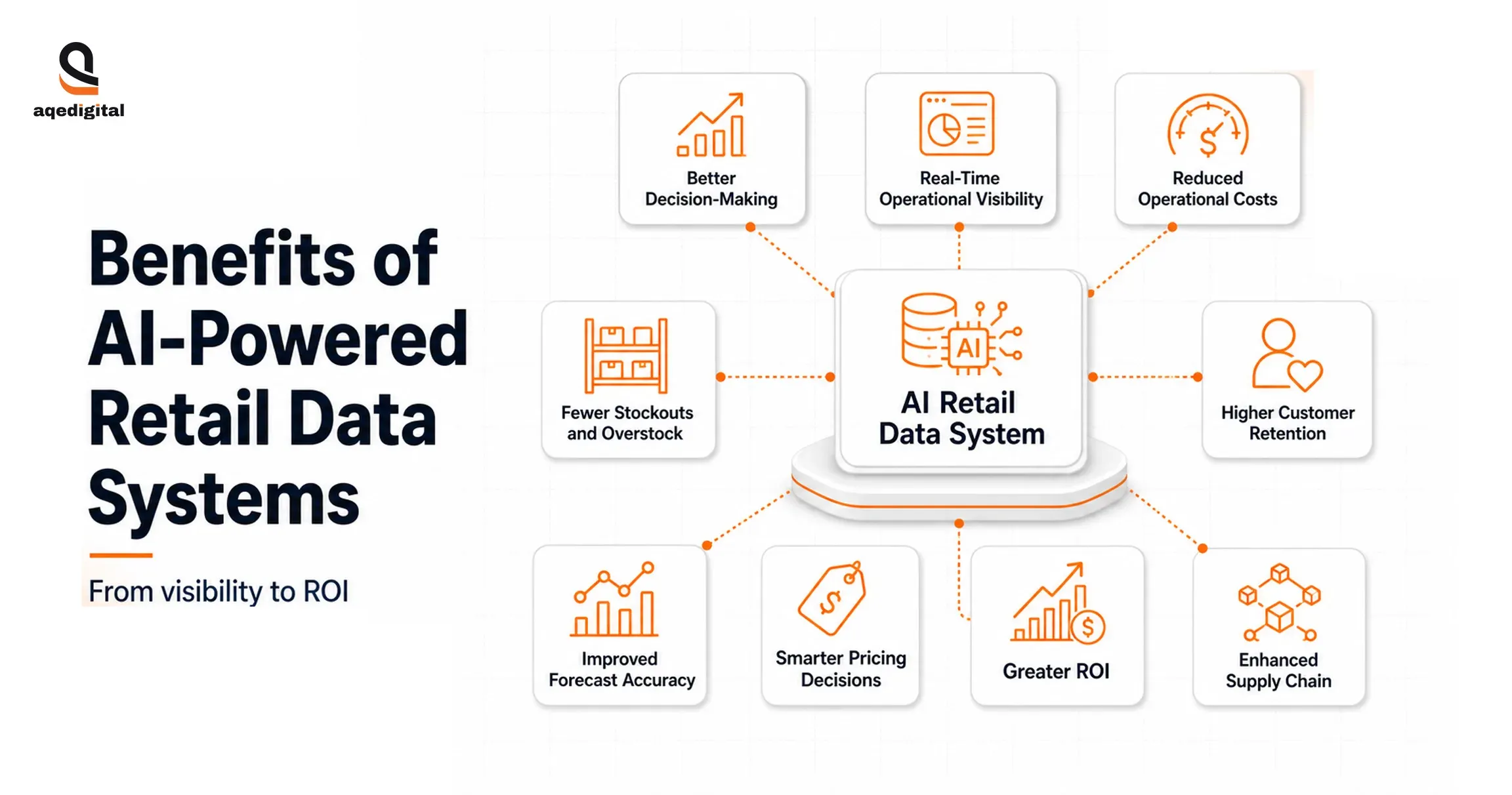
Better Decision-Making
Retail leaders no longer need to rely solely on experience or instinct. AI evaluates historical trends, live business data, and customer behavior simultaneously, helping teams make confident decisions supported by evidence instead of assumptions.
Why does it matter?
Every strategic decision carries financial consequences. Better visibility into what's happening across the business reduces uncertainty, speeds up decision-making, and allows organizations to capitalize on opportunities before competitors react.
Real-Time Operational Visibility
Imagine knowing exactly what's happening across every store, warehouse, and online channel without waiting for daily reports. AI brings operational data together into a single view, making it easier to identify issues the moment they arise.
Why does it matter?
Faster visibility means faster action. Instead of discovering problems after revenue has already been affected, retail teams can resolve operational bottlenecks before they escalate.
Reduced Operational Costs
Manual reporting, repetitive administrative work, and disconnected workflows consume valuable time. AI automates these routine activities, allowing employees to focus on strategic initiatives that create greater business value.
Organizations adopting intelligent retail automation can streamline repetitive business processes, improve workforce productivity, and scale operations more efficiently as the business grows.
Why does it matter?
Reducing operational costs isn't only about spending less. It's about using existing resources more efficiently, increasing productivity, and creating leaner business processes that continue delivering value as the business grows.
Fewer Stockouts and Overstock Situations
One of retail's biggest challenges is maintaining the right inventory at the right location. AI continuously monitors demand, supplier lead times, and stock movement to recommend inventory levels before shortages or excess inventory become expensive problems.
Why does it matter?
Balanced inventory improves customer satisfaction while reducing unnecessary carrying costs. Retailers can fulfill demand more consistently without tying up capital in products that remain unsold.
Higher Customer Retention
Customers expect brands to understand their preferences. AI analyzes purchasing patterns, browsing behavior, and loyalty activity to deliver personalized recommendations and relevant offers throughout the customer journey.
Why does it matter?
Acquiring new customers is expensive. Retaining existing ones is far more profitable. Personalized experiences encourage repeat purchases, strengthen brand loyalty, and significantly increase customer lifetime value over time.
Improved Forecast Accuracy
Retail demand changes constantly because of seasons, promotions, local events, and consumer behavior. AI continuously learns from historical and real-time data to produce forecasts that become increasingly accurate over time.
Why does it matter?
Better forecasting improves far more than inventory planning. It helps retailers optimize procurement, staffing, budgeting, and supply chain operations while reducing unnecessary waste throughout the business.
Smarter Pricing Decisions
Setting the right price has always been a balancing act between competitiveness and profitability. AI evaluates demand, inventory levels, competitor pricing, and customer behavior to recommend pricing strategies that maximize business performance.
As per the research report, organizations implementing AI-powered pricing strategies commonly achieve 2–10% revenue growth and 5–10% margin improvement.
Why does it matter?
Even small pricing improvements can significantly increase profit margins across thousands of products. AI helps retailers remain competitive without relying on blanket discounts that reduce profitability.
Greater Marketing ROI
Instead of targeting broad customer segments, AI identifies audiences most likely to engage, purchase, and return. Marketing budgets become more focused, measurable, and effective across every campaign.
Why does it matter?
Higher marketing ROI isn't achieved by spending more. It's achieved by investing in the right customers, the right channels, and the right message at exactly the right time.
Enhanced Supply Chain Resilience
Proactive Supply Chains: Supply chain disruptions rarely happen without warning. AI continuously monitors supplier performance, logistics operations, delivery timelines, and inventory movement to identify risks before they impact customers.
Why does it matter?
Retailers that anticipate disruptions can respond long before shelves become empty. That resilience protects customer satisfaction, maintains revenue, and reduces the financial impact of unexpected market changes.
AI-powered retail data systems represent only one aspect of modern retail solutions, where intelligent technologies work together to improve customer experiences, operational efficiency, and long-term business growth.
Types of Retail Data That AI Can Analyze
The effectiveness of AI depends on the quality and diversity of the data it analyzes. Modern retail data systems connect information from multiple business functions, enabling retailers to uncover hidden patterns, predict future trends, and make faster, data-driven decisions.
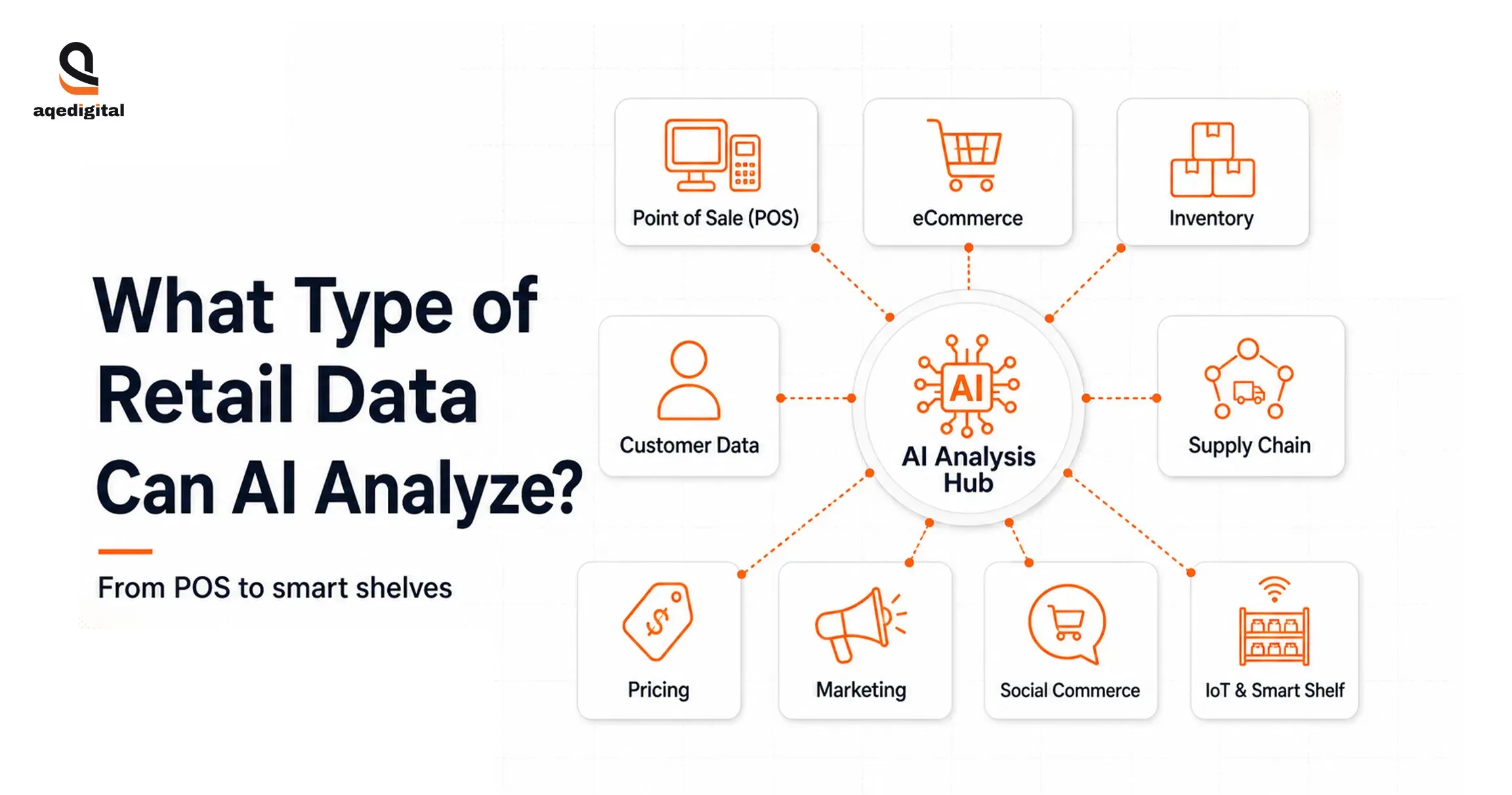
Point of Sale (POS) Data
Every transaction processed through retail POS systems reveals valuable information about customer behavior, product demand, and store performance. Integrated POS retail solutions help retailers optimize inventory, staffing, merchandising, and promotional decisions using real-time sales data.
eCommerce Data
Online shopping data captures how customers browse, compare, and purchase products across digital channels. AI analyzes these interactions to personalize shopping experiences, reduce cart abandonment, and improve conversion rates.
Inventory Data
Inventory data enables AI to balance product availability with operational efficiency. By analyzing stock movement, supplier lead times, and demand patterns, retailers can reduce stockouts while minimizing excess inventory.
Customer Data
Purchase history, browsing behavior, and loyalty interactions help AI build comprehensive customer profiles. A retail data management platform uses these insights to improve segmentation, personalization, and long-term customer retention.
Supply Chain Data
AI continuously monitors supplier performance, logistics operations, and warehouse activities to identify potential disruptions early. These insights help retailers improve procurement planning and strengthen overall supply chain resilience.
Pricing Data
Pricing data allows AI to evaluate demand, competitor pricing, inventory levels, and promotional performance simultaneously. Retailers can adjust pricing strategies dynamically to maximize both profitability and customer competitiveness.
Marketing Data
Marketing data helps retailers understand which campaigns, channels, and customer segments generate the highest returns. AI optimizes budget allocation, improves targeting accuracy, and enhances overall marketing effectiveness.
Social Commerce Data
Customer reviews, product mentions, and influencer engagement reveal how consumers perceive a brand. AI uses Natural Language Processing (NLP) to identify emerging trends and monitor brand reputation in real time.
IoT & Smart Shelf Data
Connected devices such as smart shelves, RFID tags, and in-store sensors continuously generate operational data. Combined with retail business intelligence, AI improves inventory accuracy, automates replenishment, and enhances store efficiency.
Challenges in Implementing AI-Powered Retail Data Systems
Although AI offers significant business value, successful implementation requires more than deploying advanced technology. Organizations must overcome several operational and technical challenges to maximize the effectiveness of their retail data solutions.
- Data Silos: Information often resides across disconnected applications, making it difficult to create a unified view of customers, inventory, and operations.
- Poor Data Quality: Duplicate records, missing values, and inconsistent product information reduce the accuracy of AI models and business insights.
- Legacy Infrastructure: Older systems may not support modern cloud architectures or real-time integrations, increasing implementation complexity.
- Integration Complexity: Connecting ERP, CRM, retail POS systems, eCommerce platforms, and third-party applications requires robust integration strategies.
- Security and Compliance: Retailers must protect sensitive customer information while complying with regulations related to data privacy and cybersecurity.
- Model Drift: Customer behavior evolves continuously, making it essential to retrain AI models regularly to maintain prediction accuracy.
AI-Powered Retail Data System Architecture
A modern retail architecture connects operational systems into a centralized intelligence platform capable of supporting real-time analytics and AI-driven automation.
A typical architecture includes:
- Retail POS Systems
- ERP
- CRM
- eCommerce Platforms
- Mobile Applications
- Marketing Automation Tools
- Data Lake
- Data Warehouse
- ETL/ELT Pipelines
- Feature Store
- Machine Learning Models
- APIs
- Retail Analytics Platform
- Business Dashboards
- Automation Workflows
- Business Users
Instead of operating independently, each component contributes to a unified data ecosystem where AI continuously analyzes information, generates insights, and automates decision-making across retail operations.
Future Trends Shaping AI-Powered Retail Data Systems
AI continues to evolve rapidly, and the next generation of retail data systems will become increasingly autonomous, predictive, and context-aware.
Emerging technologies will continue accelerating retail transformation, enabling retailers to become more intelligent, agile, and customer-centric.
Some emerging trends include:
- Agentic AI: Autonomous AI agents capable of independently monitoring operations, recommending actions, and executing business workflows with minimal human intervention.
- Generative AI: AI assistants that summarize reports, create marketing content, support merchandising decisions, and enhance customer interactions through conversational interfaces.
- Autonomous Inventory Management: AI-driven replenishment systems that automatically adjust inventory based on predicted demand and supply chain conditions.
- Digital Twins: Virtual replicas of stores, warehouses, and supply chains that allow retailers to simulate operational scenarios before implementing real-world changes.
- Edge AI: Processing AI models closer to stores and IoT devices enables faster decision-making while reducing cloud dependency and latency.
- AI Copilots for Retail Analysts: Conversational AI assistants that help analysts query business data, generate reports, and uncover insights using natural language.
- Real-Time Decision Intelligence: Future retail business intelligence platforms will move beyond dashboards by continuously recommending and automating operational decisions based on live business conditions.
Businesses looking to overcome these challenges often invest in comprehensive AI and Data solutions that unify fragmented systems, modernize analytics, and establish a scalable foundation for enterprise-wide AI adoption.
Conclusion
The future of retail won't be defined by the amount of data businesses collect, but by how effectively they turn that data into intelligent actions. Retailers that build AI-ready data ecosystems today will be better equipped to adapt to changing customer expectations, market disruptions, and emerging growth opportunities without relying on reactive decision-making.
At AQe Digital, we help retailers design scalable, AI-powered data ecosystems that unify fragmented data, modernize analytics, and accelerate digital innovation. Our expertise in building intelligent retail platforms enables organizations to transform data into measurable business outcomes.
Contact us to discuss how we can help you build an AI-powered retail strategy tailored to your business goals.