Digital Transformation in Retail: A Step-by-Step Guide to Implementation

Joy Chauhan
Nearly 70% of retailers report struggling to keep pace with evolving customer expectations. It costs them both sales and loyalty. Even small inefficiencies, such as delayed checkouts, stock-outs, or generic shopping experiences, can push customers toward competitors.
Such challenges highlight a bigger problem. Traditional retail processes can’t keep up with modern retail demands. Businesses need a smarter way to operate. Digital transformation in retail provides this solution by streamlining supply chains, improving customer engagement, and delivering seamless experiences across every channel.
Retailers must rethink how technology powers their operations. The solution of digital transformation can streamline supply chains, improve customer engagement, and create seamless shopping experiences across every channel.
More importantly, the right retail IT solutions provide businesses with he flexibility to adapt quickly, eliminate unnecessary costs, and scale with confidence in a rapidly changing market.
But businesses don’t need jargon. They need a roadmap. Here, we will show exactly how to put digital transformation in retail into action.
Let’s start!
What is Digital Transformation in Retail
Digital transformation in retail involves leveraging modern technology to enhance operational efficiency and the overall customer experience. It is not just about selling online or adding a new app. It is about rethinking every process with digital tools.
- Inventory is tracked in real time instead of relying on manual counts.
- Supply chains become connected and visible, reducing delays and stockouts.
- Data guides decisions, from what products to stock to how to price them.
- Customers receive personalized offers, faster checkouts, and consistent service across all stores and online platforms.
In simple terms, it shifts retail from disconnected, manual processes to connected, data-driven operations. The result is better efficiency, lower costs, and stronger customer loyalty.
Digital transformation services help retailers move beyond transactions. With the right retail IT solutions, every part of the business works together to deliver smooth, reliable, and engaging shopping experiences.
The Critical Role of Digital Transformation in Retail

The retail landscape is undergoing rapid disruption. Customer expectations are evolving, competition is intensifying, and supply chains are under constant pressure. In this environment, traditional processes no longer deliver the speed, efficiency, or personalization that modern retail demands. Digital transformation is the clear path forward, enabling retailers to remain competitive and resilient.
Key Reasons Why Digital Transformation Matters in Retail
1. Customer Expectations Are Accelerating
💡 62% of retailers admit they are unable to deliver new, innovative in-store experiences. Fewer than half believe their current POS systems support modern shopping journeys.Modern shoppers expect personalized recommendations, frictionless checkouts, and seamless interactions across channels. Retailers that fail to meet these expectations risk losing both sales and loyalty.
2. Service Inefficiencies Impact Loyalty
💡 45% of retailers report that store associates spend excessive time searching for customer answers.Delays and inefficiencies not only frustrate customers but also erode trust. In a market where convenience drives loyalty, even minor inefficiencies can lead buyers to switch to competitors.
3. Market Momentum Is Undeniable
💡 The retail digital transformation market was valued at USD 178.2 billion in 2023. It is projected to reach USD 743.4 billion by 2032 with a CAGR of 17.2%.The investment surge reflects a growing recognition that digital transformation is not optional; it is central to staying competitive.
4. Omnichannel Customers Spend More
💡 Customers who shop across both online and in-store channels spend 4% more in physical stores and 10% more online than single-channel buyers.Retailers that fail to integrate channels miss out on significant revenue opportunities.
5. Execution Remains a Challenge
💡 Only 34% of retail digital transformation projects achieve their intended goals.The problem is not willingness but execution. Success requires a clear strategy, the right digital tools, and strong alignment across people and processes.
Data transformation services in retail are no longer optional. Customers demand seamless experiences. Competitors are investing fast. Inefficiencies are cutting into margins. Acting now drives revenue, builds loyalty, and creates growth. So waiting means losing ground.

The Business Benefits of Digital Transformation in Retail
Digital transformation in retail is not just about adopting technology—it’s about creating measurable business impact. The right digital strategies improve efficiency, reduce costs, and enhance the customer experience. Here are the key benefits that matter most to retailers today:
1. Streamlined Operations
Digital tools integrate inventory, supply chain, and POS systems. Automation reduces manual errors and speeds up processes. Retailers can track stock in real time, optimize replenishment, and ensure products are available when customers want them.
2. Enhanced Customer Experience
AI-driven personalization, targeted promotions, and omnichannel engagement ensure customers receive relevant recommendations. Seamless online and offline experiences boost satisfaction, retention, and lifetime value.
3. Data-Driven Decision Making
Advanced analytics and dashboards turn sales, inventory, and customer data into actionable insights. Retailers can forecast demand, optimize pricing, and make informed merchandising decisions.
4. Agility and Scalability
Cloud-based solutions and modular systems allow businesses to scale quickly. Retailers can launch new stores, expand online channels, or introduce new services without overhauling existing infrastructure.
5. Cost Optimization
Predictive analytics and intelligent supply chain management reduce overstock, minimize stockouts, and lower operational costs. Efficient operations translate into higher margins.
6. Improved Employee Productivity
Automation frees staff from repetitive tasks. Employees focus on customer engagement, merchandising, and strategic initiatives. Retailers can get more value from existing teams without increasing headcount.
7. Competitive Advantage
Companies that adopt digital transformation early can differentiate through faster service, innovative shopping experiences, and better operational efficiency. Businesses slow to adapt risk losing market share.
Digital transformation delivers both tangible operational improvements and long-term strategic benefits. It allows retailers to stay relevant, improve profitability, and provide a superior customer experience—all while laying the foundation for future growth.
A Step-by-Step Guide to Digital Transformation in Retail
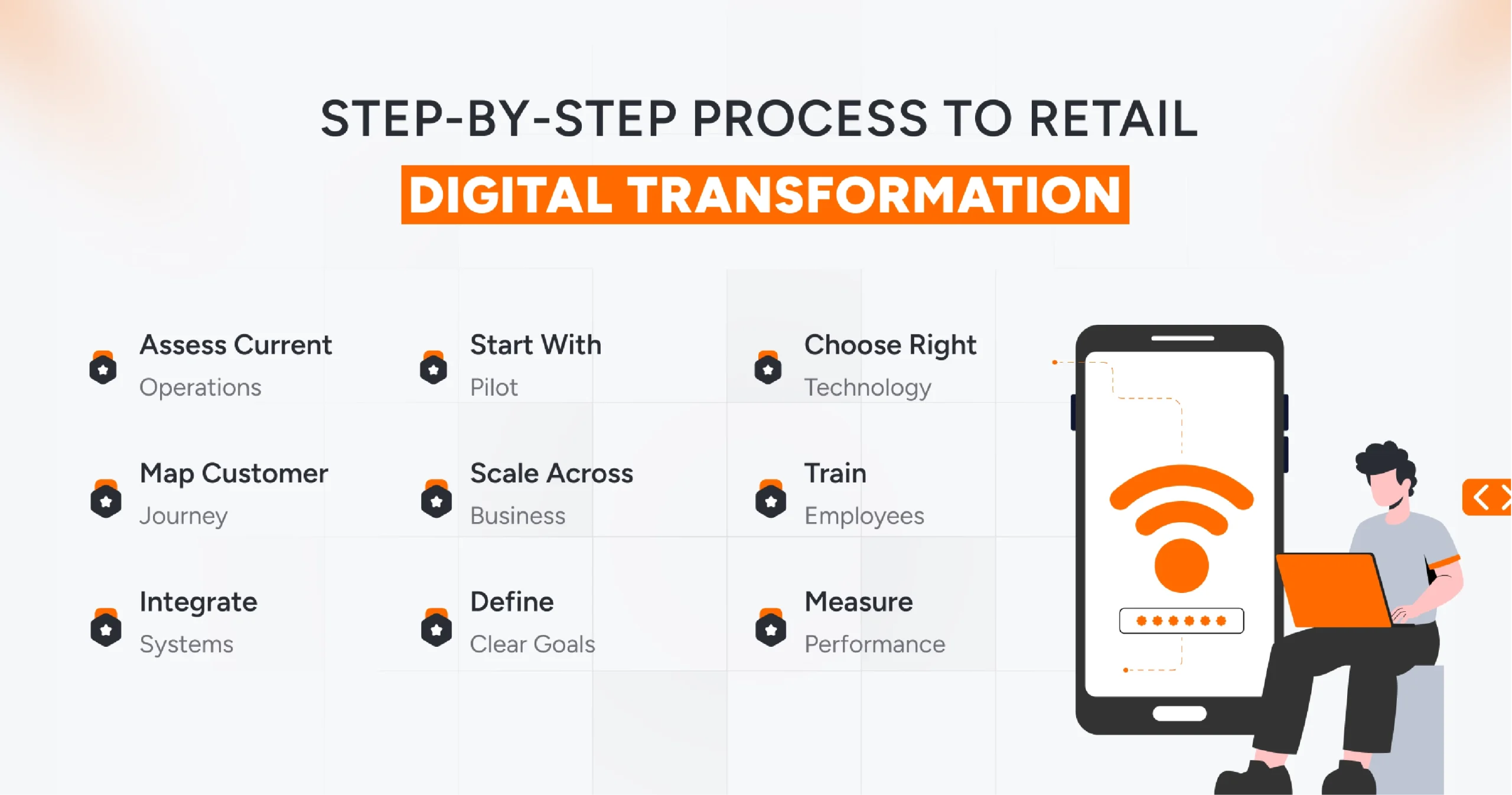
Digital transformation is a structured journey, not a one-time change. Retailers need a clear roadmap to adopt technology effectively and improve both operations and customer experience.
1. Assess Your Current Operations
Begin by reviewing how your store or chain operates today. Look at inventory management, point-of-sale systems, supply chains, and customer service processes. Identify bottlenecks, inefficiencies, and outdated systems that slow down operations or frustrate customers. Knowing where you stand is the foundation for all future improvements.
2. Define Clear Goals
Set precise objectives for what you want to achieve with digital transformation. Examples include:
- Faster inventory turnover
- Better customer personalization
- Increased online and offline sales
- Reduced operational costs
Align every digital initiative with these goals. Clear objectives make it easier to measure success and prioritize investments.
3. Map the Customer Journey
Understand how customers interact with your business at every step. Analyze online browsing, in-store visits, checkout, delivery, and after-sales support. Identify pain points where customers face delays or friction. Digital tools should be applied precisely where they enhance convenience and satisfaction.
4. Choose the Right Technology
Select tools that match your goals and existing processes. Key solutions include:
- Cloud-based ERP to manage inventory, supply chains, and orders in real time
- AI and analytics platforms for demand forecasting, pricing optimization, and customer personalization
- IoT devices and RFID for automated stock tracking and supply chain visibility
- POS and mobile solutions for faster, seamless transactions across all channels
5. Integrate Systems for Seamless Operations
Ensure that all your digital tools work together. Connect your ERP, POS, CRM, e-commerce platform, and analytics systems. Integration provides a single view of your business, reduces errors, and helps teams make decisions based on real-time data.
6. Train Your Employees
People drive digital transformation. Staff must understand and use new systems confidently. Offer hands-on training and demonstrate how tools simplify daily tasks, speed operations, and help serve customers better. Adoption is critical for long-term success.
7. Start Small with a Pilot
Launch digital solutions in one store or a specific department first. Monitor performance, gather employee and customer feedback, and identify issues. A small-scale pilot reduces risk and allows you to refine processes before a full rollout.
8. Measure Performance
Tracking key metrics is critical to understand the impact of digital transformation. Focus on indicators such as:
- Sales growth – monitor revenue trends across stores and online channels
- Customer satisfaction – track ratings, feedback, and repeat purchase behavior
- Inventory accuracy – ensure stock levels match demand and avoid stockouts or overstock
- Operational efficiency – measure fulfillment speed, checkout times, and staff productivity
With the right retail dashboards, all these metrics are available in real time. Dashboards provide a visual overview, making it easy to spot trends, identify bottlenecks, and uncover opportunities for improvement.
Retailers can drill down into specific stores, departments, or product categories to make faster, data-driven decisions.
Such data visualization not only measures performance but also guides continuous optimization. They help retailers act immediately to improve operations, enhance customer experiences, and maximize profitability.
9. Scale Across the Business
Once the pilot proves successful, the next step is to expand digital tools across all stores, channels, and departments. Scaling effectively requires a combination of technology, process standardization, and monitoring:
- Cloud-based Systems – Utilizing cloud ERP and POS platforms enables you to add new stores, regions, or online channels without requiring new hardware installations. Data from every location syncs in real-time, providing a single view of inventory, sales, and customer activity.
- Modular Technology – Adopt modular solutions for easy expansion. Features like AI analytics, IoT tracking, and mobile POS can be rolled out store by store or department by department, reducing disruption while ensuring consistent adoption.
- Centralized Data Dashboards – Retail dashboards allow executives to monitor KPIs across all locations. Real-time analytics help detect operational inefficiencies, track performance, and identify which stores need targeted support.
- Automation and Standardization – Standardize workflows across stores, such as inventory replenishment, checkout processes, and customer loyalty programs. Automation ensures that scaling does not increase errors or operational complexity.
- Continuous Innovation – Scaling is not just replication. Introduce advanced technologies such as AI-driven demand forecasting, predictive equipment maintenance, and automated fulfillment to improve efficiency and the customer experience continuously.
By combining cloud infrastructure, modular technology, centralized dashboards, and standardized workflows, retailers can scale digital transformation smoothly. This approach ensures consistent performance, faster expansion, and the flexibility to adapt to market changes.

Essential Technology Stack for Digital Transformation in Retail
Digital transformation in retail succeeds only when backed by the right technology. Retailers need tools that improve efficiency, enhance customer experience, and provide actionable insights. Here are the most essential tools and how they impact retail operations:
1. Artificial Intelligence (AI) for Personalization and Forecasting
AI helps retailers understand customer behavior and predict trends. Key applications include:
Personalized Recommendations – AI analyzes purchase history and browsing behavior to suggest products, increasing upsell and cross-sell opportunities.
Demand Forecasting – AI predicts which products will be in demand, helping optimize inventory levels and reduce overstock or stockouts.
Dynamic Pricing – Machine learning models can adjust pricing based on demand, competition, and customer segments, improving margins.
AI in retail ensures that every decision, from customer engagement to inventory management, is informed and precise. Retailers can deliver a highly personalized shopping experience while reducing operational inefficiencies.
2. Internet of Things (IoT) for Connected Retail Operations
IoT devices connect physical retail environments to digital systems. Benefits include:
- Real-Time Inventory Tracking – RFID and smart shelves automatically track stock movement.
- Supply Chain Visibility – Sensors monitor shipments, storage conditions, and delivery status, reducing delays.
- Smart Store Operations – IoT enables energy management, automated checkout, and staff allocation based on real-time data.
IoT bridges the gap between online and offline operations, giving retailers complete visibility and control over their stores and supply chain.
3. Cloud-Based ERP for Scalable Retail Management
Cloud ERP systems unify all core operations in a single platform. Key advantages for retailers include:
- Real-Time Data Access – Managers can view sales, inventory, and customer data from anywhere.
- Scalable Operations – Add new stores, products, or online channels without investing in new infrastructure.
- Integrated Workflows – Connect inventory, finance, procurement, and HR for smooth and automated processes.
Cloud ERP ensures that expansion and digital initiatives scale seamlessly while keeping operations efficient and transparent.
4. Predictive Analytics for Data-Driven Decisions
Predictive analytics turns historical and real-time data into actionable insights. Applications for retailers include:
- Inventory Optimization – Forecast which products will sell, reducing overstock and lost sales.
- Customer Segmentation – Identify high-value customer groups and target them with personalized campaigns.
- Operational Insights – Spot trends in store performance, staff productivity, and regional sales to make informed decisions.
By using predictive analytics, retailers can anticipate market demand, improve operational efficiency, and make strategic decisions that directly impact growth and profitability.
When platforms work together, decisions are faster and stores run better. Enterprise integration services unify retail operations for real impact.
The right digital tools transform retail from reactive to proactive. AI, IoT, cloud ERP, and predictive analytics help retailers deliver personalized experiences, optimize operations, and scale confidently. Technology becomes the backbone of smarter, faster, and more profitable retail.
Real-World Examples of Digital Transformation in Retail
Digital transformation is more than theory. Leading retailers worldwide have embraced technology to improve operations, enhance customer experiences, and stay competitive. Understanding how others succeed provides valuable insights for your own journey.
Walmart is enhancing its supply chain with real-time AI and automation, enabling intelligent systems to predict demand, reroute inventory, reduce waste, and simplify work for associates across markets like Costa Rica, Mexico, and Canada.
Starbucks utilizes its AI engine, Deep Brew, to enhance app personalization, delivering smarter recommendations and targeted offers based on app data.
Zara integrates real-time sales and online browsing data to guide production, inventory allocation, and trend forecasting. Cloud-based ERP and analytics allow rapid response to changing fashion trends, ensuring stores always carry what customers want while minimizing excess stock.
Sephora employs AI algorithms to analyze facial geometry, identify features such as lips, eyes, and cheekbones, and apply digital makeup with remarkable precision. The platform supports multiple skin tones, ensuring inclusivity and personalization.
Make Your Retail Business Future-Ready with AQe Digital
Digital transformation does not need to be complicated. AQe Digital makes it practical by connecting your retail systems, enabling more intelligent decisions with AI, and creating seamless customer journeys across every channel. The outcome? Operations that are easier to manage and retail businesses that grow faster.
Here’s how AQe Digital drives transformation where it matters most:
- Unified Retail Systems – Integrating POS, ERP, CRM, and eCommerce for connected operations and real-time visibility.
- AI and Predictive Analytics – Forecast demand, optimize pricing, and personalize shopping experiences with data-driven insights.
- IoT and Automation – Smart sensors and automated workflows to track inventory, reduce errors, and improve supply chain efficiency.
- Cloud-Based Scalability – Flexible ERP and cloud solutions that cut infrastructure costs and support business growth.
- Omnichannel Experience Dashboards – Seamless engagement across stores, mobile, and online, with real-time feedback and analytics.
With us, you get solutions to simplify operations, scale with confidence, and keep customers coming back.
Wrapping Up
Retailers can no longer rely on traditional systems. Real-time data, AI insights, IoT tracking, and cloud platforms are critical to stay competitive and profitable. Every inefficiency costs sales, slows operations, and risks customer loyalty.
The future of retail demands action now. Connect with us to turn technology into measurable growth and build a retail operation ready for tomorrow.