Retail Analytics: The AI-Powered Playbook for Retail, Hospitality & Travel Retail Growth

Nirav Oza
POS systems, PMS platforms, and loyalty programs all capture activity by the second, but none of them speak a language a store manager can act on before the doors open.
It’s like a race engineer getting all the data but not getting real-time analytics into the car’s vitals while the driver is battling on the race track. The radio silence becomes deafening, and the same is true with retail operations without retail analytics.
It’s holiday season, and your store manager is totally in the dark on stock inventory status. The sale begins, customers come, and can’t find their favorite products because it's a stockout.
Dashboards for retail analytics based on live data analysis using artificial intelligence platforms are what your shop needs.
It works as a platform layer, which processes data from point of sale, footfalls, and loyalty channels in real-time, and tells the operator what to replenish, what to price down, and whose number will be missed by which outlet.
This article will describe what makes an AI-based retail analytics platform different, what kind of data it requires, and how it is used by stores, hotels, and travel retail operators.
What an AI Retail Analytics Platform Does Differently?
Most retail dashboards don't fail because they lack data. They fail because they only report what has already happened.
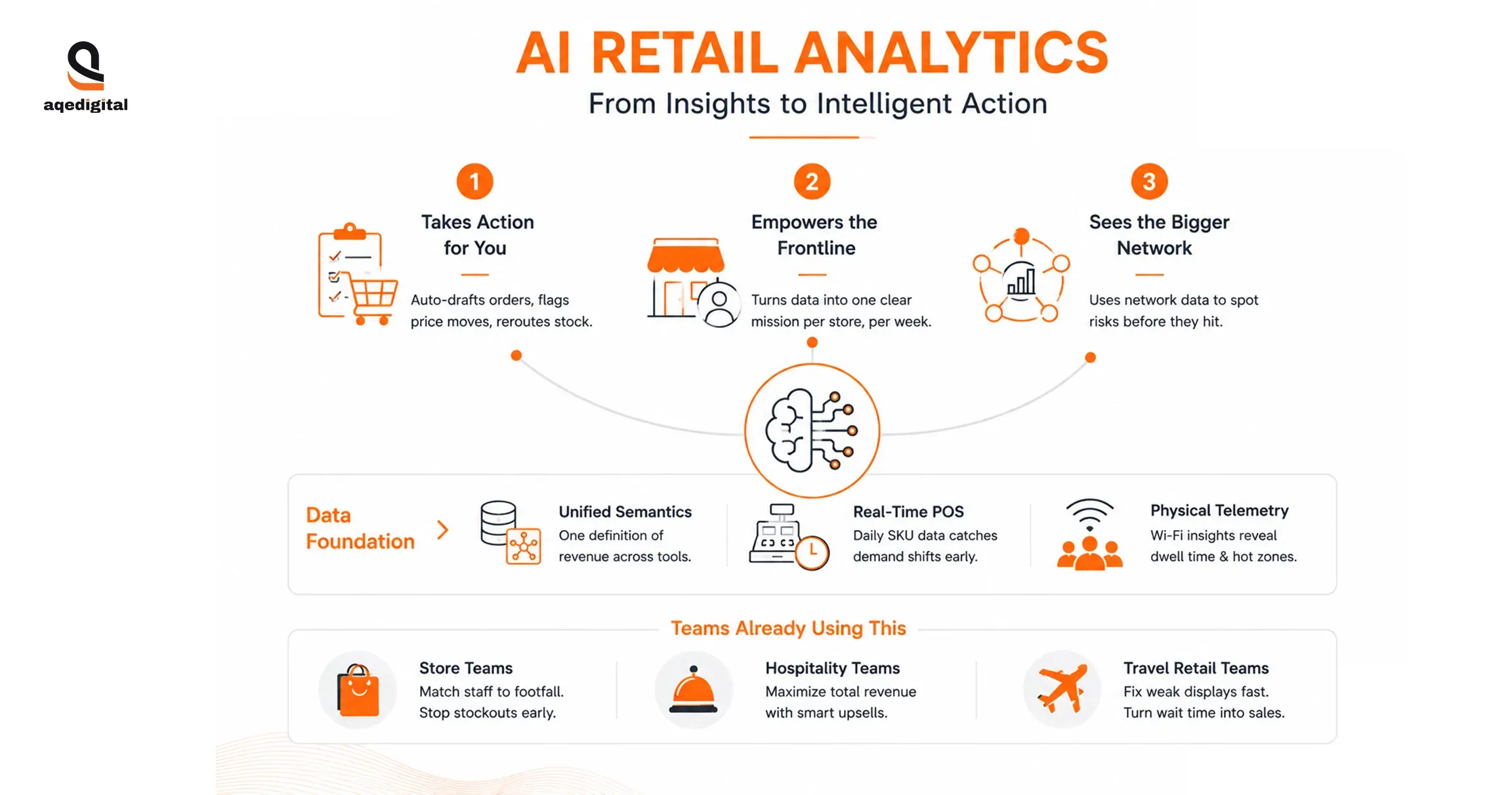
Three Ways It Operates Differently
- Prescriptive and Agentic Action- Modern platforms skip the diagnostic chart. They auto-draft replenishment orders, flag margin-safe price moves, and reroute stock from cold locations to hot ones.
- Focuses on the Frontline- Revenue leaks in the gap between HQ strategy and the store floor. AI closes it by turning sales and traffic data into one prioritized mission per manager, per week.
- Employs Network Intelligence- A single retailer's ledger only shows part of the risk. Pooling execution data across suppliers and carriers surfaces failure patterns before one late shipment becomes a shelf-out.
The Data Foundation It Needs
- A Universal Semantic Layer- POS, CRM, and supply chain tools rarely agree on what "revenue" means. A semantic layer standardizes that logic without a slow data migration.
- Real-Time POS Signals- Warehouse shipments lag reality by weeks. Daily, SKU-level POS data catches demand shifts before they hit wholesale orders.
- Physical Telemetry- Wi-Fi access points now track dwell time and hot zones. Brick-and-mortar finally gets eCommerce-grade conversion data.
Teams Already Running This
- Store Teams- Managers match staffing to real footfall, closing the help gap that empties carts. Inventory algorithms catch phantom stock before it triggers a stockout.
- Hospitality Teams- Hotels chase total revenue management, not just room rate. Guest data triggers dynamic upsells for parking, spa time, and early check-in over WhatsApp.
- Travel Retail Teams- Airport retailers read footfall against shelf data to fix weak displays mid-flight. Loyalty integrations turn dead gate time into a shopping window.

What are the Retail Data Foundations Every Platform Needs?
No retail analytics platform outperforms the data feeding it. The foundation has four inputs that matter most:
- POS transactions for the raw sales record
- Foot traffic sensors for the demand signal a receipt never captures
- PMS and loyalty data for hospitality retail outlets
- eCommerce feeds for brands running omnichannel.
Skip one of these, and the retail data layer underneath every forecast has a blind spot.
| Core Retail & Hospitality Data Sources | ||
| Data Source | What It Captures | Why It Matters |
| POS Transactions | Line-item sales, SKU velocity, basket composition, and real-time revenue metrics. | Establishes the core baseline demand signal for inventory forecasting and revenue planning. |
| Foot Traffic Sensors | In-store visits, dwell times, peak hours, and physical conversion rates by store zone. | Reveals uncaptured customer demand and identifies store layout or staffing bottlenecks. |
| PMS & Loyalty Data | Guest profiles, stay histories, lifetime value, and cross-property spending patterns. | Connects hotel retail, dining, and duty-free purchases to unified guest personas. |
| Ecommerce Feeds | Online purchases, digital cart abandonments, returns, and cross-channel browsing behavior. | Closes the loop on omnichannel attribution and drives unified inventory visibility. |
Multi-property hotel groups and travel retail operators hit a specific integration snag here: PMS systems were never built to export data the way a retail analytics platform expects it. Rollout sequencing has to account for that.
AQe Digital typically stages ingestion by property tier, starting with the highest-revenue outlets, before layering in cleansing and unification rules that reconcile a hotel's guest ID with a duty-free counter's transaction ID. Teams that skip this staging step usually rebuild the data model twice within the first year.
AQe Digital's retail industry practice has run this staging sequence across store, hospitality, and travel retail estates enough times to know where it breaks first.
Retail Business Intelligence: Turning Numbers Into Decisions
Raw retail data answers what happened. Retail business intelligence is the layer that decides what to do about it, and the ROI evidence behind that layer is no longer theoretical.
| Key Retail ROI Levers & Impact | |
| ROI Lever | Reported Impact |
| Stock-Out Reduction | 5% to 7% sales lift |
| Promotional Optimization | 3% to 4% sales lift |
| Personalization | 2% to 3% sales lift |
| Model-Driven Store Planning | 8.9x ROI, 14.1% sales-per-sq-ft lift |
Retail Reporting Dashboards
The dashboard itself is changing shape. Static, pre-built retail reporting dashboards are giving way to agents that answer plain-English questions and push KPI alerts to a manager's phone before a human goes looking for the problem.
Operators evaluating these tools consistently raise one condition before they trust a forecast enough to bet inventory dollars on it: the model has to explain itself. A platform that shows its reasoning earns adoption faster than a black-box score, a pattern that shows up repeatedly in operator discussions comparing retail performance analytics tools before a purchase decision.
That is a fair bar to set. AQe Digital's write-up on predictive analytics in retail covers how to evaluate that explainability question before signing a contract, and its broader piece on digital transformation in retail walks through the rollout sequencing question in more depth.
Retail Performance Analytics in Action: Use Cases Across Store, Hotel & Travel Retail
Retail performance analytics looks different depending on where it's used, a regular store, a hotel, or an airport, but the goal is the same everywhere: instead of just looking back at what already happened, businesses now get real-time alerts telling them exactly what to do next.
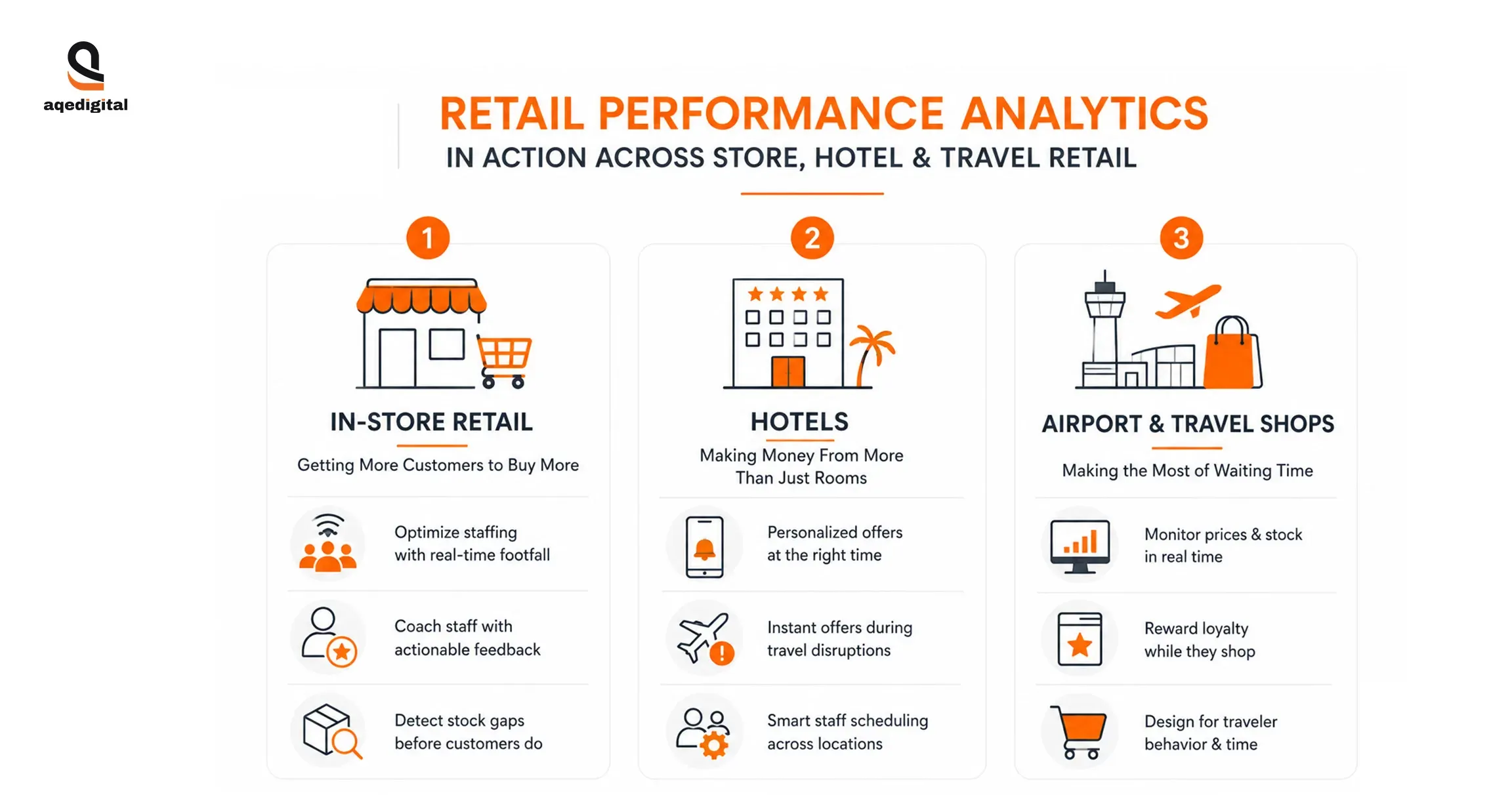
1. In-Store Retail: Getting More Customers to Purchase More
Real-time analysis of in-store behavior and events is possible due to the current advancements.
- Resolving the 'lack of staffing' issue: Using sensors near the entrance (similar to how mobile devices link to store Wi-Fi), retailers are able to anonymously count foot traffic, track how long people browse the products, and learn when the store is busier. Thus, managers may adjust the staffing schedule according to real data instead of following the old patterns, which allows to convert more browsers into buyers.
- Providing coaching for the sales team: Retailers track customer feedback from checkout counters and coach employees each week on specific activities that positively affect how much each client spends on purchases.
- Detecting missing items: Systems compare the expected sales of different products with the real sales, and any discrepancy leads to a priority order of the item. Prioritization takes into account how much revenue is missed rather than alphabetical order.
2. Hotels: Monetizing Other Sources of Guests' Spending
With hotel prices growing slower and slower, hotels start paying attention to all other sources of guests' spending.
- Offering relevant additional services: Hotels offer discounts for various services such as parking space, spa service, or early check-in to guests based on their data. It is sent directly to the guest's phone before arrival, with prices adjusted to the current demand.
- Reacting to travel issues of a guest instantly: Some hotels use automated systems to notify a guest who had a flight delay or cancellation about the possibility of booking a discounted room in the hotel and receiving transportation there.
- Using advanced scheduling systems: Resort chains have implemented systems that allocate employees to particular locations based on their language and expertise using algorithms.
3. Airports and Travel Shops: Maximizing Short-term Client Visits
Airport shops get one chance to make a sale per customer as travelers visit airports only for a limited amount of time before their flights.
- Monitoring prices and stock in real-time: Airport retail department uses live monitoring tools to track the prices, actions of competitors, and stock of multiple products to know when sales decrease or when a popular product becomes unavailable.
- Providing loyalty points for airport purchases: Some airlines allow frequent flyers to earn points and then use them for their airport shopping.
Retail Performance Analytics: KPI Benchmarking
Multi-location retail and hospitality retail estates converge on the same handful of KPIs once the data foundation is in place. The table below is a starting benchmark set for comparing outlets on equal footing.
| Key Retail ROI Levers & Impact | |
| ROI Lever | Reported Impact |
| Stock-Out Reduction | 5% to 7% sales lift |
| Promotional Optimization | 3% to 4% sales lift |
| Personalization | 2% to 3% sales lift |
| Model-Driven Store Planning | 8.9x ROI, 14.1% sales-per-sq-ft lift |
AQe Digital's AI in retail store experience piece breaks down how these KPIs feed into floor-level staffing and merchandising decisions once a platform is live across multiple property types.
Retail Analytics Is Moving From Reporting to Forward Planning
The ROI case for retail analytics is no longer an argument. The 13% sales lift figures and the 8.9x ROI benchmarks already answer the "is it worth it" question. The live argument now is the speed of adoption.
Gartner expects 60% of brands to run agentic AI for one-to-one interactions by 2028, and retailers still running monthly reports will be reading history while competitors are already acting on next week's forecast.
Store, hotel, and travel retail operators who bridge their data now will not be retrofitting an agentic layer later. They will already be running one.