Medical Device Engineering Services Explained: Role, Benefits & Healthcare Impact

Vishal Panchal
Rising costs, increasing patient expectations, and the growing burden of chronic diseases are pushing traditional care models to their limits. What worked before no longer scales. This is where medical device engineering plays a pivotal role, driving a fundamental shift in how healthcare solutions are designed and delivered.
Medical devices today are no longer standalone tools built only for clinicians. They operate within a connected ecosystem that includes hospitals, insurers, and digitally empowered patients.
This shift demands a new approach. Medical product engineering now brings together hardware, software, cloud, and data to create solutions that are not just functional but also intelligent, compliant, and outcome-driven.
This is where medical device engineering plays a pivotal role, driving a fundamental shift in how healthcare solutions are designed and delivered, supported by real-world implementations of product engineering services. The global medical device product engineering market is estimated to reach US$ 14.7 billion by 2029.
With the rise of AI, IoT, and cloud computing, medical product engineering is enabling smarter, more connected, and more personalized healthcare experiences. This isn’t just innovation, it’s a transformation in how healthcare solutions are built and delivered.
What is Medical Product Engineering?
Medical product engineering goes far beyond traditional development. It’s an end-to-end discipline that brings together strategy, design, technology, and compliance to build healthcare solutions that actually work in real-world clinical environments.
At its core, medical device engineering covers the entire product lifecycle from ideation and concept validation to design, development, testing, and deployment. But unlike conventional engineering, the focus isn’t just on functionality. A modern medical device engineer must balance multiple dimensions at once: regulatory requirements, clinical workflows, patient safety, usability, and market viability.
This is where the shift becomes critical.
Today’s healthcare products are expected to be connected, data-driven, and interoperable. That means engineering teams must think beyond isolated components and design integrated systems where embedded software, cloud platforms, and analytics work seamlessly together. It’s not just about building a device; it’s about architecting an ecosystem that delivers continuous value.
Another defining aspect of medical device engineering is its alignment with real-world healthcare dynamics. Engineers must account for evolving regulations, diverse patient needs, and the growing influence of digital health technologies. This requires a cross-functional approach combining engineering precision with clinical insight and market awareness.
In simple terms, medical product engineering transforms ideas into compliant, scalable, and user-centric medical solutions. And in today’s rapidly changing healthcare landscape, that transformation is what separates innovation from impact.

How Medical Device Engineering Services Are Redefining Healthcare Innovation?
Healthcare transformation today is not driven by isolated breakthroughs; it’s powered by connected, intelligent systems. At the center of this evolution are medical device engineering services, enabling organizations to move from fragmented solutions to integrated care ecosystems that are scalable, compliant, and outcome-focused.
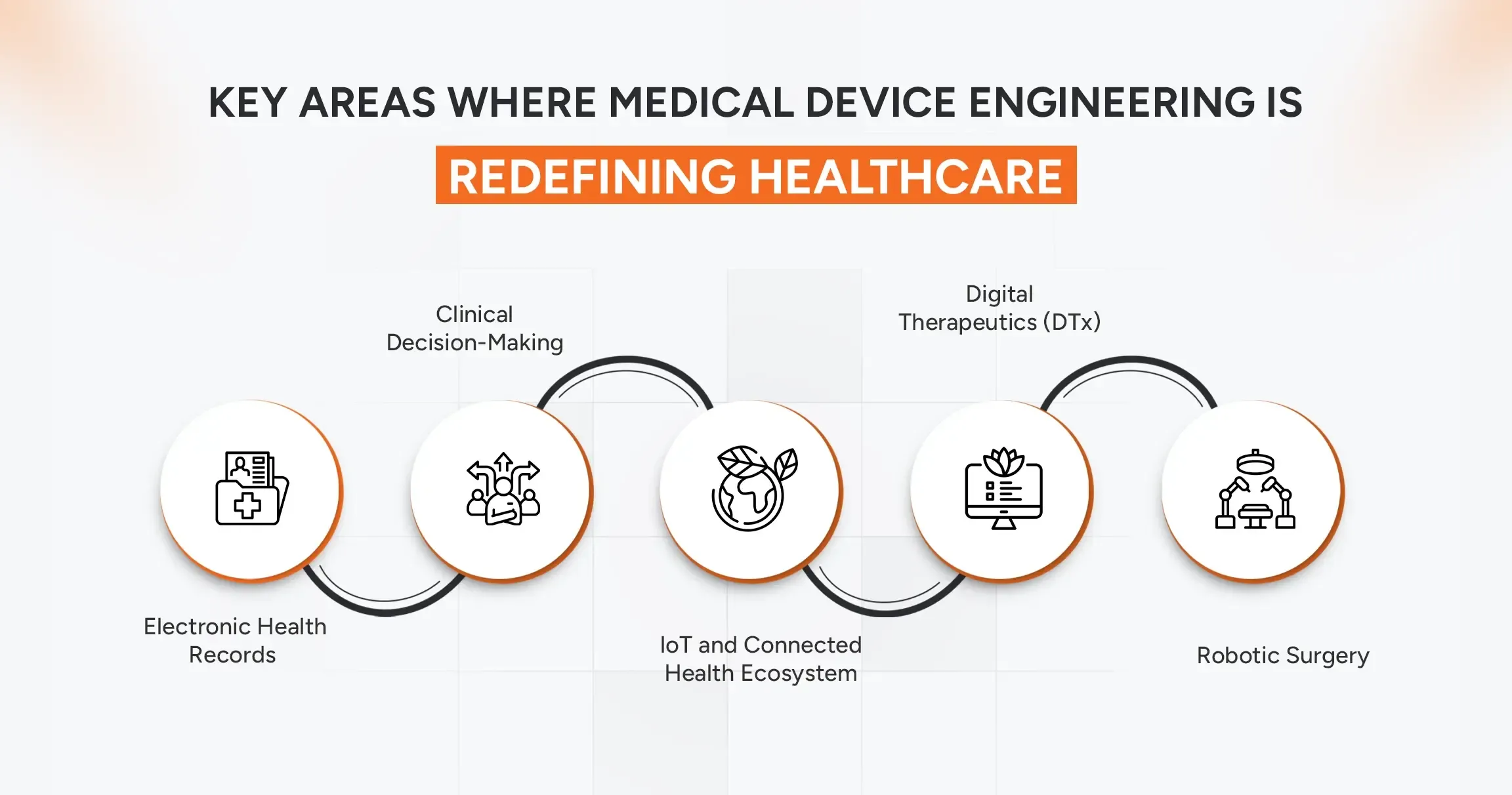
Electronic Health Records and Intelligent Care Coordination
Healthcare systems now demand more than digital record-keeping. They require seamless interoperability, real-time access, and workflows aligned with clinical realities. Engineering plays a critical role in building EHR platforms that reduce administrative burden while improving care coordination across providers.
How do medical device engineering services help with it?
Through medical device engineering services, connected devices, EHR platforms, and care systems are integrated into a unified architecture. A quality engineer in a medical device ensures data accuracy, regulatory compliance, and system reliability, while a medical device engineer enables smooth data flow between devices and clinical systems for better decision-making.
AI and Machine Learning in Clinical Decision-Making
AI is rapidly becoming a core layer in healthcare systems. From predictive analytics to automated diagnostics, it is enhancing both speed and accuracy in clinical decisions. This shift is further accelerated by AI-powered engineering optimization, enabling continuous improvement in system performance and clinical accuracy.
How does medical product engineering help with it?
Medical product engineering enables the integration of AI models into healthcare platforms, ensuring they are scalable, compliant, and aligned with clinical workflows. A medical device engineer plays a key role in embedding these capabilities into diagnostic tools, making them reliable and clinically relevant.
IoT and Connected Health Ecosystems
The shift to connected healthcare is enabling continuous monitoring and real-time patient insights. IoT bridges the gap between patients and providers, making care more proactive and accessible.
How does medical device engineering help with it?
A medical device engineer designs connected systems that integrate sensors, firmware, and communication protocols for real-time health tracking. With the support of medical device engineering services, these ecosystems are scaled securely, while a quality engineer for medical devices ensures performance consistency and data security across devices.
Digital Therapeutics (DTx) and Software-Driven Care
Digital therapeutics are transforming how conditions are managed, moving from reactive treatments to proactive, software-driven interventions.
How do medical device engineering services help with it?
End-to-end medical device engineering services enable the development of compliant, evidence-based therapeutic applications. A quality engineer in medical devices ensures these solutions meet strict regulatory standards, while a medical device engineer builds robust architectures that deliver consistent clinical outcomes.
Robotic Surgery and Advanced Interventional Systems
Robotic systems are redefining surgical precision and patient outcomes. These systems combine hardware, software, and real-time analytics to support minimally invasive procedures.
How does medical product engineering help with it?
Through medical product engineering, advanced robotic platforms are designed with integrated control systems, imaging capabilities, and precision-driven functionalities. A medical device engineer continuously refines these systems, while a quality engineer ensures safety, accuracy, and compliance at every stage of deployment.
Benefits of Medical Product Engineering in Modern Healthcare
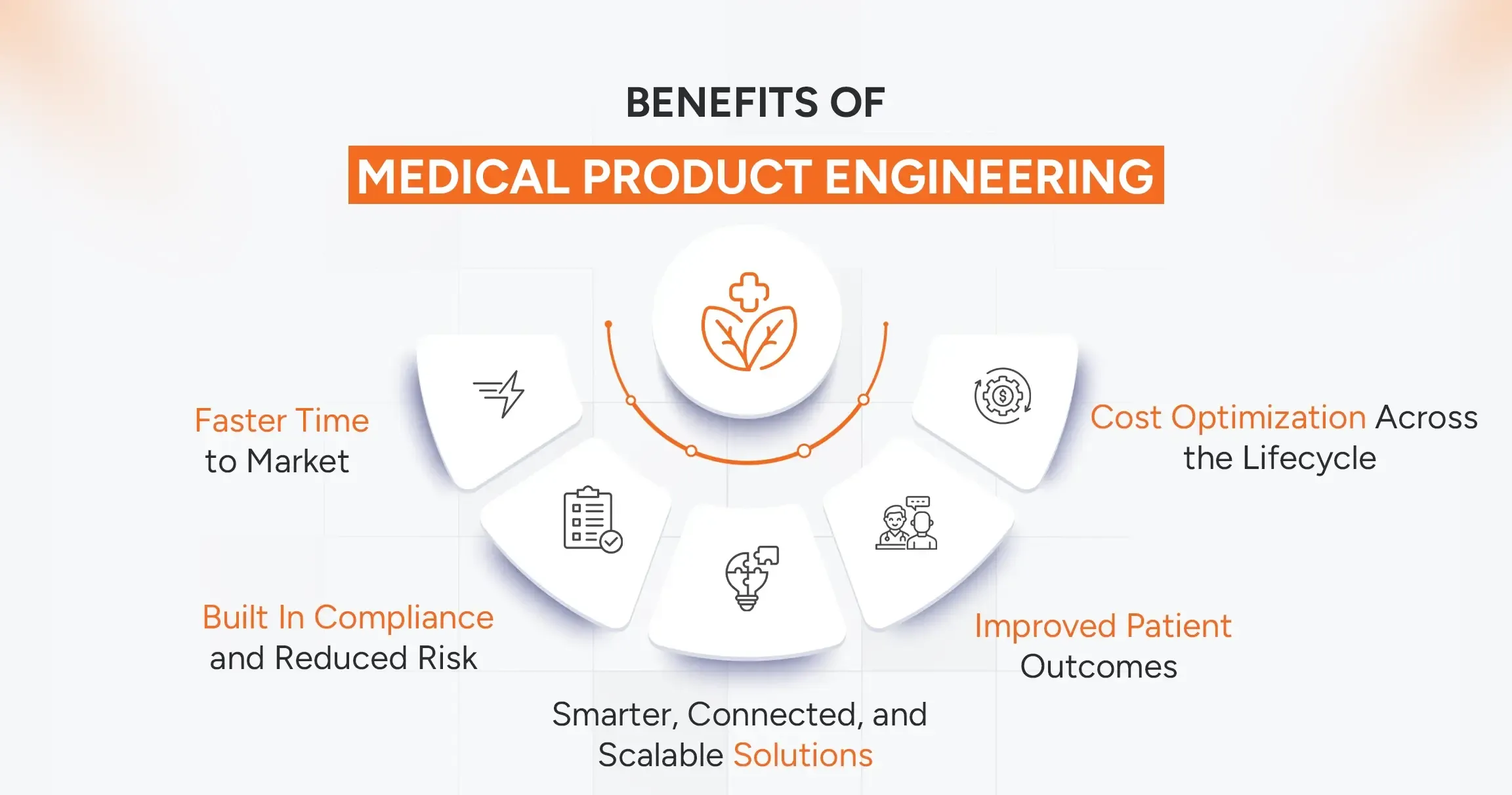
Let’s get straight to it. Innovation alone doesn’t win in healthcare. Outcomes do. That’s where medical product engineering creates a real, measurable advantage.
Faster Time to Market Without Compromising Quality
Speed matters, but in healthcare, precision matters more. With structured medical device engineering services, organizations can accelerate development while maintaining strict quality standards. A skilled medical device engineer ensures that design, development, and validation happen in sync, reducing delays and eliminating rework.
Built-In Compliance and Reduced Risk
Regulatory alignment is not a one-time activity. It needs to be embedded into every stage of development. This is where medical device engineering becomes critical. By integrating compliance into the product architecture, teams reduce approval risks and avoid costly setbacks. A quality engineer for medical devices ensures every component meets safety and performance expectations from the start.
Smarter, Connected, and Scalable Solutions
Healthcare is shifting toward connected ecosystems. Through medical product engineering, organizations can build solutions that seamlessly integrate devices, data, and platforms. A medical device engineer focuses on interoperability, while medical device engineering services enable systems to scale efficiently as demand grows. These capabilities also extend to adjacent domains like product engineering for order management, where system integration and workflow optimization play a critical role.
Improved Patient Outcomes Through Intelligent Design
Everything ultimately comes down to patient impact. Advanced medical device engineering integrates technologies like AI, IoT, and real-time analytics to enable accurate diagnostics and personalized care. When engineering is aligned with clinical needs, outcomes improve in a meaningful way.
Cost Optimization Across the Lifecycle
Building the product is only part of the equation. Sustaining it efficiently is equally important. Effective medical device engineering services help optimize costs across the entire lifecycle. With the involvement of a quality engineer, medical device issues are identified early, reducing expensive fixes and long-term operational challenges.
In simple terms, medical product engineering is not just about building devices. It is about building solutions that perform, scale, and deliver consistent value in a complex healthcare environment.

AQe Digital’s Medical Device Engineering Services Portfolio
Delivering scalable and compliant healthcare solutions requires more than isolated development. AQe Digital combines deep domain expertise with structured medical device engineering services to support the entire product lifecycle—from concept to continuous optimization.
Software Product Engineering
We deliver end-to-end medical product engineering that aligns innovation with regulatory and clinical expectations. Our approach ensures faster development while maintaining precision, scalability, and compliance.
Key Capabilities:
- Full Lifecycle Development: From ideation to deployment across embedded, mobile, and cloud platforms led by experienced medical device engineer teams
- Regulatory-Driven Engineering: Built-in compliance aligned with global standards, validated by a quality engineer for medical devices
- Interoperability Frameworks: Integration with EHR, HIS, and third-party systems using standardized healthcare protocols
- Secure Architecture Design: Data security, privacy, and risk mitigation are embedded into every layer of development
Cloud Application Development, Deployment, and Monitoring
We enable healthcare organizations to build and scale secure digital platforms through advanced cloud-driven medical device engineering services.
Key Capabilities:
- Cloud-Native Development: Scalable and secure healthcare applications designed for high availability and performance
- Modern Architecture: Microservices, containerization, and DevSecOps practices for agility and resilience
- System Integration: Seamless connectivity across devices, platforms, and enterprise systems
- Infrastructure Optimization: Continuous monitoring and performance tuning to ensure cost efficiency and reliability
- IoMT Cloud Platforms: Multi-tenant, secure platforms supporting connected medical devices and real-time data exchange
Application Software
We build high-performance healthcare applications that balance usability with clinical precision, powered by robust medical product engineering practices.
Key Capabilities:
- Clinical Workflow Alignment: Applications designed around real-world healthcare processes by a skilled medical device engineer
- User-Centric Interfaces: Intuitive design to improve adoption and reduce operational complexity
- Performance and Reliability: High-quality applications validated by a quality engineer for medical devices for consistency and compliance
- Cross-Platform Development: Seamless experiences across web, mobile, and enterprise environments
IoT and Connectivity
We enable connected healthcare ecosystems where devices, data, and systems work together seamlessly through advanced medical device engineering services.
Key Capabilities:
- Device Integration: Connectivity across wearables, medical devices, and hospital systems
- Real-Time Data Exchange: Secure transmission of patient data for continuous monitoring
- Protocol Enablement: Support for healthcare standards and custom communication frameworks
- Edge and Remote Monitoring: Reliable performance for decentralized and remote care environments
Product Design Services
Our design approach combines usability, compliance, and engineering precision to create impactful healthcare solutions.
Key Capabilities:
- User Experience Design: Intuitive and accessible interfaces aligned with clinical needs
- Design for Compliance: Regulatory-ready product designs supported by a quality engineer for medical devices
- Prototyping and Validation: Rapid design iterations led by experienced medical device engineer teams
- Human-Centered Engineering: Focus on safety, usability, and real-world adoption
New Product Development
We help organizations transform ideas into market-ready solutions through structured and scalable medical product engineering.
Key Capabilities:
- Concept to Commercialization: End-to-end product development supported by medical device engineering services
- Agile Development Models: Faster iteration cycles without compromising quality or compliance
- Risk and Quality Management: Continuous validation led by a quality engineer of a medical device
- Scalable Product Architecture: Designed for long-term growth and adaptability
Data, AI, and ML Services
We embed intelligence into healthcare systems through advanced data engineering and AI-driven medical device engineering services.
Key Capabilities:
- Predictive Analytics: Data-driven insights for proactive decision-making
- AI-Powered Diagnostics: Intelligent models integrated into clinical workflows
- Data Engineering Pipelines: Scalable data architectures for real-time processing
- Personalized Care Enablement: AI-driven solutions designed by expert medical device engineer teams for targeted outcomes
Conclusion
Healthcare innovation is no longer defined by how advanced a device is, but by how well it fits into a larger, outcome-driven ecosystem. This is why medical product engineering is becoming essential. It ensures that every solution is not only functional but adaptable, compliant, and built for long-term impact in a rapidly changing environment.
AQe Digital brings a structured and future-ready approach to medical device engineering services, combining deep domain expertise with execution precision. Backed by experienced medical device engineer teams and strong validation practices led by a quality engineer for medical devices, the focus remains on delivering reliable, scalable, and compliant solutions.
If you are looking to build or scale your healthcare solutions, contact us to explore how we can support your journey.
https://www.aqedigital.com/blog/increase-engineering-revenue-productivity-ai-strategies/