Loop Engineering vs Graph Engineering: A Decision Framework for AI Agent Architecture

Priyanka Wadhwani
Boris Cherny, the engineer who built Claude Code at Anthropic, told an audience at the company's developer conference that he no longer writes prompts. He designs loops that write the prompts instead. Peter Steinberger, creator of the OpenClaw coding agent, made a near-identical claim within days: stop prompting agents, start designing the loops that prompt them.
Their comments turned loop engineering into the dominant phrase in AI engineering circles through mid-2026, and a second term, graph engineering, followed within weeks to describe how multiple agents coordinate.
So, what are these- loop and graph engineering concepts?
And most importantly, as an enterprise, which approach is best for your projects?
Choosing between the two decides how much a team builds, how much it spends on tokens, and whether the project reaches production at all. This piece covers both architectures, the enterprise adoption data behind them, and a four-question test for choosing one.
Loop Engineering vs Graph Engineering: What is the Design Difference?
The loop engineering vs graph engineering comparison does not lead to two opposite approaches but more of complementary concepts. Both represent different layers of cognitive systems design. A loop is the smallest possible graph, or a single node with an edge pointing back to itself.
So, what’s the real design difference in both approaches?Loop engineering is a self-prompting feedback cycle. What this means is you spawn up an agent to iteratively guide itself towards a goal. The entire flow is as follows.
- Agents discover the goal.
- Plan the processes
- Execute the tasks
- Verify the output by itself
- Repeat the process till result is achieved.
Graph engineering is like a layer on the loop or an orchestrator that sits on top of the loop and organizes multiple specialized agents or steps into a structured, directed graph. Basically, it acts like an organization chart that helps in coordinating, parallelizing, and routing multiple agents.
Now that you know the design difference, let’s understand the difference on an architecture level.
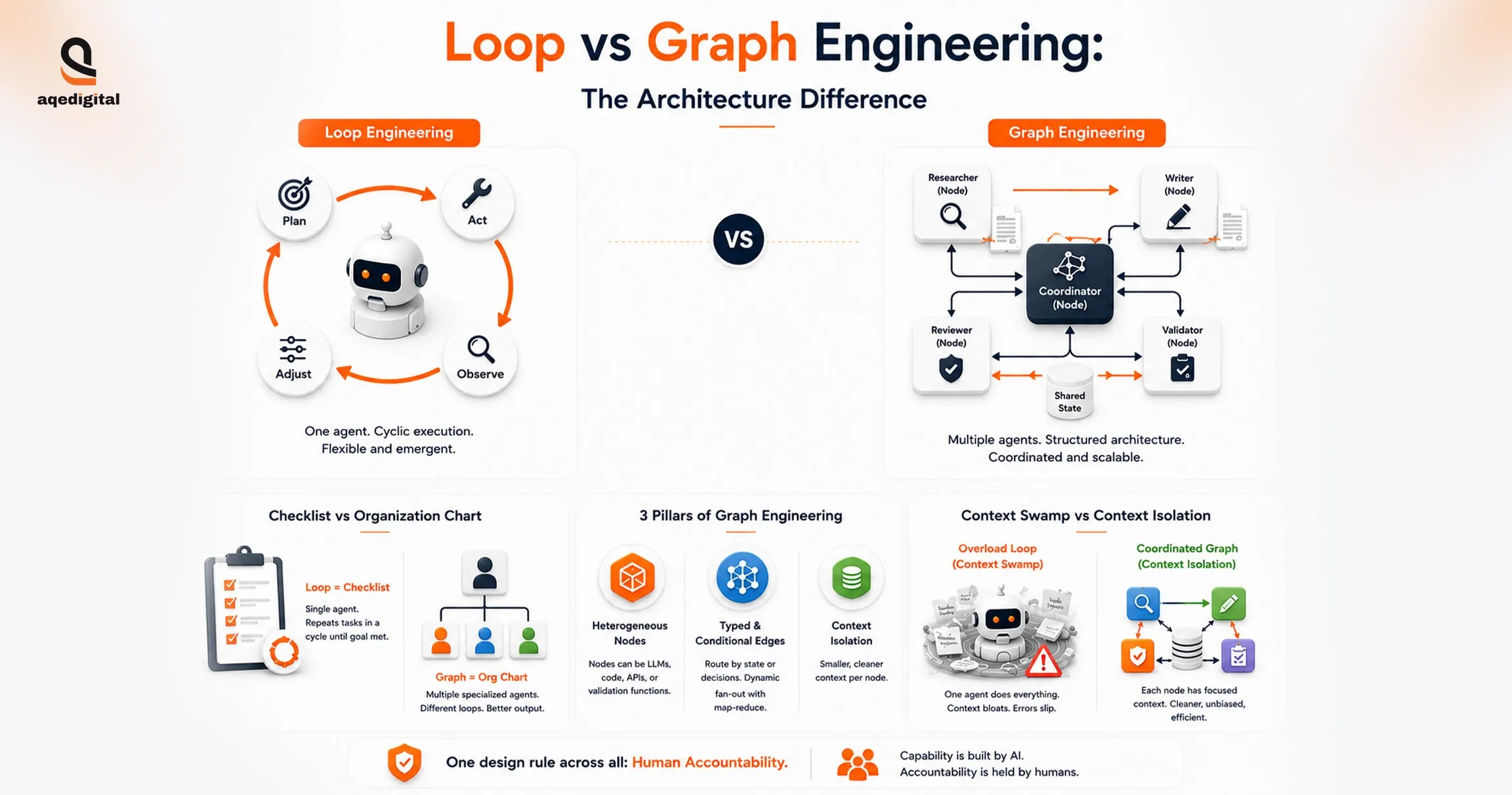
Loop vs Graph Engineering: The Architecture Difference
The primary difference between loop engineering vs graph engineering lies in how control flow, context windows, and task delegation are structured and executed.
| Loop Engineering vs. Graph Engineering: Extended Architectural Dimensions | ||
| Dimension | Loop Engineering | Graph Engineering |
| Unit of Control | One agent's execution cycle. | Multiple specialized nodes, edges, and shared state. |
| Execution Path | Highly flexible and emergent; sequential planning. | Declarative, constrained, and structurally explicit. |
| Context Management | Sequential and accumulative (often leading to "context swamping"). | Isolated per node; clean parameters passed via the shared state schema. |
| Execution Mode | Strictly sequential. | Supports parallel fan-out and fan-in (concurrency). |
| Failure Modes | Weak verifiers, infinite retries, tool thrashing, token runaway. | Incorrect topological routing, state leakage between nodes, high coordination overhead. |
| Stable vs. Ephemeral | N/A (runs state dynamically in context). | Supports a dual-graph model: a stable, long-lived Org Graph (roles/zones) and an ephemeral, runtime Work Graph (tasks/edges). |
Checklist vs Organization Chart
Loop engineering models an agent like a worker that follows the checklist. It is a single-agent system that runs tasks in a cycle until a stop condition is met. The developer’s focus here is on creating an automated cycle and evaluation rules rather than verifying it and prompting bac
On the other hand, graph engineering models the agents like an organization chart. Here, there is an entire system of agents. Multiple specialized agents execute different loops to create the desired output. And if you think loop engineering is more efficient, it contradicts in terms of output. Using multiple specialized agents ensures developers can declare constrained and predictable routing paths upfront.
There are three main pillars of graph engineering,
- Heterogeneous Nodes- Graph engineering offers bounded units of execution. A node does not need to be an LLM. It can be a fast model, deterministic code like a database fetch, or a validation function.
- Typed and Conditional Edges- It offers the capability to define pathways that route between nodes. What this means is developers can define state variables or model decisions. It also helps developers use map-reduce APIs like LangGraph’s Send to dynamically span multiple nodes.
Context Swamp vs Context Isolati
Single loop's big break point: context rot.
- Overload Loop: One agent does research, draft, review, context turn swamp. Raw tool output, half-drafts, reasoning all pile same window. Agent reviews own work in same mud it wrote in, rubber-stamp errors follow. Grading own homework, answer key open.
- Coordinated Graph: Graph engineering approach allows splitting context per node. Researcher Node pulls raw data, hand-clean structured notes to Writer Node only. Reviewer Node gets fresh context, no bias, judges draft against bar, no raw search logs cloud it. Cut token spend hard. Cut accidental leak too.
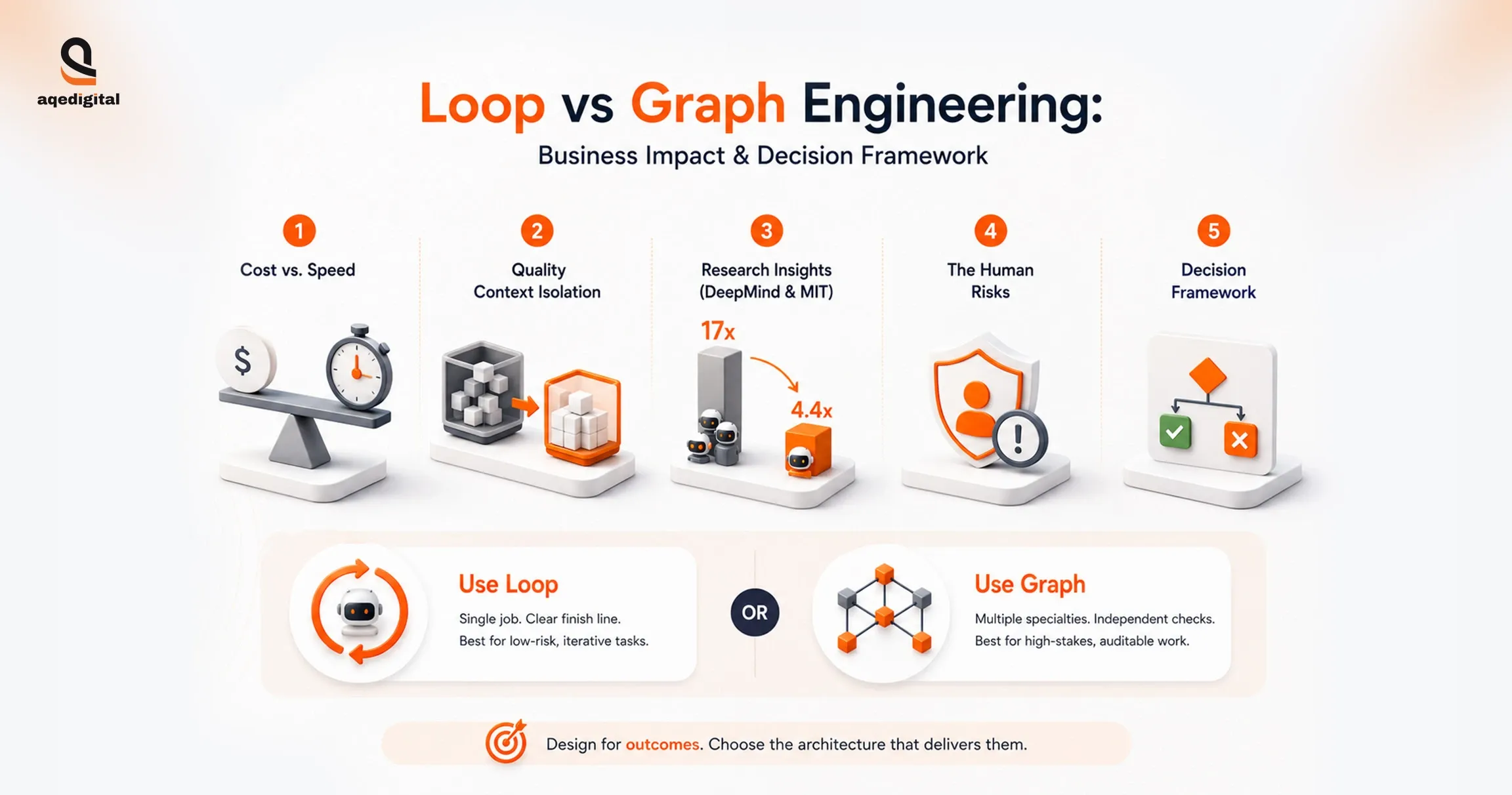
Loop vs Graph Engineering: The Business Impact & Decision Framework
Deploying agentic AI isn't just about prompt accuracy anymore. It's an infrastructure and organizational design problem. When deciding whether to keep an application as a single Loop (one agent, cyclic and iterative) or promote it to a Graph (a network of specialized agent nodes), leaders need to look past the hype and weigh real cost, speed, and quality tradeoffs.
1. Cost vs. Speed
Running a multi-agent system costs money in two places: the actual work, and the coordination between agents.
Graphs split work into parallel branches, so tasks that would run one after another in a Loop can run at the same time in a Graph. Running three review checks (security, style, logic) side by side finishes faster than running them in sequence. But that speed comes at a token cost: a Graph fires up multiple agents at once, so it burns more tokens than a Loop processing one thing at a time.
The tradeoff hinges on how often your agents succeed on the first try. When nodes usually pass, a Graph costs about the same as a Loop in tokens, just faster in wall-clock time. When nodes fail often, a Graph gets expensive fast: one failed reviewer can force the whole parallel batch to rerun, while a sequential Loop only pays for the step that actually failed.
Mitigation: route tasks to different model tiers based on risk. Cheap, fast models handle low-risk scanning and classification. Mid-tier models handle drafting and summarization. Reserve your most expensive, most capable model for final review and high-stakes decisions. This cuts token spend substantially without cutting quality where it matters
2. Quality: Context Swamping vs. Context Isolation
In a single overloaded Loop, one agent searches, drafts, and reviews inside the same context window. That window fills with raw data, half-finished drafts, and old reasoning. The agent then reviews its own work using the same messy context it wrote the work in, which invites rubber-stamping. It's grading its own homework with the answer key open.
Graphs fix this by isolating context per node. A Writer node gets only clean research notes. A Reviewer node starts fresh, seeing only the final draft and the quality bar, nothing else. That isolation produces a genuinely independent check, and it also cuts wasted tokens since no node carries context it doesn't need.
Giving your data explicit relationships, marking that one fact supersedes another, or that one step depends on another, helps agents reason correctly across multiple steps. Graphs consistently handle this kind of multi-step reasoning better than a single overloaded Loop.
3. Two Real Findings from DeepMind and MIT Research
Research evaluating multi-agent configurations surfaced two consistent patterns worth building around:
The uncoordinated swarm trap. Letting a flat group of agents talk to each other with no central coordinator causes them to validate each other's mistakes in a feedback loop, amplifying errors roughly 17x.
Adding a central orchestrator that limits cross-agent chatter and structures handoffs cuts that amplification down to roughly 4.4x, the same coordinator pattern AQe Digital builds into its agentic AI systems to keep multi-agent workflows from drifting.
The 45% threshold. Multi-agent coordination only pays off when a single agent's baseline success rate on the task is below 45%. If one model is already highly accurate on its own, adding more agents and coordination overhead makes things slower and worse, not better.
4. The Human Risks
Agents running unattended for hours or days create three quiet organizational debts:
- Comprehension debt — A gap between how much AI-generated code or documentation exists and how well your team actually understands it. Code can pass every test and still be unmaintainable by a human during an outage.
- Intent debt — The reasoning behind a design choice gets lost if it's never written down. Without documenting why a system works the way it does, agents will keep optimizing for the wrong thing. Keeping that reasoning auditable is a core reason enterprises lean on application integration services rather than bolting agents onto existing systems ad hoc.
- Cognitive surrender — The habit of accepting an automated system's output without question, which quietly erodes human oversight.
5. The Decision Framework
Work through these questions in order. Your first "no" tells you what to build.
Does a human review every output before it's acted on? If yes, a simple prompt is enough; you don't need a Loop or a Graph.
If no: can "done" be checked by something other than a human? If no, don't deploy a Loop; you have no reliable stop condition.
If yes: does the task fit inside one model's context window? If yes, deploy a Loop.
If no: do the independent parts of the task need to run at the same time? If yes, deploy a Graph. If no, just give your Loop more tools instead of adding agents.
- When to use a Loop: a single, repeatable job with a clear finish line and a way to check it automatically, like fixing code until the tests pass. Best for low-risk, open-ended work where one continuous reasoning trace is the simplest way to stay consistent, the pattern behind AI voice agent implementations, where one agent runs a full conversation loop end to end.
- When to promote to a Graph: the job splits into distinct specialties needing different models or tools, or needs an independent reviewer that never touches the working context. Best for high-stakes production work that needs auditable routing, isolated failures, or a human approval step before anything sensitive happens.

Loop vs Graph Engineering: Which Should You Choose?
- Teams evaluating loop versus graph architecture can work through four questions in order, stopping at the first no.
- Does a person review every output before it acts on anything? Then prompt engineering is sufficient, and a loop only buys unsupervised execution, not autonomy.
- Can “done” be checked by something other than a person, such as a test, a schema, a rubric, or a second model, since without a mechanical check an agent runs on a token budget instead of a stop condition.
- Does the task fit inside one agent's context and one domain, since a loop is the cheapest way to keep assumptions consistent across that task?
- Do independent branches of the task need to run at the same time, since only here does the added design and observability cost of a work graph pay off
Anthropic has documented its own early multi-agent research system spawning far more subagents than a simple query required. The fix was better prompting inside the existing loop, not a different graph topology, a useful caution before reaching for a graph too early.
Default to the loop. Escalate to the graph only when the fourth question forces it.
Ready to Design the Right AI Agent Architecture?
Prompt, loop, and graph stack on top of each other; they don't compete. A prompt governs one response. A loop governs one agent's repeated cycle. A graph governs how multiple agents split a task and recover when one part fails.
Right now there's a gap: intent to adopt agentic AI is high, governance maturity isn't there yet. Build the loop first. Add the graph only when your four-question test forces it.
That gap, between wanting agentic AI and knowing how to govern it, is exactly where most teams get stuck. AQe Digital works with enterprises on that exact problem: designing the right control layer for AI-based services before scaling agents into production, so the architecture holds up under real failure conditions, not just demo conditions.