How is Agentic AI Revolutionizing Healthcare? Use Cases, Benefits & Future Outlook

Vishal Panchal
Healthcare startups, institutions, and organizations worldwide have tons of data. And this is not an advantage but a challenge. The data set is expected to exceed 180 zettabytes, with the healthcare sector contributing almost one-third of it. Generating valuable insights can be challenging. This is where agentic AI in healthcare can help. It can collect, analyze, and process healthcare data to offer real-time insights.
Leveraging agentic reasoning, AI doctors, systems, clinicians, and hospital chain owners can not just read data, but reason, decide, and act autonomously within their workflows. However, many of the clinicians, healthcare startup CTOs, and hospital admins are still in the dark due to a lack of understanding of,
- What does agentic really mean in practice?
- How it outperforms traditional AI models
- What does it mean for healthcare operations?
- What are the real-world and advanced use cases?
This guide answers all the above questions for healthtech founders and enterprise leaders ready to transform mountains of unused data into actionable, intelligent care. It explores how healthcare AI solutions, including agentic AI, are redefining what’s possible for healthcare service providers. You’ll learn what agentic AI is, why it matters, the challenges it solves, and the key use cases it brings to the table. Let’s start with the basics first.
What is Agentic AI?
Agentic AI is an autonomous, proactive system that can plan, execute, and adapt to specific scenarios and achieve goals independently. It interacts with other systems automatically without human intervention to perform particular tasks. Unlike generative AI, it is not dependent on human prompts.
So, if you want to use agentic AI, an initial prompt is needed, and after that, each step of a specific task is performed by the AI model. It conducts a series of actions, makes contextual decisions, and learns from changing environments to adjust processes. This is why most agentic AI use cases revolve around the automation of multi-step processes.
How Does Agentic AI Work?
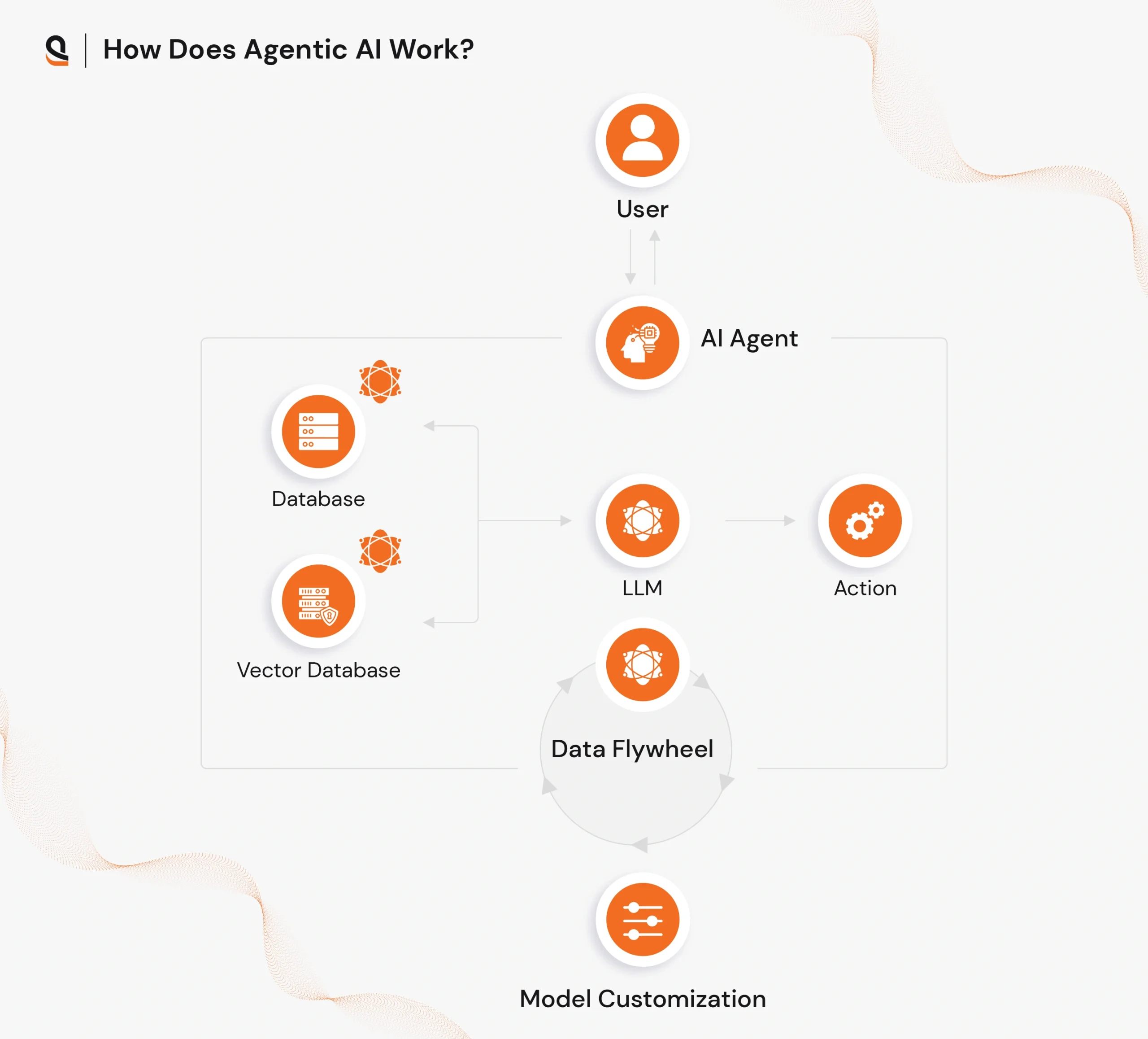
Agentic AI works like an automated agent that performs all the necessary steps to execute any task.
Here is how it works,
1. Perceiving the Task- AI agents collect and analyze data from various sources, including sensors, databases, and digital interfaces.
2. Reasoning- Large language models integration (LLMs) at the core of agentic AI assume the role of an orchestrator or a reasoning engine. In this role, they understand the task at hand, generate a roadmap, design solutions, and coordinate with other models to execute them.
3. Execution- Integrating with external tools and software through APIs, agentic AI executes all the steps necessary to complete the task. What makes it more interesting is that it can think like humans and adjust the process in changing environments, ensuring seamless execution.
4. Learning- Agentic AI continuously improves through the data flywheel. It is a process of training the agentic AI models through data generated with each interaction it has with other models and systems.
Now that you know the basics of agentic AI, it’s time to understand its use in the healthcare domain.
What Does Agentic AI Mean in Healthcare?
The healthcare industry has a data overload problem. Analyzing a massive amount of data that changes every 73 days can be challenging. If you are a clinician or a hospital chain owner, analyzing massive patient data, gaining insights, and preparing treatment plans accordingly will require considerable effort.
Agentic AI in healthcare is an advanced system that operates autonomously, making decisions, adapting to contexts, and executing actions to achieve medical goals. It builds on generative AI by converting prompts into actionable steps for further execution.
Such systems help healthcare CTOs automate key tasks and offer diagnostic support for doctors. So, if you are a healthcare CIO, CTO, or an enterprise healthcare leader, agentic AI can provide many benefits.
The top benefits of using agentic AI in healthcare for your operations are,
- You can offer tailored treatment plans and ensure better diagnostic efficacy through agentic AI for healthcare data analytics.
- You can automate tasks like symptom analysis, synthesizing medical history, and lab results for real-time diagnosis.
- Your diagnostic accuracy will increase, ensuring better patient care more quickly.
- You can integrate agentic AI-based virtual health assistants to offer consultations, monitor patient condition, and manage appointments
However, this is not all! There are many different agentic AI use cases in healthcare that you can leverage for your hospital or clinic. But understanding AI agent useful case studies and their impact on your operations is essential.

Why is Implementing Agentic AI Important for Healthcare?
Healthcare systems are often strained due to rising patient demands, staffing shortages, and complex data ecosystems. Agentic AI in healthcare can help reduce the strain through more intelligent automation. More than AI that simply analyzes data, agents can make decisions in real-time, ensuring timely diagnosis and care in emergency scenarios. Plus, it can help overcome the challenges of insurance claims, medical billing, and patient data management.
What Challenges Agentic AI in Healthcare Can Solve?
Healthcare systems face multifaceted challenges, from diagnostic delays to resource inefficiencies. Agentic AI offers targeted solutions by operating as an intelligent, self-governing entity. For instance, it tackles data silos by autonomously aggregating and analyzing disparate patient records. It enables faster identification of patterns in chronic disease management, such as predicting diabetes complications before they escalate.
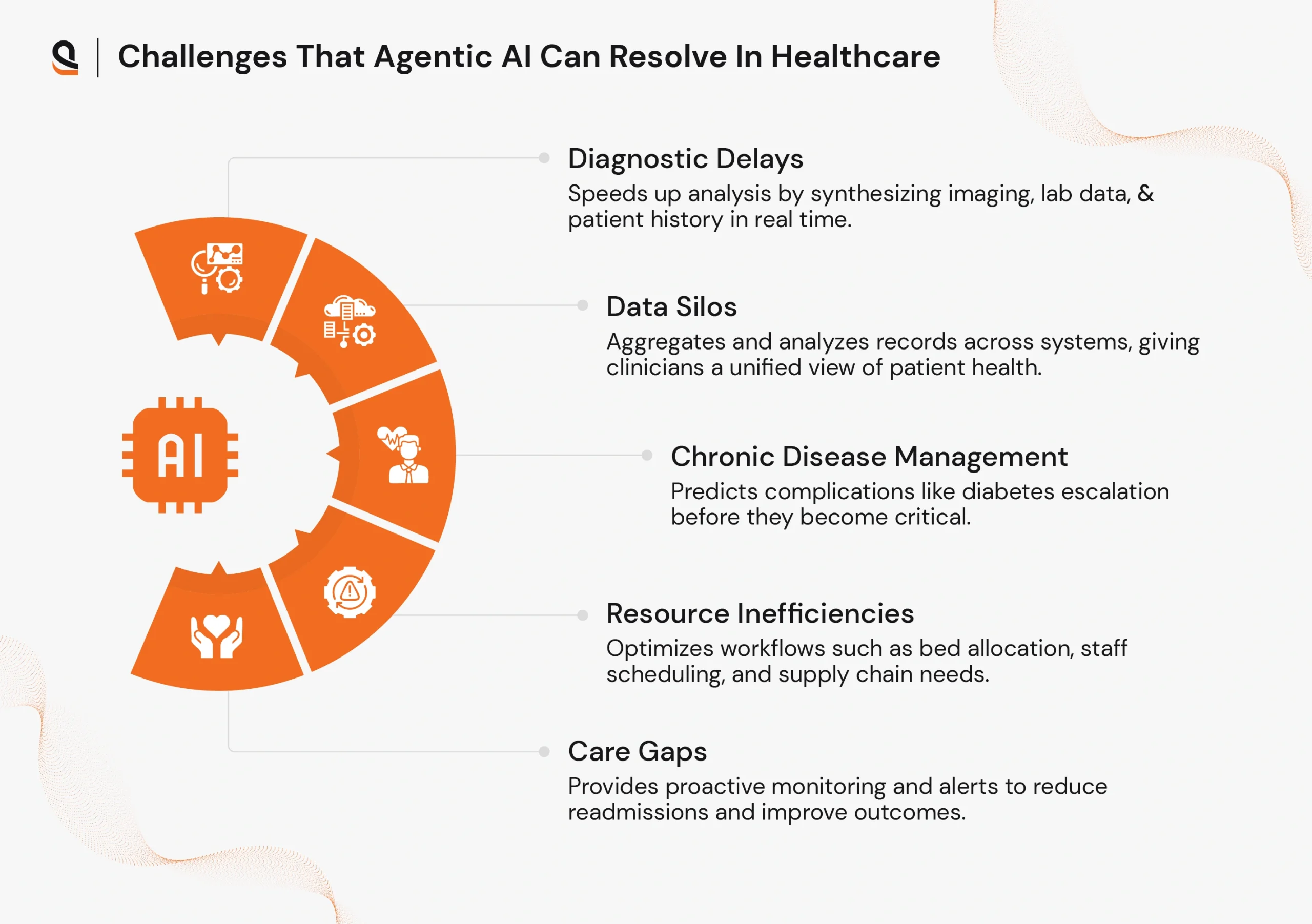
Some of the key challenges agentic AI in healthcare can mitigate are,
- Diagnostic Delays: Speeds up analysis by synthesizing imaging, lab data, and patient history in real time.
- Data Silos: Aggregates and analyzes records across systems, giving clinicians a unified view of patient health.
- Chronic Disease Management: Predicts complications like diabetes escalation before they become critical.
- Resource Inefficiencies: Optimizes workflows such as bed allocation, staff scheduling, and supply chain needs.
- Care Gaps: Provides proactive monitoring and alerts to reduce readmissions and improve outcomes.
How Does Agenctic AI in Healthcare Reduce Admin Burden and Streamline Workflows?
One of the most prominent agentic AI use cases is automation in healthcare for administrative tasks. Agentic AI can reduce the admin burden by streamlining the hospital workflows. This includes automatic repetitive tasks, handling documentation autonomously, transcribing consultations in real-time, and generating compliant reports.
Medical insurance claim management and accurate medical billing are also challenges that agentic AI can solve. Leveraging custom software development solutions with agentic AI integration, hospital chains can build custom medical billing systems. Such systems can help automate the application of medical codes to streamline insurance claims.
How Does Agentic AI Integrate With Current Healthcare Systems?
Modern hospitals and clinics already rely on electronic health records (EHR), imaging platforms, lab systems, and scheduling tools. By connecting through APIs and interoperable frameworks, agentic AI can embed itself directly into these workflows without disrupting daily operations.
For example, an AI agent can pull structured and unstructured data from EHRs, analyze lab results, and cross-reference them with medical guidelines in real time. It can then push insights back into the same interface that physicians already use, eliminating the need for multiple logins or data silos.
Similarly, integration with hospital management systems allows agents to automate appointment scheduling, insurance claim submissions, and even inventory management for medical supplies.
The advantage lies in scalability. Instead of requiring a complete overhaul of legacy systems, agentic AI operates as a smart orchestration layer, working alongside existing platforms to streamline workflows, reduce administrative friction, and ensure clinicians can focus more on patient care. This ability to “plug in” and evolve with healthcare infrastructure makes agentic AI a practical and future-ready solution.
How Are AI Agents Changing the Healthcare Industry?
The rise of agentic AI is reshaping healthcare from the inside out. By acting autonomously, AI agents support doctors, nurses, and administrators in ways that were once only possible through large human teams. From assisting with diagnoses to managing care workflows, these systems are creating a new model of proactive, intelligent healthcare delivery.
What Are AI “Doctors” and How Do They Work?
AI “doctors” are not replacements for medical professionals but intelligent agents that act as diagnostic and decision support systems. They analyze patient records, medical images, lab results, and even genetic data to provide recommendations or highlight areas of concern.
For example, an AI agent can review thousands of chest X-rays in seconds and flag subtle abnormalities for a radiologist to examine. Similarly, in primary care, AI can triage patient symptoms through natural language processing, offering initial guidance before the physician intervenes. These systems facilitate the scanning of vast amounts of data, surfacing valuable insights, and mitigating the risk of human oversight.
How Do AI Agents Assist Healthcare Providers?
AI agents are increasingly being deployed as assistive partners across the healthcare value chain. In diagnosis, they identify patterns in medical images, pathology slides, and lab data that can speed up decision-making. In triage, agents collect and analyze patient-reported symptoms to prioritize cases and ensure urgent conditions are addressed quickly.
Care planning is another area where AI proves valuable. By considering medical history, genetic predispositions, and current treatments, AI agents recommend tailored care plans that clinicians can review and refine. This level of personalization enhances patient outcomes while reducing the trial-and-error often associated with treatment.
Importantly, these systems are not designed to replace clinicians but to augment their expertise, giving them more time to focus on complex cases and direct patient interactions.
What Companies Are Already Deploying Agentic AI Agents?
Several global leaders are already experimenting with or deploying agentic AI in healthcare.
- Mayo Clinic has piloted AI-driven systems for radiology and diagnostic support, reducing time-to-diagnosis in complex cases.
- Google DeepMind developed AI models for retinal disease detection, demonstrating near-human accuracy in identifying diabetic retinopathy.
- Babylon Health created AI-powered triage agents that guide patients through symptom-checking and connect them with doctors when needed.
- Microsoft and NVIDIA are investing heavily in healthcare AI platforms, building ecosystems for hospitals to deploy intelligent diagnostic and care-planning agents.
- Startups like PathAI and Ada Health are also leveraging agentic AI to accelerate pathology analysis and patient triage at scale.
These healthcare case studies demonstrate the transformative value of AI for CTOs evaluating enterprise adoption and startups seeking to differentiate themselves. For more examples, read our blog on the Benefits of AI Agents in Healthcare. Such case studies clearly show that agentic AI is not a futuristic concept. It is already becoming an integral part of modern healthcare delivery.

What is Agentic Reasoning and Why Does It Matter in Healthcare?
With agentic reasoning, AI doctors have capabilities beyond recognizing patterns. It involves AI that can think, adapt, and plan on its own. This means agentic AI in healthcare systems doesn’t just point out a symptom. It suggests and assesses different diagnoses, considers evidence, and changes its approach as new information comes in.
This ability turns AI from a simple tool into a valuable partner in clinical settings, providing personalized and evidence-based decisions in complex real-life situations.
How Do Reasoning-Based AI Doctors Compare to Human Doctors?
A recent large-scale study, toward the autonomous AI doctor, evaluated the Doctronic multi-agent LLM system against board-certified clinicians in 500 real-world urgent-care telehealth encounters.
The results were notable:
- AI and human doctors agreed on the top diagnosis in 81% of cases
- Their treatment plans matched 99.2% of the time
- In anonymous expert reviews, the AI outperformed human clinicians in 36.1% of discordant cases, while humans were superior in 9.3%
Research shows that systems using agentic reasoning AI doctors are now matching and sometimes exceeding human performance in clinical settings.
What Studies or Benchmarks Highlight Its Performance?
Beyond Doctronic’s performance, emerging benchmarks are testing agentic AI on more complex clinical reasoning:
- MedAgentsBench is a new benchmark that focuses on challenging, multi-step medical reasoning tasks, showing that advanced AI models like DeepSeek R1 and OpenAI’s o3 outperform others in balancing reasoning and efficiency.
- In specialized neurological diagnostics, a multi-agent framework applying structured cognitive functions achieved 89.2% accuracy, well above the 69.5% of its base model. This highlights how modular agentic design improves performance on complex tasks.
What Are the Key Use Cases of Agentic AI in Healthcare?
Healthcare leaders today face immense pressure, with rising patient volumes, staffing shortages, and increasing compliance demands. For CIOs, CTOs, and hospital administrators, the question is no longer whether AI has a role in healthcare but how to apply it for measurable ROI.
This is where agentic AI in healthcare stands apart. Unlike traditional AI tools, agentic AI agents can autonomously plan, execute, and learn from multi-step processes, making them valuable across clinical, operational, and administrative workflows.
For healthtech founders and product managers, these agentic AI use cases are not only reshaping hospitals but also opening new product innovation opportunities.
How is Agentic AI Used in Clinical Trials, Diagnostics, and Patient Monitoring?
- Clinical Trials: AI agents streamline recruitment by scanning EHRs, flagging eligible patients, and managing consent digitally. They also monitor compliance and adverse events, reducing trial timelines by months.
- Diagnostics: By analyzing imaging scans, pathology results, and medical records simultaneously, AI agents support clinicians in achieving faster and more accurate diagnoses. For instance, AI-driven systems have matched radiologists in detecting lung nodules and diabetic retinopathy.
- Patient Monitoring: Integrated with wearables and IoT devices, AI agents track vitals in real time and alert care teams to risks like irregular heartbeats or glucose spikes. This proactive approach to remote patient monitoring helps reduce costly readmissions and ensures timely intervention.
If you’re exploring solutions, you can see how healthcare AI solutions are already being deployed across leading hospitals.
Advanced Use Cases of Agentic AI in Healthcare
Some of the advanced agentic AI use cases for the healthcare industry are,
1. Drug Discovery and Personalized Medicine
AI agents autonomously screen molecules, simulate drug interactions, and recommend candidates for trials. In oncology, this supports personalized treatment plans based on genetic profiles, accelerating precision medicine.
2. Robotic Surgery Assistance
Agents act as cognitive copilots in robotic-assisted surgeries. They analyze intraoperative imaging in real time, helping surgeons improve accuracy and reduce risks.
3. Digital Twins of Patients
By combining genomic data, lifestyle factors, and medical history, agentic AI builds patient-specific digital twins. These simulations predict treatment outcomes, enabling safer and more personalized therapies.
4. Population Health and Epidemiology
For administrators and public health leaders, AI agents analyze population-level data to detect outbreaks early and optimize vaccination or treatment strategies.
5. Genomic Data Analysis
Agents autonomously analyze large-scale genomic datasets to identify disease risks and recommend preventive interventions, bringing precision medicine closer to reality in revolutionary healthcare.
Which Healthcare Workflows Benefit Most from Autonomous AI?
- Administrative Operations: Automated billing, coding, and claims reduce manual workload. Hospitals adopting custom healthcare software development integrated with AI agents achieve measurable cost savings.
- Clinical Decision Support: AI assists in triage, diagnostics, and care planning, allowing doctors to focus on complex cases.
- Resource Management: Agents optimize bed allocation and predict supply chain needs for medicines and equipment.
- Telehealth and Virtual Care: Virtual assistants schedule appointments, monitor symptoms, and escalate critical cases to physicians.
- Research and Development: AI-driven digital twins and drug discovery platforms drastically reduce time-to-market for new therapies.
For CIOs and healthcare IT heads, these are the workflows where agentic AI use cases deliver immediate impact while laying the foundation for long-term digital transformation. By blending automation with reasoning, agentic AI in healthcare is not only solving today’s challenges but also reshaping the future of medicine.
For enterprises evaluating adoption, partnering with the right AI Software Development Services ensures scalable, secure, and future-ready deployment. To see the bigger picture, explore how Agentic AI Reshapes Business across industries.
How Will Agentic AI Revolutionize the Future of Healthcare?
The promise of agentic AI in healthcare goes far beyond today’s diagnostic and administrative use cases. Over the next decade, these autonomous systems will become a cornerstone of modern healthcare delivery.
How Will Agentic AI Enhance Long-Term Patient Outcomes?
By combining continuous monitoring, predictive analytics, and personalized medicine, AI agents in healthcare will shift the industry from reactive treatment to proactive prevention. Imagine digital twins that simulate treatment outcomes before a prescription is written, or AI-driven care plans that evolve in real time as patient data changes.
These advances will reduce chronic disease complications, shorten hospital stays, and improve survival rates.
What Role Will Regulation, Security, and Oversight Play?
As agentic AI use cases expand, governance becomes critical. Regulatory bodies will demand transparent decision-making, explainable AI outputs, and strict adherence to HIPAA security rules, GDPR, and emerging AI-specific laws.
Security will also be paramount, as autonomous systems processing sensitive health data must be hardened against cyber threats. Oversight frameworks will ensure AI acts as a trusted partner rather than a black-box decision engine.
How Can Enterprises and Startups Prepare for Agentic AI Adoption?
For CIOs, CTOs, and healthtech founders, preparation begins with scalable data infrastructure, interoperability, and robust governance models. Hospitals can start by integrating AI into existing EHR and monitoring systems, while startups can focus on niche agentic AI in healthcare applications such as triage or genomic analysis.
Partnering with experienced providers of AI software development services ensures adoption is secure, compliant, and future-ready.
How AQe Digital Can Help You Integrate Agentic AI in Healthcare
Healthcare leaders today need to utilize agentic AI to enhance patient outcomes, streamline administrative tasks, and foster innovation. Successful examples of agentic AI can improve patient care delivery, hospital administration, automate tasks, and ensure diagnostic accuracy.
These examples provide valuable insights from various AI studies and proven healthcare practices. Start small, build measurable impact, and scale with confidence. Contact us to understand how we can help you begin revolutionizing healthcare with agentic AI.
