Fleet Telematics: Features, Benefits, and Business Use Cases

Nirav Oza
The global fleet telematics market exceeded $27 billion in 2025 and is projected to grow at 16.9% annually through 2035. That is not momentum built on hype. It reflects a decisive operational shift: fleet operators who once made fuel, routing, and maintenance decisions based on gut instinct now have continuous, sensor-verified intelligence from every vehicle in their fleet. Fleet telematics has made the operational guess obsolete.
The cost of delay is measurable. Fleets without fleet telematics lose 10 to 25% more fuel to poor driver behavior, miss maintenance intervals that lead to unplanned breakdowns, and incur liability exposure that documented telemetry would eliminate.
83% of U.S. commercial fleet operators had deployed some form of fleet telematics by 2025. The gap between telematics-equipped fleets and those still running on radio calls is widening every quarter.
This guide covers what fleet telematics is, how a telematics fleet management system works, which features generate real ROI, and how businesses across logistics, construction, and field services are using fleet telematics to cut costs and build operational control.
What is Fleet Telematics?
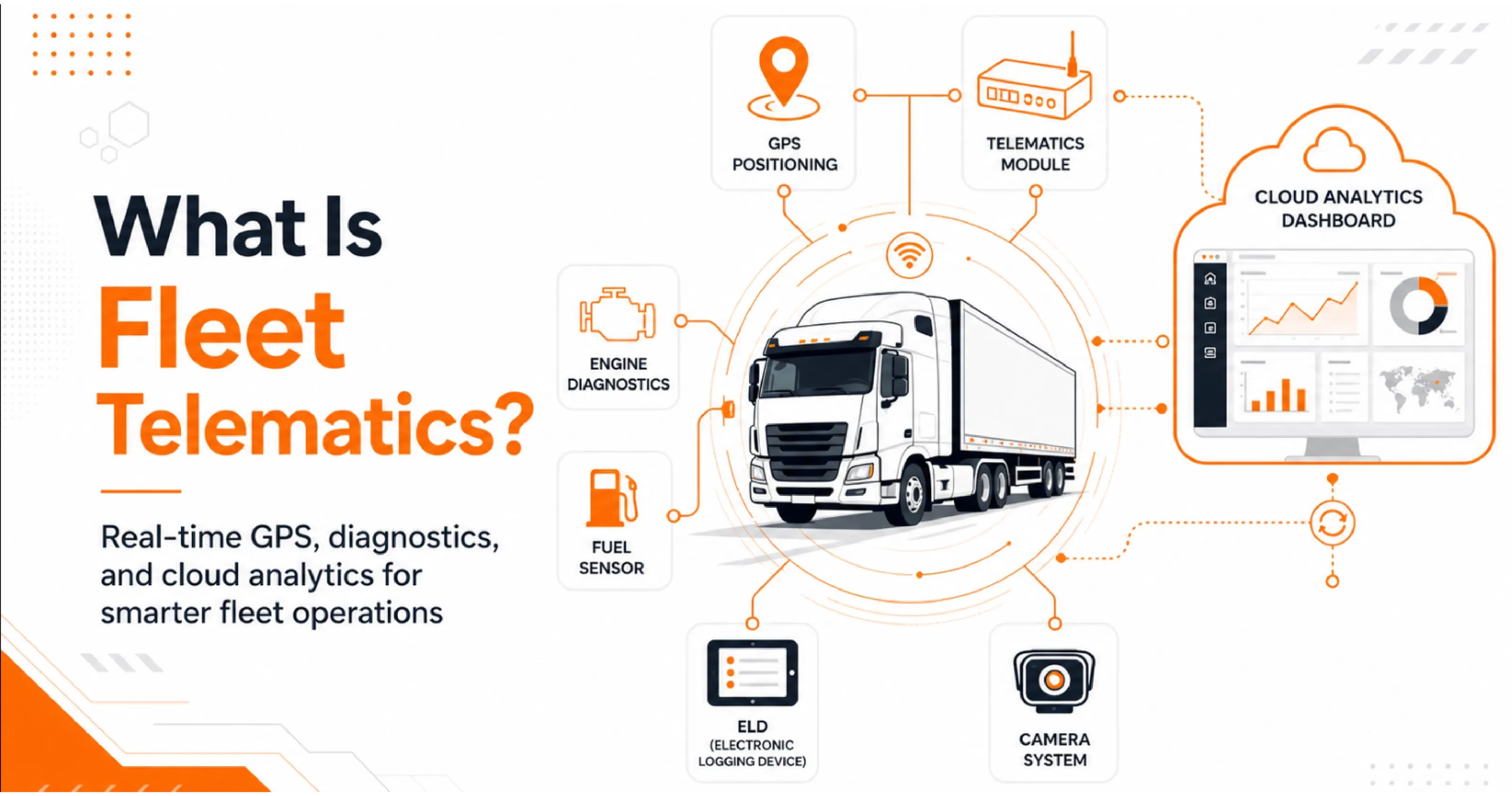
Fleet telematics is the integrated use of GPS positioning, onboard vehicle diagnostics, cellular communications, and cloud-based analytics to monitor, manage, and optimize commercial vehicle fleets in real time.
The term combines telecommunications and informatics, which is why the disciplines of telematics and informatics appear together in every technical framework for modern fleet management. Early systems logged position and little else.
Current fleet telematics platforms connect to engine control units, fuel sensors, trailer load monitors, driver-facing cameras, and electronic logging devices. A single commercial vehicle generates thousands of data points per journey. Fleet telematics platforms ingest all of it.
GPS Telematics: The Positioning Foundation
GPS telematics is the base layer every fleet telematics system requires. Satellite positioning provides real-time vehicle location, speed, heading, and route history. GPS telematics feeds dispatch tools, geofence alerts, and customer ETAs.
Without accurate GPS telematics data, route optimization, speed compliance enforcement, and idle time calculation all lose precision. Every downstream analytics function depends on a clean positioning layer.
The Telematics Module: Where Data Collection Begins
The telematics module is the hardware device installed in each vehicle, connecting to the OBD-II or CAN-BUS port. A telematics module houses a GPS receiver, accelerometers, a cellular modem, and, in newer configurations, an edge computing processor for onboard analytics.
It collects speed, engine diagnostics, fuel consumption, fault codes, and driver behavior events, encrypts them, and transmits them via 4G LTE to cloud infrastructure. 5G-capable telematics modules entered large-scale fleet deployments in 2026, cutting transmission latency to near real-time across high-density corridors.
How Telematics Works: The Complete Data Loop?
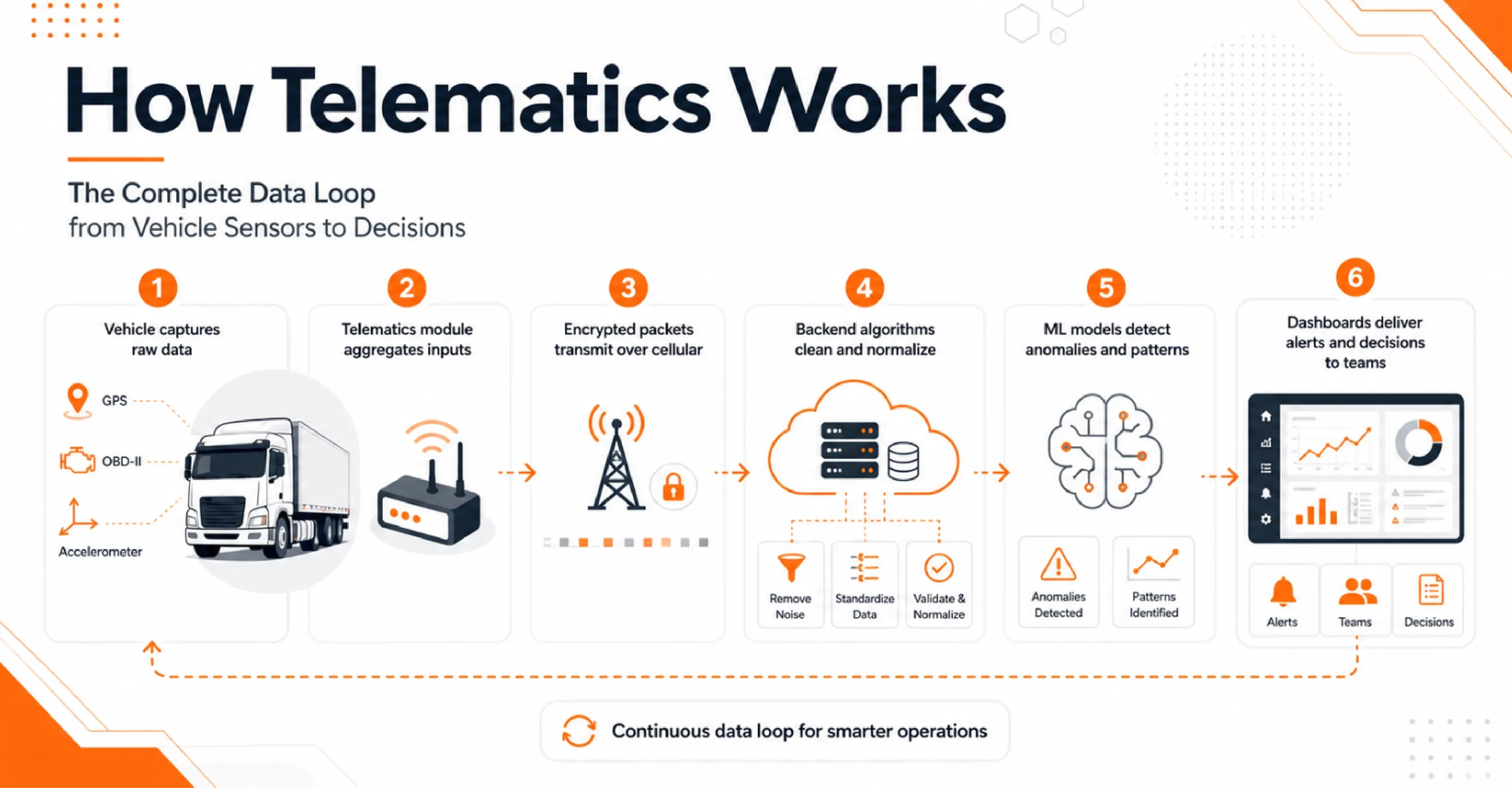
Understanding how telematics works starts at the vehicle. GPS satellites fix position. OBD-II ports feed engine temperature, RPM, and fault codes.
Step 1: Vehicle Captures Raw Data
GPS satellites fix position. OBD-II port pulls engine temp, RPM, and fault codes. Accelerometers log harsh braking and acceleration. Every sensor runs simultaneously. No driver input needed.
Step 2: Telematics Module Aggregates Inputs
The onboard module consolidates all sensor streams into a single data package. Timestamps each event. Prepares for transmission. This is the device mounted to the vehicle, a gateway between the physical asset and the cloud.
Step 3: Encrypted Packets Transmit Over Cellular
The module sends compressed, encrypted data packets to cloud servers via a cellular network. Happens in near real-time. No manual upload. No USB. Vehicle moves data moves with it.
Step 4: Backend Algorithms: Clean and Normalize Records
Raw sensor data arrives messy. Backend strips noise, fills gaps, standardizes units across fleet. Without this step, ML models get garbage input. Clean data = reliable insight.
Step 5: ML Models Identify Patterns
Reflecting the broader adoption of AI in the Automotive Industry, algorithms scan normalized records for anomalies: engine parameters drifting outside the normal range, drivers repeatedly speeding the same corridor, or vehicles burning 15% more fuel than the fleet average. The system flags deviations humans would miss across 500 vehicles.
Step 6: Dashboards Push Decisions to the Right People
Maintenance teams get alerts. Managers review utilization reports. Drivers see behavior scores. Coaching triggers automatically. No phone calls. No manual escalation. Insight reaches the decision-maker without middleman.
Core Features of a Telematics Fleet Management System
A production-grade telematics fleet management system is not a single feature. It is an integrated stack driving robust Fleet Management Solutions. These are the components that determine whether a fleet telematics deployment generates genuine ROI or sits underused.
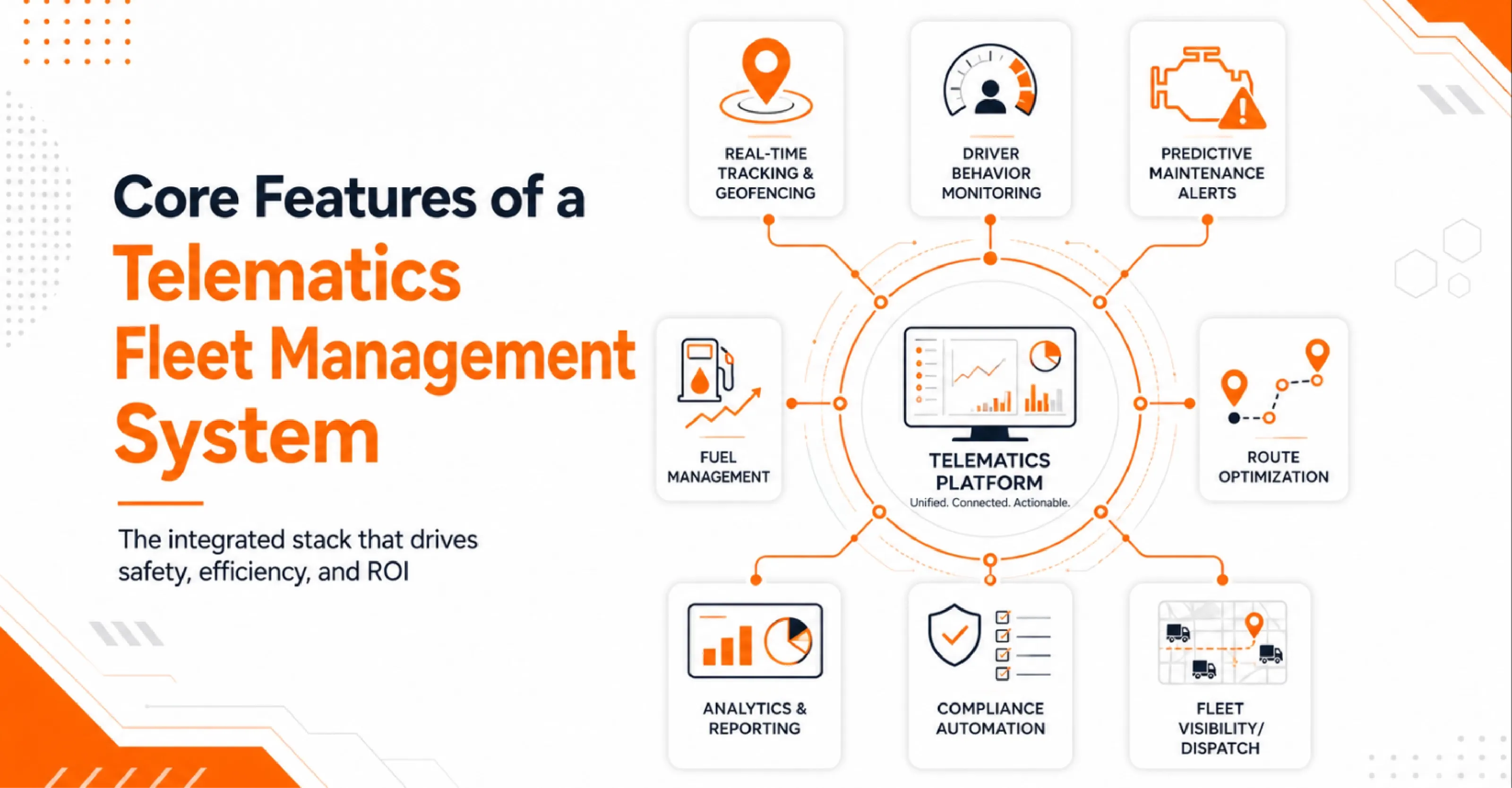
Real-Time Tracking and Geofencing
Live vehicle positions across the entire fleet are updated continuously through GPS telematics. Geofences trigger instant alerts when vehicles enter or exit defined zones: unauthorized movement, site arrivals, and regulatory boundary compliance. Dispatch teams gain full fleet visibility without manual check-ins.
Driver Behavior Monitoring
The telematics fleet management system scores each driver on speeding, harsh braking, harsh acceleration, seatbelt use, and mobile device activity. Fleets that implement behavior coaching from fleet telematics data see 27% reductions in speeding events and 20% drops in distracted driving incidents, based on 2025 industry data. Safety improvements translate directly into lower insurance premiums.
Predictive Maintenance Alerts
Fleet telematics reads OBD-II diagnostics continuously. When any engine parameter deviates from normal thresholds, the system generates a maintenance alert before a fault cascades into a breakdown. This shift from scheduled-interval to condition-based maintenance is where fleet telematics earns back its cost fastest. Construction fleets using this approach have achieved 48% downtime reductions within 12 months.
Route Optimization
Fleet telematics analytics combine traffic data, vehicle capacity, fuel consumption rates, and delivery windows to calculate optimal routes automatically. Automated dispatch reduces dead miles without dispatcher intervention, compressing delivery cost-per-stop without adding headcount.
Fuel Management
Idle time monitoring, driver behavior scoring, and route efficiency analysis together cut fuel consumption by 10 to 15% within three to six months of fleet telematics deployment, for a 50-vehicle fleet spending $ 500,000 annually on fuel, which translates to $ 50,000 to $ 75,000 in annual recoverable cost. In 2026, fleets using GPS telematics-driven coaching reported an average 12% decrease in fuel costs.
Fleet Telematics Analytics and Reporting
Fleet telematics analytics convert raw sensor streams into operational intelligence: cost-per-mile, fleet utilization rates, compliance hours, and maintenance spend by vehicle, all in a single reporting layer. Fleet telematics analytics are what separate a passive monitoring tool from a platform that informs real strategic decisions about fleet composition, route planning, and capital allocation.
Compliance Automation
For regulated fleets, the telematics fleet management system automatically handles Hours of Service logging, IFTA fuel tax reporting, and DVIR documentation. Compliance that once consumed hours of administrative work per week runs without manual input, reducing both operational cost and audit exposure.

Telematics and Fleet Management: The Integrated Advantage
Telematics and fleet management work best as a unified system, not parallel tools that occasionally sync. When fleet telematics data feeds directly into dispatch scheduling, maintenance work orders, payroll verification, and compliance reporting, the operational benefit compounds. Disconnected tools produce disconnected results.
A fully integrated telematics fleet management deployment means that when a vehicle logs an engine fault 30 miles into a delivery run, the platform simultaneously reroutes the driver to the nearest service point, notifies the maintenance coordinator, and pushes an updated ETA to the customer. No phone calls. No manual escalation. Telematics and fleet management operate as one system.
For organizations investing in broader enterprise digital transformation consulting, fleet telematics typically delivers among the fastest payback periods in the technology portfolio, often under 12months, because it automates decisions that previously required human intervention at every step.
Fleet Telematics: Key Use Cases for Your Business
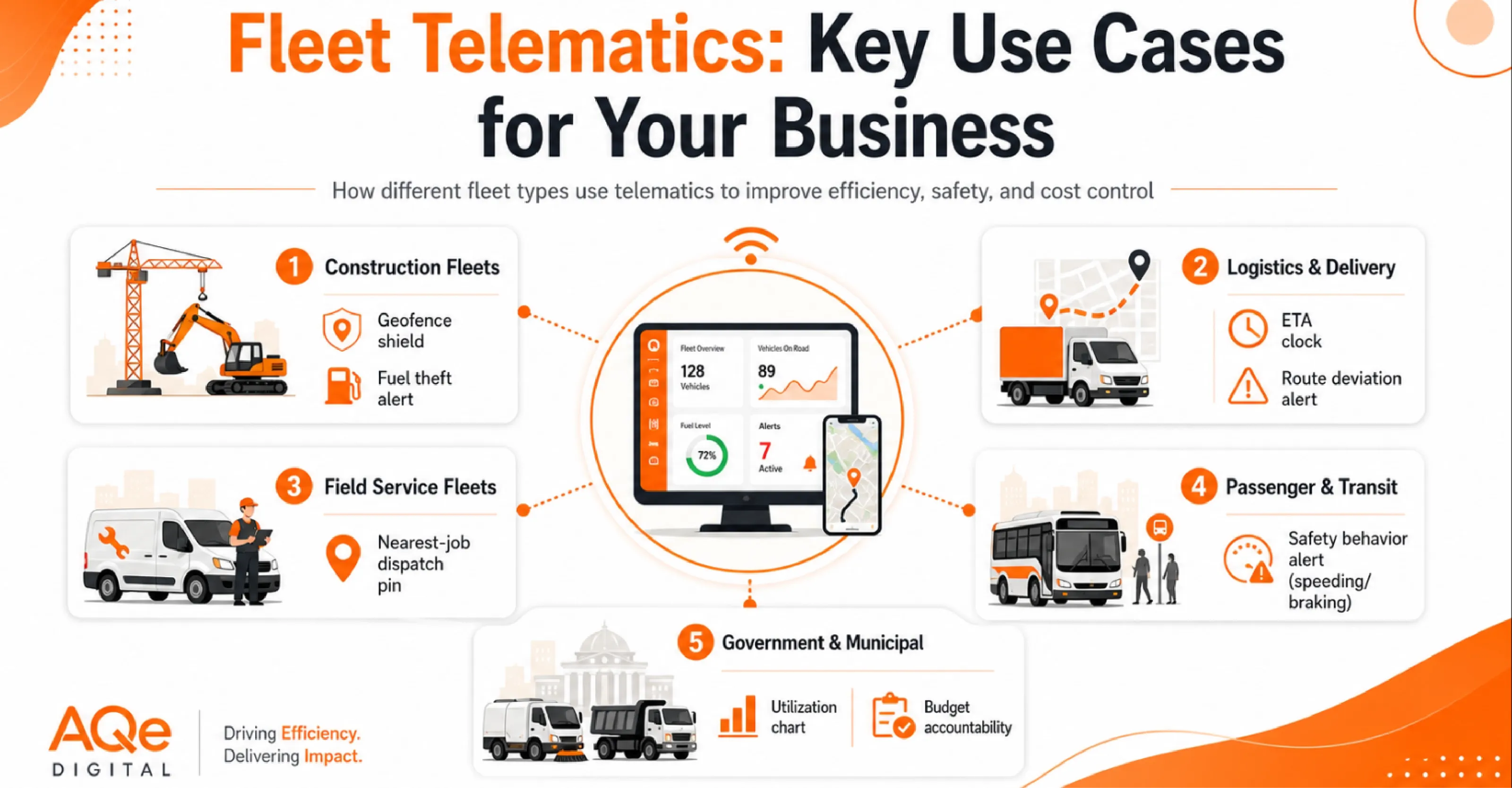
Here are some of the key fleet telematics use cases that you need to understand before investing in it.
Construction Fleets
Construction fleet telematics operates under different pressure than road freight. Heavy equipment carries replacement costs in the hundreds of thousands. Downtime on a single machine delays an entire project phase. Utilization mismatches, where equipment sits idle on one site while another runs short, directly compress project margins.
Telematics solves this through geofenced perimeter alerts that catch unauthorized equipment movement, fuel theft detection that flags discrepancies between logged consumption and pump fills, and utilization reporting that removes surplus assets before they drain operating budgets. For project-based operations running under deadline pressure, construction fleet telematics is an operational control system, not a monitoring add-on.
Logistics and Delivery Fleets
Delivery operations live and die on timing. A late truck is a customer complaint. A missed window is a failed SLA. Telematics gives dispatchers live vehicle location, estimated arrival times, and route deviation alerts without calling drivers.
When a delay happens, rerouting happens in real time. Proof of delivery disputes get resolved with timestamped location data. Idle time between stops becomes visible and manageable. For courier networks and last-mile operators, telematics turns guesswork into a trackable, improvable system.
Field Service Fleets
HVAC crews, plumbers, electricians, and repair technicians run on job count. More jobs completed per day means more revenue per vehicle. Telematics shows dispatchers which technician is closest to the next job, which vehicle is available, and which driver is running behind schedule.
Fuel waste from unnecessary detours gets caught early. Customer disputes about arrival times get settled with accurate trip records. Service managers stop relying on phone calls and start managing from a dashboard that updates automatically.
Passenger and Transit Fleets
School bus operators, shuttle services, and private transit companies carry people, not packages. Accountability standards are higher. Driver behavior directly affects passenger safety and operator reputation.
Telematics tracks speeding, harsh braking, and distracted driving patterns in real time. Safety managers receive alerts before incidents escalate. Route adherence reporting confirms drivers follow approved corridors. Operators meet compliance requirements without manual log audits.
Government and Municipal Fleets
Public sector fleets face budget scrutiny that private operators do not. Every vehicle needs to justify its operating cost. Telematics gives fleet managers the utilization data to identify underused assets, reduce surplus vehicle inventory, and document cost savings for budget reviews.
Maintenance scheduling becomes evidence-based instead of calendar-based. Fuel consumption gets tracked per vehicle and per department. When accountability is required, the data is already there.
Fleet Management vs Telematics: Key Differences
The fleet management vs telematics distinction matters when you evaluate what to deploy and what to integrate. Conflating the two leads to overspending on redundant tools or underbuilding the data layer your fleet management processes actually need.
| Fleet Management vs Fleet Telematics Key Differences Overview | ||
| Dimension | Fleet Management | Fleet Telematics |
| Scope | Manages end-to-end fleet operations including maintenance, fuel, compliance, and driver administration. | Monitors vehicle activity and performance using connected GPS and sensor technologies. |
| Primary Layer | Software platforms, operational workflows, and reporting systems. | Hardware devices, IoT sensors, GPS trackers, and telematics modules. |
| Data Origin | Manual records, invoices, fuel logs, service schedules, and operational entries. | Continuous real-time data collected directly from vehicles and onboard systems. |
| Maintenance Model | Uses preventive and scheduled maintenance based on fixed service intervals. | Enables predictive maintenance using fault alerts and vehicle diagnostics. |
| Primary Value | Improves coordination, compliance tracking, and operational management. | Delivers operational intelligence, route optimization, and cost reduction. |
Fleet management is the operational discipline. Fleet telematics is the data infrastructure that enables precise fleet management. Together, a telematics fleet management system delivers what neither achieves separately: real-time operational control backed by automated data from every vehicle.
AQe Digital's AI-Powered Fleet Management Solution integrates both layers into a unified platform, connecting vehicle sensor data to dispatch, maintenance, compliance, and analytics without a rip-and-replace of existing systems.
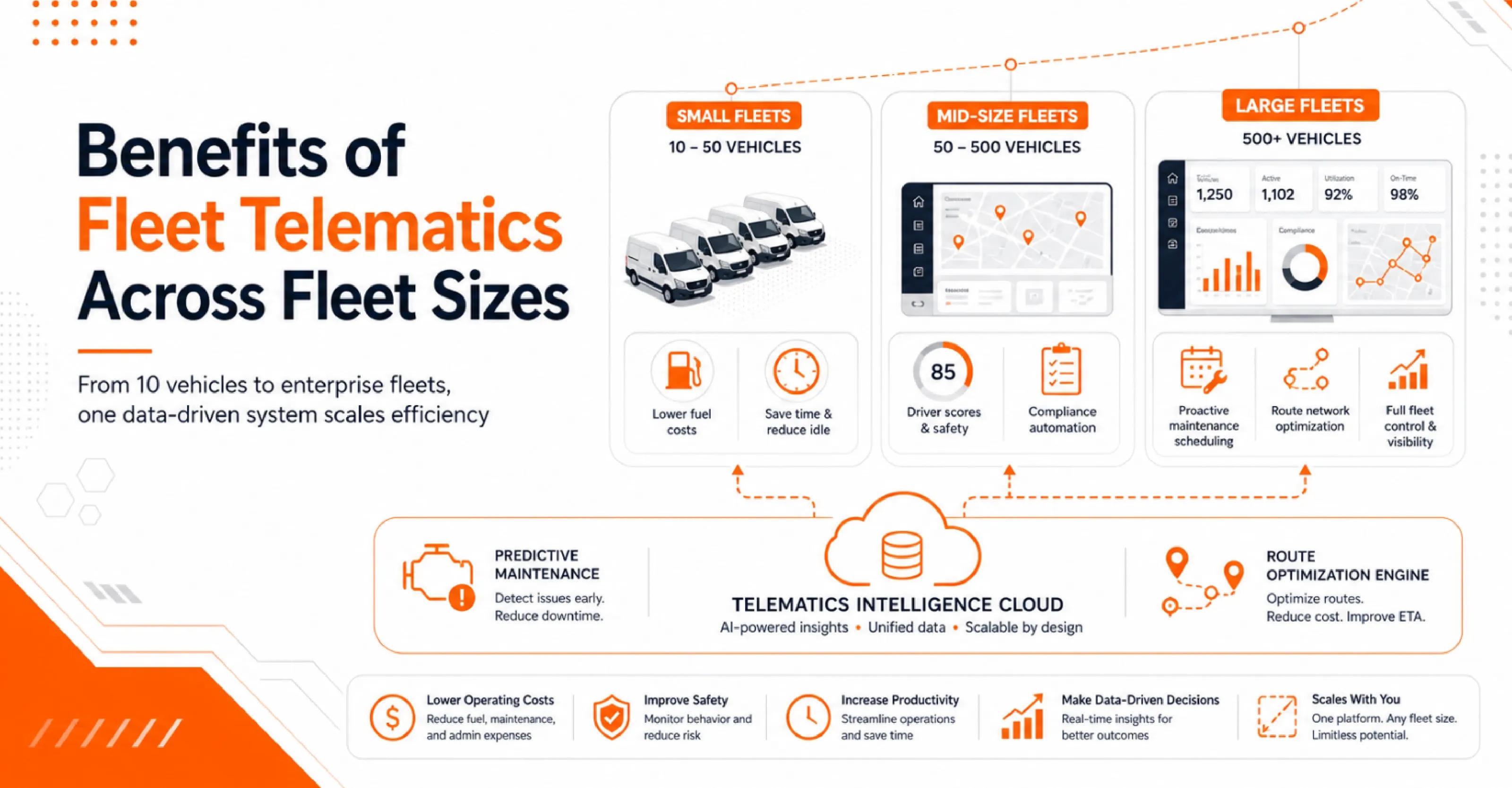
Benefits of Fleet Telematics Across Fleet Sizes
Fleet telematics scales across fleet sizes without requiring enterprise budgets to start.
Large Fleets
Telematics gives large operations a single view of every vehicle, every driver, and every route in one place. Fuel bills drop because the system flags wasteful driving before it compounds across hundreds of vehicles. Maintenance becomes scheduled instead of reactive, so breakdowns happen less and repair costs shrink. Managers spend less time chasing updates and more time acting on them. At this scale, telematics replaces entire layers of manual coordination.
Mid-Size Fleets
Growing fleets lose money in the gap between gut decisions and real data. Telematics closes that gap. Dispatchers know where every vehicle is without calling drivers. Idle time becomes visible and controllable. Driver behavior improves when scores are tracked, and coaching is automatic. Compliance paperwork that used to take hours gets pulled in minutes.
Small Fleets
A 10-van operation runs on thin margins. One wasted trip, one preventable breakdown, or one disputed delivery costs more than it looks. Telematics catches all three. Owners see which drivers burn extra fuel, which vehicles need attention before they fail, and which routes waste time. No special training needed. No IT team required. Log in, see the fleet, act on what matters.
It is crucial to understand that AI and data engineering services offer advanced fleet telematics platforms, with capabilities such as machine-learning-driven maintenance prediction and route optimization within reach for smaller fleets. Cloud delivery models now give a 15-vehicle service business access to the same predictive analytics a national logistics operator uses.
How AQe Digital Delivers Fleet Telematics Intelligence?
AQe Digital's approach to fleet telematics goes beyond packaging a third-party tracker. Working with operators across manufacturing operations and logistics networks, AQe Digital applies core Automotive Software Development principles to design fleet telematics integration architectures that connect existing vehicle hardware to unified analytics platforms without a forklift replacement of legacy systems.
The process begins with a fleet assessment: mapping current telematics module configurations, identifying data gaps, and establishing baseline cost-per-mile and utilization metrics.
AQe Digital then builds an integration layer that consolidates fleet telematics data feeds with maintenance management systems, ERP platforms, and compliance tools. Smart production planning tools tie real-time fleet telemetry to operational scheduling, ensuring vehicle capacity aligns with production and delivery demand.
Implementations run in phased 90-day sprints. Most clients see measurable ROI from fleet telematics investments within the first quarter. Models calibrate to actual vehicle data, not generic benchmarks.

Conclusion
Fleet telematics has moved from an optional upgrade to operational infrastructure. The technology is mature, the ROI is documented, and 83% market adoption confirms that fleets running without fleet telematics are operating at a structural disadvantage.
Whether you run 10 vehicles or 10,000, fleet telematics provides the data layer that turns operational guesswork into decisions grounded in continuous, real-time evidence: lower fuel bills, fewer unplanned breakdowns, safer drivers, and documented compliance.
The question is not whether fleet telematics is worth the investment. It is whether your competitors are already running it while you are still on radio calls and spreadsheets.