How Business Trends Are Changing With Artificial Intelligence (AI) In The Automotive Industry?

Priyanka Wadhwani
The automotive world has entered a new era, one where Artificial Intelligence(AI) in the automotive industry is no longer a futuristic concept but a living, breathing force reshaping how vehicles think, manufacture, react, and communicate. Cars are evolving into intelligent companions, built to understand drivers, adapt to road conditions, and create seamless digital journeys. And as this intelligence moves closer to the edge, the digital transformation in automotive is accelerating faster than ever before.
Today’s vehicles don’t just move us from place to place; they interpret, suggest, and react through advanced sensors, real-time data, and multimodal AI models that run directly inside the car. This shift brings safer experiences, more personalized interactions, and a level of convenience that feels almost human.
AI influences how vehicles are designed, tested, built, and delivered. Manufacturers are embracing AI to refine aerodynamics, detect invisible defects, predict equipment failures, and orchestrate supply chains with precision that traditional systems never could. As automakers accelerate digital transformation, many seek partners who can offer end-to-end support from modern platform engineering to data intelligence. Our automobile AI solution helps companies integrate AI-powered capabilities into their existing systems without disrupting operations, ensuring faster deployment and measurable ROI.
What we’re witnessing is a pivotal moment for future mobility. A moment where innovation, electrification, and intelligence intersect to create vehicles that anticipate rather than respond. And this blog will explore how AI is powering that transformation, practice by practice, technology by technology, shaping the next generation of automotive excellence.
What Is AI in the Automotive Industry?
AI in the automotive industry refers to the growing ecosystem of intelligent technologies such as machine learning, deep learning, computer vision, multimodal models, and edge-based processing that collectively reshape how vehicles are imagined, engineered, manufactured, and experienced. It’s the invisible brain behind modern mobility, transforming raw sensor data, factory inputs, and driver behavior into actionable insights that make every touchpoint smarter and more responsive.
Instead of relying solely on traditional mechanical systems, automakers now integrate AI to understand context in real time. It analyzes the road, recognizes patterns, adapts to driving styles, and interprets signals from hundreds of in-vehicle sensors with precision that humans simply cannot match at scale. This intelligence stretches far beyond the road; it optimizes design workflows, enhances crash-safety modelling, streamlines production lines, and predicts equipment failures before they disrupt operations.
Trends and Implementation of AI in the Automotive Industry
AI is reshaping modern mobility from the factory floor to the open road, fueling rapid digital transformation in automotive and setting new benchmarks for safety, efficiency, personalization, and sustainability. Every trend in AI in the automotive industry signals a clear direction that includes more automation, more intelligence, and more environmentally conscious innovation powered by AI’s role in green automotive technology.
Below are the most influential trends and real-world implementations defining the future of mobility.
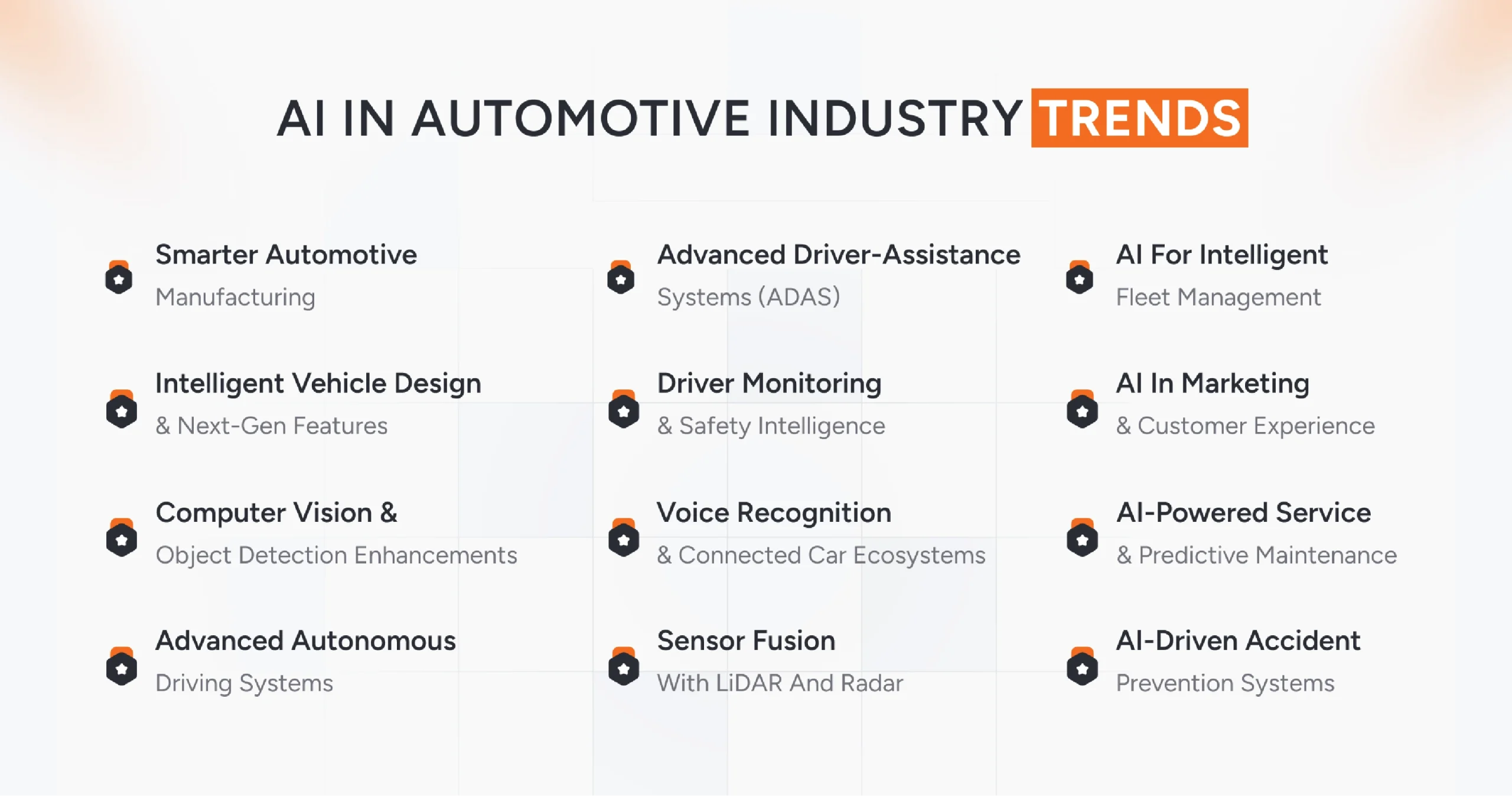
Smarter Automotive Manufacturing
AI in the automotive industry is enabling factories to run with unparalleled speed, precision, and consistency. Automated systems learn from production data and optimize workflows without human intervention, resulting in fewer errors and higher throughput. As digital transformation in automotive accelerates, AI-driven robots collaborate with humans to streamline complex tasks and improve safety.
How AI Makes This Possible?
Deep learning models analyze high-resolution images, sensor data, and robotic workflows in real time, allowing automated systems to self-correct, predict equipment failure, and optimize production lines without manual intervention.
Benefits
- Reduced production downtime
- Higher accuracy in defect detection
- Faster assembly cycles
- Lower operational costs
- Improved product consistency
AI-Powered Service & Predictive Maintenance
Predictive maintenance is one of the most impactful advancements brought by AI in the automotive industry. Instead of waiting for components to fail, AI systems monitor vehicles continuously and identify early signs of wear and tear. This helps manufacturers prevent costly breakdowns, improve customer satisfaction, and extend the overall lifespan of vehicles.
How AI Makes This Possible?
Vehicle sensors stream continuous performance data to machine learning models that detect anomalies, forecast component failure, and guide technicians with precise fault insights.
Benefits
- Fewer unexpected repairs
- Faster service turnaround
- Longer vehicle lifespan
- Better customer satisfaction
- Data-backed maintenance planning
Intelligent Vehicle Design & Next-Gen Features
AI-powered design tools allow automakers to explore thousands of possibilities in minutes, speeding up innovation and helping create safer, smarter vehicles. Engineers use generative models to optimize aerodynamics, strengthen vehicle structures, and reduce unnecessary weight, improving both performance and sustainability. This push for intelligent design also supports AI’s role in green automotive technology, making next-gen cars more energy-efficient and environmentally friendly.
How AI Makes This Possible?
Generative models create thousands of design variations, reinforcement learning improves autonomous behavior, and multimodal AI interprets voice, gestures, and context for seamless interaction.
Benefits
- Safer vehicle structures
- Faster design cycles
- Better energy efficiency
- Highly personalized features
- More intuitive user interfaces
Advanced Autonomous Driving Systems
Autonomous vehicles rely heavily on AI to make split-second decisions that keep drivers and pedestrians safe. From navigating complex intersections to predicting the behavior of surrounding vehicles, AI improves situational awareness dramatically. This evolution marks a major milestone in the digital transformation in automotive, enabling cars to drive with minimal human input.
How AI Makes This Possible?
Neural networks process camera feeds, lidar maps, and radar signals simultaneously, predicting road conditions, recognizing objects, and responding to hazards in milliseconds.
Benefits
- Increased road safety
- Better navigation accuracy
- Reduced driver fatigue
- Lower crash potential
- Improved traffic flow
Computer Vision & Object Detection Enhancements
Vision-based AI systems interpret lane markings, road signs, and moving objects even in challenging conditions like fog, rain, and nighttime driving. The improved perception significantly reduces accidents, supports higher levels of autonomy, and makes ADAS features more dependable. As the AI in the automotive industry continues to evolve, computer vision is becoming the backbone of safer mobility.
How AI Makes This Possible?
Vision models analyze pixel-level information using convolutional neural networks (CNNs) and transformer-based architectures to accurately understand surroundings.
Benefits
- Reliable detection accuracy
- Safer self-driving decisions
- Better obstacle prediction
- Enhanced ADAS performance
- More confidence in automation
Sensor Fusion with Lidar and Radar
Sensor fusion is transforming how vehicles perceive their environment by combining data from lidar, radar, cameras, and ultrasonic sensors. This unified 360° perspective allows vehicles to react more intelligently and predictively to road conditions. This advancement strengthens the digital transformation in automotive, enabling more stable navigation and safer decision-making.
How AI Makes This Possible?
Fusion algorithms merge data streams from lidar, radar, ultrasonic sensors, and cameras, producing a unified environmental model for autonomous control systems.
Benefits
- High precision mapping
- Better visibility in low light
- Robust performance in rain/fog
- More stable autonomous driving
- Improved lane and object tracking
Advanced Driver-Assistance Systems (ADAS)
ADAS features rely on AI to enhance driving safety by detecting dangers far earlier than a human can. These systems analyze traffic patterns, driver behavior, and environmental conditions to prevent crashes and reduce fatigue. With more automakers integrating AI-powered ADAS, the automotive industry is moving toward a future where accidents become increasingly rare. This is one of the most noticeable outcomes of AI in the automotive industry innovation.
How AI Makes This Possible?
Real-time sensor processing and perception models analyze driver behavior, nearby vehicles, and road conditions to trigger automated safety responses.
Benefits
- Rapid hazard detection
- Reduced human error
- Enhanced highway driving
- Lower accident rates
- Improved driver confidence
AI-Driven Accident Prevention Systems
Accident prevention powered by AI enhances driver safety by reacting instantly to imminent threats. These systems evaluate distance, speed, and trajectory to make protective manoeuvres when human reaction time is too slow. In the broader scope of digital transformation in automotive, it supports more sustainable mobility by reducing accident-related congestion and emissions.
How AI Makes This Possible?
Deep neural networks evaluate distance, speed, and trajectory, activating automatic braking or evasive steering when necessary.
Benefits
- Fewer collisions
- Better pedestrian safety
- Real-time threat response
- Protection during distraction
- Higher vehicle safety ratings
Driver Monitoring & Safety Intelligence
Driver monitoring powered by AI enhances road safety by identifying fatigue, distraction, and impaired behavior in real time. Cameras track facial expressions, eye movement, and posture to detect risky behavior before it leads to an accident. This is essential for fleets, commercial vehicles, and long-distance drivers who face high fatigue risks. As AI in the automotive industry advances, driver monitoring is becoming a standard safety requirement globally.
How AI Makes This Possible?
Interior cameras use facial recognition and pose estimation algorithms to detect abnormal behavior, triggering alerts or automated interventions.
Benefits
- Reduced drowsy driving accidents
- Early distraction detection
- Enhanced fleet safety
- Real-time driver coaching
- Emergency response automation

Smart Navigation & Predictive Route Optimization
AI revolutionizes navigation by forecasting traffic, analyzing road conditions, and suggesting the fastest, most efficient routes. These systems consider weather, closures, and patterns of congestion to minimize travel time and reduce fuel usage. This plays a major role in AI’s role in green automotive technology, helping cut unnecessary emissions.
How AI Makes This Possible?
Machine learning models analyze historical trip patterns, live data streams, and environmental signals to predict delays and suggest alternatives.
Benefits
- Shorter travel times
- Fewer traffic bottlenecks
- More accurate ETAs
- Better fuel efficiency
- Improved driver convenience
Voice Recognition & Connected Car Ecosystems
Voice-controlled systems are becoming central to connected cars, enhancing convenience and safety by minimizing distractions. Drivers can control music, navigation, climate, and communication without touching any buttons. Our experience in building connected mobility products, including solutions like enhanced vehicle visibility and style with a bluetooth-based mobile app, showcases how digital innovation can elevate user experience, personalize vehicle interactions, and strengthen brand loyalty.
How AI Makes This Possible?
NLP and speech recognition models decode accents, noise levels, and contextual user intent to understand commands accurately.
Benefits
- Safe hands-free operation
- Personalized in-car controls
- Improved driver comfort
- Seamless device syncing
- Faster access to information
Personalized In-Car Entertainment
By analyzing behavioral patterns, the system recommends the perfect mix of music, podcasts, and media. This elevates in-car experiences and makes journeys more enjoyable, especially on long drives. Personalization is becoming a hallmark of AI in automotive industry innovation, strengthening user satisfaction.
How AI Makes This Possible?
Recommendation engines analyze past behavior, trip patterns, and acoustic profiles to deliver hyper-personalized media experiences.
Benefits
- More engaging journeys
- Mood-based entertainment
- Intelligent volume adaptation
- Better passenger satisfaction
- Context-aware recommendations
AI for Intelligent Fleet Management
AI brings operational efficiency to fleet management. Real-time telematics data allows companies to reduce operational costs and improve safety across large vehicle fleets. These insights also support sustainability goals by monitoring emissions and encouraging more efficient routes.
How AI Makes This Possible?
Predictive analytics and telematics data feed into models that evaluate driver behavior, optimize routes, and schedule maintenance proactively.
Benefits
- Lower fleet costs
- Reduced downtime
- Efficient fuel usage
- Streamlined logistics
- Better asset utilization
AI in Electric Vehicle Optimization
AI improves EV performance by boosting battery life, optimizing power distribution, and managing charging cycles intelligently. These enhancements directly support AI’s role in green automotive technology, reducing energy waste and extending vehicle range. AI also helps predict battery degradation, ensuring safer and more reliable EV operation over time. As EV adoption grows, AI becomes essential for pushing sustainable mobility forward.
How AI Makes This Possible?
Energy models forecast power usage, optimize thermal management, and analyze battery health to extend range and longevity.
Benefits
- Longer EV range
- Smarter charging cycles
- Reduced energy waste
- Better performance control
- Lower environmental impact
AI in Marketing & Customer Experience
AI helps automakers attract, convert, and retain customers through hyper-personalized communication and automated support. Predictive models identify buyer intent, recommend relevant vehicles, and engage customers at the perfect moment.
How AI Makes This Possible?
NLP-driven agents, predictive models, and behavioral analytics personalize communication, automate follow-ups, and streamline customer service.
Benefits
- Higher conversion rates
- Personalized messaging
- Faster customer support
- Improved brand loyalty
- Better marketing ROI
AI for Quality Control & Automotive Design
AI elevates design and quality control by detecting microscopic defects and producing innovative design concepts at a rapid speed. Vision systems ensure every component meets strict standards, while generative AI accelerates early-stage design ideation. It’s one of the most transformative outcomes of AI in the automotive industry, enabling data-driven creativity and flawless production.
How AI Makes This Possible?
Generative models simulate ideal structures, while vision systems scan parts with micrometre precision to detect defects instantly.
Benefits
- Faster design cycles
- Perfect part precision
- Fewer recalls
- Cost-effective production
- Higher build quality

Generative AI in Automotive: Unlocking the Next Wave of Innovation
Generative AI is quickly emerging as one of the most transformative forces shaping the future of mobility, amplifying the benefits of AI in the automotive industry and opening doors to capabilities automakers could only imagine a few years ago.
One of the clearest examples is the shift from bulky, confusing vehicle manuals to conversational, voice-enabled assistants. Instead of flipping through hundreds of pages or waiting for customer support, drivers can simply ask a question and receive instant, AI-generated responses. The system can read diagnostic signals in real time, decode error messages, and generate step-by-step guidance tailored to the exact vehicle model and situation. It’s faster, clearer, and significantly more user-friendly.
But the impact of generative AI goes far deeper than convenience. It is becoming a core enabler of predictive maintenance, an area that redefines reliability and customer trust. GenAI can identify behavioral patterns in vehicle data, forecast potential part failures, and recommend the best course of action before an issue disrupts the journey. This shift toward proactive servicing helps reduce breakdowns, extends vehicle life cycles, and elevates overall customer satisfaction.
Generative AI also supports advanced design workflows, content creation for infotainment, immersive customization options, and automated engineering insights. It gives OEMs the tools to optimize everything from material selection to battery efficiency while improving collaboration between teams.
As the automotive ecosystem evolves, GenAI stands at the forefront that helping accelerate decision-making, empowering personalized mobility, and strengthening the long-term benefits of AI in the automotive industry across every stage of the vehicle lifecycle.
How AQe Digital Supports AI Adoption in the Automotive Industry?
Automotive companies often struggle with integrating AI into their existing digital ecosystems, scaling data capabilities, or modernizing legacy applications. AQe Digital helps bridge this gap by providing the technology backbone, intelligent solutions, and strategic support automakers need to implement AI-driven innovations faster, smarter, and with measurable business impact.
- Insight Mapping: We help automotive businesses identify high-impact AI opportunities across manufacturing, customer experience, mobility, and operations, ensuring every initiative delivers clear value.
- Platform Engineering: AQe Digital builds robust digital platforms that support AI-powered features such as predictive analytics, automated workflows, and intelligent vehicle services.
- Data Intelligence: Our team structures, cleans, and analyzes data from vehicles, sensors, and enterprise systems to unlock meaningful insights that accelerate decision-making.
- AI Integration: Instead of developing new AI models, we specialize in integrating existing AI tools like computer vision modules, predictive engines, and conversational systems into your software seamlessly.
- Mobile Enablement: We create next-gen mobile applications for drivers, technicians, and fleet operators that deliver real-time insights, diagnostics, and improved user experiences.
- Cloud Acceleration: AQe Digital helps automotive brands modernize their cloud infrastructure, ensuring faster processing, scalable AI workloads, and secure data management.
- System Modernization: We upgrade legacy platforms with modern architectures, optimized workflows, and improved interfaces, making them fully compatible with today’s AI-driven automotive solutions.
Conclusion
AI isn’t just an upgrade for the automotive industry; it’s the new competitive baseline. Brands that embrace it gain safer vehicles, smarter operations, and unmatched customer experiences. Those that don’t will fall behind fast, losing efficiency, market relevance, and innovation momentum. The road ahead belongs to companies that act now, not later. So if you’re looking to integrate AI into your automotive ecosystem or simply need expert guidance on where to begin, contact us. With our deep expertise and proven experience, we’ll help you navigate the shift with clarity, confidence, and real results.