How to Choose the Right Data Warehouse Software for Your Business?

Nirav Oza
The true value of your data depends on how effectively your organization can store, organize, and use it. As per the report, Global data creation is projected to reach nearly 394 zettabytes by 2028, and organizations need to take significant measures to capitalize on their data.
So, choosing the right enterprise data warehouse software is crucial for businesses of any scale and vertical.
The right data warehouse solution centralizes your data and creates a reliable foundation for faster reporting, smarter analytics, and data-driven decision-making across every department.
However, not every platform is built the same. Your business needs a solution that aligns with your data warehouse requirements, supports future growth, and integrates seamlessly with your existing ecosystem.
If you're planning long-term growth, understanding an enterprise data warehouse is necessary.
What Is Enterprise Data Warehouse Software and Why Does It Matter?
Enterprise data warehouse software is the technology that helps businesses collect, integrate, store, and analyze data from multiple systems in one centralized environment. Instead of managing disconnected spreadsheets, applications, and databases, companies can create a single source of truth for reporting and business intelligence.
Businesses often combine enterprise data warehouse software with data analytics consulting services to turn centralized data into actionable insights.
Modern data warehouse tools automate complex tasks such as data extraction, transformation, loading (ETL), scheduling, performance monitoring, and pipeline management. Data warehouse automation software becomes especially valuable, as it reduces manual work, minimizes errors, and accelerates data delivery.
The real goal is not just storing data. It is turning data into actionable insights. The global Enterprise Data Warehouse (EDW) market is projected to grow from approximately USD 12.3 billion in 2025 to USD 73.7 billion by 2032, reflecting rapid enterprise adoption.
A well-designed data warehouse solution gives leadership teams faster access to accurate information, supports advanced analytics, and helps organizations make smarter decisions at scale. In short, the software is what transforms a data warehouse from infrastructure into a strategic business asset.
When Should You Invest in a Data Warehouse Solution?
If your business relies on data to drive decisions, there comes a point when traditional reporting tools are no longer enough. You need a data warehouse solution that brings everything together for faster and more accurate analysis.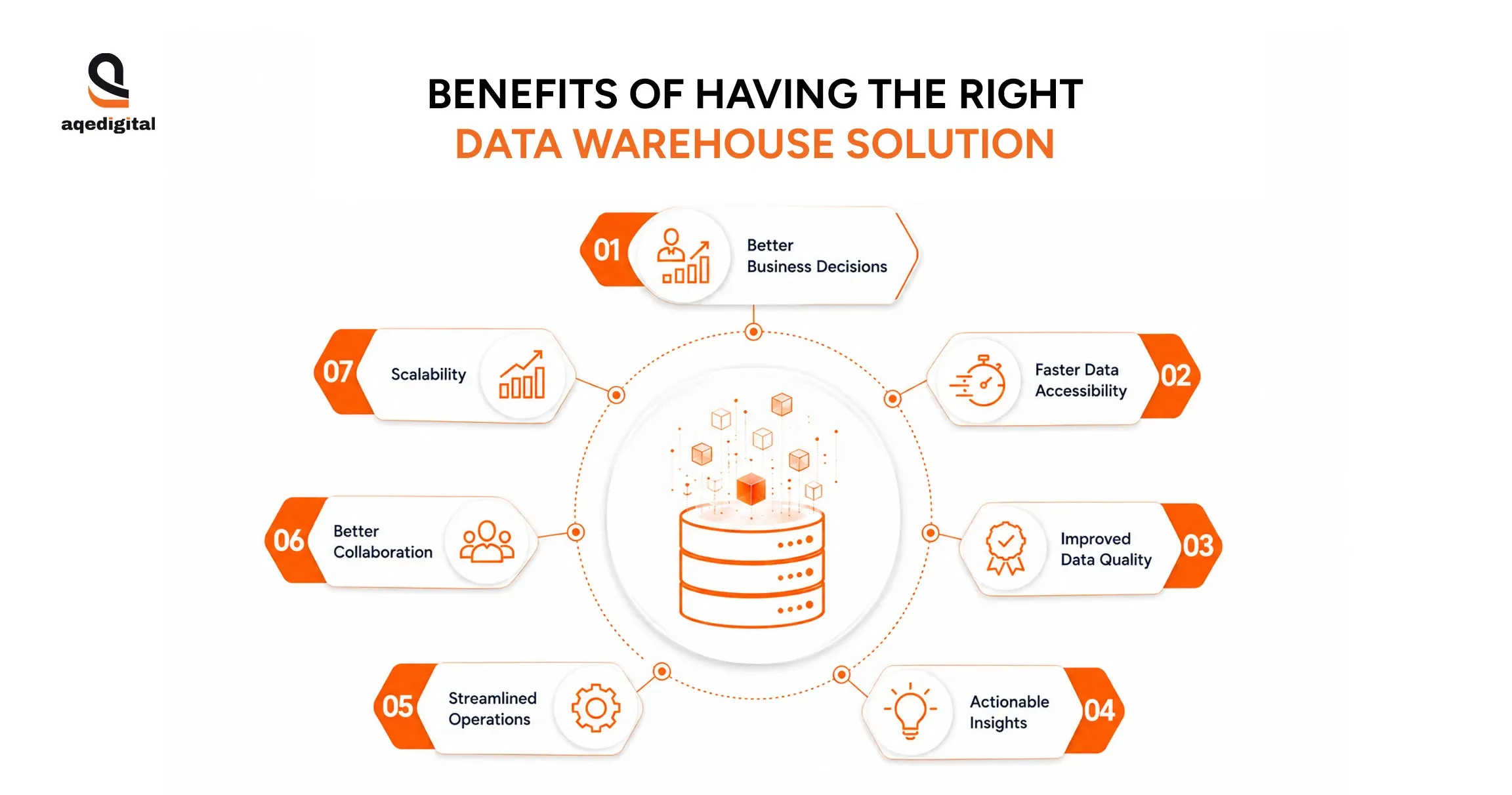
The global data warehousing market is expected to grow from USD 37.4 billion in 2025 to USD 81.15 billion by 2034.
Here are the signs it's time to invest:
- Your data is spread across multiple systems. Consolidate everything into one trusted repository.
- You need deeper business insights. Go beyond standard dashboards and analyze raw data with SQL.
- Teams rely on different reports. Create a single source of truth for everyone.
- Executives need faster answers. Generate reliable reports without manually combining data.
- Analytics has become time-consuming. Simplify complex processes with scalable data warehousing services.
- Your business is expanding. Choose enterprise data warehouse software that can scale with growing data volumes.
- Real-time reporting is becoming essential. Access timely insights for faster decision-making.
- Cross-functional collaboration is increasing. Allow multiple teams to work from the same accurate and up-to-date data.
A well-designed data warehouse model brings together information from multiple departments and sources into one analytics-ready environment. Growing datasets often require specialized big data analytics services to uncover deeper business insights.
Must-Have Data Warehouse Tools Features You Shouldn't Compromise On
Not all data warehouse tools deliver the same value. Some offer excellent performance but fall short on security. Others provide scalability but lack the integrations your teams depend on.
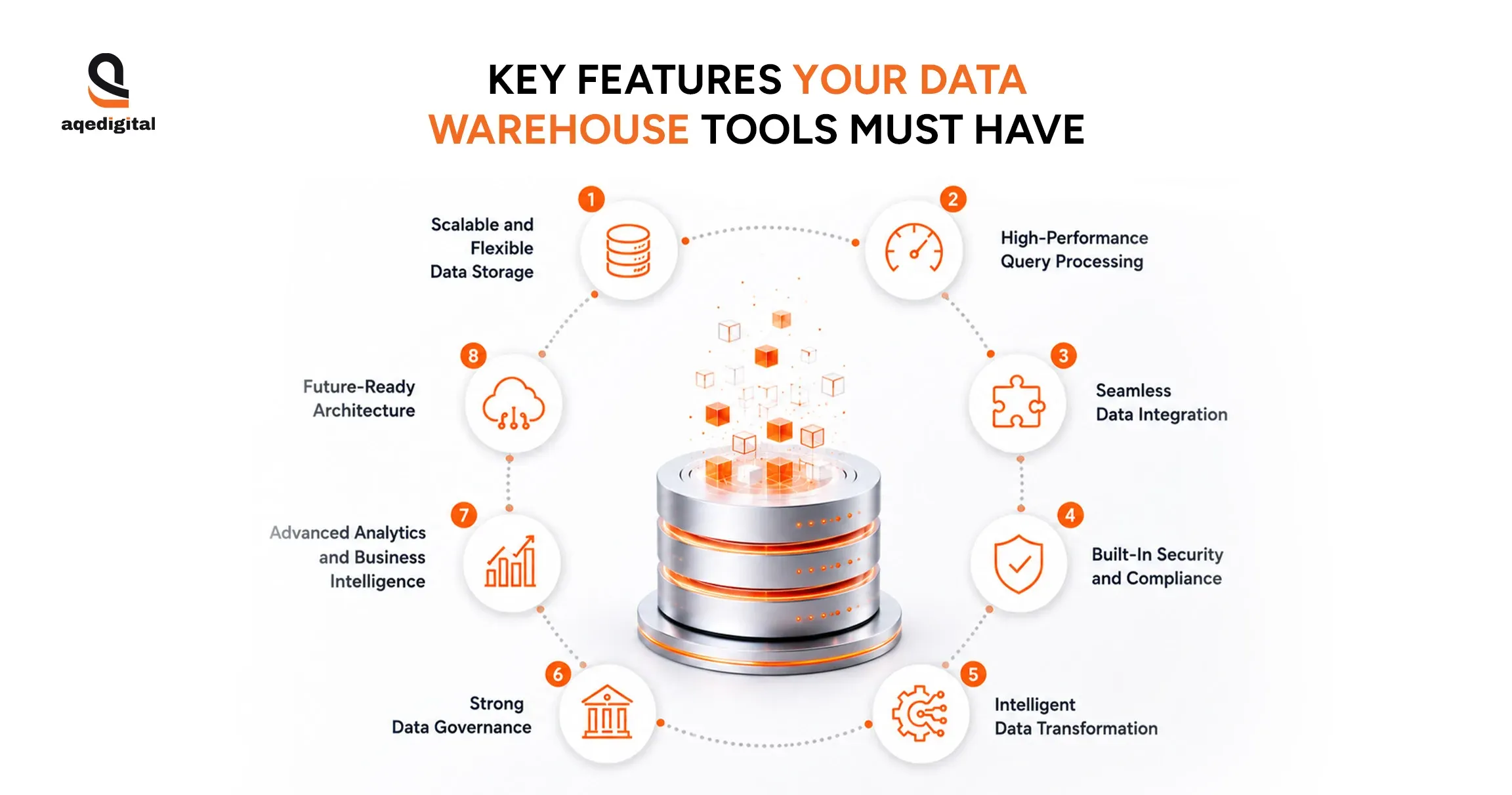
Here are the features every business should evaluate before making a decision.
Scalable and Flexible Data Storage
Your data will continue to grow. Your platform should grow with it.
Look for a data warehouse solution that can:
- Store structured, semi-structured, and unstructured data.
- Scale storage without system redesign.
- Handle billions of records efficiently.
- Support high-performance analytical workloads.
A scalable storage architecture ensures your business won't outgrow its platform in a few years.
High-Performance Query Processing
Your enterprise data warehouse software should deliver consistent performance, even when multiple teams are running reports simultaneously.
Prioritize features such as:
- Massively Parallel Processing (MPP)
- Intelligent query optimization
- Result caching
- Workload isolation
- Independent compute and storage scaling
These capabilities help maintain speed while keeping infrastructure costs under control.
Seamless Data Integration
A warehouse is only as useful as the data it can collect.
Modern data warehousing services should connect effortlessly with your existing business ecosystem, including CRM, ERP, finance, marketing, and customer support platforms.
Look for support for:
- Native connectors
- APIs and SDKs
- Batch data ingestion
- Real-time data streaming
- ETL and ELT workflows
The easier data moves into your warehouse, the faster your teams can generate meaningful insights.
Built-In Security and Compliance
Security should never be treated as an optional add-on. Instead, it should be built into the platform from the start.
Key capabilities include:
- Role-based access control
- Column-level and row-level permissions
- Encryption during storage and transmission
- Audit logs
- Compliance support for standards such as GDPR, HIPAA, and SOC 2
Intelligent Data Transformation
Modern data warehouse automation software should simplify data preparation without creating additional manual work.
Look for features such as:
- ELT-first architecture
- Incremental data loading
- Automatic schema evolution
- Native transformation frameworks
- Version-controlled transformation workflows
Automated transformation improves data quality while reducing engineering effort.
Strong Data Governance
A reliable data warehouse model should help teams understand where data comes from, who owns it, and how it is being used. Strong governance improves trust in business reports and reduces errors across departments.
Essential governance capabilities include:
- Centralized data catalog
- Metadata management
- Data lineage tracking
- Automated data quality monitoring
- Policy-based access management
Advanced Analytics and Business Intelligence
The ultimate purpose of a warehouse is to generate better business decisions.
Select a platform that works seamlessly with leading analytics and visualization platforms while giving analysts direct access to trusted data.
Important capabilities include:
- Native SQL support
- Integration with leading BI platforms
- Machine learning functions
- Statistical analysis capabilities
- Interactive dashboards and reporting
Future-Ready Architecture
Your investment should continue delivering value as your business evolves.
Before selecting a platform, evaluate whether it supports:
- Cloud scalability
- AI-ready analytics
- Multi-cloud deployment
- Automation capabilities
- Flexible infrastructure expansion
Many organizations now combine modern warehouses with AI and data solutions to improve forecasting and automation.

How the Right Data Warehouse Solution Helps Your Business Grow Faster
Investing in a data warehouse solution is about creating a reliable foundation that helps every team make faster, smarter, and more confident decisions.
If you're evaluating enterprise data warehouse software, focus on the business outcomes it can deliver rather than just its technical capabilities.
Here are the biggest advantages you can expect.
Make Better Business Decisions
A centralized data warehouse gives leaders access to complete, up-to-date information instead of scattered reports from multiple systems. It allows executives to identify opportunities, reduce risks, and plan with greater confidence.
Access Business Data Faster
Modern data warehousing services consolidate information into one centralized platform, allowing employees to retrieve accurate data quickly without depending heavily on IT teams.
Improve Data Quality Across Every Department
Different teams often work with different versions of the same data.
A well-designed data warehouse model standardizes information collected from multiple sources, ensuring marketing, finance, sales, operations, and leadership all work with consistent and trustworthy data.
Understand Business Performance More Clearly
The right platform enables businesses to analyze trends, customer behavior, operational performance, and sales patterns over time. These insights make forecasting more accurate and strategic planning more effective.
Get Answers to Complex Business Questions
Business leaders constantly ask questions like:
- Which products generate the highest profit?
- Which marketing channels deliver the best ROI?
- Why are customer retention rates changing?
- Which regions create the most revenue?
A centralized data warehouse solution combines data from multiple business systems, making it easier to answer these questions with confidence.
Streamline Daily Operations
Modern data warehouse automation software automatically cleans, transforms, and organizes incoming data before it reaches business users. This reduces manual effort, minimizes reporting errors, and helps teams spend more time analyzing insights instead of fixing data issues.
Support Company-Wide Collaboration
Successful organizations rely on shared information.
When everyone works from the same trusted data source, collaboration becomes easier across departments. Finance, marketing, sales, operations, and leadership can align their decisions using consistent metrics and reports.
Build a Stronger Foundation for Future Growth
Enterprise data warehouse software that can scale alongside your organization helps avoid costly migrations in the future. As data volumes increase and analytics become more advanced, your platform should continue supporting new technologies, users, and business requirements without disrupting operations.
5 Factors That Can Help You Select The Right Enterprise Data Warehouse Software
Selecting the right enterprise data warehouse software is about finding a solution that fits your current operations while supporting future business growth.
Before making your decision, ask these five questions and evaluate:
1. Does It Match Your Business Size?
Small businesses often benefit from cloud-based data warehousing services that require minimal IT management. Mid-sized companies should look for flexible platforms that integrate easily with existing systems.
Large enterprises need a scalable data warehouse solution capable of handling high data volumes from multiple sources without compromising performance.
2. Can It Meet Your Performance Expectations?
Review how the platform handles query performance, system availability, and growing workloads. Whether you choose cloud, on-premises, or a hybrid deployment, the solution should deliver fast and reliable access to business-critical data.
3. Does It Support Your Cloud Strategy?
If your organization is moving toward cloud infrastructure, your warehouse should move with it.
Modern data warehouse tools should support cloud-native deployments, hybrid environments, and seamless scalability without requiring major infrastructure changes later.
4. Can It Handle Your Current and Future Data Volumes?
Your data will continue to grow.
Choose a platform that supports increasing workloads, low-latency reporting, and expanding datasets without requiring frequent upgrades. Scalable architecture is one of the most important data warehouse requirements for long-term success.
5. Is It Ready for Your Analytics Strategy?
A flexible data warehouse model ensures your business can continue generating deeper insights as technology evolves. Understanding data warehouse vs data lake can help you get the right architecture.
The best data warehouse solution is one that aligns with your business goals, supports future growth, and gives your teams the confidence to make data-driven decisions every day.
Conclusion
Having the right data warehouse software is an investment in your organization's ability to adapt, innovate, and respond to changing business demands with confidence. As data ecosystems become more complex, businesses that prioritize a scalable and future-ready foundation will be better positioned to uncover new opportunities and maintain a competitive edge.
At AQe Digital, we help organizations design and implement intelligent data solutions that align with long-term business objectives, ensuring every investment delivers measurable value and lasting impact.
Contact us to discover how AQe Digital can help you build a scalable, secure, and future-ready data warehouse solution tailored to your business.