Customer Experience Transformation ROI: How to Avoid the 70% Failure Rate?

Nirav Oza

It’s 2026, and many organizations believe the 2022 McKinsey report that 70% of transformations fail is no longer relevant. But what they are missing is the reasons why digital transformations fail and how they impact customer experience. Over the past 4 years, those reasons have only evolved, not been resolved.
From the technology gap to tracking vanity metrics and data challenges, these are some of the digital transformation challenges that are becoming increasingly complex. And in 2026, you need a strategy to overcome them.
In this article, you will get a complete understanding of the current state of customer experience transformations, how to track the real ROI of CX transformations, and the reasons why it fails with a 180-day plan to overcome it.
The State of Customer Experience Transformation in 2026
The state of customer experience transformation is shifting from reactive, siloed interactions to a predictive approach. By using an AI-based ecosystem, businesses are transforming how customers interact.
However, this shift towards AI-based customer experience transformation has a flip side. It does offer excellent ROI, but legacy system failures, data architecture bottlenecks, and change management issues persist. This is why digital transformation is leading to rapid AI adoption and realizing our potential gains.
Shift to Predictive and Agentic AI
Customer experience strategies have moved beyond simple chatbots to agentic, AI-based, multimodal systems. This means businesses can deploy end-to-end workflow automation with autonomous systems.
It’s not about solving user queries anymore, but predicting what can hinder customer experience. And this is often referred to as predictive orchestration. AI-powered capabilities allow companies to detect what customers need. This creates enough room for the companies to improve customer satisfaction through rapid changes.
The Data Challenge: Moving to Logical Data Fabrics
A critical roadblock for most customer experience transformations in 2026 is the technology trap. Most organizations automate processes with digital transformations, leveraging AI, but they struggle with fragmented data. Every department has a different source of truth, which provides siloed data across development, testing, marketing, sales, and maintenance.
- Journey-First Architecture: Organizations now focus on customer journeys first. Instead of purchasing 10 different tools for the marketing or support team, companies architect data flows around critical touchpoints in the user journey map.
- Logical Data Fabric: Overcoming tedious, traditional data integrations can delay projects. This is where a logical data fabric architecture helps. Using this approach, companies can create a virtual data layer that connects diverse sources into a single source of truth.
- Customer Data Platforms (CDPs): Organizations now use advanced customer data platforms that act as the nervous systems of customer experience. It enables real-time identity resolution and audience segmentation. However, it requires solid data engineering to clean and unify all the data from different sources, or CDP will end up as a silo.
While it’s easy to pin the 70% failure tag on the technology gap, the real failure reasons are often observed in the ambiguity of business goals, leadership disengagement, and neglecting the human element. So, understanding what ROI really means and how to measure it for your customer experience transformation projects becomes essential.

What ROI Really Means in Customer Experience Transformation?
ROI for customer experience transformation is now a “connective tissue” between the experience design and enterprise performance. It answers a key question every CFO asks: “Are we extracting meaningful business outcomes?”
Here is what ROI really means in customer experience transformation for your business in 2026.
1. Vanity to Forensic: The Shift in Metrics
Organizations relied on metrics such as Net Promoter Score (NPS) or customer satisfaction scores to measure ROI earlier. These are helpful metrics, but in isolation, they don’t provide valuable insight into why digital transformations fail. So, if you are looking to get deeper insight into digital transformation ROI, the best way is to shift towards forensic metrics like customer lifetime value and churn rates.
Organizations must use control groups to demonstrate if a specific customer experience intervention directly affected the key business metrics.
2. Revenue Growth and Cost-to-Serve
The ROI of customer experience transformations can be measured using two complementary metrics.
A Revenue Growth and Protection
Rather than viewing CX as a “support” function, leading organizations treat it as a primary driver of top-line velocity. The ROI here is measured through the lens of asset preservation and conversion efficiency.
- LTV Multipliers: Data indicate that CX leaders increase Customer Lifetime Value (CLV).
- Revenue Protection (Churn Mitigation): In high-margin segments, ROI is often a “defensive” metric. A mere 2% reduction in churn within premium tiers directly preserves high-velocity revenue streams that would otherwise require higher acquisition costs to replace.
- Sales Velocity & Conversion: The introduction of “Smart Research Assistants” (Agentic AI) into B2B sales cycles has redefined the funnel, increasing conversion rates.
B: Operational Efficiency: The Cost-to-Serve Compression
This lever focuses on OPEX rationalization, the ability to scale service without a proportional increase in headcount.
- Intelligent Containment: ROI is captured by shifting high-friction, expensive human touchpoints to autonomous digital channels.
- The Productivity Tipping Point: Incremental gains, such as the 11 minutes saved per day via Microsoft Copilot, represent a structural shift when aggregated.
3. The “Technology Trap”: Data Fabric as the ROI Foundation
A foundational axiom of AI consulting is that layering sophisticated technology on top of fractured processes yields negative ROI.
- Logical Data Fabric vs. Silos: Data silos can erode revenue through operational friction. To counteract this, agile firms are adopting Logical Data Fabric architectures. A prime example is City Furniture, which utilized this unified approach to realize a 345% ROI and a staggering 440% increase in average revenue per user (ARPU).
- Unified Profile Integrity: Without a Customer Data Platform (CDP) to provide a single source of truth, agents suffer from “toggle tax”, the time lost switching between disconnected systems. A unified desktop environment directly bolsters ROI by reducing Average Handle Time (AHT) and training overhead.
4. Strategic Governance: ROI as a Risk Mitigation Protocol
With 70% of transformation initiatives failing, ROI must serve as a governance mechanism. It is the “defense” against goal ambiguity and “pilot purgatory.”
- Bain’s Value Creation Plan (VCP): This framework shifts the perspective from static P&L metrics to a lifecycle value tracker (Attract, Serve, Retain, Grow). It forces leadership to move beyond “vanity metrics” and prioritize high-impact behavioral changes.
- Return on Experience (ROX): Modern CFOs are treating ROX as a leading indicator of financial health. While ROI measures lagging financial results, ROX quantifies employee and customer behaviors, advocacy, effort reduction, and sentiment.
Why Digital Transformation Fails?
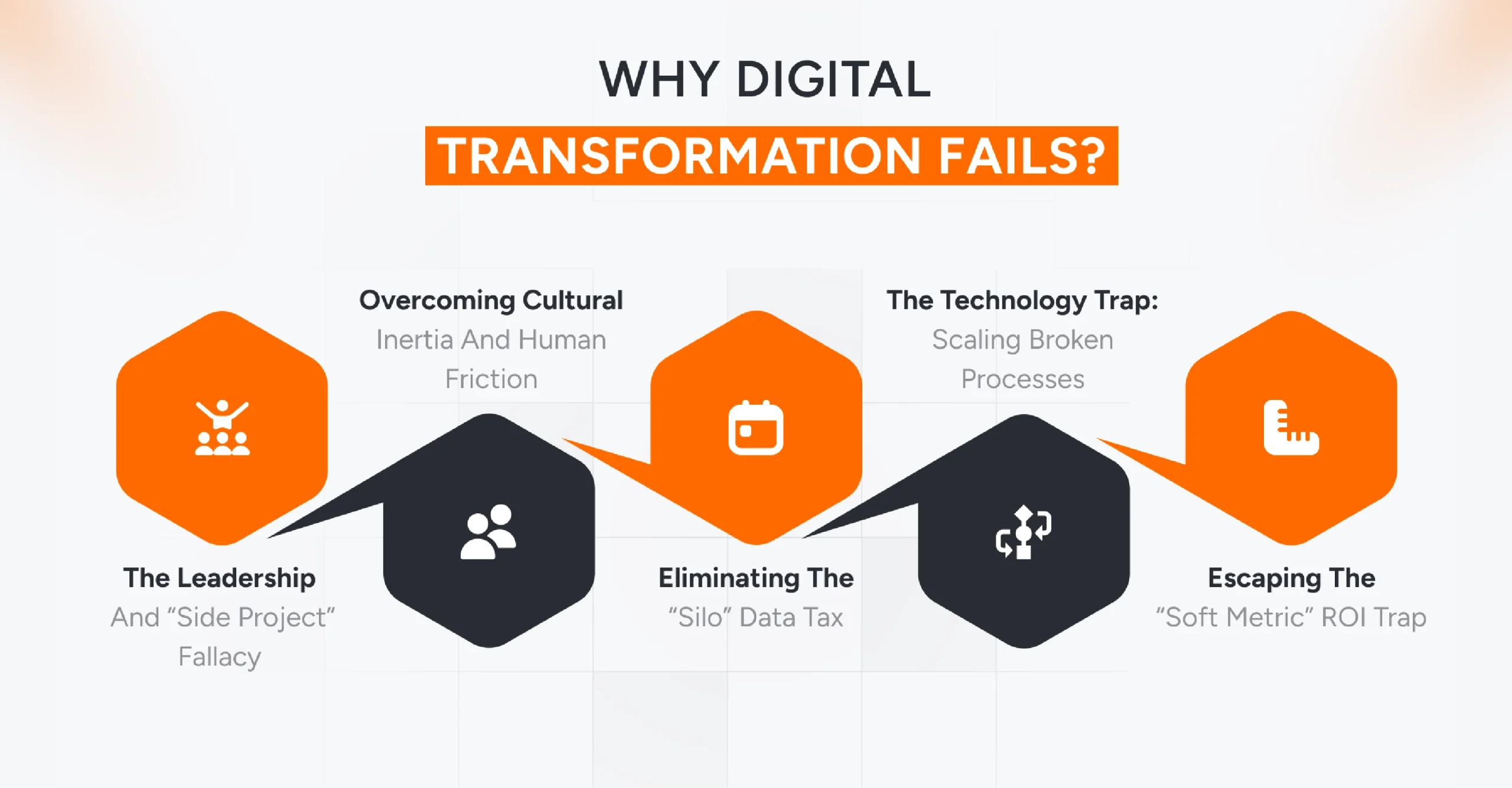
The digital transformation failure rate remains a significant hurdle for the modern enterprise. While technology is often blamed, the reality of digital disappointment usually lies in the friction between legacy organizational inertia and the demands of a high-velocity customer-experience transformation.
Achieving a resilient enterprise digital strategy requires a forensic understanding of these failure vectors to ensure your roadmap delivers value.
1. The Leadership Vacuum and “Side Project” Fallacy
A primary reason for transformation failure is the absence of unified executive sponsorship. When digital initiatives are relegated to departmental “side projects” rather than treated as strategic imperatives, they lack the cross-functional authority to dismantle legacy silos. Without a “Captain” at the C-suite level to navigate resource allocation and internal politics, the initiative loses momentum, leading to strategic drift.
2. Cultural Inertia and the Human Friction Point
Culture acts as the ultimate arbiter of success. Why digital transformation fails often comes down to the “Human Element,” the collective resistance to new workflows. If employees view new systems with suspicion or fear of displacement, they will inevitably retreat to old habits. Transformation is a psychological shift; ignoring the change management curve ensures that even the most sophisticated tech stack will suffer from low adoption.
3. Data Fragmentation and the “Silo” Tax
Effective AI and automation require a unified data engine. However, many organizations suffer from “Fragmented Truths,” where customer data is trapped in isolated departmental repositories. These silos create operational blindness, making it impossible to achieve a 360-degree view. This lack of a “Logical Data Fabric” results in inconsistent customer journeys and a direct hit to the bottom line due to systemic inefficiencies.
4. The “Technology Trap”: Scaling Broken Processes
A common root of digital transformation failure is treating software as a silver bullet. Pouring advanced technology over inefficient, manual processes simply generates “chaos at scale.” This misalignment between vendor capabilities and actual business needs leads to clunky interfaces and technical debt. Success requires “Problem-First Architecture,” optimizing the process before automating the workflow.
5. ROI Attribution and the “Soft Metric” Trap
Initiatives often stall when they cannot bridge the gap between “soft” customer sentiment and “hard” financial logic. CFOs require a clear link between CX improvements and financial outcomes, such as reduced churn or margin expansion. Without forensic metrics to track value throughout the lifecycle, leadership cannot justify continued investment, which can lead to project cancellation during budget cycles.
6. Integration Gaps and Legacy Dependencies
Modern tools must coexist with legacy infrastructure. Failure frequently stems from an “Integration Gap,” where new solutions are “bolted on” rather than integrated into the end-to-end journey. This creates a fragmented experience for both employees and customers, as disconnected systems require manual workarounds and duplicate data entry.
7. Internal Focus vs. User-Centric
Many projects are designed to solve internal operational hurdles rather than enhance the customer’s experience. This internal bias results in friction-heavy “hand-offs” between channels. A successful transformation must shift from focusing on activities (deploying a tool) to outcomes (changing customer behavior), ensuring the technology serves the human journey.
The 6-Month Customer Experience Transformation ROI Timeline
A successful 6-month customer experience transformation is not intended as a total organizational overhaul; rather, it is a surgical strike to establish a “Lighthouse” project. This strategic anchor demonstrates fiscal viability, catalyzes executive buy-in, and reduces the inertia that drives the high rate of digital transformation failure.
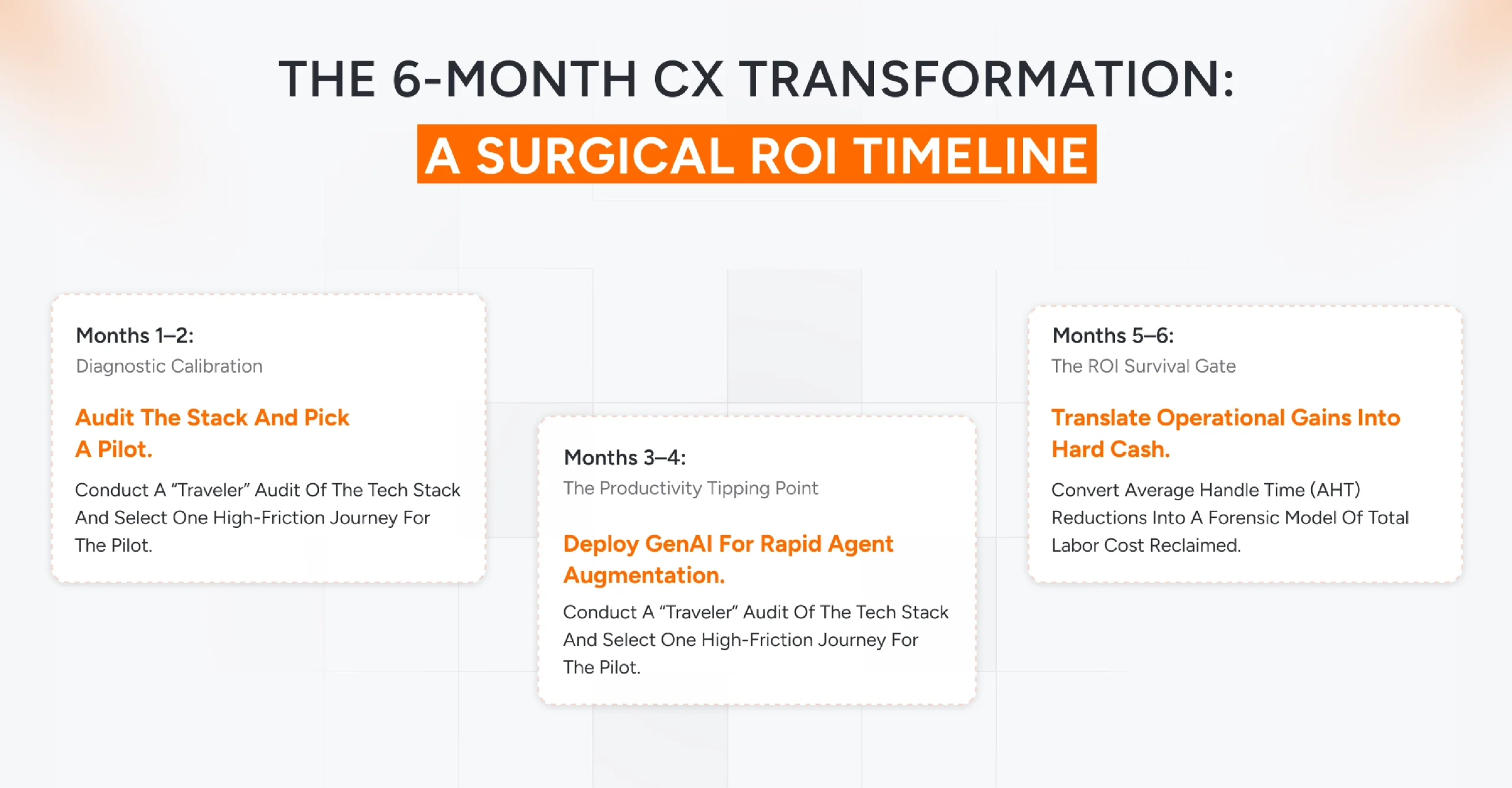
Months 1–2: Diagnostic Calibration and Baseline Engineering
The initial 60 days are dedicated to eliminating the “ambiguity trap” that causes most digital disappointment. The goal is to define the “value at stake” with forensic precision.
- The “Traveler” Audit (Days 1–30): Conduct a deep-dive audit of the tech stack to identify “data dead zones” where customer context vanishes. Establish hard baselines for Cost-to-Serve and Customer Lifetime Value (CLV). Success here is linked to a crisp financial aspiration, not just “better service.”
- Architecting the Lighthouse (Days 31–60): Avoid the “boiling the ocean” fallacy. Select a single, high-friction journey, such as new account onboarding, for the pilot. Design data flows around the customer’s movement rather than the departmental org chart.
Months 3–4: Rapid Prototyping and The Productivity Tipping Point
In this phase, the enterprise digital strategy moves into the “build” cycle, focusing on high-impact, low-friction deployments to generate “Quick Wins.”
- Agentic Augmentation: Deploy GenAI tools for “Next Best Action” and automated case summarization. The objective is to hit the “productivity tipping point,” the moment when saved minutes add up to hundreds of reclaimed agent hours.
- The 90-Day Integration Test: Launch the pilot in a live environment. By providing agents with unified context and eliminating “screen-hopping,” early movers often realize a significant drop in customer effort and a surge in first-contact resolutions.
Months 5–6: Operationalization and the ROI Survival Gate
By Month 6, the initiative reaches its “survival point.” You must translate operational gains into the “hard” financial logic required to avoid digital transformation failure.
Quantifying Operational Alpha: Measure the delta in Average Handle Time (AHT) and error rates. Successful implementations in this window have shown the ability to reduce back-office manual labor by massive margins while tripling digital application volumes.
The Forensic ROI Calculation: Shift from vanity metrics to forensic logic. Convert “seconds saved per call” into “total labor cost reclaimed.” Use this data to move from subjective sentiment to a defensible Net Financial Gain model.

How AQe Digital Ensures Efficient Customer Experience Transformation?
The gap between 30% of enterprises that succeed and 70% that fail gives you a clear understanding of the real problem. It’s not about bad code but a lack of clarity. And clarity comes from identifying metrics that provide real insights into digital transformations.
This is where AQe Digital can help. With more than 27 years of experience delivering digital transformation for businesses across industries, our teams will design your customer experience transformation and provide real-time insights through advanced data analytics.
So, if you are looking to transform customer experiences across platforms, connect with us now.