Custom Software Development Process: What You Receive at Each Phase

Jigar Mistry
What breaks any custom software development process? Is it just bad code? Or Lack of proper scoping?
There is no definite answer, but if you look closely at the reports, you will find a key trigger behind each custom software development process failure. And that is a lack of understanding of what to expect.
What this means is your teams must know what the deliverables are and what should be the real outcome out of each of the phases in the software development lifecycle. In fact, Gartner predicts that over 40% of agentic AI projects will be canceled by the end of 2027.
And the biggest causes will be escalating costs, unclear business value, and inadequate risk controls. When teams can't state what a project should deliver, the project is already at risk. This piece helps you with the exact framework needed to overcome such bottlenecks.
It covers,
- Deliverables at the end of each phase
- A roadmap to ensure deliverables are as per defined goals
- Requirements assessment
And a list stating when you should start the process.
But first, you need to understand the process.
What is the Custom Software Development Process?
Most software projects don’t fail because of bad code. They fail because nobody agreed on what to build, or nobody checked whether the build still matched the plan.
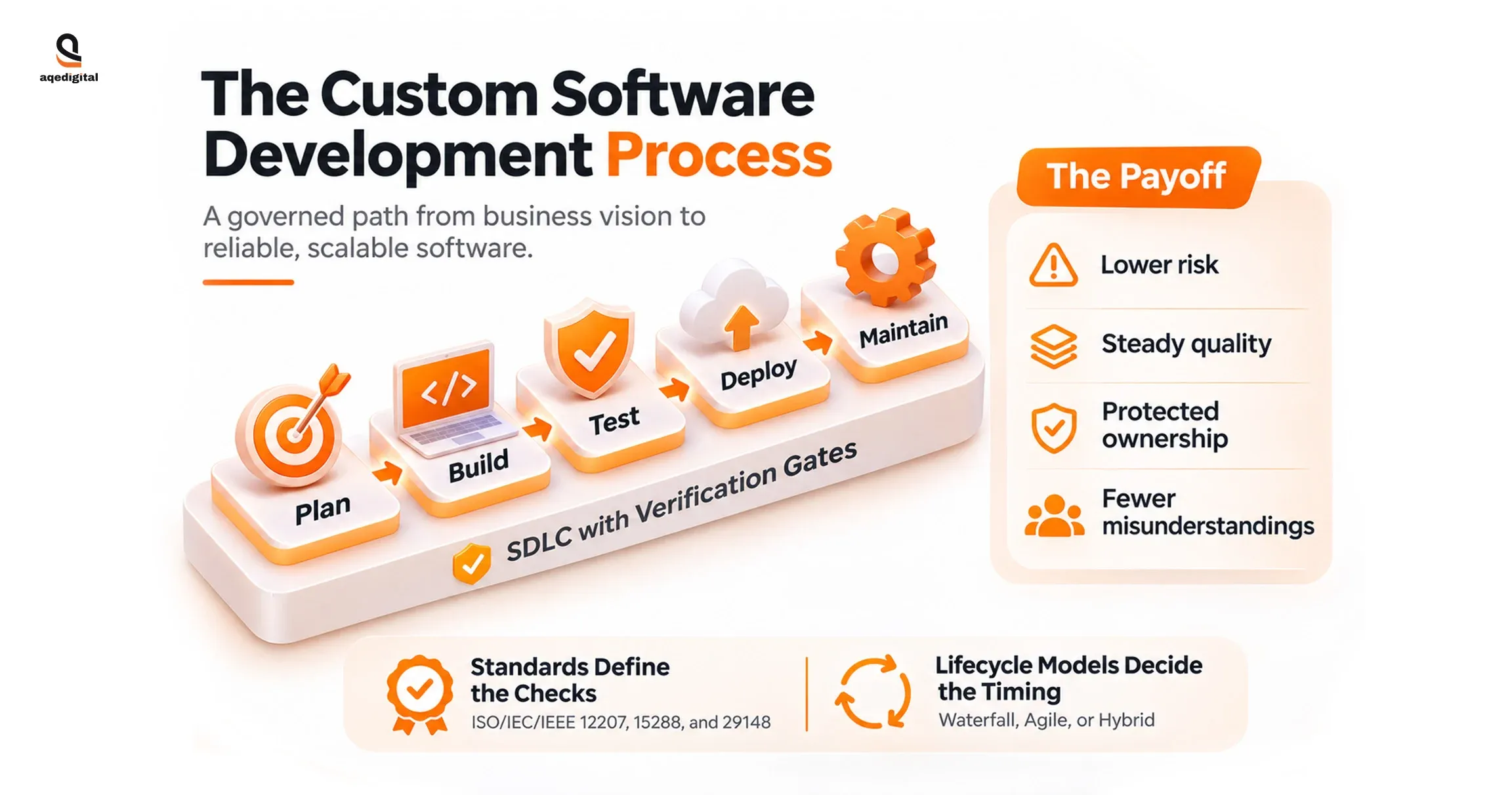
The custom software development process fixes that. It’s a framework that turns a business vision into software that’s reliable, secure, scalable, and maintainable. Older projects had high failure rates for three reasons: loose scope control, thin understanding of the project, and architectural drift.
Modern software development lifecycle (SDLC) governance closes those gaps. It places verification gates and boundary conditions between phases. A phase doesn’t pass until it clears its check.
Standards Define the Checks, Not the Lifecycle Model
ISO/IEC/IEEE 12207, 15288, and 29148 give teams guidelines for managing development, defining requirements, and maintaining quality. They cover acquiring, supplying, developing, operating, and maintaining software.
They don’t force one lifecycle model on you. That’s where waterfall, agile, and hybrid approaches come in. The standards set what must be checked. Your model decides when.
Agile doesn’t remove the phases. It repeats them in small loops called sprints, which are fixed-length events of one month or less. Same phases. Smaller loops.
Following this process pays off in four ways:
- Lower risk. Gates catch problems before the next phase builds on them.
- Steady quality. Every phase has a check, so quality doesn’t depend on who’s watching.
- Protected ownership. Clear approvals keep your rights to the software documented.
- Fewer misunderstandings. Your development partner and your team work from the same signed-off scope.
Your Model Decides What You Receive and Who Signs Off
| Delivery Models Compared | |||
|---|---|---|---|
| Model | What you receive | When | Who approves |
| Waterfall | Full SRS, full design, then one build | Documents up front, working software late | Business sponsor at each phase gate |
| Agile | Working increment, release notes, updated backlog | End of every sprint (one month or less) | Product Owner against the Definition of Done |
| Hybrid | Signed SRS and architecture, then sprint builds | Documents first, builds in increments | Sponsor on scope, Product Owner on increments |
Now you know what the process is and how each model delivers. Next, each phase and what it offers your project.

What Do You Receive at Each Phase of the Custom Software Development Process?
One of the most important questions for any software development team is to understand what the deliverables of each phase are. In a well-run project, every phase produces specific technical, legal, and operational deliverables. These act as a binding verification gate and operational baseline. If a phase ends and you are holding nothing, the phase doesn't happen.
Here is what each of the phase deliverables are,
| Deliverables at Each Phase | ||||
|---|---|---|---|---|
| # | Phase | Deliverables you receive | Who signs off | Acceptance test |
| 1 | Discovery | Vision and scope document, feasibility report, user journeys, risk register, estimate | Business sponsor | Scope and estimate range accepted in writing |
| 2 | Requirements | Software requirements specification (SRS), prioritized backlog, acceptance criteria | Product Owner and sponsor | Every requirement is testable and numbered |
| 3 | Design | Roadmap, architecture document and decision records, clickable prototype, data model | Product Owner and CTO or technical lead | Prototype walkthrough passes user journeys |
| 4 | Development | Sprint builds, release notes, source repository access, CI/CD pipeline | Product Owner | Increment meets the Definition of Done |
| 5 | Testing | Test plan, test and coverage report, security scan results, UAT sign-off | Product Owner and QA lead | Acceptance criteria pass in UAT |
| 6 | Deployment | Production release, rollback plan, runbook, documentation, training | Sponsor and operations lead | Release live, rollback rehearsed |
| 7 | Maintenance | SLA, monitoring and incident reports, patch log, quarterly roadmap review | Operations lead | SLA targets reported against actuals |
Now that you know what the deliverables are, let’s understand them one by one for each of the phases.
Phase 1: Discovery and Feasibility
Before starting the project, the development team needs to understand what the business wants to achieve and if the idea is feasible. They need to:
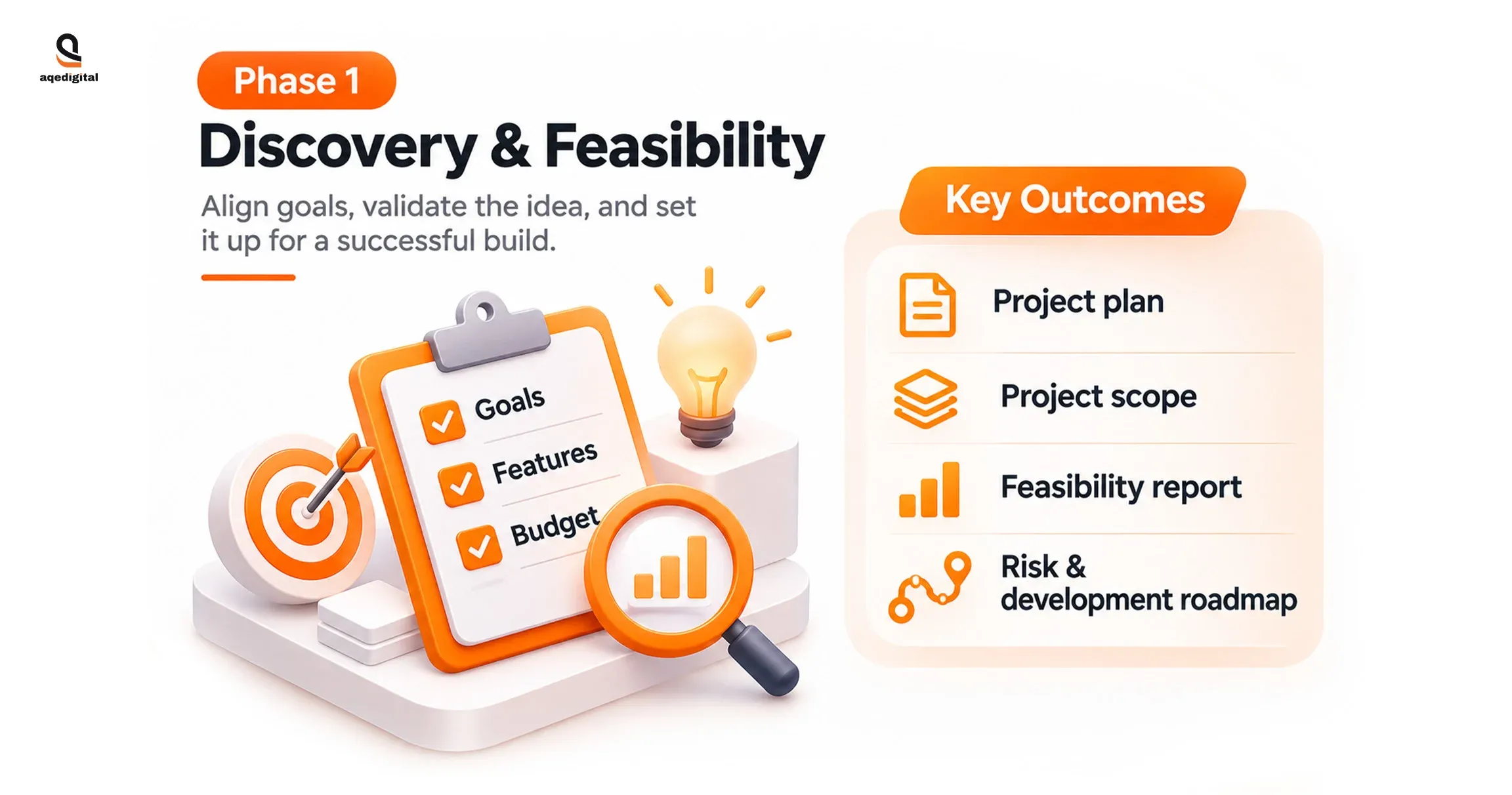
- Discuss the business goals and digital transformation priorities.
- Identify the problems the software would solve.
- Decide what features are needed.
- Estimate the time and the budget.
- Define possible challenges, such as technical limitations, security requirements, and legal regulations.
What this discussion leads to is:
- Project plan: a document explaining the objective of the project, who will be involved, the estimated budget, and expected timelines.
- Project scope: a list of what the software will include and what is outside the scope.
- Feasibility report: an assessment of whether the project is technically possible, practical, and worth investing in.
- Risk and development roadmap: a list of possible challenges and plans for how the project will progress.
| Discovery Deliverables and Decisions | ||
|---|---|---|
| Deliverable | What it contains | Decision it unlocks |
| Vision and scope document | Goals, users, in-scope and out-of-scope items | Whether the project is worth funding |
| Feasibility report | Technical options, integration constraints, build vs buy | Whether to build, buy, or stop |
| User journeys | How each user type moves through the system | Which flows get built first |
| Risk register | Named risks, likelihood, owner, mitigation | Where to hold contingency |
| Estimate | Cost and time as a range, with assumptions | What budget to commit |
Every row ends in a decision, not a document. That’s the test. A deliverable that doesn’t change what you do next is padding.
Watch for three red flags:
- No written output. Workshops that end in a slide deck and no scope document.
- No named risks. A discovery with an empty risk register hasn’t discovered anything.
- No estimate range. A single number with no assumptions is a guess dressed up as a quote.
The financial logic is about timing. An error in a requirement costs a sentence to fix on paper. The same error found after build costs rework across design, code, and tests. Discovery is where you find the cheap ones.
Phase 2: The SRS Analysis
A software requirements specification (SRS) is the signed document that states what the system shall do, how well it shall do it, and what limits apply. The Product Owner owns it. It becomes the baseline against which every build, test, and change request is measured. Without it, scope is whatever the last meeting remembered.
ISO/IEC/IEEE 29148 replaced IEEE 830 and defines the content below.
| SRS Sections Explained | ||
|---|---|---|
| SRS section | Purpose | Example content |
| Introduction | Scope, definitions, intended users | Business goal, glossary, stakeholders |
| External interfaces | What the system connects to | Payment gateway, ERP API, SSO |
| Functional requirements | What the system shall do | Order creation, approval routing |
| Quality requirements | How well it shall do it | Response time, availability, security |
| Design constraints | Limits on the solution | Hosting region, mandated stack |
Here’s what a good one looks like. Mandatory behavior is written with “shall.” These five lines are illustrative.
- REQ-014: The system shall allow an authenticated approver to approve or reject a purchase request within the request detail screen.
- REQ-015: The system shall send an email notification to the requester within 60 seconds of a decision.
- REQ-021: The system shall record the user ID, timestamp, and decision for every approval action.
- REQ-032: The system shall return the dashboard within 3 seconds for 95% of requests at 500 concurrent users.
- REQ-040: The system shall store all personal data in the [region] hosting region.
Each one is numbered, singular, and testable. That’s the standard to hold a vendor’s SRS to. Words like “fast” and “user-friendly” fail it.
Once the SRS is signed, a change becomes a numbered change request. The vendor states which requirements are affected, the effort, and the schedule impact, and you approve or decline before work starts. How it’s priced depends on your contract, so get the change-control model in writing.
Acceptance Criteria and the Definition of Done Do Different Jobs
Acceptance criteria are the conditions a single user story must meet to be accepted. The Definition of Done is the quality bar every item must meet. As Atlassian puts it, the Definition of Done usually applies to all backlog items, while acceptance criteria apply to one story, and both must be met to complete it.
| User Story vs Acceptance Criteria vs Definition of Done | |||
|---|---|---|---|
| User story | Acceptance criteria | Definition of Done | |
| What it is | A need from the user’s view | Conditions for this story to pass | Quality bar for every item |
| Scope | One feature | One story | All backlog items |
| Example | “As an approver, I want to reject a request” | “Rejection requires a reason of 10+ characters” | “Code reviewed, tests pass, deployed to staging” |
| Owner | Product Owner | Product Owner | Whole team |
Acceptance criteria come in three formats:
- Given/When/Then. Given a pending request, when the approver rejects it without a reason, then the system shows an error and keeps the request pending.
- Checklist. Reason field is mandatory. Reason has at least 10 characters. Requester is notified.
- Rule-based. Rejections must carry a reason. Requests without one can’t leave “pending.”
Copy this template:
| Acceptance Criteria Template | |||
|---|---|---|---|
| Story | Acceptance criteria | Test owner | Sign-off |
| [As a... I want... so that...] | [Numbered, testable conditions] | [Name/role] | [Name, date] |
This is the template that makes milestone payments verifiable. Tie each payment to criteria that passed, not to hours spent.
A Roadmap Sits Between the SRS and the Sprint Backlog
A software development roadmap is an ordered plan of milestones, each with a scope, a release, and a sign-off. It’s broader than a backlog and firmer than a wish list. Here’s an illustrative six-month example.
| Illustrative Six-Month Roadmap | ||||
|---|---|---|---|---|
| Milestone | Scope | Release | Dependency | Sign-off |
| M1 (Month 1) | Discovery output, SRS, prototype | None (documents) | Stakeholder availability | Sponsor |
| M2 (Months 2-3) | Core workflows, authentication | Internal alpha | Signed SRS, architecture | Product Owner |
| M3 (Month 4) | Integrations, reporting | Pilot release | Third-party API access | Product Owner |
| M4 (Month 5) | UAT, security scan, fixes | Release candidate | Test environment | Product Owner and QA lead |
| M5 (Month 6) | Production launch, training | Production v1.0 | Hosting, runbook | Sponsor and operations lead |
Phased releases matter for a reason beyond comfort. Every milestone with a release is a checkpoint where wrong assumptions surface while they’re still cheap. One big delivery date removes every checkpoint but the last.
Two design artifacts earn their keep here:
- Architecture decision records (ADRs). Each one captures a technical choice, the options considered, and the reason. A new engineer, or a new vendor, can’t reopen a settled debate at your expense.
- A clickable prototype. Users test the flow before production code exists, so a misunderstanding costs a design edit instead of a rebuild.
Phase 3: Development Phase
During development, you receive a working, reviewed increment at the end of every sprint, plus the paper trail around it: release notes, an updated backlog, and access to the source repository and CI/CD pipeline. Sprints last one month or less, so a stalled project becomes visible within weeks, not quarters.
One sprint from a product engineering team produces four artifacts:
| Sprint Artifacts | |
|---|---|
| Artifact | What it tells you |
| Sprint planning output | What the team committed to, and why |
| Demo build | What actually works now |
| Release notes | What changed, what was fixed, what’s known |
| Updated backlog | What’s next, re-ordered by priority |
Put three things in writing before the first sprint:
- Repository access in an account you own, from day one. Not at handover.
- CI/CD pipeline configuration committed alongside the code. Builds stay reproducible.
- IP and code ownership in the contract. Who owns the source, on what payment trigger, and which third-party licenses are included. There’s no universal default, so the contract decides.
Then ask for delivery metrics: deployment frequency, lead time, and change failure rate. Large, infrequent batches fail bigger than small, frequent ones. A vendor who can’t report these numbers can’t show you how their delivery behaves.

Phase 4: Testing and QA
Before launch, you should receive seven test artifacts. Together they show what was tested, what passed, and what remains open. A verbal “it works” isn’t evidence.
| Testing Artifacts | ||
|---|---|---|
| Artifact | Shows | Owner |
| Test plan | Scope, approach, environments | QA lead |
| Test cases | What’s checked, against which requirement | QA lead |
| Coverage report | How much code and how many requirements are tested | QA lead |
| Performance test results | Behavior under expected and peak load | Engineering lead |
| Security scan results | Known vulnerabilities and their status | Security lead |
| UAT sign-off | Business users confirm acceptance criteria pass | Product Owner |
| Defect log | Open, fixed, and deferred issues with severity | QA lead |
Security evidence should align to NIST SSDF. The “Produce Well-Secured Software” group in NIST SP 800-218 covers design review, code review, testing, and secure configuration. In practice, that means the vendor hands you code review records, scan reports, and configuration baselines, not a statement that the product is secure.
Notice the pattern across all seven. Each artifact maps back to a numbered requirement in the SRS. That’s why the SRS comes first. If testing can’t point at a requirement, it’s testing something nobody asked for.
Phase 5: Deployment and Handover
At deployment, you receive the production release, a rollback plan, a runbook, documentation, and training. At handover, you receive code, credentials, infrastructure-as-code, licenses, and backups. In maintenance, you receive an SLA, monitoring and incident reports, a patch log, and a quarterly roadmap review.
Use this 12-item handover checklist:
| Handover Checklist | ||
|---|---|---|
| # | Item | You should hold |
| 1 | Source code | Full repository in your account |
| 2 | Credentials | Admin access, rotated at handover |
| 3 | Infrastructure as code | Scripts that rebuild the environment |
| 4 | Architecture documentation | Current diagrams and ADRs |
| 5 | API documentation | Endpoints, auth, examples |
| 6 | Runbook | Step-by-step operations and recovery |
| 7 | Rollback plan | Tested, with a named owner |
| 8 | Test suite | Automated tests and how to run them |
| 9 | Third-party licenses | List, terms, and renewal dates |
| 10 | Backup and restore procedure | Verified restore, not just a schedule |
| 11 | Training | Sessions delivered, materials recorded |
| 12 | Open defect and known-issues list | Severity and agreed handling |
Warranty length and the maintenance share of lifetime cost have no reliable public benchmark. Negotiate both explicitly instead of assuming a norm.
For vulnerabilities, the “Respond to Vulnerabilities” group in NIST SP 800-218 asks vendors to identify residual vulnerabilities in releases, address them, and prevent recurrence. Your patch log and incident reports are the evidence that this is happening.
Where to Start
- Ask every shortlisted vendor for a sample SRS and a sample discovery report. Vendors who can produce them already work the way this guide describes.
- Fill in the Deliverable Ledger for each phase before you sign. Any empty cell is a phase nobody governs.
- Demand numbered, testable requirements. Reject any SRS that relies on “fast” or “user-friendly.”
- Tie each payment to passed acceptance criteria. Don’t pay for hours spent.
- Get repository access, IP assignment, and the handover checklist into the contract. Settle ownership before the build starts, not after it ends.
- Agree SLA tiers before go-live. Targets are hard to negotiate once you depend on the system.
Final Thoughts
Custom software rarely fails in the code. It fails in the gaps between phases, where nobody wrote down what "done" meant. Every phase in this guide closes the same way: a named deliverable, a named approver, and a test that either passes or doesn't.
Discovery ends in a scope and an estimate range. Requirements end in a numbered SRS. Testing ends in a UAT sign-off. Maintenance ends in an SLA with actuals reported against it. Skip one, and the next phase builds on a guess.
Most vendor proposals leave that part out. You'll hear about sprints, stacks, and timelines. You won't always hear what lands in your hands at the end of each one.
So hold every vendor to the ledger. Ask for a sample SRS and a sample discovery report. Get repository access, IP assignment, and the 12-item handover checklist into the contract before the build starts. Tie each payment to passed acceptance criteria, not hours spent.
AQe Digital delivers every phase with signed deliverables, so you always know what you own. Connect with our experts now.