DevOps Automation: What to Automate Across the Software Delivery Lifecycle

Jigar Mistry
Modern software teams are expected to deliver changes faster without compromising reliability, security, or operational stability.
As applications become more distributed, manual coordination across development, testing, infrastructure, and deployment creates increasing delivery friction.
This is where DevOps automation tools, DevOps automation services, and release automation become strategically important. Automation can connect activities across the software delivery lifecycle, reducing repetitive intervention while making execution more consistent and measurable.
The scale of modern infrastructure reinforces this shift. The 2025 CNCF Annual Cloud Native Survey found that 98% of surveyed organizations have adopted cloud native techniques, while 82% of container users now run Kubernetes in production, highlighting how automation is becoming part of mainstream software delivery infrastructure.
But what is DevOps automation really solving? It is not simply about adding more scripts or configuring another CI/CD platform. Effective automation connects code, infrastructure, testing, security, deployment, and operational feedback into repeatable engineering workflows.
DevOps automation helps orchestrate a delivery system where automation removes avoidable friction while engineers retain control over architecture, risk, quality, and critical decisions.
What is DevOps Automation?
DevOps automation uses software, infrastructure, workflows, and engineering policies to execute repetitive activities across the software delivery lifecycle with limited manual intervention.
Instead of relying on developers or operations teams to manually build applications, configure environments, execute tests, or deploy releases, automated workflows can perform these activities consistently.
A mature automation model connects multiple stages rather than automating isolated tasks. Source control can trigger builds, builds can trigger testing, successful validation can initiate deployment, and production telemetry can feed information back into engineering workflows.
Why Does DevOps Automation Matter?
Automation becomes valuable when software delivery involves frequent changes, multiple environments, distributed systems, and increasingly complex dependencies.
AWS recommends automating as much of the deployment process as possible because repeatable automated deployments can reduce human error, improve consistency, and accelerate delivery.
For engineering leaders, the larger opportunity is creating a predictable delivery system where every change follows controlled and observable paths.
What are the Benefits of DevOps Automation?
DevOps automation can improve more than deployment speed. When automation connects development, testing, infrastructure, and operations, it can create measurable improvements across the software delivery lifecycle.
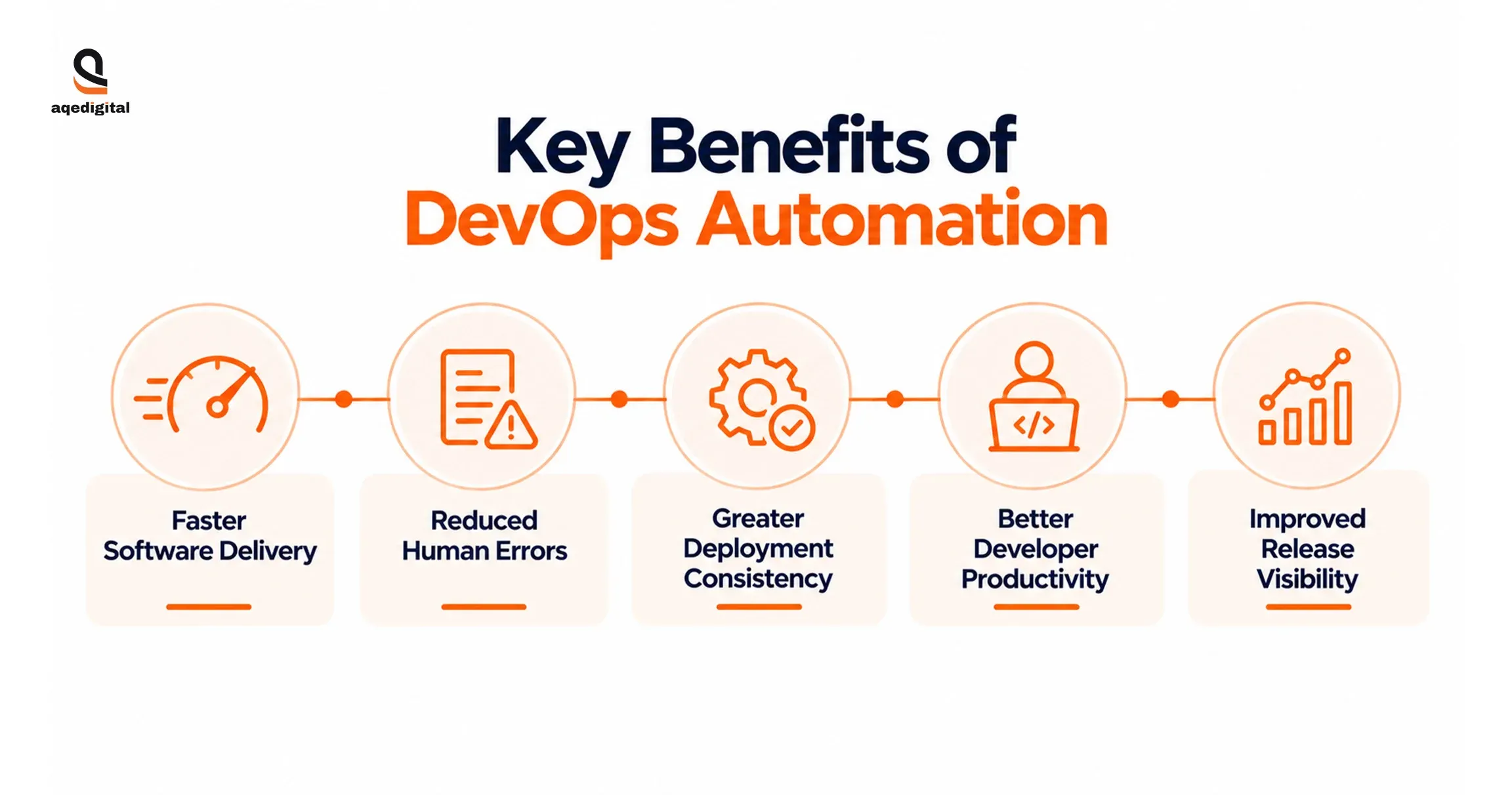
Faster Software Delivery
Automated builds, testing, provisioning, and deployments reduce the time teams spend waiting for manual processes to complete. This allows validated changes to move through delivery stages with fewer operational delays.
Reduced Human Errors
Manual deployments and infrastructure changes can introduce inconsistent configurations, missed steps, or incorrect parameters. Automated workflows execute predefined procedures consistently, reducing avoidable errors across repetitive delivery activities.
Greater Deployment Consistency
Standardized automation ensures that applications follow the same deployment procedures across environments. This reduces environment-specific variations and makes release outcomes more predictable as software teams and application portfolios grow.
Better Developer Productivity
Developers can spend less time managing repetitive builds, environment setup, deployment procedures, and operational tasks. Instead, engineering effort can shift toward application improvements, architecture, testing strategy, and higher-value technical work.
Improved Release Visibility
Automated workflows create traceable records of builds, tests, approvals, deployments, and failures. Engineering and operations teams can use this information to identify bottlenecks and understand where delivery processes require improvement.
The real benefit is not automation itself. It is creating a software delivery system that becomes faster, more consistent, observable, and easier to scale as engineering complexity grows.
What Should Organizations Automate First?
Not every DevOps activity requires the same automation strategy. Organizations should prioritize activities that are repetitive, measurable, rules-driven, and expensive to perform manually.
Code Integration and Build Validation
Every code change should move through consistent validation before it becomes a deployable artifact.
Build automation can compile applications, resolve dependencies, execute static analysis, validate package integrity, and generate versioned artifacts without requiring developers to repeat these activities manually.
This creates an early feedback loop while preventing inconsistent build procedures between developers and environments.
Automated Testing
Testing represents one of the most important areas for automation because manual validation cannot scale with frequent software changes.
Automated testing in DevOps can include unit tests, integration tests, API validation, security checks, regression suites, and environment-specific quality gates.
The objective should not be running every possible test after every change. Test suites should be organized according to risk, execution time, and the stage where failures provide the most useful feedback.
Deployment and Release Execution
Deployment becomes a strong automation candidate when applications move repeatedly across development, staging, and production environments.
Release automation can package approved artifacts, apply environment-specific configuration, execute deployment strategies, validate application health, and initiate rollback procedures when predefined conditions are violated.
A properly designed delivery workflow can therefore make deployments repeatable rather than dependent on individual engineers remembering a sequence of operational steps.

How Can Infrastructure Be Automated?
Application automation becomes difficult to scale when infrastructure provisioning remains manual.
Infrastructure should increasingly be represented as version-controlled definitions that can be reviewed, tested, and deployed through the same engineering principles used for application code.
Infrastructure as Code
Infrastructure as code automation allows teams to define networks, compute resources, databases, permissions, containers, and other infrastructure components through declarative or programmable configurations.
This approach makes infrastructure changes reproducible and traceable while reducing configuration drift between environments.
For larger organizations, the architectural benefit is particularly important because infrastructure becomes part of the software delivery system rather than a separate manual operational layer.
Environment Provisioning
Teams can automate the creation and configuration of development, testing, staging, and production environments using reusable infrastructure modules.
Standardized provisioning reduces differences between environments and makes temporary environments easier to create for testing, troubleshooting, or feature validation.
However, provisioning automation should include policy controls, secrets management, identity boundaries, and approval mechanisms rather than simply creating infrastructure faster.
How Should the Deployment Pipeline Be Automated?
A delivery pipeline should coordinate the movement of code from source control to a production-ready state through predictable stages.
- Build: The pipeline retrieves source code, resolves dependencies, compiles or packages the application, and produces a traceable artifact.
- Validate: Automated checks evaluate code quality, tests, security requirements, dependency risks, and other release conditions.
- Deploy: Approved artifacts move through predefined environments using consistent deployment procedures rather than environment-specific manual commands.
- Verify: Post-deployment checks validate application health, infrastructure conditions, critical integrations, and business functionality.
- Recover: Rollback or remediation procedures should be available when deployments fail defined health or quality thresholds.
This model creates an automated deployment pipeline where each transition has explicit conditions instead of relying on informal coordination between teams.
Release automation can also support controlled strategies such as blue-green deployments, canary releases, progressive delivery, and automated rollback when appropriate conditions are established.
What Technologies Support DevOps Automation?
Modern automation rarely depends on one platform. Enterprise environments typically combine multiple technologies according to the type of activity being automated.
| DevOps Automation Technologies at a Glance | |||
|---|---|---|---|
| Technology | Best Suited For | Key Value | Main Consideration |
| CI/CD Platforms | Build, test, and deployment workflows | Centralized delivery orchestration | Pipeline complexity can increase over time |
| Infrastructure as Code | Cloud and infrastructure provisioning | Repeatable environments | Requires strong state and change management |
| Containers | Consistent application packaging | Environment portability | Requires orchestration and image governance |
| Configuration Management | System and application configuration | Consistent operational states | Requires careful inventory and versioning |
| Policy Engines | Compliance and deployment controls | Automated enforcement | Policies must remain maintainable |
| Observability Platforms | Deployment and runtime feedback | Faster detection and diagnosis | Requires meaningful signals and alert design |
The right combination depends on architecture, application criticality, regulatory requirements, existing platforms, and engineering maturity.
Organizations should avoid selecting technologies first and attempting to redesign processes around them later.
How Does DevOps Pipeline Automation Improve Delivery?
DevOps pipeline automation becomes more valuable as delivery systems become distributed across multiple teams, repositories, environments, and cloud platforms.
A mature pipeline can standardize common controls while still allowing individual applications to use technology appropriate to their architecture.
For example, a platform team may provide reusable pipeline templates containing security scanning, artifact management, testing gates, deployment policies, approvals, and observability integrations.
Product teams can then consume these capabilities without rebuilding the same automation independently for every application.
Standardize the Common Parts
Reusable pipeline components should cover recurring requirements such as authentication, artifact handling, security checks, deployment strategies, approvals, and notifications.
Keep Application-Specific Logic Separate
Business-specific testing, deployment parameters, and application validation should remain configurable instead of forcing every application into an identical workflow.
Make Failures Visible
Pipelines should expose failed tests, infrastructure errors, deployment failures, security violations, and approval delays through centralized observability.
How Does AI Change DevOps Automation?
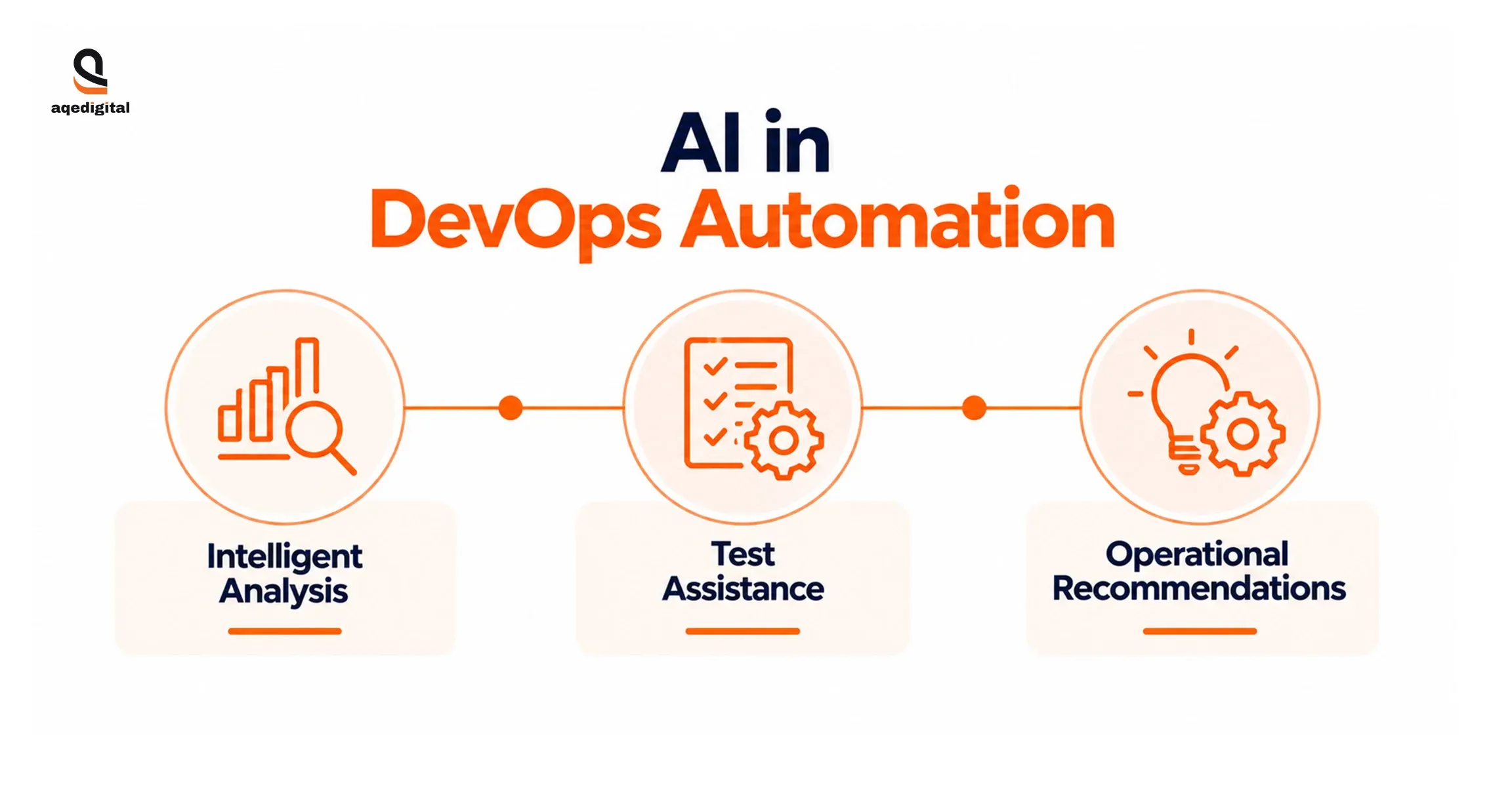
AI introduces another layer of automation by helping teams interpret large volumes of technical information rather than simply executing predefined rules.
Traditional automation generally follows known conditions. AI-based systems can assist with log analysis, anomaly identification, incident classification, test generation, documentation, and operational recommendations.
However, automation should not turn uncertain AI output directly into unrestricted production changes.
- Intelligent Analysis: AI can correlate logs, deployment events, alerts, and application signals to help engineers identify potential causes faster.
- Test Assistance: AI can generate or recommend test cases based on application changes, existing test coverage, and historical defects.
- Operational Recommendations: AI can summarize incidents or suggest remediation paths while keeping production changes subject to appropriate controls.
The most reliable architecture keeps AI inside governed workflows rather than treating it as an unrestricted deployment authority.
How Should Organizations Scale Automation Across Departments?
Automation becomes increasingly valuable when organizations establish reusable capabilities rather than allowing every team to build isolated solutions.
Build an Automation Roadmap
Organizations should prioritize automation based on delivery bottlenecks, operational risk, transaction volume, engineering effort, and expected business impact.
This helps teams focus investment on workflows where automation can create measurable improvements instead of automating activities simply because technology makes them possible.
Create Reusable Integration Components
Shared pipeline templates, infrastructure modules, deployment patterns, testing frameworks, and integration components can reduce duplicated engineering effort.
These reusable capabilities can also make it easier to introduce standardized security, observability, and governance controls across multiple applications.
Establish Governance Standards
Automation should have clear standards covering:
- Access: Define authentication, authorization, and privileged-access controls.
- Changes: Establish versioning, testing, approval, and deployment procedures.
- Monitoring: Track technical failures, business exceptions, and workflow performance.
- Ownership: Assign accountable teams for every production automation.
- Lifecycle: Define maintenance, modernization, retirement, and replacement processes.
Governance becomes increasingly important when organizations use multiple DevOps automation tools across teams and environments.
Monitor Technical and Business Health
Automation should be evaluated through technical and operational measures rather than the number of automated workflows created.
Useful indicators include deployment frequency, lead time, change failure rate, recovery time, pipeline duration, failed automation runs, and manual intervention rates.

Common Mistakes That Limit Automation Results
Automating Inefficient Processes
Replacing a manual checklist with a script does not necessarily improve the underlying process.
Teams should first remove unnecessary approvals, duplicate validations, redundant handoffs, and avoidable dependencies before encoding the remaining workflow into automation.
Selecting Technology Before Defining Requirements
Choosing DevOps automation tools before understanding delivery requirements can create unnecessary complexity and encourage teams to redesign processes around technology limitations.
Architecture, integration requirements, security policies, application dependencies, and operational objectives should determine technology selection.
Ignoring Exceptions
Automated workflows rarely operate under perfect conditions.
Teams should define how systems respond when builds fail, deployments become unhealthy, infrastructure provisioning partially succeeds, external services become unavailable, or security checks produce unexpected results.
Measuring Only Automation Activity
The number of automated workflows does not indicate whether software delivery has actually improved.
Engineering leaders should connect automation investments to delivery speed, reliability, quality, security, developer experience, operational cost, and recovery performance.
Key Architecture Considerations for Enterprise Automation
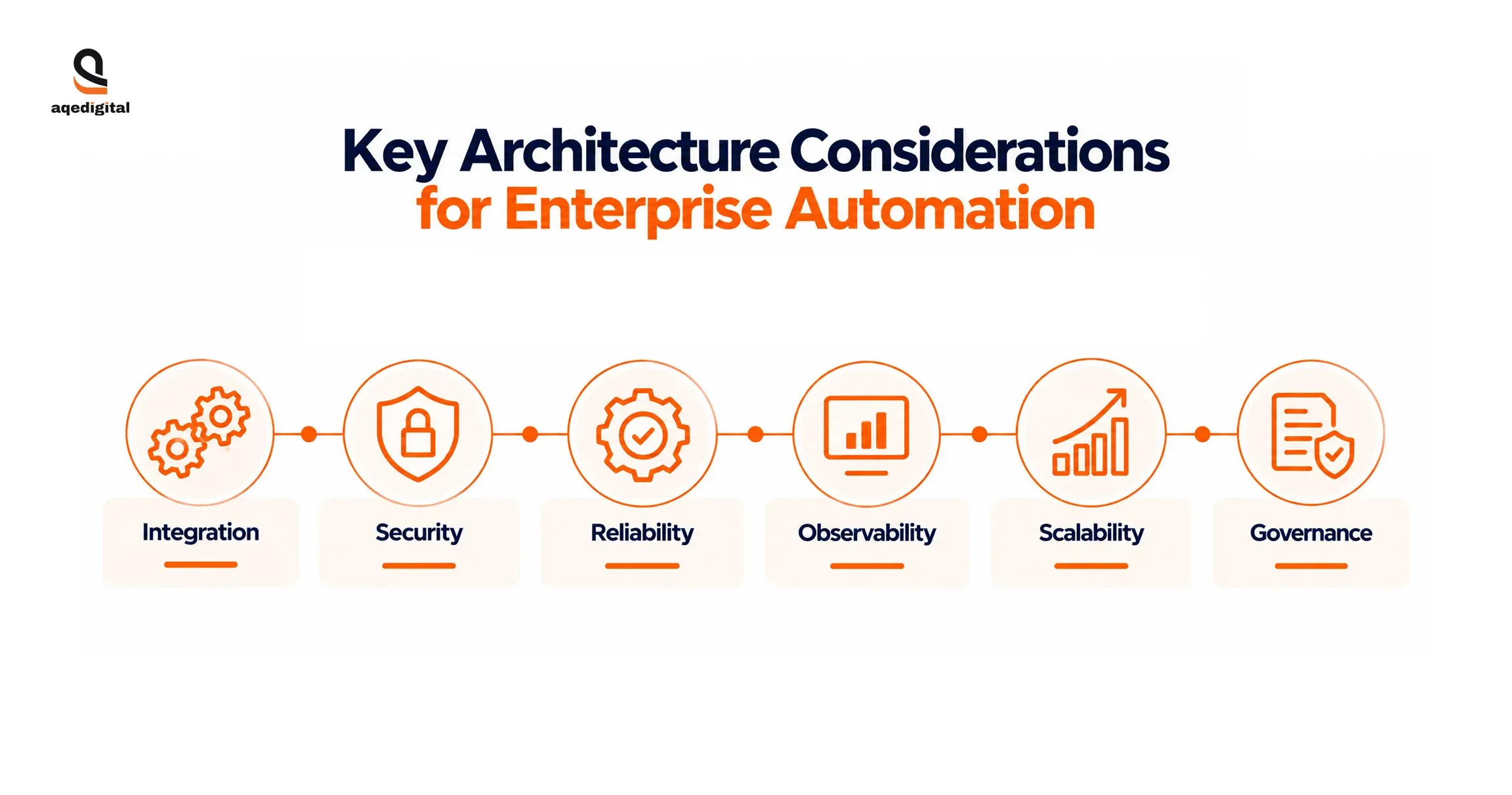
Enterprise automation requires an architecture that remains reliable as applications, teams, environments, and deployment frequency increase.
- Integration: Automation should connect APIs, repositories, infrastructure platforms, monitoring systems, security tools, and enterprise applications through maintainable interfaces.
- Security: Identity, secrets, permissions, artifacts, and deployment actions require controlled access and auditable execution.
- Reliability: Critical workflows need retries, failure handling, rollback mechanisms, and recovery paths appropriate to their operational risk.
- Observability: Pipeline execution, deployment events, infrastructure changes, and application health should generate actionable technical signals.
- Scalability: Automation components should support growing application portfolios without creating proportional increases in manual maintenance.
- Governance: Ownership, versioning, approvals, lifecycle management, and compliance requirements should be defined before automation reaches production.
How AQe Digital Can Help Build Scalable Automation
Enterprise DevOps automation requires more than implementing isolated workflows because successful transformation depends on delivery architecture, integration strategy, infrastructure, testing, security, observability, and long-term maintainability.
AQe Digital can help organizations assess existing software delivery processes, identify automation opportunities, design integration architectures, and implement solutions aligned with measurable engineering objectives.
Its DevOps automation services can support organizations dealing with fragmented toolchains, repetitive delivery processes, infrastructure inconsistencies, legacy applications, integration challenges, and growing release volumes.
For organizations evaluating their broader automation roadmap, DevOps automation services can provide structured support for assessing processes, technical dependencies, automation opportunities, and implementation priorities.
The resulting architecture may combine CI/CD platforms, infrastructure as code, containers, testing frameworks, observability platforms, AI capabilities, and existing enterprise systems rather than forcing every process into a single technology approach.
Our experts can also help organizations evaluate and integrate DevOps automation tools according to their existing architecture, engineering workflows, security requirements, and scalability objectives.
The focus remains on building maintainable automation capabilities rather than creating another collection of disconnected scripts.
Conclusion
The most effective DevOps programs do not begin by asking how many engineering tasks technology can eliminate. They begin by examining how code, infrastructure, testing, decisions, and operational responsibilities move through the software delivery lifecycle.
For engineering teams, release automation can create more predictable delivery, while automation across testing, infrastructure, security, and observability provides the foundation for continuous improvement.
Organizations that establish strong delivery foundations can progressively introduce intelligent capabilities while maintaining governance, observability, security, and human accountability.
AQe Digital helps businesses move toward that model by combining DevOps engineering, automation architecture, integration expertise, and digital transformation capabilities around measurable delivery outcomes.
Contact us to know more about how our DevOps automation services can help you address the unique delivery challenges and requirements of your business.