Cloud Migration vs Cloud Modernization: How They Differ and How to Choose the Right Approach?

Jigar Mistry
Cloud adoption is no longer simply about moving applications from physical infrastructure to a cloud environment. Businesses increasingly need to decide whether they should migrate existing workloads, modernize applications, or combine both approaches.
The distinction matters because cloud migration can improve infrastructure flexibility and scalability, while cloud modernization can fundamentally improve how applications are developed, deployed, maintained, and scaled.
For organizations planning a transformation, cloud migration consulting can help assess existing workloads, dependencies, security requirements, and business objectives before selecting the right path.
Gartner forecasts that worldwide end-user spending on public cloud services will reach $723.4 billion in 2025, up from $595.7 billion in 2024.
A well-planned cloud modernization strategy can go further by addressing application architecture and technical limitations that may continue after a basic migration.
What Is Cloud Migration?
Cloud migration is the process of moving applications, workloads, data, databases, and supporting infrastructure from an existing environment to a cloud platform.
The objective is usually to achieve greater scalability, operational flexibility, availability, or infrastructure efficiency without necessarily redesigning the application itself.
A migration can involve moving workloads from on-premises data centers, private infrastructure, or one cloud environment into another. The complexity depends on application dependencies, data volume, architecture, compliance requirements, and downtime tolerance.
Types of Cloud Migration
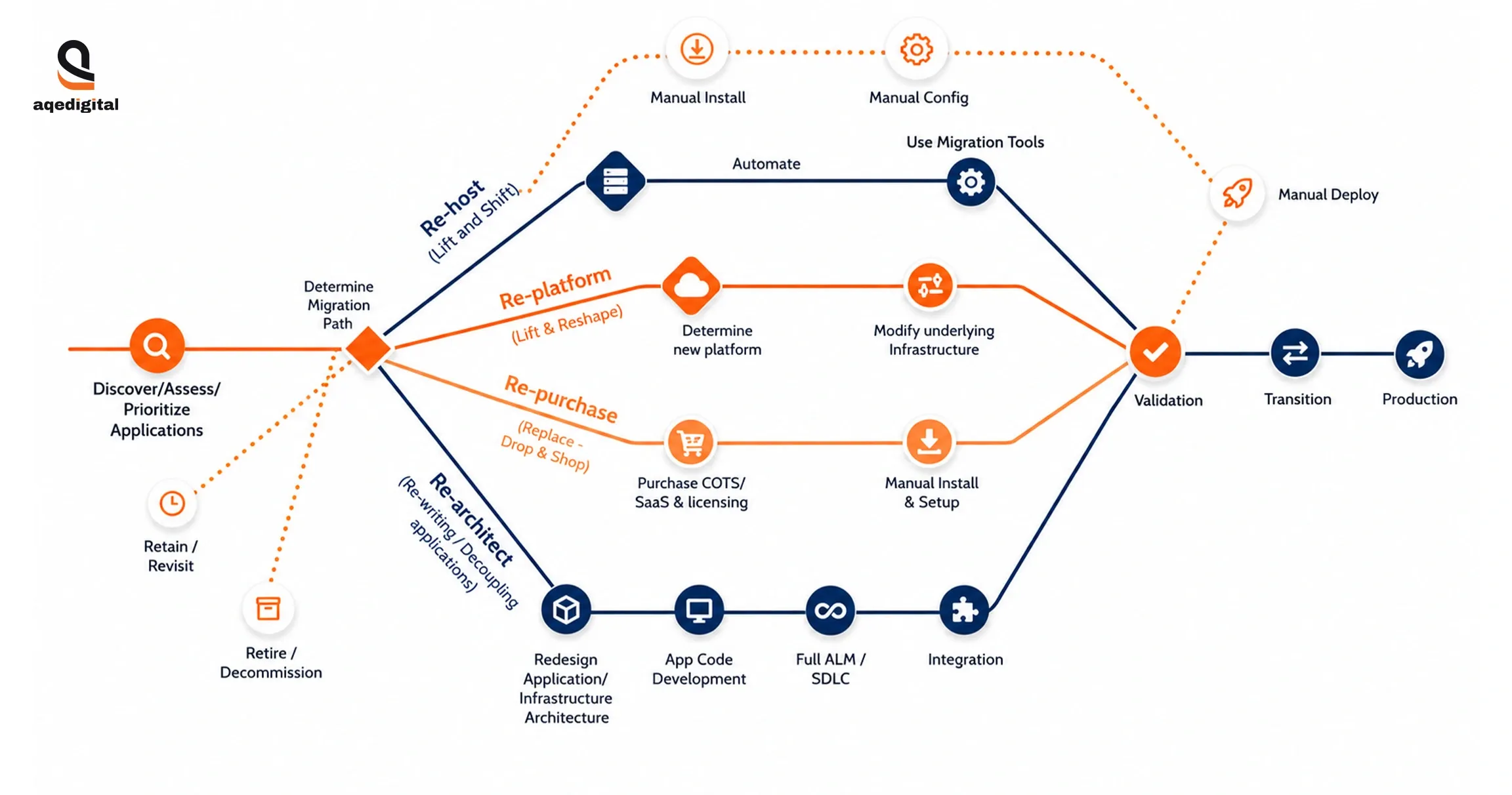
Businesses can choose different migration approaches depending on how much change an application requires.
Rehost
Rehosting, often called "lift and shift," moves an application and its supporting infrastructure to the cloud with minimal changes to the existing architecture.
It is usually faster and less disruptive, making it suitable when infrastructure migration is the immediate priority.
Replatform
Replatforming introduces limited changes to an application so it can benefit from selected cloud capabilities without requiring a complete redesign.
For example, an application may move from a self-managed database to a managed cloud database service while keeping most application code unchanged.
Repurchase
Repurchasing replaces an existing application or software solution with a cloud-based alternative, often through a SaaS platform.
This approach can eliminate the need to migrate and maintain certain legacy systems when a suitable cloud service already meets business requirements.
Refactor
Refactoring involves making significant changes to application code and architecture so the workload can take better advantage of cloud-native capabilities.
It requires more development effort than rehosting or replatforming but can provide greater scalability, resilience, and operational flexibility.
Retain
Retention means keeping an application in its existing environment when migration does not currently provide enough technical or financial value.
Organizations may retain systems because of regulatory requirements, complex dependencies, limited business value, or plans to replace them later.
Retire
Retiring removes applications that are obsolete, duplicated, unused, or no longer support meaningful business processes.
Identifying these workloads before migration can reduce unnecessary cloud costs and prevent teams from carrying outdated systems into the new environment.
These approaches are often called the 6 Rs of cloud migration, although terminology can vary between cloud providers and consulting organizations.
Cloud Migration Examples
A business might migrate its existing web application from an on-premises server to Amazon Web Services, Microsoft Azure, or Google Cloud without fundamentally changing its application architecture.
Other examples include:
- Moving enterprise databases from physical servers to managed cloud databases.
- Migrating virtual machines into cloud infrastructure.
- Moving file storage into scalable cloud storage services.
- Transferring development and testing environments to cloud infrastructure.
- Migrating an existing application between cloud providers.
The key point is that migration does not automatically mean modernization. An application can move to the cloud while retaining much of its original architecture.

What is Cloud Modernization?
Cloud modernization involves transforming applications, architectures, and development practices so they can take better advantage of modern cloud capabilities.
Instead of simply relocating existing workloads, modernization examines how applications are built and operated.
This may involve containers, microservices, serverless computing, managed databases, APIs, automated deployment pipelines, observability, and cloud-native architecture.
The Cloud Native Computing Foundation reported that 89% of surveyed organizations had adopted cloud-native techniques to some degree, with 80% running Kubernetes in production in its 2024 annual survey.
The goal is not modernization for its own sake. It is to improve attributes such as scalability, maintainability, deployment speed, resilience, security, and development productivity.
Types of Cloud Modernization
Modernization can range from targeted improvements to complete architectural transformation.
Application Refactoring
Refactoring changes an application's internal code structure without necessarily changing its overall functionality or user experience.
It can improve maintainability, performance, testing, and cloud compatibility while allowing the business to preserve existing application capabilities.
Rearchitecting
Rearchitecting involves redesigning major parts of an application to overcome limitations within its existing architecture.
This may include moving from tightly coupled components toward more scalable architectures that better support distributed cloud environments.
Containerization
Containerization packages applications and their dependencies into portable containers that can run consistently across development, testing, and production environments.
It can simplify deployment and provide greater flexibility when organizations adopt platforms such as Kubernetes.
Microservices Transformation
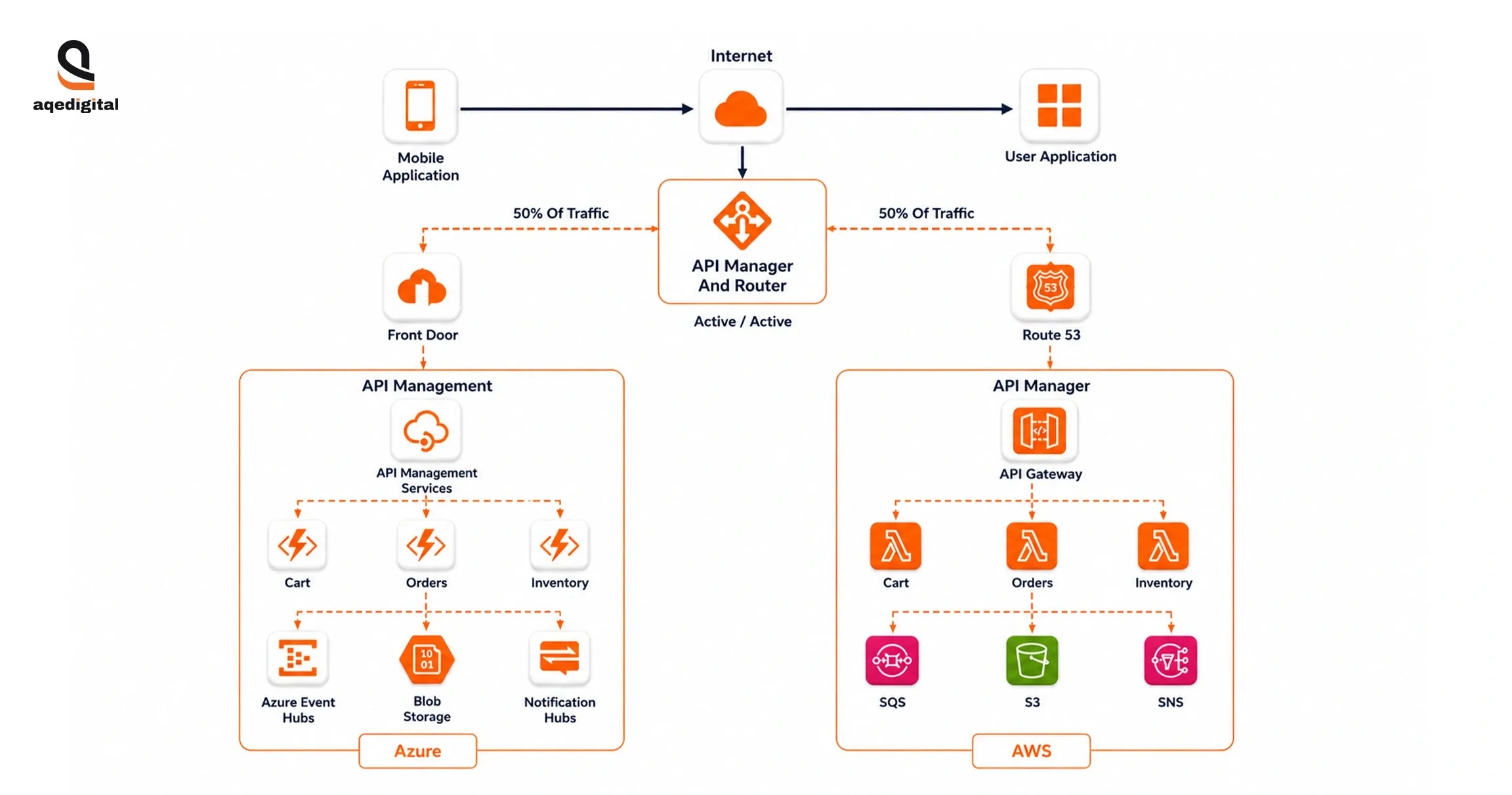
Microservices modernization breaks a large application into smaller, independently deployable services that communicate through defined interfaces.
This approach can allow teams to develop, deploy, and scale individual services without rebuilding or redeploying the entire application.
Database Modernization
Database modernization involves moving from legacy database architectures toward managed, distributed, cloud-optimized, or purpose-built database services.
The right approach can improve scalability, availability, backup management, and operational efficiency while reducing infrastructure administration.
DevOps and Delivery Modernization
DevOps modernization improves how applications are built, tested, deployed, and monitored through automation and standardized engineering practices.
Organizations may introduce CI/CD pipelines, infrastructure as code, automated testing, observability, and security controls to create a faster and more reliable delivery lifecycle.
Cloud Modernization Examples
An organization may convert a monolithic application into independently deployable services that can scale according to individual workload requirements.
Another example could involve replacing a self-managed database with a managed cloud database while introducing automated backups, monitoring, scaling, and disaster recovery.
A business might also containerize legacy applications, implement CI/CD pipelines, and introduce infrastructure as code to create more consistent and repeatable deployments.
Cloud Migration vs. Cloud Modernization: Key Differences
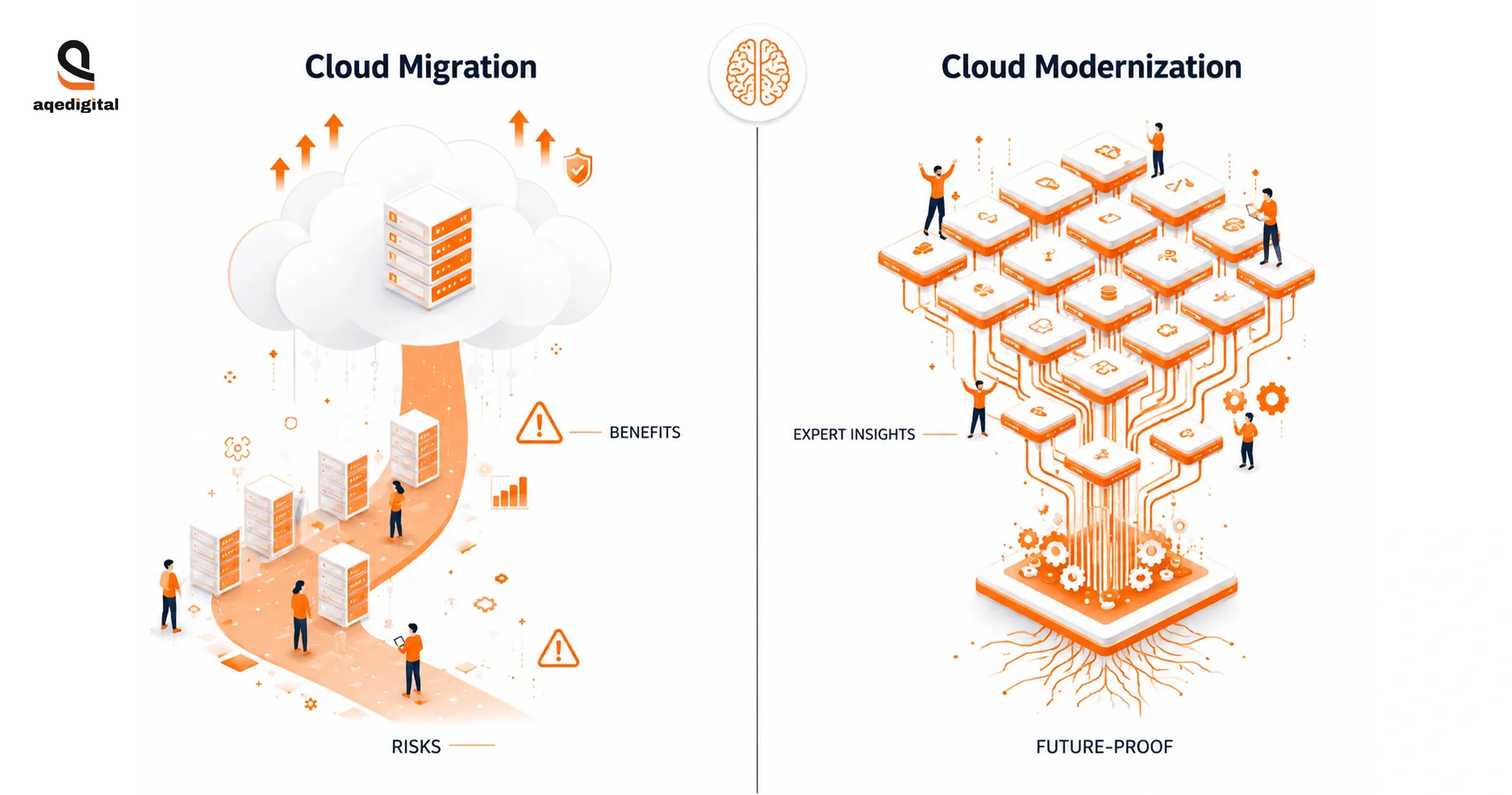
Migration and modernization can support the same cloud transformation program, but they solve different problems.
| Cloud Migration vs. Cloud Modernization | |
|---|---|
| Cloud Migration | Cloud Modernization |
| Primarily moves existing workloads to the cloud. | Transforms applications for better cloud capabilities. |
| Can involve minimal application changes. | Usually requires architectural or code-level changes. |
| Often focuses on infrastructure and workload relocation. | Focuses on application architecture and engineering practices. |
| Can provide faster cloud adoption. | Usually requires more planning and development effort. |
| Lower initial application transformation effort. | Higher initial transformation effort. |
| Useful for applications that already perform adequately. | Valuable when legacy architecture limits business or technical goals. |
| Can preserve existing technical debt. | Can reduce selected architectural and technical limitations. |
| May be suitable for quick infrastructure transition. | Better suited to long-term application transformation. |
When Do You Need Cloud Migration?
Cloud migration can be appropriate when your existing applications are functional, but your infrastructure creates operational or business limitations.
Consider migration when:
- Your data center infrastructure is becoming expensive to maintain
- You need greater infrastructure scalability
- Hardware refresh cycles are creating unnecessary operational work
- You want to improve infrastructure availability and disaster recovery
- Your organization needs faster infrastructure provisioning
- Existing applications can run effectively without major architectural changes
For these scenarios, cloud migration solutions can provide a practical path toward cloud adoption without immediately undertaking extensive application redevelopment.
When is Cloud Modernization Necessary?
Cloud modernization becomes more important when the application's existing architecture prevents you from achieving the flexibility or performance expected from cloud environments.
Consider modernization when:
- Monolithic architecture makes independent scaling difficult
- Releases require lengthy manual processes
- Legacy dependencies restrict development speed
- Applications experience scalability or reliability limitations
- Infrastructure management consumes excessive engineering effort
- Teams need automated CI/CD and modern observability
- Business requirements demand frequent application changes
In these situations, simply moving the application may transfer existing limitations into a new environment. Cloud application modernization services can instead address those architectural constraints.
Benefits of Cloud Migration and Cloud Modernization
Cloud transformation can deliver different benefits depending on whether the organization focuses on migration, modernization, or a combination of both.
Scalability and Resource Flexibility
Cloud migration allows businesses to move workloads onto infrastructure that can scale resources more flexibly than many traditional environments.
Cloud modernization can take this further by allowing individual application components to scale independently through architectures such as microservices, containers, or serverless services.
Improved Operational Efficiency
Migration can reduce the infrastructure management burden associated with physical servers, hardware maintenance, and traditional data center operations.
Modernization can additionally automate deployment, infrastructure provisioning, testing, monitoring, and application operations, allowing engineering teams to spend more time on product development.
Faster Application Delivery
Cloud migration can provide faster access to infrastructure resources, particularly when provisioning previously depended on physical hardware or lengthy infrastructure processes.
Modernization can improve the software delivery life-cycle further through CI/CD pipelines, automated testing, infrastructure as code, and independently deployable application components.
Better Resilience and Availability
Cloud migration can provide access to distributed infrastructure, managed services, backup capabilities, and disaster recovery options.
Modernization can strengthen application resilience by designing systems around fault isolation, automated recovery, redundancy, and independently managed services.
Greater Cost Visibility and Control
Migration can replace some capital-intensive infrastructure expenses with more flexible cloud consumption models, although cloud costs still require active management.
Modernization can improve cost efficiency by matching application resources to actual workloads and reducing unnecessary infrastructure utilization through appropriate architectural choices.
Improved Security and Compliance Management
Cloud migration provides access to cloud-native identity, encryption, monitoring, security controls, and managed infrastructure capabilities.
Modernization can integrate security more deeply into development and deployment through automated security testing, centralized observability, policy controls, and DevSecOps practices.
Deciding Between Cloud Migration and Modernization: What Should You Consider?
Choosing between migration and modernization requires more than evaluating technical architecture. Business objectives, application complexity, budget, risk, team capability, and future growth should all influence the decision.

Business Objectives
Start by identifying what the transformation must achieve.
If the primary goal is infrastructure consolidation or a data center exit, migration may be sufficient. If the objective involves faster releases, greater scalability, or architectural flexibility, modernization may deliver more value.
Application Complexity
Assess the application's architecture, dependencies, databases, integrations, and technology stack before choosing an approach.
Older applications with tightly coupled components may require incremental modernization rather than a direct migration.
Technical Debt
Identify outdated frameworks, unsupported dependencies, inefficient code, and architectural constraints that could prove costly to migrate.
Moving technical debt into the cloud does not eliminate it.
Performance and Scalability
Determine whether the current architecture can handle expected workloads, traffic patterns, and future growth.
If scaling the entire application is inefficient, modernization may provide greater long-term value than simply increasing infrastructure capacity.
Budget and Timeframe
Migration often requires less application redevelopment, which can make it suitable for organizations working under tighter timelines.
Modernization requires greater engineering investment but can produce broader technical improvements over the longer term.
Team Capabilities
Evaluate whether your internal teams have experience with cloud-native architecture, containers, DevOps, infrastructure as code, security automation, and managed cloud services.
External cloud migration consulting services can help bridge capability gaps while reducing transformation risks.
Security and Compliance
Review data sensitivity, regulatory requirements, identity management, encryption, network architecture, and audit requirements before selecting the target architecture.
Security should be designed into the transformation rather than addressed after workloads have moved.
Total Cost of Ownership
Compare not only migration expenses but also infrastructure consumption, licensing, development effort, maintenance, monitoring, support, and future modernization requirements.
A lower initial migration cost does not necessarily represent a lower long-term technology cost.
Future Architecture
Finally, consider where the application needs to be three to five years from now.
A migration-first strategy may be appropriate when immediate infrastructure change is the priority, while modernization can provide greater value when long-term application agility is the strategic objective.
How AQe Digital Can Help With Cloud Migration and Modernization
Cloud transformation becomes more effective when migration decisions are based on application dependencies, business priorities, technical constraints, and long-term architecture.
AQe Digital can help organizations assess existing environments, plan transformation roadmaps, modernize applications, and implement cloud solutions aligned with their operational and business objectives.
Cloud Assessment and Strategy: Our team evaluates workloads, dependencies, architecture, and business requirements to identify suitable migration and modernization opportunities.
Migration Planning and Execution: From workload assessment through deployment, teams can structure migration activities around application dependencies, security requirements, testing, and business continuity.
Application Modernization: We help transform suitable applications using modern architectural approaches, cloud-native technologies, APIs, containers, and improved development practices.
DevOps and Automation: Modern delivery practices can help automate infrastructure provisioning, testing, deployment, monitoring, and operational processes across cloud environments.
Scalable Cloud Architecture: The objective is not simply to move applications into the cloud, but to create an architecture that can support changing workloads, evolving business requirements, and future technical improvements.
Conclusion
Cloud migration and modernization should not be treated as competing technology choices. They represent different levels of transformation that can be combined according to an organization's application landscape and business priorities.
Migration can provide a practical route away from infrastructure limitations, while modernization can create a stronger foundation for application agility, scalability, and long-term engineering efficiency.
The right strategy begins by understanding what the business needs from its technology rather than choosing a cloud approach simply because it is popular.
If you are planning your next cloud transformation, contact us to help identify the right modernization opportunities and build a practical path toward a more scalable cloud ecosystem.