How to Develop An App Like Airbnb For Your Business?

Vishal Panchal
Airbnb offers a successful model for entrepreneurs and businesses to transform spare rooms into a multibillion-dollar venture. Beyond this, it enables the creation of digital marketplaces for staycations, property rentals, and co-working spaces, projected to reach $38.4 billion by 2034.
However, competing in this vast market presents challenges like scaling the platform, establishing trust, and ensuring app reliability. These challenges need a custom software solution that maintains performance as the user base expands. Regulatory compliance and data security management are also critical, alongside the high development costs many entrepreneurs face.
This article will address your concerns as a potential creator of Airbnb alternatives, outlining the reasons to build one, its benefits, business models, top apps, and development costs. Let’s get started.
What Does An App Like Airbnb Mean for Businesses?
For mid-sized startups, an Airbnb-type platform is more than a travel app. It’s an opportunity to tap into the platform economy. Applications like Airbnb connect supply and demand at scale, creating ecosystems where property owners and travelers connect seamlessly.
However, it’s a two-sided marketplace, featuring reviews and secure payments, as well as cloud-native infrastructure built for scale. With the right strategy, these platforms can achieve growth without requiring a significant amount of capital, generate steady income, and enter or transition into new markets without the need for physical assets.
At the core of this strategy is the Airbnb business model, which drives success through a highly scalable and flexible platform. But what’s so special about this business model?
What is Airbnb’s Business Model?
Airbnb works as a platform that connects property owners (hosts) and travelers (guests). The company does not own any properties but provides a space for these two groups to meet. The real value of Airbnb lies in its system, which facilitates millions of transactions easily, securely, and adaptively.
The Core Principles of Airbnb’s Business Model:
- Asset-light growth: Airbnb generates revenue by connecting people to rentals, enabling it to grow rapidly without requiring substantial capital.
- Self-reinforcing network: More hosts bring in more guests, and more guests attract more hosts, creating a cycle of growth.
- Building trust: Reviews, ratings, ID verification, and secure payments help establish credibility and reduce issues.
- Strong platform: Cloud-based systems enable global growth, ensuring that reliability and compliance are built into the design.
Airbnb charges hosts and guests a fee based on a percentage of each booking. They also charge service fees for additional features, such as priority listings and enhanced support. Hosts can pay for better visibility in search results. Airbnb also offers “Experiences” and long-term rentals to broaden its revenue sources.
Offering such a wide range of services on its platform requires Airbnb to build advanced features. From advanced property search to listing management and secure online payments, there are many features that an app like Airbnb needs.

What Features Should an Airbnb-Like App Include?
Creating Airbnb alternatives that can help you maximize ROI in a highly competitive market requires features tailored to meet the distinct needs of users. When creating an app like Airbnb, it is essential to ensure that features are responsive, scalable, and flexible.
Some of the key features you can include are,
Features For The Guest App
Here are the top features you can add to the guest app, creating an Airbnb alternative.
Features For The Host App
Here are the top features you can add to the host app.
Features For The Admin App
Here are the top features you can add to the admin app.
Now that you know what features to add to an app like Airbnb, here is how you can build such an application.

How Do You Build an App Like Airbnb Step-by-Step?
Building an application like Airbnb involves more than just development; it requires creating a platform that connects users, fosters trust, and scales globally. Here’s how entrepreneurs, hospitality owners, and SaaS founders can approach it strategically, leveraging custom mobile app development services.
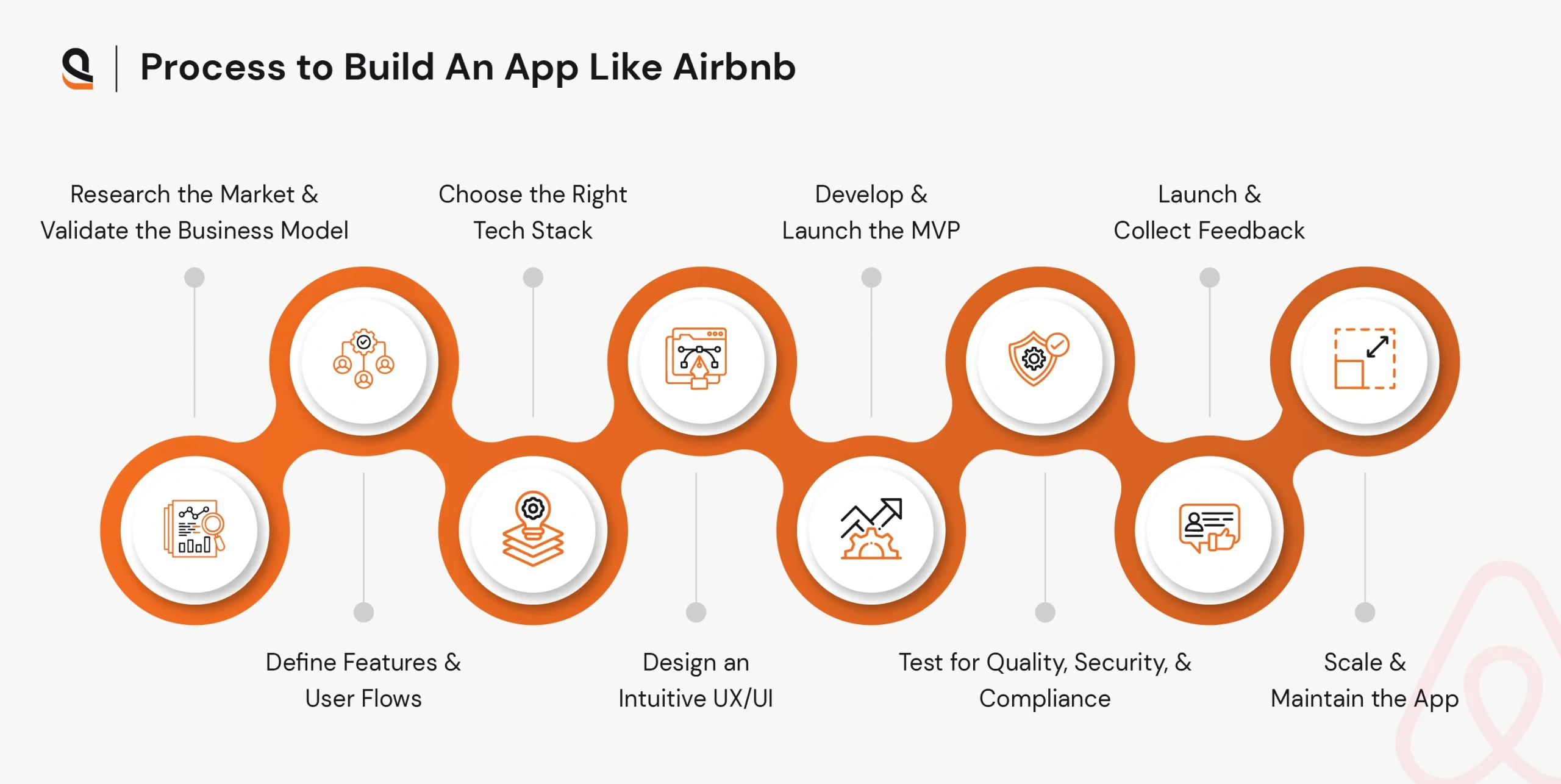
Step 1: Research the Market and Validate the Business Model
The journey starts with market research. Entrepreneurs must decide whether to launch a broad Airbnb alternative or focus on a niche, such as student housing, co-living, healthcare stays, or even workspaces. Studying competitors, such as Vrbo versus Airbnb or other similar sites, helps uncover gaps and opportunities. The goal here is to validate the business model and define what will differentiate your platform.
Step 2: Define Features and User Flows
Once the model is validated, the next step is to outline the MVP features. Any Airbnb-like app should include basic features such as registration, property listings, advanced search filters, booking functionality, payment processing, reviews, and secure messaging.
Mapping the journeys of users, hosts, and admins ensures a smooth, intuitive, and scalable experience. The focus at this stage is on clarity, building lean, testing fast, and avoiding unnecessary complexity.
Step 3: Choose the Right Tech Stack
The technical foundation determines scalability. Modern Airbnb-type apps are typically built using frameworks like React Native or Flutter for mobile development, Node.js or Python for the backend, and PostgreSQL or MongoDB for data management.
Cloud-native infrastructure on AWS, GCP, or Azure ensures global reach and flexibility. Integrations with payment services (such as Stripe and PayPal), mapping APIs (like Google Maps), and messaging APIs are also essential. At AQe Digital, we prioritize cloud application development services to ensure compliance and scalability from the outset.
Step 4: Design an Intuitive UX/UI
Even the best features won’t work if the design is clunky. Application modernization, updating legacy systems, refreshing the UI, and adopting modern UX patterns are essential for a successful Airbnb-style app. Prioritize simple, trust-building design so guests can search, book, and pay in just a few clicks. Verified badges, transparent pricing, and intuitive navigation inspire confidence and keep users coming back.
Step 5: Develop and Launch the MVP
Instead of building everything at once, start with an MVP. This lean version includes the most critical features, enabling founders to test product-market fit quickly. White-label web design services and Airbnb clone app development can further reduce time to market while providing customization options. This step is about validating real user behavior before investing in a full-scale rollout.
Step 6: Test for Quality, Security, and Compliance
Before launch, the app must undergo rigorous testing. Functional and load testing ensure smooth performance under pressure, while security testing adds layers such as encryption, multi-factor authentication, and secure payment processing. Depending on your niche, compliance with GDPR, PCI DSS, or HIPAA rules 2025 may also be required. Without these safeguards, scaling an Airbnb-like app becomes risky.
Step 7: Launch and Collect Feedback
Launching to a smaller audience or region helps gather valuable feedback. Reviews, ratings, and user behavior analytics pinpoint areas where the user experience can be enhanced. This stage involves learning, optimizing, and preparing the app for broader markets.
Step 8: Scale and Maintain the App
The final step is continuous improvement. Features like loyalty programs, AI-driven recommendations, and multi-currency support can be added over time. Scaling also means ensuring the infrastructure can handle traffic spikes and global expansion.
Equally important is budgeting for updates, as knowing the cost of maintaining an app ensures the platform remains competitive and reliable. At AQe Digital, we help founders and businesses not just build apps similar to Airbnb, but also scale and sustain them with future-proof technology.
How Much Does It Cost to Build and Maintain an Airbnb-Like App?
Building an app like Airbnb can cost anywhere between $35,000 and $ 300,000 or more. However, the cost may vary based on features, scale, compliance requirements, and whether you choose to build from scratch or customize an Airbnb clone app. For example, a custom app similar to Airbnb can cost more than a clone app because it needs extensive coding.
However, Airbnb clone app development often comes with pre-built code that has limitations on customizations and may also pose security issues. At the same time, a custom app like Airbnb offers more flexibility for enterprises and entrepreneurs to add specific features. Another crucial factor is application complexity.
Here is the cost of developing an Airbnb-type app based on its complexity,
Which Are The Factors That Affect The Cost to Build An App Like Airbnb?
Estimating the development expenses and the cost of maintaining an app requires an understanding of various factors. For example, the platforms on which you will host the app or the type of design you are considering for the app can impact the cost.
Here are the factors you need to keep in mind while estimating the cost to build an app like Airbnb.
1. Application Scope
Complex application features require more effort and development time, resulting in higher costs. Additionally, basic listings, search, booking, and payments, as well as advanced capabilities such as dynamic pricing, AI recommendations, identity verification, dispute workflows, and host tools, increase development hours.
2. Advanced Features
Advanced features, such as an AI-powered recommendation engine, KYC/identity checks, and multi-currency payments, require more development effort and specialized talent. Hiring such specialized developers and creating advanced features will cost you more. However, with expert AI in hospitality solutions designed specifically for your organization, you can optimize the cost of an app like Airbnb.
3. Deployment Platform
The platform you choose —iOS, Android, or cross-platform —directly impacts the cost. Building natively for both iOS and Android almost doubles the development effort compared to starting with one platform.
On the other hand, hybrid frameworks like React Native or Flutter can save costs upfront but may come with trade-offs in performance and scalability. Beyond mobile, if you also want a responsive web app, your cost of ownership (TCO) will increase further.
4. UI/UX Design
A visually appealing and user-friendly design requires significant investment. Simple, template-driven UI is cheaper, but it may not deliver the premium experience users expect. Custom animations, personalized dashboards, or interactive maps will raise design and development costs but can boost user engagement and retention.
5. Technology Stack
Your choice of backend infrastructure and third-party integrations plays a significant role in determining costs. Cloud services like AWS, GCP, or Azure offer scalable options but also incur recurring costs. Similarly, integrating third-party APIs for maps, payments, chat, or notifications requires licensing fees and ongoing maintenance. A scalable and secure stack is critical, but it comes at a price.
6. Development Team and Location
The size, structure, and geography of your team can dramatically affect costs. Hiring an in-house team in the US or Western Europe can be significantly more expensive than outsourcing to development partners in regions such as Eastern Europe or South Asia.
7. Security and Compliance
Apps handling payments and personal data, like an Airbnb clone, must comply with data privacy regulations such as GDPR, PCI DSS, and local KYC rules. Building secure login systems, encrypted data storage, and fraud detection adds to the development and testing effort. Compliance-related costs are often overlooked but can be significant in the long run.
8. Maintenance and Scaling
The cost of building an app is only the beginning. Ongoing expenses for bug fixes, updates, server hosting, customer support, and scaling infrastructure can amount to 15–20% of the original development cost annually. As your user base grows, so will your need for more robust servers, security audits, and continuous feature enhancements.
Read more: What are the Top 10 Features Every Successful Enterprise Mobile App Must Have in 2025How AQe Digital Can Help Build An App Like Airbnb?
Building an app like Airbnb involves multiple cost drivers, including the scope of features and design, platform choice, compliance, and ongoing maintenance. The most effective approach is to start lean, validate with users, and then scale with advanced features such as dynamic pricing, AI-driven recommendations, and multi-currency support as your business grows.
At AQe Digital, we specialize in building scalable, user-friendly, and secure digital marketplaces. Whether you’re testing an MVP or scaling a full-featured platform, our team ensures the right mix of intuitive design, robust architecture, and future-ready tech.
With our end-to-end support from strategy and development to launch and growth, you can bring your Airbnb-style idea to market faster and more cost-effectively.