AI Loop Engineering for Software Development: How Engineering Leaders Turn Coding Agents Into Reliable Delivery Systems

Nirav Oza
AI has changed coding forever. This statement is often heard on your smartphones or TV screens, but has it really changed the way software is developed? Some may argue yes! But the truth is, engineering leaders are facing something called “Productivity Paradox.”
What this means is senior engineers basically babysit junior engineers who use AI to generate code at a frantic pace. Again, this code generation heavily relies on prompting. And with prompting, there are non-deterministic reasoning engines in play. These engines provide model drift, structural regressions, and logical hallucinations.
You get a high-speed assembly line that requires human supervision and intervention to catch every bug. And this is the biggest blocker in current AI adoption across enterprises. Loop engineering bridges the gap between human-supervised automation and complete agentic automation.
It is the missing layer in the stack that ensures no human intervention is needed to achieve the result you need from agentic workflows. But loop engineering in AI software development is a new concept, and most engineering heads have doubts.
This piece focuses on providing an understanding of what is AI loop engineering in software development and why you should adopt it.
What is AI Loop Engineering? (And Why It's Replacing Prompt Engineering)
Loop engineering is a process of designing, operating, and refining repeatable feedback cycles that help AI agents achieve verified outcomes without human intervention. So, this is like end-to-end automation for your workflows.
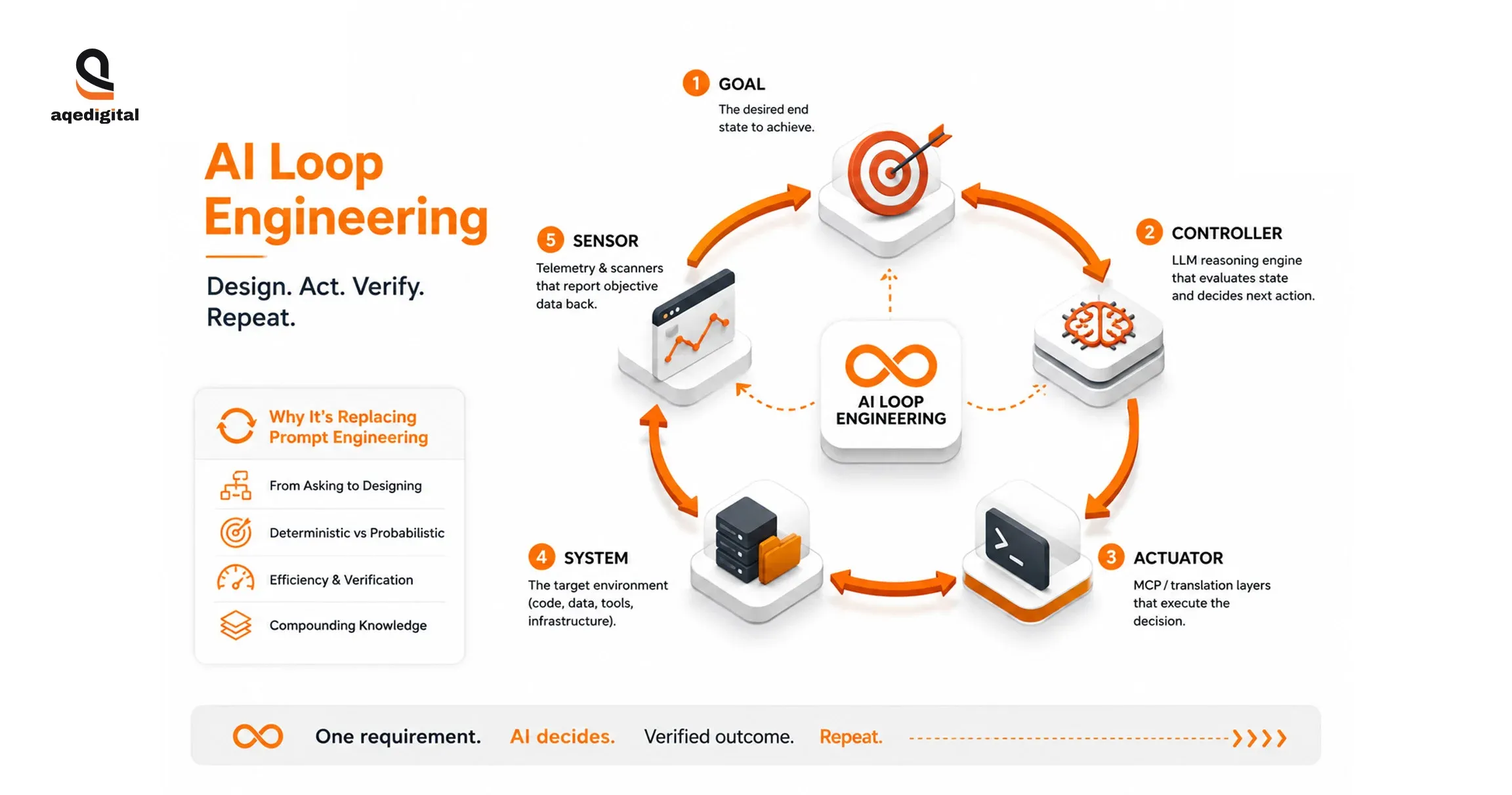
Unlike the conventional approach of first prompting the LLM and then reviewing the results and again prompting to get the desired results, this loop ensures you give only one of your requirements. AI becomes the decision-maker. It evaluates the environmental feedback to decide what the next move will be.
Structural Anatomy (The Model)
A production-grade AI loop engineering system works like cruise control on a car. It continuously monitors the state to achieve a verifiable result through five core components,
- The goal - The end result or state you want after competition of the task by AI agents like “ensure all integration tests in test/auth pass.”
- The controller- It is the orchestrator of the entire task, ideally the LLM (reasoning engine), which evaluates the system’s state and selects the next best action.
- The actuator- These are Model Context Protocol (MCP) or translation layers that execute the controller’s decision.
- The system- this is the target environment, which includes everything from file systems and databases to containerized registries.
The sensor is the deterministic telemetry layer that tests run times and security scanners to report objective data back to the controller.
Why is it replacing prompt engineering?
Prompt engineering is a bottleneck for most organizations. Because there is no standard, some engineers, coders, and developers are great at prompting. Others are not. Plus, prompting optimizes the entire software development process only for single responses waiting for human approval.
AI loop engineering in software development is shifting the entire process from
- Asking to designing- Prompt engineering is still stuck on what tech stack I should use, but loop engineering says I will use these frameworks and provide you with the result you need. It shifts the entire process from approving each step to designing a system that checks every step by itself.
- Deterministic vs probabilistic- Instructions by users in a context window can be suggestions for AI agents. So they sometimes ignore it. However, loop engineering is a more deterministic approach, so AI agents need to ensure specific results at the end of the process.
- Efficiency and verification- AI loop engineering in software development allows execution of asynchronous workflows. This includes the execution of overnight pull request optimization, multi-hour benchmarking, and other such tasks that are humanly difficult to monitor.
- Compounding knowledge- Loop engineering uses skills (codified project knowledge in SKILL.md files) and memory to ensure the knowledge of task execution compounds instead of resets.
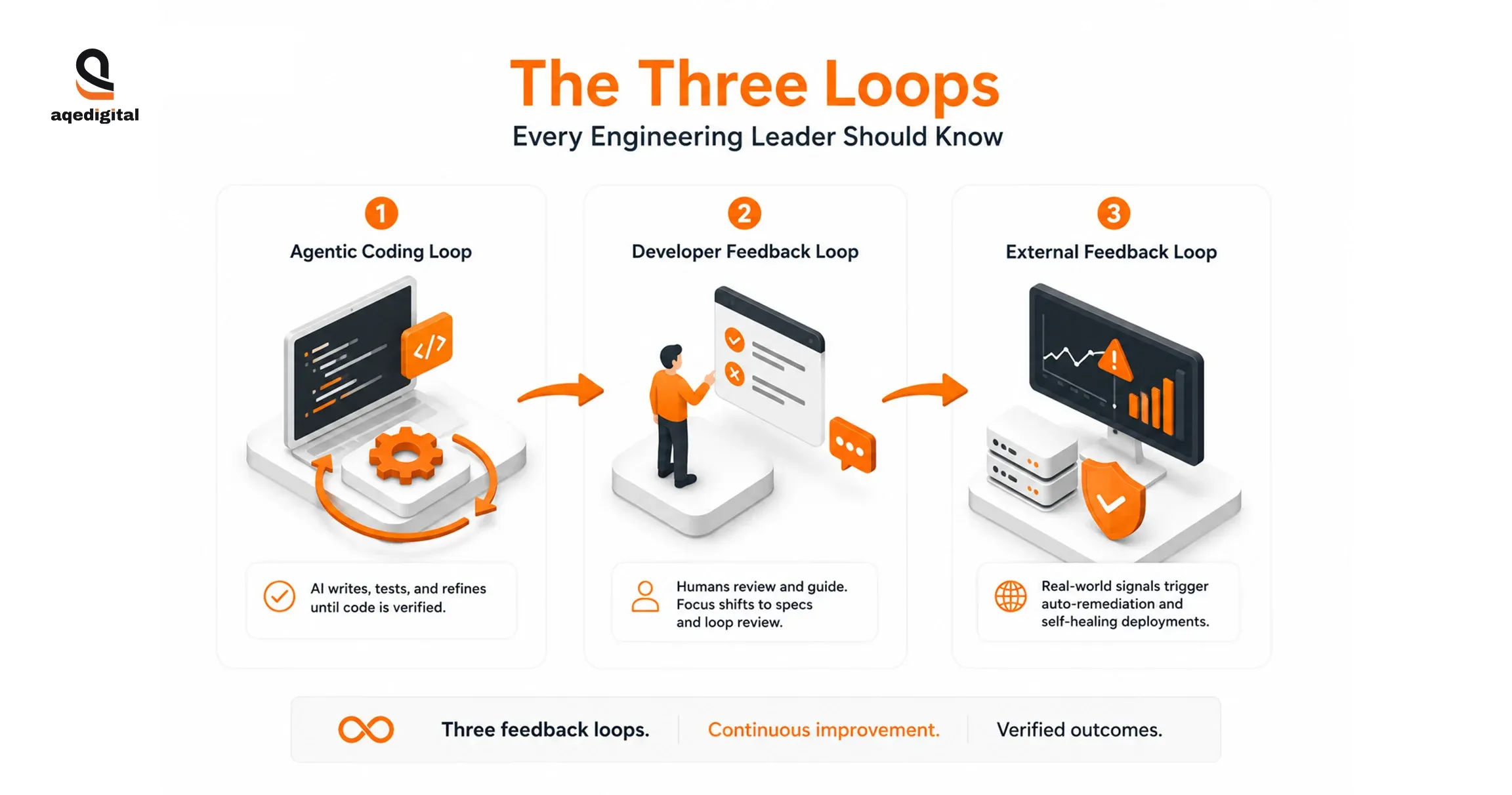
The Three Loops Every Engineering Leader Should Know
Andrew Ng’s framework to build complex products using AI agentic workflows is formalized around three distinct feedback loops,
Agentic Coding Loop
The first and base-level loop of the entire loop engineering system is agentic coding, where AI functions as the decision-maker. It begins with an agent receiving the specification of the task or product to be built. It completes planning, writing code, and testing tasks autonomously till a bug-free code is verified.
Agents use deterministic test runners and linters to measure the outcomes after every run. AI agents adjust the entire process to get desired results.
Developer Feedback Loop
This loop merges the conventional and loop engineering approaches. It integrates human intelligence into automated systems to ensure AI mistakes can be identified and rectified urgently. In this loop, the engineering value moves away from syntax authorship towards specification engineering and loop review.
External Feedback Loop
It is a loop that connects the software side with real-world scenarios for automation. Production monitoring systems detect anomalies in real-time and automatically trigger loops that implement code repairs and deploy self-healed containers.
The Business Case - ROI, Market Signal, and Adoption Data
Every engineering leader building a budget case for loop engineering hits the same wall. The CFO asks for numbers, not concepts. So here are the numbers that matter, and one honest caveat that most vendor decks conveniently skip.
Enterprise ROI evidence
The headline figure first. A Forrester Total Economic Impact study puts GitHub Copilot at a 376% ROI over three years. Healthy organizations running AI coding tools see 2.5-3.5x average returns, and top-quartile teams reach 4-6x. At the developer level, the average engineer saves around 3.6 hours per week using AI coding tools. Scoped tasks complete 55% faster with AI assistance.
Adoption benchmarks
AI adoption is now nearly universal. Stack Overflow's 2025 Developer Survey found that more than 84% of developers are using or planning to use AI tools, up from 76% the previous year. However, successful adoption depends on having a clear AI strategy, not just access to AI tools.
However, only 29% of developers trust AI output, down 11 percentage points year over year. The number one frustration, cited by 45% of respondents, is AI code that is "almost right, but not quite." And 66% of developers say they spend more time fixing almost-right AI code.
Read those two trends together, and you get the real business case. Adoption without trust is exactly the productivity paradox from the intro. Loop engineering exists to close that gap with verification, not with more prompting.
Real-World Examples - Loops and Agents in Production
Theory convinces nobody in a budget meeting. Named companies with published numbers do. So here are three you can put in front of your leadership team this week.
Accenture (enterprise-scale Copilot)
Accenture ran one of the largest enterprise evaluations of AI coding to date. Pull requests increased by 8.69%. The pull request merge rate rose 15%. Successful builds jumped 84%.
The build number is the one to watch. More PRs merging with more builds passing means throughput increased without quality collapsing. Developers retained 88% of AI-generated characters in their editor, and 90% committed code the tool suggested. That is a feedback loop working at enterprise scale, with deterministic checks (builds, tests, review) acting as the sensor layer.
Duolingo (onboarding + review velocity)
Duolingo's numbers hit a different pain point: onboarding. Developers new to a repository moved at least 25% faster with AI assistance, against 10% for engineers already familiar with the codebase.
Median code review turnaround dropped 67%, from 9.6 days to 2.4 days.
Pull request volume rose 70%. Notice what this means for the loop model. The developer feedback loop got faster because the agentic coding loop underneath it produced cleaner input. Loops compound.
Tooling reality - Claude Code, Codex, Cursor, OpenClaw
| AI Coding Tools Comparison – Key Capabilities (2026) | |
| Tool | Key Capability / Role |
| Claude Code | Authoring approximately 4% of public GitHub commits per day and widely used for autonomous agentic coding workflows. |
| Codex | Cloud-scale parallel task execution with CI/CD integration, enabling autonomous software engineering workflows. |
| Cursor | AI-first IDE for daily development, offering inline code generation, debugging, and rapid developer feedback loops. |
| OpenClaw | Open-source coding agent that lets teams self-host and pay only for model API usage and infrastructure. |
A Practical Roadmap - How to Adopt Loop Engineering on Your Team
Here is the staged plan. Each stage builds on the previous one, and skipping ahead is how most adoptions fail.
Stage 1 - Instrument before you accelerate
Baseline your delivery metrics before a single agent touches your codebase. DORA metrics (deployment frequency, lead time, change failure rate, time to restore), PR turnaround, and review cycle time. Not vibes. Numbers.
This matters because developers misjudge their own AI productivity. If you cannot measure the before, you will never prove the after, and your budget case dies in the next planning cycle.
Stage 2 - Write specs and evals a loop can act on
A loop is only as good as its goal definition. "Make the checkout faster" is a prompt. "Reduce p95 checkout API latency below 300ms with all integration tests in test/checkout passing" is a specification a loop can verify itself against.
Start converting your top recurring task types into spec templates with paired eval suites. This is where engineering value shifts, away from syntax authorship and toward specification engineering, exactly as the developer feedback loop section described.
Stage 3 - Design verification, review gates, and stopping conditions
Decide what "done" means mechanically. Which tests must pass? Which scans must clear. Who reviews what, and at which points the loop must stop and wait for a human.
Set failure limits here too. Three failed attempts, then escalate. Without stopping conditions you are not running a loop. You are running loopmaxxing with a budget attached.
Stage 4 - Govern cost, permissions and escalation
Put a per-loop token budget in place with alerts at 50% and hard stops at 100%. Scope agent permissions to the minimum the task needs. Define the escalation path: who gets paged when a loop stalls, and who owns the decision to retry, rewrite the spec, or take the task back to a human. This stage is boring. It is also the one that keeps loop engineering off your CFO's incident report.
Stage 5 - Scale from single agents to supervised subagent workflows
Only now do you scale. Single verified loops first. Then orchestrated subagent workflows where a controller agent delegates to specialized subagents for planning, coding, testing, and review, each with its own eval gates.
The teams doing this well run overnight PR optimization, multi-hour benchmarking, and self-healing deployment loops with humans reviewing outcomes, not keystrokes.
How AQe Digital Executes AI Loop Engineering for Software Development
You can build all five stages internally. Most teams take 9-12 months to get there, and the expensive part is not the tooling. It is the failed loops along the way.
This is where AQe Digital's approach differs from typical AI development partners. Most vendors sell to you, agents. AQe Digital builds the loop infrastructure around them, which is the part that actually determines whether agents deliver or drift. A real productivity jump in engineering with AI comes from reliable systems, not just more AI agents.
The execution model runs on three layers,
- Instrumented baselines first - Every engagement starts with DORA and throughput instrumentation of your existing delivery pipeline. No acceleration before measurement. This is how ROI gets proven in your numbers, not vendor benchmarks.
- Eval-first loop design - AQe Digital's engineering teams convert your recurring task types into verifiable specifications with paired eval suites, then wire deterministic verification (test runners, linters, security scanners, build checks) as the sensor layer of every loop. Agents do not self-report success. The evals decide.
- Governed autonomy at scale - Permission scoping, token budget controls, review gates, and failure-limit escalation built into every workflow before it runs unattended. Then staged scaling from single agentic loops to supervised subagent orchestration across your SDLC.
Start Building AI Loop Engineering That Scales
Your job as an engineering leader has changed, but not in the way the headlines suggested. It was never going to be about writing better prompts. It is about engineering the loops around the agents, the goals, verifiers, gates, and budgets that turn probabilistic code generation into deterministic delivery.
The adoption data says your competitors are already running agents. The trust data says most of them are running agents badly. The gap between those two facts is where loop engineering pays, and it will not stay open long. The decision in front of you is not whether to adopt AI coding. That decision is made. The decision is whether you keep babysitting it or start engineering it. Modern AI ML development services focus on delivering reliable AI systems with governance, verification, and measurable business outcomes rather than simply deploying AI agents.