Agile Methodology Vs Scrum: Which Is Best For Your Business In 2026?

Joy Chauhan
Amidst AI adoption as the focus of most organizations, agile remains relevant. According to a Forrester report, 95% of professionals still believe that agile adoption is the most important for their organization. Recognizing the relevance of agile in modern software development, many CEOs and CTOs plan to invest in adopting it.
However, they often confuse agile methodology with terms like Scrum, Kanban, and others. Understanding the difference between agile methodologies and Scrum is crucial before you plan its adoption.
Agile methodology is an umbrella term, and Scrum is a subset of it. Both promote incremental and continuous improvements. But implementations can differ. And there are many other differentiators too.
This article provides a comprehensive comparison of agile methodology vs. Scrum, including when to use agile or Scrum for your projects. Let’s start with the basics first.
What Is An Agile Methodology?
Agile methodology is an approach to software development that breaks the entire project into smaller, manageable cycles, known as sprints. This methodology emphasizes a blend of collaboration, flexibility, and quicker response to changes.
Agile methodology offers incremental, continuous improvements to your software. This means you can deliver value to customers, ensure faster enterprise digital transformations, and continuously improve based on their feedback in each sprint.
What Are The Key Principles Of Agile Methodology?
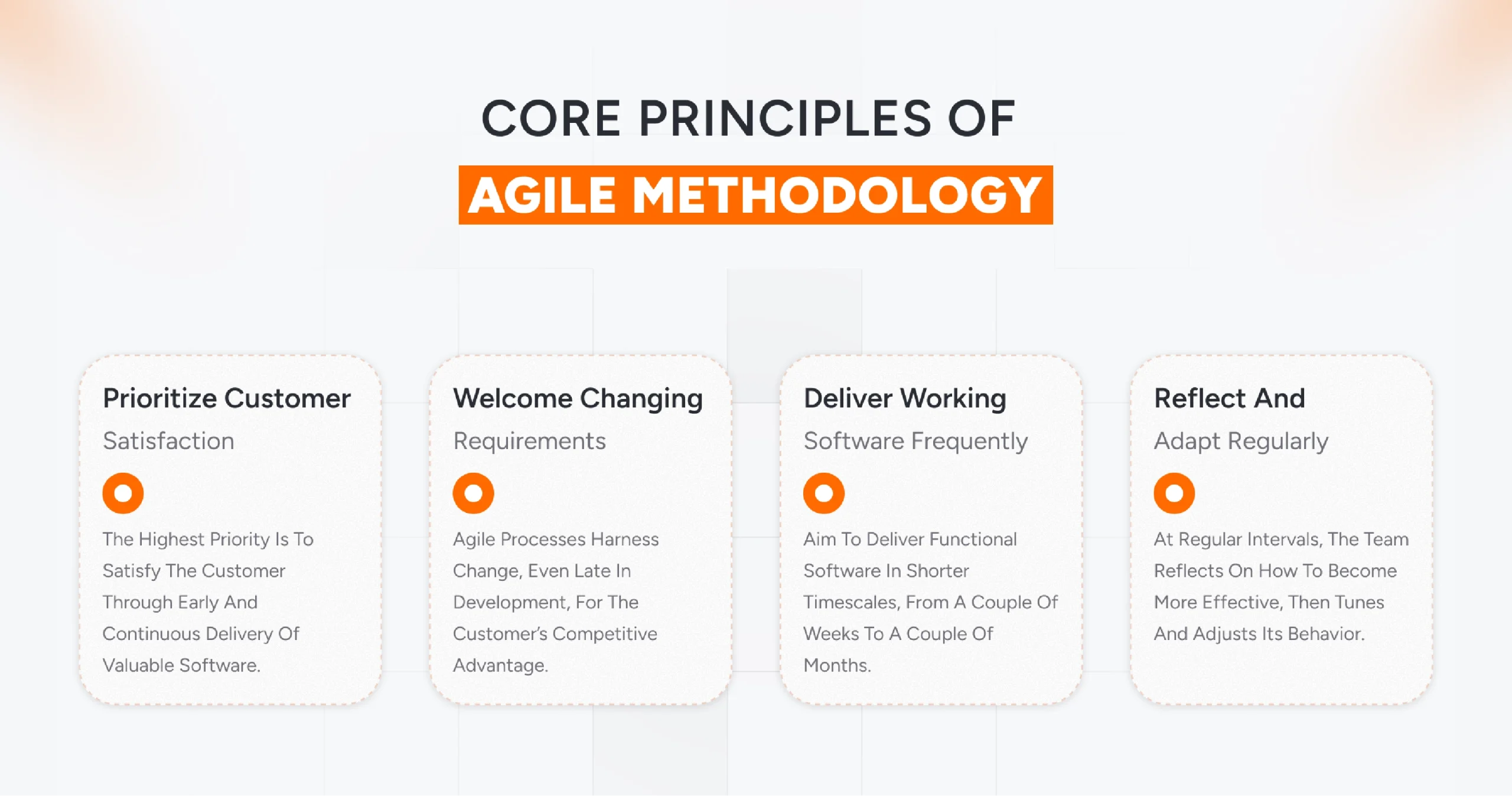
Agile methodology focuses on continuous improvement, collaboration, and customer-centric software development. Some of the key principles of an agile method are,
1. Prioritize Customer Satisfaction
Agile methodology emphasizes people, relationships, and collaboration. This means you need a collaborative effort among team members, stakeholders, and customers to develop software. It is an approach to continuous delivery with a constant feedback loop. So, keeping up with the feedback and delivering value continuously requires a team effort.
Using an agile approach to software development, your teams can solve problems, deliver faster, and achieve faster resolutions. In practice, this means your team needs to focus on direct interactions rather than a ticketing system.
2. Flexibility Of Change
Agile methodology offers flexibility as the default. This approach to software development makes you adaptable and open to new ideas. It becomes crucial to consider how dynamic markets operate, with business priorities continually shifting. Agile processes are designed to embrace the constantly changing business demands.
What this means in practice is that you can pivot quickly throughout the software development lifecycle, focusing more on features and creating a product differentiator.
3. Delivering A Working Software
Rather than waiting for a perfect product, agile prioritizes delivering software that works. Measuring the usage of this working software with incremental updates ensures continuous improvements. The overall progress of your software development project is measured by the products or services delivered rather than waiting for the final launch.
4. Adapting Fast
Adaptability is inherent in agile software development. But going beyond the adaptable approach, your team needs to respond quickly to sudden market changes. This means adding a new feature or modifying existing ones. It can be a pivot or simply an aesthetic makeover of the UI.
What makes agile methodology efficient is the speed at which you can adapt to such changes or customer demands.
Now that you know what agile is and the key principles, it’s time to understand Scrum. Especially if you are to differentiate between agile methodology vs scrum, knowing them individually becomes crucial. One thing you need to keep in mind is that agile methodology is an umbrella, and Scrum is one of its spokes.

What is Scrum?
Scrum is an agile framework that focuses on breaking a software development project into smaller sprints. It is built on empiricism and lean thinking.
What this means for a business owner, entrepreneur, or even a CTO is,
Asserting and ensuring that knowledge comes from experience. So each decision needs to be based on the same expertise and observations.
Always focus on reducing waste and optimizing resources.
Scrum is implemented based on three core pillars,
- Transparency- Emergent processes and work that each team member does should be easily visible to all. Plus, every critical decision must be made based on the Scrum artifacts.
- Inspection- Every sprint must be inspected at the end of the cycle. It helps you detect undesirable variances or problems.
- Adaptation- Adjust the process immediately if any metric which is measured or any outcome already defined does not meet with your requirements.
Components of the Scrum Framework
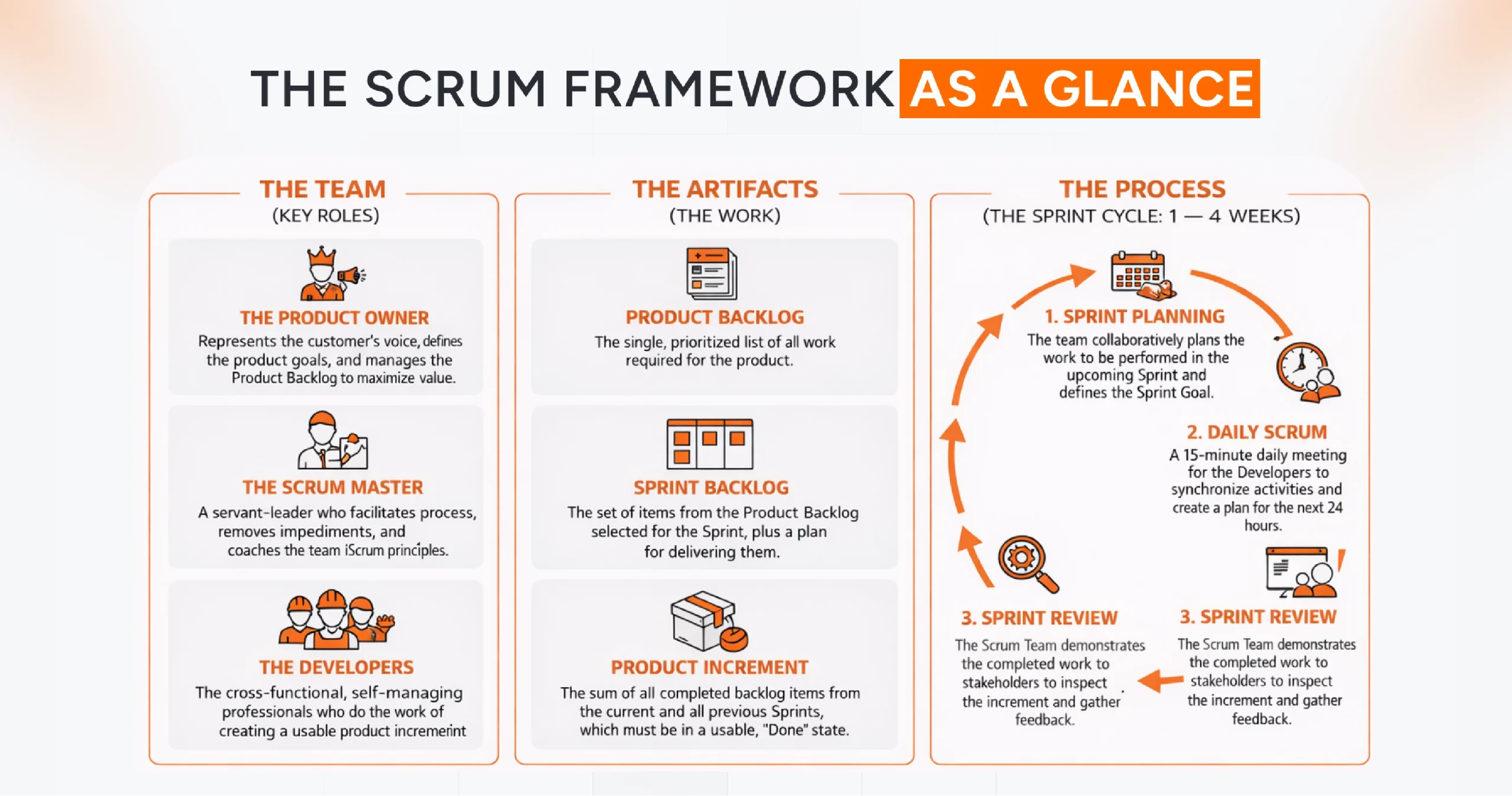
The Scrum framework consists of three distinct components: The Scrum Team (roles), five Scrum Events (time-boxed meetings), and three Scrum Artifacts (information). These elements work together to ensure iterative delivery, process transparency, and continuous adaptation to change.
1. The Scrum Team (Roles)
The fundamental unit of Scrum is the Scrum Team, a small group of typically 10 or fewer people. This team is cross-functional (possessing all necessary skills) and self-managing (internally deciding who does what, when, and how).
Scrum defines three specific accountabilities to ensure clarity and delivery:
2. Scrum Events
Scrum Events are fixed-length (time-boxed) occasions designed to create regularity and minimize the need for undefined meetings. The Sprint acts as a container event, typically lasting one month or less, serving as the heartbeat where ideas are turned into value.
The framework utilizes five main events to inspect and adapt progress:
- Sprint Planning: The team collaborates to define the Sprint Goal and select work from the backlog. This initiates the cycle.
- Daily Scrum: A 15-minute daily meeting for Developers to inspect progress toward the Sprint Goal and adapt the plan for the next 24 hours.
- Sprint Review: Held at the end of the Sprint. The team and stakeholders review the completed Increment and discuss future adaptations.
- Sprint Retrospective: The final event focused on the team’s process. They inspect interactions, tools, and methods to plan improvements for the next Sprint.
- Backlog Refinement: An ongoing activity (often called grooming) where the PO and Developers clarify and prioritize future backlog items.
What This Means For You:
Strict time-boxing is essential for Scrum’s efficiency. If a Daily Scrum consistently runs over 15 minutes, it usually indicates the team is trying to solve problems during the meeting rather than just identifying them for offline resolution.
3. Scrum Artifacts
Scrum Artifacts represent work or value. They are designed to maximize transparency of key information so that everyone has the same understanding of the “artifact.”
Each artifact is paired with a specific commitment to ensure focus and measurability:
Now that you know what agile and scrum are, it’s time to understand the difference between agile methodology vs scrum.

Agile Methodology vs Scrum: Key Differences
The difference between agile methodologies and Scrum stems from their core philosophies. Agile methodology is a mindset, while Scrum is an application of that mindset. Here is a breakdown of the differences between agile methodology and Scrum based on their core philosophies.
Difference Of Agile Methodology vs Scrum For Structure And Components
Agile methodology has core values based on customer interaction, delivering working software, flexibility, and quicker response time. On the other side, Scrum focuses on sprints, predefined roles, sprint planning, daily scrums, and artifacts.
But if you are looking to choose an approach for software development, the most important thing to keep in mind is- “Scrum is a subset of agile!” It’s a lightweight framework that uses agile software development at its core.
So, agile is “Why,” and Scrum is “How.” But using Scrum does not mean your organization is agile. You need to ensure the core agile methodology remains intact as you implement Scrum. Often, organizations implement Scrum from the top down in the organizational structure. What this does is create mini-waterfalls or pockets of processes, teams, and sprints that are not agile.
Software Delivery Structure and Time
Agile defines iterative delivery. Scrum, on the other hand, provides a strict, time-boxed mechanism. Agile methodology and Scrum in terms of software delivery lie in the planning stage itself. Agile minimizes the upfront planning and design efforts. It focuses on early and continuous delivery of valuable software.
Scrum uses a highly structured sprint approach. These are often one month or less in duration. Each sprint includes,
- Sprint planning
- Daily scrums
- Sprint inspection
A sprint often results in a feature or function delivered to the user. Based on user feedback, the team works on the next increment to ensure continuous improvement.
Roles and Accountability
As agile values individuals and interactions, the team structure includes a customer representative role. It focuses on self-organizing teams. Agile methodology emphasizes such teams to fulfill the best architectural requirements and designs.
At the same time, a scrum team has the following roles,
- Product owners are responsible for maximizing product value and for prioritizing work.
- Developers are responsible for creating the increment each sprint and adhering to the definition of done.
- Scrum masters are accountable for ensuring the scrum framework is implemented and act as process facilitators.
Agile Methodology vs Scrum: Software Development Implementation
Here are the significant differences between agile methodology and Scrum, based on how you implement them in the software development process.
Now that you know the differences, let’s decide which approach to choose and when.
Read more: 10 Must-Have Software Development Tools for 2026
When Should You Choose Agile?
Agile methodology is best for your software development project when
- Your project requirements are not clearly defined upfront and are subject to frequent changes.
- You want to maximize early ROI through defined, iterative product feature delivery.
- You need a competitive advantage in a fast-changing and dynamic market.
- Your project needs frequent testing, quality assurance, and incremental updates.
- You want to ensure a sustainable development approach.
When Should You Choose Scrum?
Scrum methodology seems a more sensible option when,
- You need to test features quickly and get instant feedback
- You are under a tighter deadline for delivering the final product to the customer.
- Your project needs a structured approach with well-defined rules, roles, and artifacts.
- Your project needs continuous inspection and adaptation.
How AQe Digital Can Help You Implement Agile Methodology?
Comparing agile methodology vs Scrum is not just about which approach you should choose. It’s a mindset that you will adopt. Agile methodology is a guiding mindset and set of principles, while Scrum is a structured framework that applies and operationalizes those principles in practice.
Applying the agile approach is where most organizations falter. They focus too much on implementation in line with the theoretical agile approach, and practicality often suffers as a result. At AQe Digital, we know what practical application agile methodology can offer.
With more than 27 years of experience in delivering agile-based software development solutions for enterprises, we know what it takes to accelerate delivery while maintaining quality. If you are looking to apply agile methodology to your projects, connect with our experts now.