What is Decision Intelligence: Platforms, Tools, and Use Cases for 2026

Cheta Pandya
Enterprises in the AI era operate within highly volatile, uncertain, and densely interconnected environments. Most enterprise systems frequently hit a structural "complexity ceiling." In legacy systems, decision-making processes struggle to cope with the scale and speed modern businesses demand.
At an average Fortune 500 company, ineffective decision-making burns more than 530,000 days of working time and roughly $250 million in wasted labor costs. Managers spend 37% of their time deciding. McKinsey found 58% of that time is used ineffectively.
Decision intelligence closes the gap with applied engineering, treating decision-making as a continuous, measurable, and highly efficient business process. This becomes key when 76% of companies name data-driven decision-making as a main goal of their data program.
However, 67% do not completely trust the data behind those decisions. And with data intelligence, enterprises can close the data trust gap. Still, enterprises must know what actually sits inside these platforms and how any of it is different from the BI stack you already bought.
This guide covers the definition, the five-stage framework, the comparison against business intelligence, what agentic AI adds and what it breaks, the 2026 vendor landscape, industry use cases with named outcomes, a 90-day rollout plan, and the five mistakes that kill these programs before production.
What is Decision Intelligence?
Decision intelligence is the discipline of engineering how an organization makes decisions. It combines data, analytics, AI, and human judgment into modeled, repeatable decision flows that can be supported, augmented, or fully automated, and it learns from the outcome of every decision it makes.
That is the idea. The engineering underneath is where programs succeed or stall.
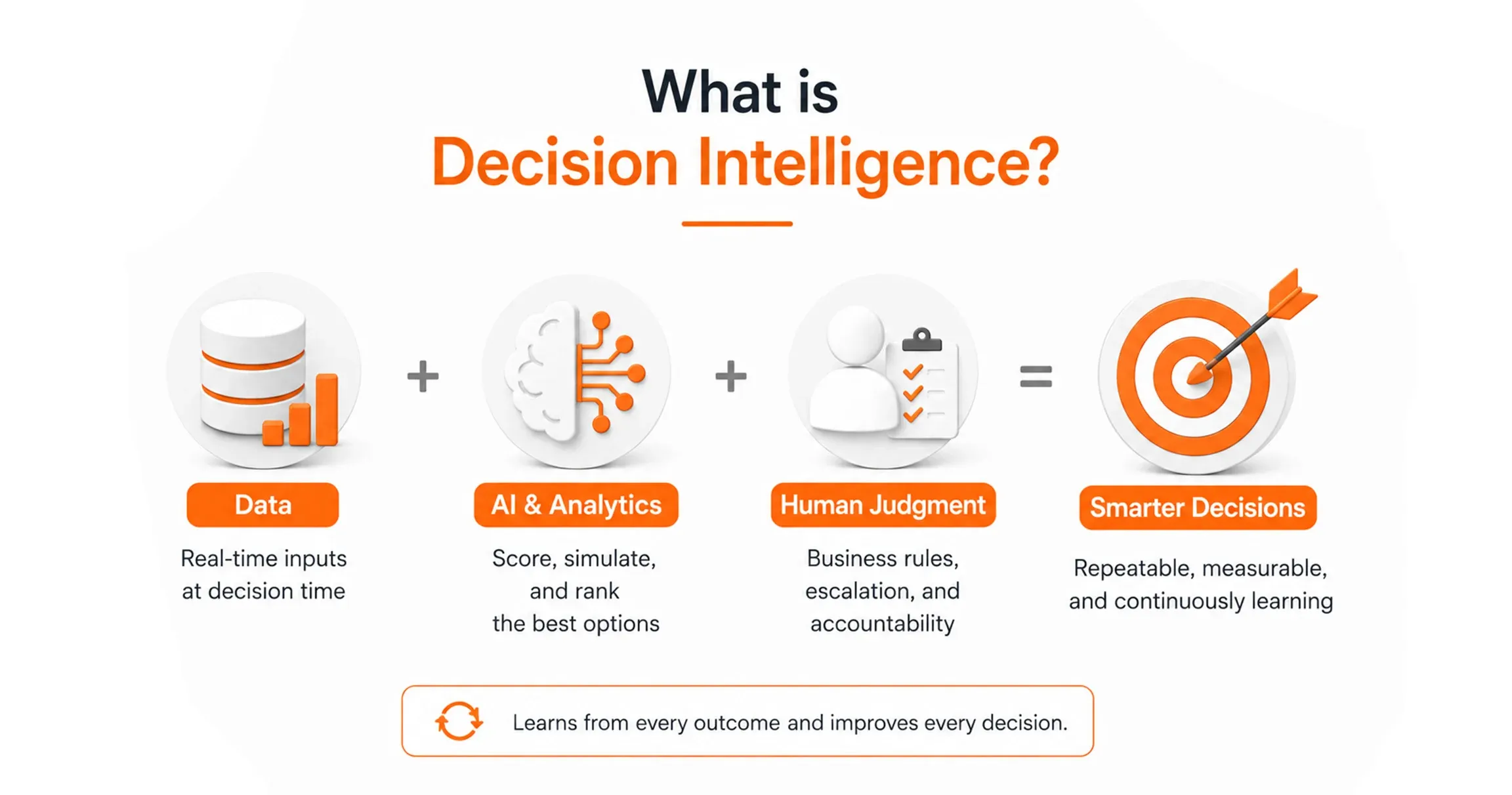
The Three Components: Data, AI, and Human Judgment
The failure mode is usually a missing component, not a weak one.
- Data - inputs that reach the model at decision time. Not in a Tuesday batch. Latency is a design constraint, not an infrastructure footnote.
- AI and analytics - the layer that scores options, simulates scenarios, and ranks actions against a defined objective.
- Human judgment - encoded business logic, escalation thresholds, and a named reviewer who owns the call when risk crosses a line.
Cassie Kozyrkov, Google's first Chief Decision Scientist, describes the field as "a new field of study that addresses all aspects of selecting between options," unifying data science with the social and managerial sciences. That framing pulls organizational behavior inside the technical scope.
The Decision Intelligence Framework: A Five-Stage Loop
The decision intelligence framework most enterprises can actually run has five stages, and the fifth is the one people skip.
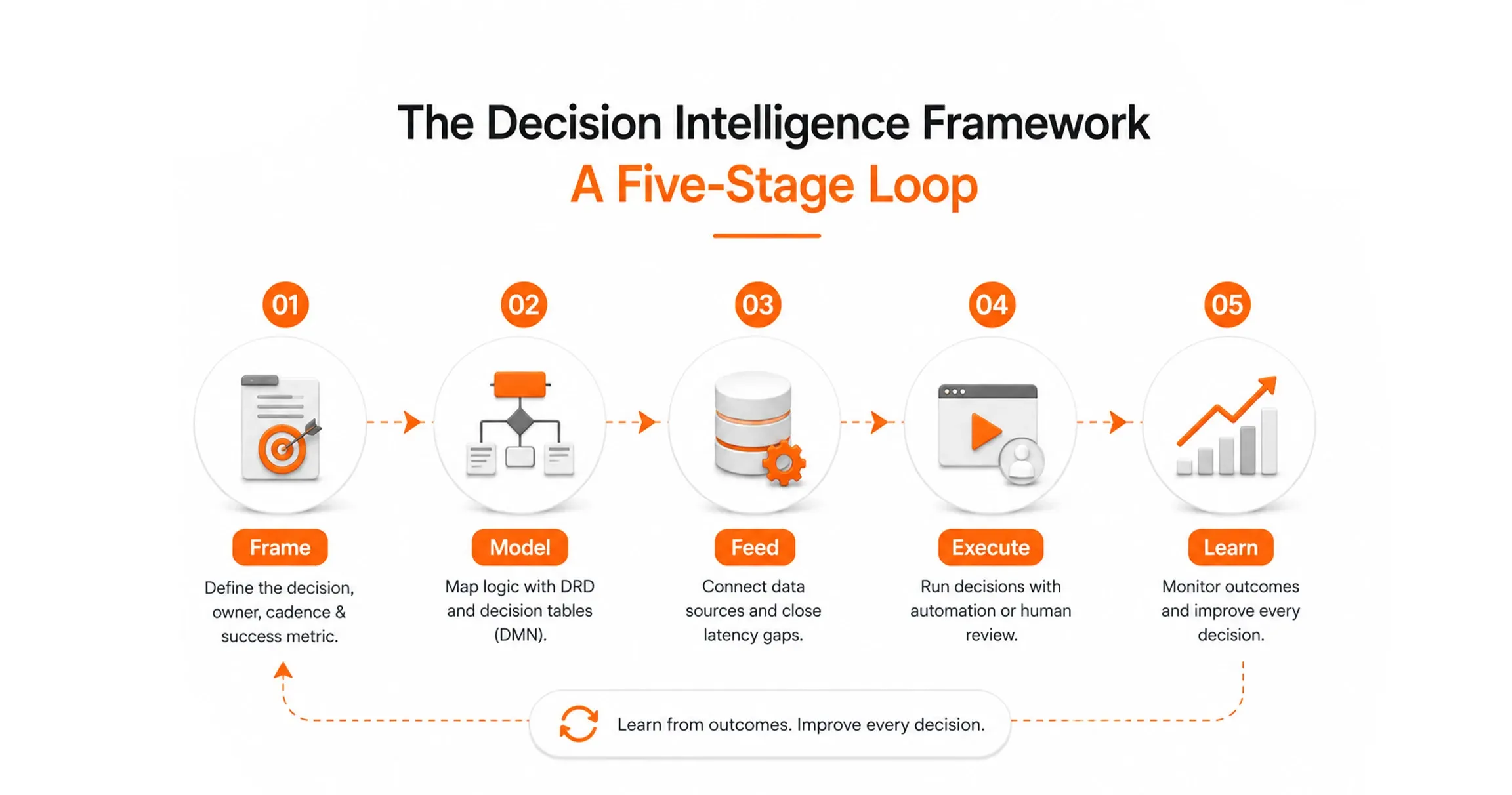
- Frame - name the recurring decision, its owner, its cadence, and what a good outcome looks like in numbers.
- Model - build a Decision Requirements Diagram (DRD), then define logic and decision tables using the DMN standard (Decision Model and Notation).
- Feed - map data dependencies and close the latency gaps.
- Execute - deploy into a decision engine, with human-in-the-loop review or straight-through automation depending on risk.
- Learn - closed-loop monitoring, retraining on realized outcomes.
Stage five converts a project into an asset. Skip it, and you have built an expensive recommendation engine that never improves.
Decision Intelligence vs Business Intelligence: What Actually Changed
Business intelligence lets you analyze, visualize, and extract insight. The newer discipline translates that insight into the decision itself and executes it, then learns from the result.
You already have Power BI. Here is what it does not do.
| Decision Intelligence vs Business Intelligence | ||
|---|---|---|
| Dimension | Business Intelligence | Decision Intelligence |
| Unit of output | A dashboard or report | A decision or recommended action |
| Time orientation | Retrospective, descriptive | Forward-looking, prescriptive, real-time |
| Who acts | A human reads it and decides later | The system recommends or executes; human in the loop where risk requires |
| Learning | Static until someone rebuilds the report | Closed-loop, retrains on realized outcomes |
| Success metric | Dashboard adoption, query volume | Decision quality, decision latency, realized outcome |
BI Answers What Happened. DI Decides What to Do.
The gap is not analytical sophistication. It is who holds the pen. These platforms shift focus from data and reports to the decisions themselves. Rather than optimizing the dashboard, they improve how calls get made, how guidance reaches whoever acts, and how outcomes are evaluated over time. A dashboard has never once placed a purchase order.
Where Prescriptive Analytics Stops
Prescriptive analytics names the recommended action and stops there. Three things get added past that point: an execution path that writes back into your ERP or CRM, a governance layer that records why the call was made, and a feedback loop scoring the realized outcome against the modeled expectation.
Without write-back, a recommendation is a suggestion sitting in a queue. That gap between recommendation and execution is where most analytics ROI disappears.
AI Decision Intelligence: How Agentic AI Changes the Model
The convergence of Generative AI and goal-seeking autonomous agentic workflows marks a structural shift in how enterprises approach Decision Intelligence (DI).
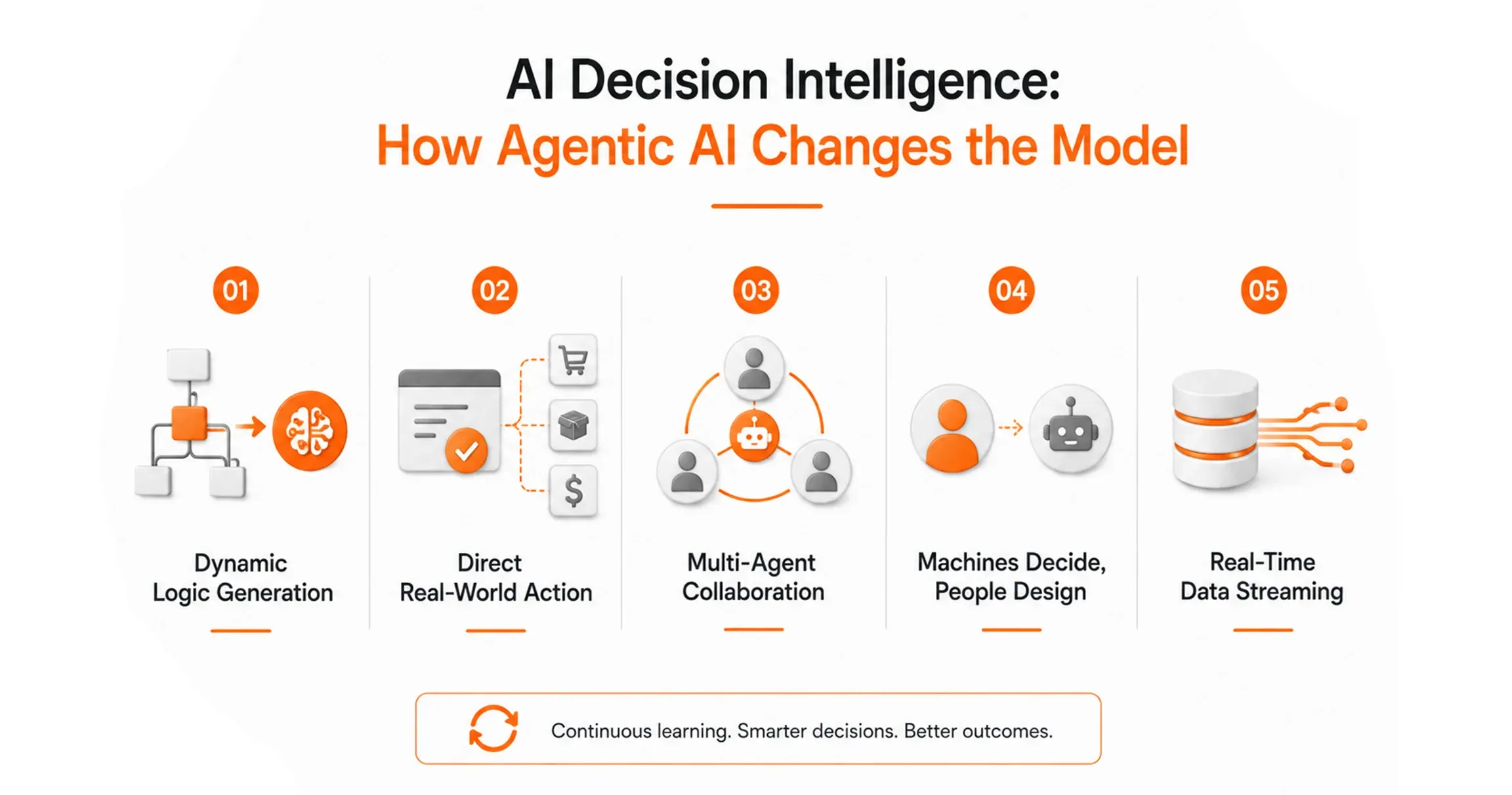
Legacy decision systems relied on rigid, linear logic: hardcoded if-then rule branches and fixed workflows that could not adapt to real-world ambiguity. Agentic AI changes that foundation across five operational dimensions.
1. From static workflows to dynamic real-time logic generation
Legacy decision management tools depend on pre-mapped workflows and static business rules to process data and produce outcomes.
Agentic Decision Intelligence replaces that dependency by combining large language model reasoning with decision ontology, reusable agent functions, and decision engines that generate logic in real time.
Rather than following hardcoded paths, autonomous agents are handed complex, qualitative, non-deterministic business goals. They reason through operational complexity, orchestrate multi-step processes, and coordinate specialized agents dynamically.
Static rule branches cannot absorb ambiguity. Agentic reasoning can, and that difference is the entire point of the shift.
2. From text generation to direct real-world action
Traditional Generative AI produces text: reports, forecasts, summaries that still require a human to act on them.
Agentic AI closes that gap. Operating within pre-modeled parameters, autonomous agents execute actions natively across enterprise systems through API integrations, adjusting pricing, triggering inventory replenishment, or flagging security anomalies without waiting on manual review.
Generation without action is just a draft. Action is the deliverable.
3. From isolated models to multi-agent collaboration
Analytical and machine learning models have historically operated as isolated point solutions, disconnected from adjacent departments and downstream execution. Enterprise AI is moving toward coordinated multi-agent networks instead, where specialized agents represent distinct functional roles across the business.
They share context, raise and test hypotheses, run simulations, and coordinate to optimize workflows globally rather than locally, matching logistics, inventory, and demand as one connected system instead of three separate ones.
This coordination model is extending upward into governance functions as well, with board-level agents beginning to run continuous simulations against corporate and market data to stress-test major decisions before they reach a vote. Coordination beats isolation whenever the workflow spans more than one function, and most enterprise workflows do.
4. Shifting human and machine roles
Under the traditional model, humans stayed "in the loop," reviewing dashboards to make calls that machines supported. Agentic DI inverts that relationship.
Machines now make the routine operational decisions, guided by people who no longer sit in the loop but design the system around it. Human professionals shift into the role of decision architects: they design, oversee, and govern the rules that agents operate under.
Business specialists configure, test, and orchestrate agent teams using natural language and low-code interfaces, without needing deep engineering skills. The person who used to approve every decision now approves the system that makes them.
5. Eliminating latency through agentic data streaming
Traditional analytical models relied on periodic batch processing, which created a lag between spotting a market change and acting on it. Real-time, event-driven data streaming is expanding to feed agentic AI directly, giving autonomous agents a continuous flow of operational data instead of a periodic snapshot.
That continuity lets agents react and adjust strategy instantly. Batch processing was built for a world where decisions could wait. That world is gone, and the latency it tolerated is gone with it.
What Are Key Decision Intelligence Use Cases by Industry?
Unlike traditional Business Intelligence, which compiles historical data to show what already happened, Decision Intelligence is prescriptive and outcome-oriented. It exists to answer one operational question: what specific action should we take to achieve our goal?
Enterprises across sectors deploy DI against a wide range of strategic, operational, and tactical decisions.
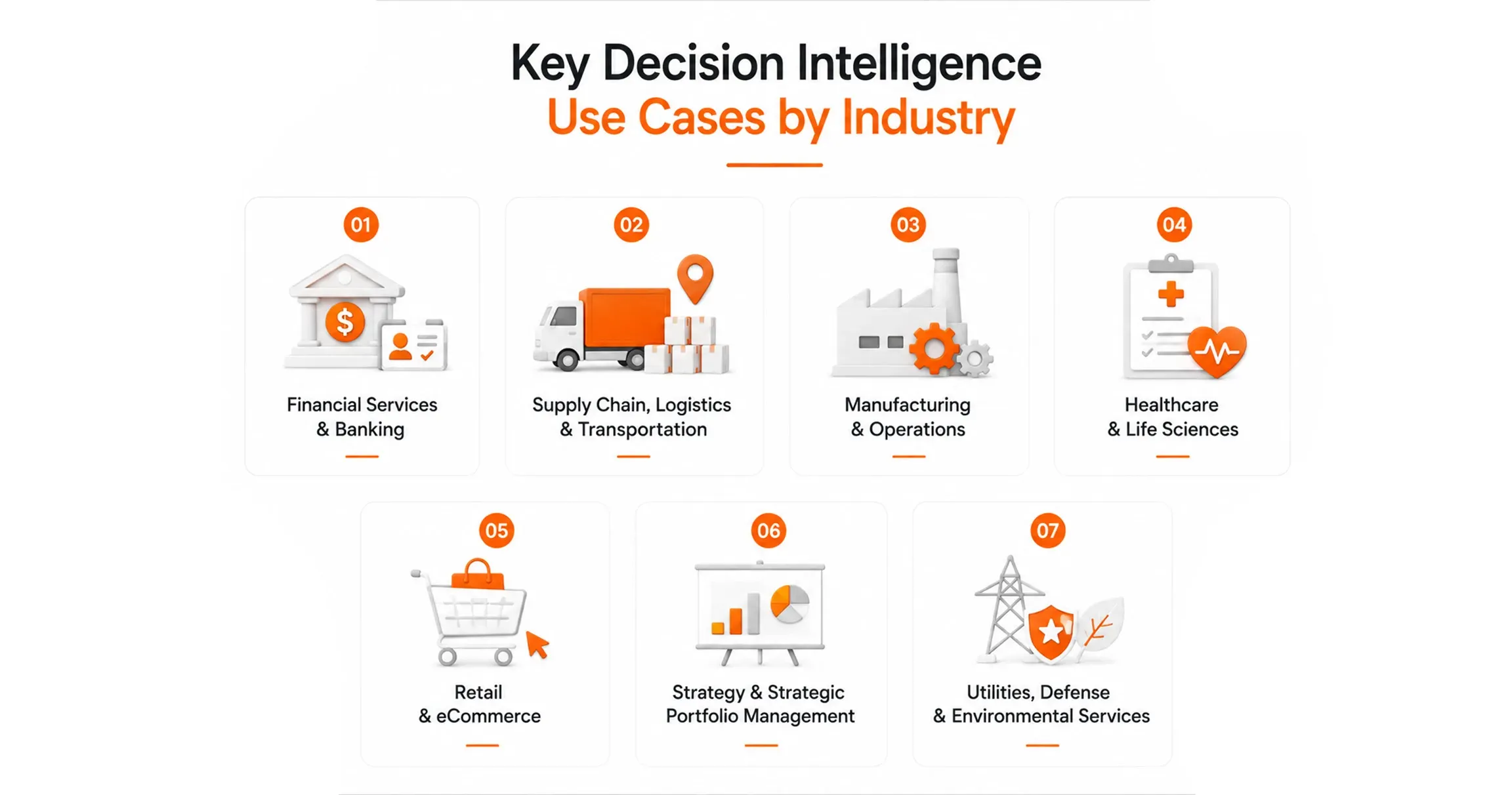
The following breaks down the core use cases by industry.
1. Financial Services and Banking
Financial institutions use DI to automate credit and loan approvals, consolidating structured customer data, credit scores, transaction histories, debt-to-income ratios, collateral, alongside qualitative variables like employment and residence history.
The system evaluates risk in real time, approving low-risk applicants instantly and routing borderline cases to human underwriters with full data context attached. Payment networks and retail banks apply the same real-time logic to fraud detection, tracking transaction patterns and behavioral signals simultaneously to block fraudulent payments before they clear.
Regulated institutions extend this into anti-money laundering compliance, using entity resolution and graph analytics to integrate previously siloed databases into a single customer view, surfacing hidden networks and nested relationships that point to laundering schemes.
Investment firms use the same category of tooling for portfolio management, optimizing asset-allocation frameworks, automating advisory workflows, and running Monte Carlo simulations to model how rate fluctuations or market volatility could move long-term portfolio yields.
2. Supply Chain, Logistics, and Transportation
DI platforms ingest real-time demand signals to automate replenishment and inventory rebalancing across warehouses. Unlike static forecasting tools, DI weighs inventory levels against logistics trade-offs, supplier constraints, and procurement lead times at the same time, which is what actually mitigates stockouts and lowers carrying costs.
Transportation providers apply the same model to routing and staff scheduling, processing traffic congestion, weather forecasts, fuel costs, and driver constraints to make routing decisions in real time. Supply chain leaders also use DI to simulate what-if trade scenarios, identifying lower-cost sourcing alternatives and mitigating exposure to global disruption before it hits the P&L.
3. Manufacturing and Operations
Manufacturers integrate equipment sensor data, predictive models, parts availability, and crew schedules into one system, and the platform sequences maintenance work orders dynamically, optimizing for asset health while cutting unscheduled downtime.
The same modeling approach extends to broader operational optimization, simulating alternative production paths to balance competing constraints, energy cost, quality control, production yield, and steering operations toward maximum margin.
4. Healthcare and Life Sciences
Clinical decision support tools powered by DI merge clinical expertise with structured patient records. Analyzing patient histories, clinical guidelines, and demographic profiles, the system recommends care pathways and tags patient risk.
Hospitals apply the same simulation logic to operations, modeling real-time patient workflows to optimize emergency care, nurse scheduling, and bed allocation for maximum throughput. Life sciences enterprises use DI further upstream, streamlining medication supply chains and identifying high-opportunity trial locations and clinical site cohorts.
5. Retail and eCommerce
Retailers use DI to manage pricing dynamically across thousands of SKUs and channels at once, simulating price-elasticity scenarios against competitor actions, seasonal demand, and inventory position to protect margin.
On the customer side, DI analyzes transaction and behavioral history to generate personalized recommendations and flag early churn indicators, automatically pushing retention incentives to the buyers worth keeping.
6. Strategy and Strategic Portfolio Management
Specialty strategizing platforms build a digital twin of enterprise operations, unifying sales, product, engineering, and marketing roadmaps, so chief executives can simulate, search, and stress-test competitive product launch scenarios before committing capital.
Portfolio leaders use visual planning environments alongside risk-modeling tools to prioritize project funding, mapping hidden dependencies and quantifying risk exposure so they can see how delaying one project cascades into delays or cash flow impact across other business units.
7. Utilities, Defense, and Environmental Services
Grid networks use DI to combine human expertise with real-time data, forecasting demand spikes, preventing service interruptions, and managing resource allocation before shortages become outages. Defense agencies apply the same modeling discipline to mission planning, running scenario simulations to optimize resource allocation and stress-test strategic variables.
Field service organizations combine geographic records, incident histories, and weather patterns to anticipate pest outbreaks and automatically schedule preventive route dispatches.

How to Implement It: A 90-Day Starting Plan?
Pick one decision, model it properly, put it in production inside a quarter. That sequence is the plan.
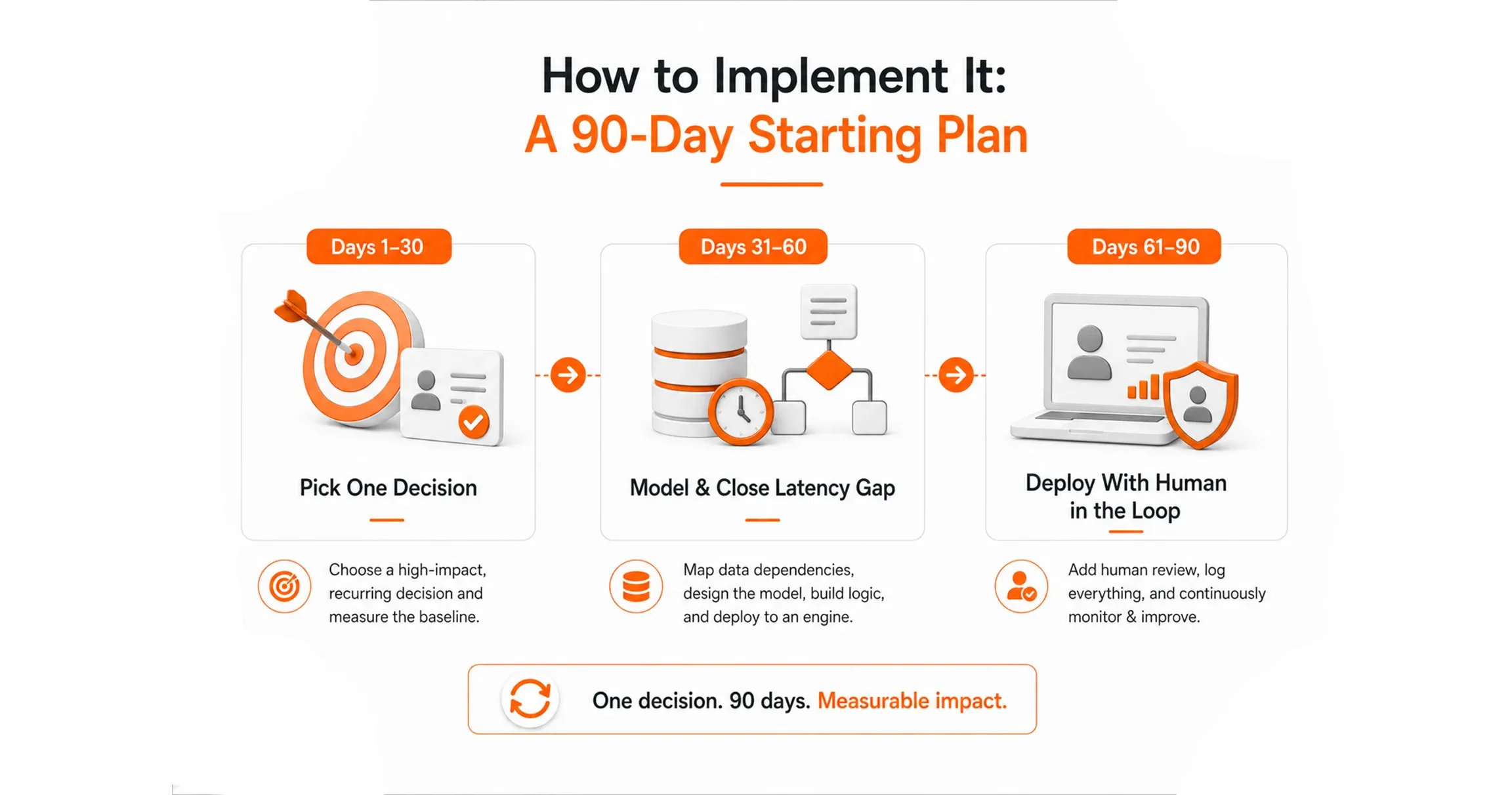
Days 1 to 30: Pick One Decision
Identify recurring decisions that are high-stakes, high-frequency, and currently bottlenecked by manual processing or by institutional knowledge living in one analyst's spreadsheet. Choose one where you can demonstrate measurable ROI quickly.
Do not start with your most complex decision. That instinct kills more programs than any technical constraint.
Name the owner, the cadence, the current cycle time, the current error rate. If you cannot measure the status quo, you cannot prove the improvement.
Days 31 to 60: Model It and Close the Latency Gap
The right data has to reach the model at the time of the decision, not in a weekly batch. Map the dependencies and close the latency gaps before modeling anything else. Then run the sequence: decision needs, DRD, business logic and decision tables, deploy to an engine.
Mitigation: teams that skip latency mapping usually rebuild the data model twice inside the first year.
Days 61 to 90: Deploy With a Human in the Loop
Ship with a reviewer in the path, even if you intend full automation later. Log every decision, every input version, every override. Continuous monitoring and retraining is a permanent operating discipline, not a phase that ends at go-live.
What to Measure
| What to Measure | |
|---|---|
| Metric | Definition |
| Decision latency | Time from trigger event to executed action |
| Decision quality | Percentage where realized outcome met modeled expectation |
| Automation rate | Percentage straight-through versus human-reviewed |
| Realised value | Working capital released, waste avoided, loss prevented |
Five Mistakes That Kill These Programs
Each is recoverable in month two and expensive in month ten.
- Starting with the hardest decision. Over 40% of agentic AI projects will be canceled by the end of 2027 on cost and unclear value, most of them hype-driven and misapplied from the start. Ambition at scoping is the expensive kind.
- Automating a decision nobody governs. Gartner warns that ungoverned LLM-based decisions will cause financial and reputational loss. If a decision has no named owner today, automating it does not create one.
- Building on data you do not trust. 67% of organizations do not completely trust their decision data, and only 12% report data of sufficient quality and accessibility for effective AI implementation. Automation multiplies whatever sits underneath it.
- Skipping the semantic layer. Poor semantics drive hallucinations, higher token spend, and higher cost. Prioritizing semantics in AI-ready data raises GenAI accuracy by up to 80% and cuts costs up to 60%.
- Treating it as a technology project. McKinsey found that 68% of middle managers and 57% of C-level executives say most of their decision-making time is used ineffectively. The bottleneck is organizational, and no platform purchase resolves it.

Why AQe Digital for Decision Intelligence Solutions?
Most vendors sell you the decision layer. That is the visible 20% of the work.
The other 80% is integration into your ERP, the latency engineering that gets data to the model on time, and the audit trail that lets you defend a call to a regulator eighteen months out. Here is where AQe Digital concentrates.
- Engineering-first integration depth. We build the write-back path, not just the recommendation. Our AI & Data Solutions teams work at the ERP, CRM, SCADA, and EHR layer, because a decision that cannot execute in your systems of record is a slide, not a capability. That includes the unglamorous work: connector development, data contract definition, a latency budget per input.
- Governance built in, not bolted on. Every flow we deploy carries a versioned model, a logged input set, an override record and an outcome score. Not because compliance asked, but because the closed loop cannot function without it. In banking, insurance and healthcare, this is the difference between a pilot and something a regulator accepts.
- Framework and stack agnostic. We model in DMN, deploy onto whichever platform fits the decision type, and refuse to argue that one vendor answers every use case. Financial crime and demand planning need different tools. Our Process & Workflow Automation practice makes that heterogeneity manageable rather than expensive.
The outcome a CDAO can sign off on: one production decision flow, with measured latency, a defensible audit trail, and a realized value number that survives finance review.
Final Thoughts
The 50% of business decisions Gartner expects to be augmented or automated by AI agents by 2027 will not land evenly across your organization. It arrives one modeled decision at a time, in the functions where somebody named the decision, named its owner, and measured the outcome.
Your competitors are not buying a bigger platform this quarter. The ones pulling ahead picked a single recurring decision, closed the latency gap underneath it, and shipped it with a human in the loop. The question in front of you is not which vendor. It is which decision.
Most enterprises do not need another platform. They need one decision, modeled properly, running in production by the end of the quarter.
AQe Digital builds those. Start with a decision flow diagnostic. Talk to our team about the call costing you the most right now.