Software Testing in AI-Assisted Delivery: How to Secure AI Code?
Software testing used to trail the code by a few days. Now picture a sprint demo where an AI assistant builds a customer onboarding flow in an afternoon. It works on the big screen, the product owner signs off, and the feature merges by Friday.
Two weeks later, a security scan finds an API key hardcoded in a config helper. The unit tests passed because they tested exactly what the AI wrote.
The demo proved it worked. Nothing proved it was safe.
That gap is about to widen. Gartner predicts that 90% of enterprise software engineers will use AI code assistants by 2028, up from less than 14% in early 2024. Code volume rises; review hours do not. So the testing system, not the reviewer, has to catch what slips through.
This guide answers three questions: what to automate, where to place security checks in your pipeline, and how to test AI-generated code before it ships. Then it shows how to prove the return to finance. Get the order wrong, and you automate the easy checks while the risky ones reach production.
What is Software Testing, and What Makes it Different in AI-Assisted Delivery?
Software testing is the practice of evaluating an application to confirm it works as intended, meets requirements, and is free of defects and security flaws before users rely on it. It runs at four levels: unit, integration, system, and acceptance testing.
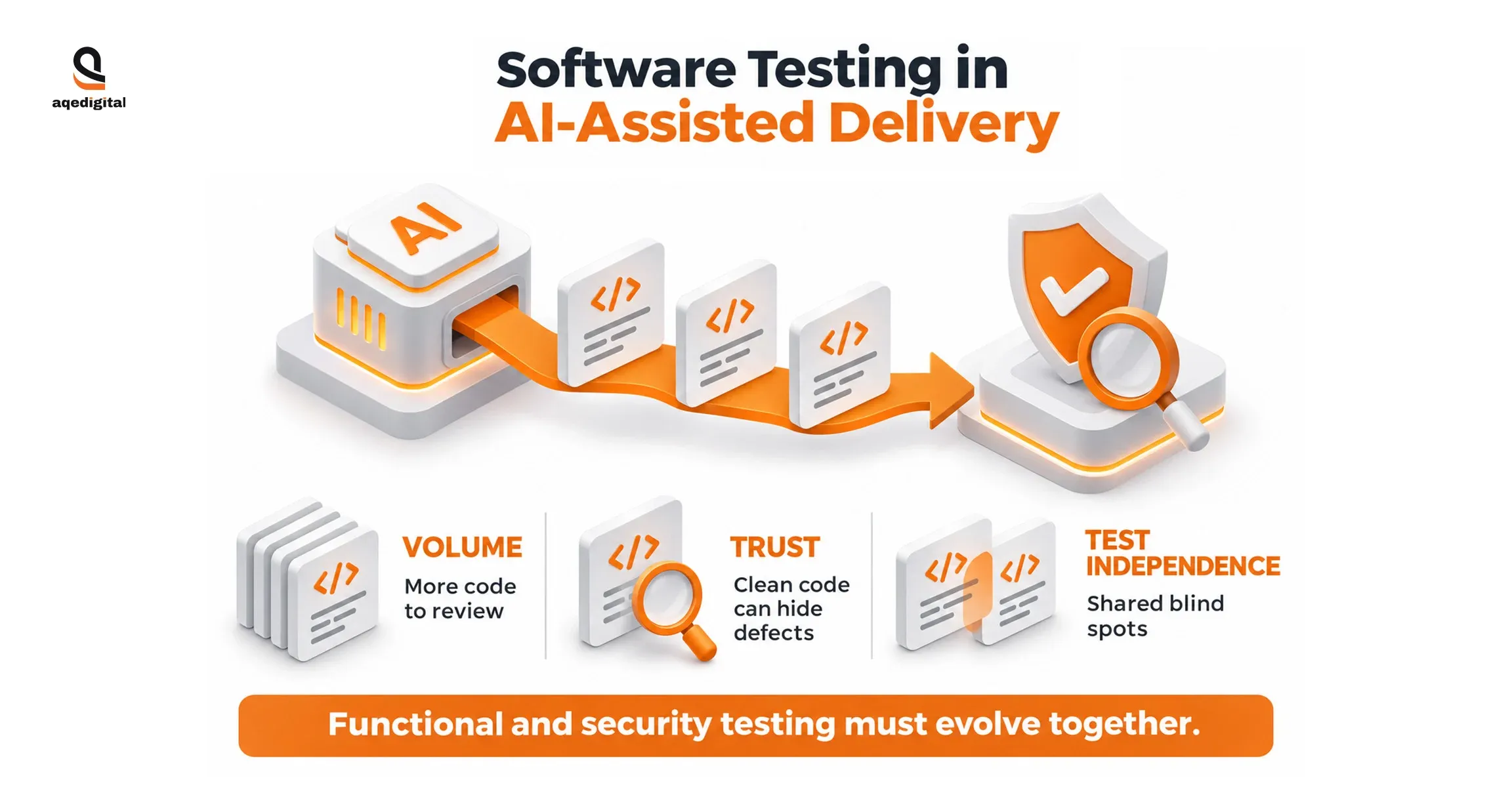
What changes in AI-assisted delivery is volume and origin. Your team now ships code nobody fully wrote, so security checks have to run as often as functional ones.
Three things change.
- Volume: More code arrives than reviewers can read line by line.
- Trust: AI code looks clean, so reviewers approve it faster than they should.
- Test independence: When the same assistant writes the feature and its tests, both share the same blind spots, so a green build can confirm a bug instead of catching it.
SAST vs DAST vs SCA
| SAST vs DAST vs SCA | ||
|---|---|---|
| Approach | Scope | Typical use |
| SAST (static application security testing) | Scans source code without running it | Injection flaws, hardcoded secrets, and unsafe functions, caught in the IDE or pull request |
| DAST (dynamic application security testing) | Attacks the running application from the outside | Authentication gaps, misconfigurations, and exposed endpoints, caught in staging |
| SCA (software composition analysis) | Checks open source dependencies for known vulnerabilities and licenses | Risky or fake packages, often pulled in by AI suggestions |
Think of airport security. SAST is the bag X-ray that inspects contents before anything moves. DAST is the body scanner that checks the traveler, not the bag. SCA is the passenger manifest check against a watch list. Skip one, and the other two cannot cover for it.
Shift Left Testing, DevSecOps, and Other Terms
Shift left testing moves checks earlier in the cycle, into the IDE and the pull request, where fixes are cheapest. Shift left security applies the same idea to vulnerabilities. A DevSecOps pipeline automates both inside CI/CD, so every commit gets functional and security checks without a manual handoff.
A test automation framework keeps those tests maintainable. Treat security as a test type, not a separate department.
What Clients Ask Us Before, During, and After a Project
"I'm a QA lead at a 120-person US fintech. Half our developers now use GitHub Copilot, and our Selenium regression suite takes three days to run and triage by hand. Leadership thinks AI means we can test less and hire fewer testers. Give me a straight answer: does software testing change when AI writes the code, or is it the same playbook with more volume?"
It changes. The playbook adds two layers: security scans on every pull request, and review rules that flag AI-authored code touching authentication, payments, or personal data.
Then fix the three-day cycle. Move regression to API-level tests that run in under an hour, and keep Selenium for a short smoke suite. More code on the same testing cadence just means more defects reach users faster.
What to Automate: Building a Test Automation Framework for AI-Speed Code
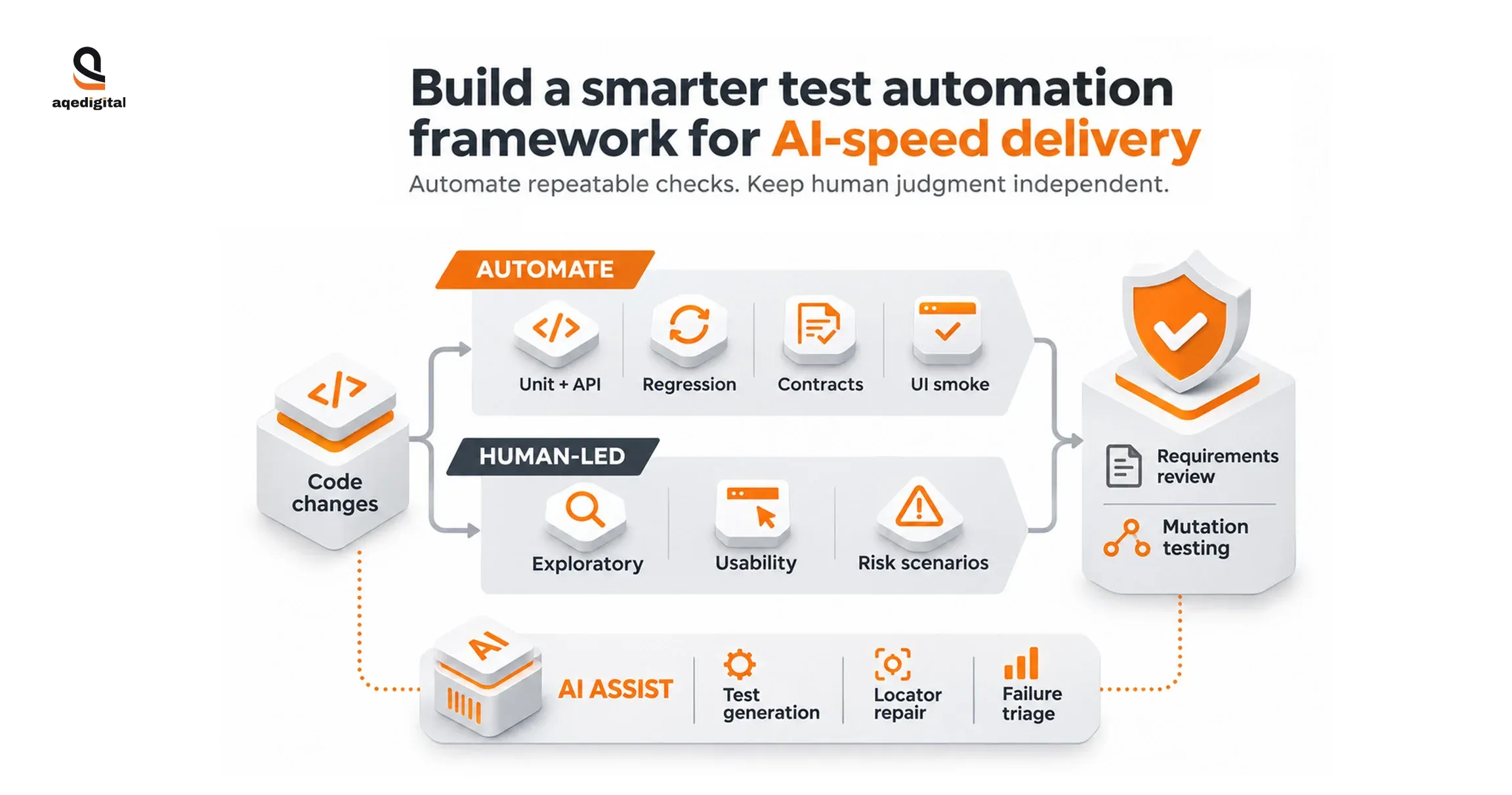
Use one filter: automate any check that is repeatable, deterministic, and needed on every change. Keep humans where judgment matters.
Automate the Repeatable Checks First
Start with unit and API tests, because they are fast, stable, and cheap to maintain. Add regression and contract tests next, then a small UI smoke suite. A framework built UI-first breaks on every layout change and soon gets ignored.
Keep Humans on Exploratory and Risk Testing
Exploratory testing, usability, and business-rule edge cases still need people. A tester asking "what if a customer refunds twice?" finds defects no script imagined.
Where AI in Software Testing Earns its Keep
AI helps with test case generation from requirements, self-healing locators for UI tests, and triage of flaky failures. However, AI-generated tests can confirm buggy behavior, because they learn from the same code they test.
Review them against the requirement, not the implementation, and check their strength with mutation testing, covered below. AQe Digital's product engineering and QA services run automated functional, regression, performance, and security testing inside CI.
What Clients Ask Us Before, During, and After a Project
"I'm director of engineering at a 400-person US healthtech company. We run Jest and Cypress, have about 2,000 end-to-end tests, and roughly 15% fail each night randomly. Our HIPAA risk review with outside auditors is next quarter, and I want to add AI test generation to grow coverage fast. Rank the top three things to fix before adding more tests."
Fix stability before volume. First, quarantine flaky tests and fix or delete them within two sprints. Second, push half of those end-to-end checks down to API tests. Third, add automated security testing for endpoints that handle PHI (protected health information), since HIPAA reviewers will ask about it.
Only then add AI generation. Route its tests through code review, and run a mutation testing tool such as StrykerJS, which works with Jest, to prove they catch real defects.

Where to Shift Left: Mapping Security Checks to Your DevSecOps Pipeline
Here is a practical map: every stage of your pipeline gets one job, and only critical findings stop the line.
Assign One Check to Every Pipeline Stage
| Assign One Check to Every Pipeline Stage | ||
|---|---|---|
| Pipeline stage | Automated check | Gate rule |
| IDE and pre-commit | Secrets scanning, SAST linting | Block commits containing secrets |
| Pull request | Unit tests, SAST, SCA | Block on critical or high findings with an exploit path |
| Build | Container and infrastructure-as-code scans | Block on known critical CVEs (publicly cataloged vulnerabilities) |
| Staging | DAST, integration and end-to-end tests | Block release on failed authentication or access tests |
| Production | Runtime monitoring and alerting | Alert and roll back |
Shift Left Security Without Drowning Developers
Breaking builds on low-severity findings kills DevSecOps programs, because developers learn to click past alerts. Among DevSecOps best practices, two matter most: block only what is exploitable, and route everything else to a weekly backlog with an owner.
What Clients Ask Us Before, During, and After a Project
"I'm CISO at a 900-person US insurance carrier. We run GitLab CI with SonarQube and Snyk, and developers have started bypassing pipelines because builds fail on hundreds of medium findings. Our PCI DSS assessment is six months out, and the board is watching. Give me a straight answer: which findings should block a merge, and which should only create tickets?”
Block only critical and high findings with a reachable exploit path, plus any committed secret. Everything else becomes a ticket with an owner and a deadline, such as 30 days for medium findings.
Then tune SonarQube and Snyk rules for a month and track false positives. Once developers trust the gates, your evidence for the PCI DSS assessment comes straight from pipeline logs.
How to Secure AI-Generated Code Before it Ships
Treat AI-generated code as a distinct risk class: same pipeline, stricter rules where the blast radius is high. Four moves cover most of the risk: know the failure patterns, tier code by impact, test the tests, and lock down dependencies.
AI-Generated Code Security Risks to Test for
Most AI-generated code security risks fall into five patterns your scans should target:
- Hardcoded secrets: keys and tokens copied into helpers and config files.
- Insecure defaults: permissive CORS (cross-origin resource sharing) settings, disabled certificate checks, verbose errors.
- Missing authorization: endpoints that authenticate users but never check permissions.
- Hallucinated packages: AI suggests package names that do not exist, and attackers register them. This is called slopsquatting.
- Stale patterns: deprecated crypto and libraries learned from old public code.
Match Each Risk to the Check That Catches It
A generic scan catches some of these patterns and misses others. Give each one an owner check.
| Match Each Risk to the Check That Catches It | ||
|---|---|---|
| Risk | Check that catches it | Where it runs |
| Hardcoded secrets | Secrets scanning plus SAST credential rules | Pre-commit and pull request |
| Insecure defaults | SAST and infrastructure-as-code scans; DAST for live CORS and headers | Pull request, build, staging |
| Missing authorization | Negative authorization tests written from the requirement | Pull request and staging |
| Hallucinated packages | SCA blocking unknown or newly published packages | Pull request |
| Stale patterns | SAST rules for deprecated crypto; SCA for end-of-life libraries | Pull request |
Missing authorization is the one scanners handle worst. SAST cannot tell which user should see which record, and most DAST tools only confirm that a login exists. Closing that gap takes tests that people write.
Write Negative Authorization Tests
AI assistants write the happy path well: a logged-in user asks for their own record and gets it. They rarely write the test where user A asks for user B’s invoice. Add these for every Tier 1 endpoint:
- Cross-account access: request another user’s resource by ID and expect a 403 or 404.
- Role escalation: call an admin action with a standard user token and expect a denial.
- Missing token: call the endpoint without credentials and expect a 401.
Here is a sample test:
test("user cannot read another user's invoice", async () => {

  const res = await request(app)

    .get(`/api/invoices/${otherUserInvoiceId}`)

    .set("Authorization", `Bearer ${userAToken}`);

  expect([403, 404]).toContain(res.status);

});
Write these from the access rules in the requirement, not from the code, so they fail when the AI skipped a check.
An AI Code Risk Tier Model
Not every AI-written line needs the same scrutiny. Tier code by what it touches, and scale the checks to match.
| An AI Code Risk Tier Model | ||
|---|---|---|
| Tier | Code it touches | Required checks and merge rule |
| Tier 1: High blast radius | Authentication, payments, personal or health data | SAST, SCA, DAST in staging, and a named security reviewer; no merge without reviewer approval |
| Tier 2: Business logic | Pricing rules, workflows, internal APIs | SAST, SCA, and tests written from the requirement; block on critical or high findings |
| Tier 3: Low risk | UI components, glue code, scripts | Standard pipeline checks and gates |
Tiering keeps scrutiny where breaches happen without slowing every pull request.
Test the Tests With Mutation Testing
When AI writes both the code and its tests, a green build proves little. Mutation testing fixes that. The tool makes small deliberate changes to your code, such as flipping a comparison or deleting a line, and reruns the suite. If the tests still pass, they are not checking behavior.
Run it on Tier 1 and Tier 2 code first, where weak tests cost the most. StrykerJS covers JavaScript and TypeScript, and PIT covers Java.
Lock Down the Software Supply Chain
- Pin versions: commit lockfiles so every build uses reviewed dependency versions.
- Control the source: pull packages through a private registry or allowlist, not straight from the public internet.
- Gate new packages: set SCA to block unknown or newly published packages until someone reviews them.
Guardrails That Scale
Accenture found that 77% of organizations lack the essential data and AI security practices needed to protect business models, data pipelines, and cloud infrastructure.
So start small: label AI-assisted pull requests, make SAST and SCA mandatory on them, and enforce Tier 1 review with a CODEOWNERS file:
/src/auth/@your-org/security-reviewers

/src/payments/ @your-org/security-reviewers

/src/**/pii/@your-org/security-reviewers
Then turn on "Require review from Code Owners" in branch protection, so no Tier 1 change merges without that team. If your teams are also building AI features, align these rules with your AI and data engineering governance.
What Clients Ask Us Before, During, and After a Project
"I'm CTO of a 60-person US SaaS startup. About 70% of our new code comes from Cursor, we deploy daily on GitHub Actions, and our first SOC 2 Type II audit is four months out. We have no security engineer and one DevOps contractor. Be honest: how exposed are we, and what is the minimum setup an auditor will accept?"
More exposed than you think, but fixable. Add secrets scanning, SAST, and SCA to GitHub Actions this month, with blocking rules for critical findings. Add DAST against staging next month.
One caution: a Type II audit tests whether controls ran across an observation period, so controls added late have little history to show. Confirm the window with your auditor, or consider a Type I report first.
Then document it.
Auditors want evidence that testing and security checks run on every change, with exceptions approved by a named owner. Branch protection, scan logs, and a monthly risk review cover most of what they will ask.
How to Prove Software Testing ROI to Finance
Software testing ROI comes from three sources: hours saved on regression, defects that never reach production, and breaches that never happen. Finance accepts the first as hard savings and the other two as risk reduction, so measure each one with a baseline and a unit.
Software Testing Benefits Worth Tracking
Each benefit needs a number: shorter regression cycles (hours per release), fewer escaped defects (production bugs per release), faster vulnerability fixes (mean time to remediate), and higher release frequency.
Why ROI is Harder Than It Looks
The default metric is test count or coverage, and neither proves value. The real return is the incident that never happens.
In the US, that number is large: IBM reported that the average US data breach cost reached a record $10.22 million in 2025. One escaped vulnerability can outweigh years of tooling spend.
A Simple ROI Scorecard
- Regression time: hours per release, before and after automation.
- Escaped defects: production bugs per release.
- Remediation speed: days from finding to fix for critical issues.
- Gate health: share of builds blocked by real, not false, findings.
Finance accepts this because each line has a baseline and a unit.
What Clients Ask Us Before, During, and After a Project
"I'm VP of quality at a 250-person US e-commerce retailer on Shopify Plus with custom middleware. Manual regression takes 120 hours per release; we ship 24 releases a year, and a QA automation partner quoted $95,000 to build the suite. My CFO wants a number before Monday. Give me the Excel formula for first-year ROI and tell me what it leaves out."
Put hours per release in B2, releases in B3, loaded hourly rate in B4, and automation cost in B5. Use =(B2*B3*B4-B5)/B5. At $60 an hour, 2,880 hours saved is worth $172,800, so first-year ROI is about 82%.
It leaves out three things. Two lower the number. Automation rarely removes every manual hour, so multiply B2 by the share you expect to automate. Suites also need upkeep, so put annual maintenance in B6 and use =(B2*B3*B4-B5-B6)/(B5+B6).
One raises it: escaped defects and security incidents avoided, which are often larger. Track production bugs per release for two quarters to add that line to your business case. A CFO trusts a conservative number more than a perfect one.
Conclusion
Remember, within a few years, most code will start with an AI suggestion. Software testing becomes the control point that decides whether that speed turns into value or risk. This month, take one step for each question in this guide:
- What to automate: pick the three test layers to automate first, starting with unit and API tests.
- Where to shift left: map SAST, SCA, and DAST gates to your pipeline stages.
- How to secure AI code: tier AI code by blast radius, add CODEOWNERS review on Tier 1 paths, and run mutation testing on critical modules.
Then run the ROI formula on your current regression cost, maintenance included, and take it to finance.