How to Take Over a Software Product From Another Vendor?

Joy Chauhan
Imagine taking over a product built by another vendor only to find it’s broken at an architectural level, there is a lot of technical debt, and legacy systems are not ready for AI integrations. That’s the situation you may find yourself in if you are taking over a software operations and maintenance build by someone else.
But would you write everything from scratch?
No, and even if you think of it, the budget will skyrocket, making your investments leak massive amounts of money. So, the goal of this takeover needs to be to identify the risks and technical debt, establish control, and ensure you have a clear roadmap on how to execute the takeover.
And it does not stop at understanding what is technical debt, but requires codebase audits, extensive testing, and business logic analysis. And this piece provides you with a roadmap to ensure a smoother takeover of a software product another vendor has built, reducing dependencies and technical debt.
So, let’s start with our first step.
Step 1: Secure Access to the Codebase and Infrastructure
The first milestone when taking over an SFTP product from another vendor is to secure control over the codebase and infrastructure. What this means is that possessing repository links or administrative passwords is not enough for operational readiness, and you need to prepare yourself for it.
To establish control without causing production downtime, please follow the following steps while taking over a software product from another vendor.
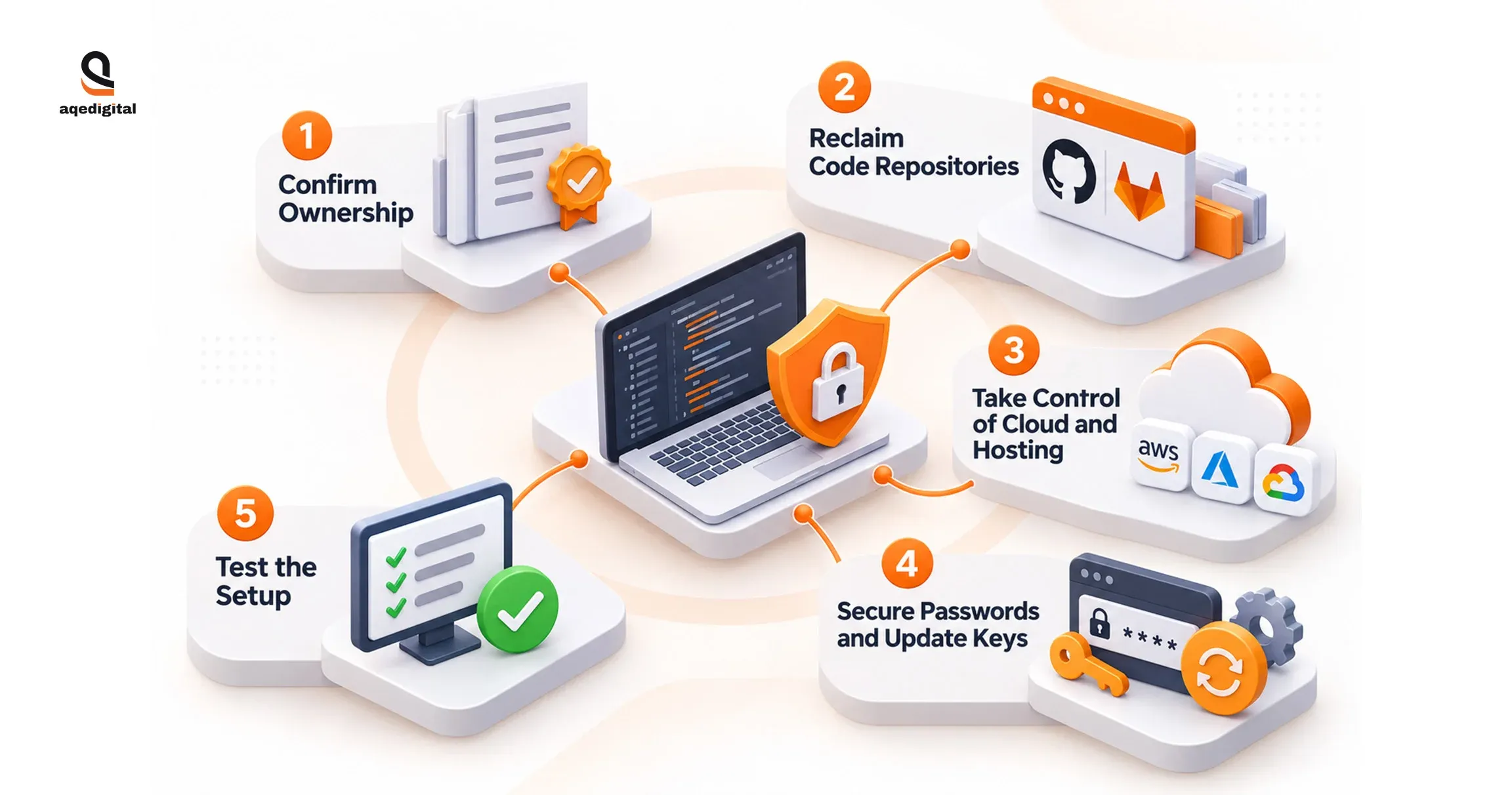
1. Confirm Legal Ownership and Primary Accounts
The first step will be to verify that work-for-hire agreements, subcontractor non-disclosure agreements, and intellectual property assignments guarantee full organizational ownership of all the custom source code, database schemas, and proprietary algorithms. You also need to ensure that all the primary digital assets, cloud environments, and domain accounts are registered under your corporate organization entity.
2. Reclaim Source Code Repositories
Make sure your own team, the owner, and storage systems such as GitHub or GitLab. Review data access across systems and who has it, including outside developers, automatic deployment keys, and links that trigger actions when code changes.
Aggregate every part of the code in one place, like the website, the backend, the mobile app, the server setup, scripts, database change files, and data pipelines.
3. Take Control of Cloud and Hosting
Change the role of the main owner of the cloud accounts and billing contacts for your hosting provider, such as AWS, Google Cloud, or Azure, to your company. Set up alerts so you are warned if costs rise unexpectedly.
Change the control of your domain name, DNS settings, security certificates, markets, and content delivery network to your company. Make sure that you take over the Apple and Google App Store accounts and signing keys used to publish updates.
You also need to secure access to payment tools, email sending services, and analytics tools.
4. Secure Passwords and Turn Off Old Access Safely
A key mistake that you need to avoid is shutting off the old developer's access on day one. Old passwords and keys are often hidden inside background tasks, scheduled jobs, and database scripts. Turning them off too quickly can stop the product from working, so make sure you do avoid this mistake.
Next, store all the password keys and database connection details in a secure password manager or secure secret vault. Turn on two-factor authentication for everyone who uses it.
Here is a stage-wise process you can follow:
- Confirm that your new admin login works and remove all developers' main admin accounts.
- Create new database passwords and storage keys and test them in the staging environment, and then remove the old ones.
- Create new keys for background task message queues and scheduled jobs. Monitor the logs for errors for about 72 hours before removing the old keys.
- Renew security certificates, update login redirect addresses, and remove old app signing keys.
5. Test the Setup Before Calling It Done
Use virtual machines or a separate computer, and ask your team to build and run the product from scratch using only the setup instructions. This will show whether anything important is missing from the code or was never saved. Check the live product carefully without changing anything.
Make sure users can log in, complete key transactions, run background jobs, and send messages. This gives you a clear picture of whether the system is behaving normally or whether there are any anomalies that you need to consider and make changes to later.

Step 2: Secure Access to the Codebase and Infrastructure
This step helps you understand different approaches you can leverage to reduce technical debt. Especially, it helps your team to understand how the product works in a real environment and how they can find new ways for technical debt remediation.
It starts by understanding the documentation of a software project takeover. The docs for a software product show how it was meant to work, and to learn how it actually works, your team needs to watch it run.
1. Monitor How the System Really Behaves
Monitor real user actions from start to finish through the screens, servers, databases, and any outside services they touch. Use automated scanning tools and simulations, but have experienced engineers review the results.
Tools often flag false alarms and miss protections that should exist or business rules that only make sense in context. Determine which version of the code is live without assuming the main branch matches what customers see. Write down the version identifier, release tag, build number, and settings currently running on the system.
2. List All Software Components
Make a comprehensive list of every piece of the software, including:
- Website
- Mobile apps
- Background workers
- Scheduled tasks
- Caches
- Search tools
You also need to list outside libraries and tools that the product uses. Check if these libraries or tools are no longer maintained and have loopholes in security. If the product uses AI features, check:
- How its data is stored and searched
- Which AI model version it relies on
- How much it costs to run as the usage grows
3. Map the Outside Connections and Data
Make sure your team lists every outside service that the product connects to, such as payment, email, text messaging, login, and CRM tools. Identify who owns each account and make a record of it.
Identify its usage limits and schedule changes. Document the database structure and how changes are applied. Find out whether updates happen automatically during release or need someone to run them manually.
4. Know and Protect Business Rules
One of the key technical debt management strategies is to know what the key business rules are and protect them. First, you need to take note of the key rules the product follows, such as how orders move between stages, who can do what, and how money is calculated.
These are important business logic rules that you need to first understand and then think about rewriting the product, even if the code looks complex and there are issues with it.
You need to understand that there are years of hidden fixes and customer-specific rules, which are often buried inside the business logic. A rewrite can lose them and introduce new bugs. The best approach is to set up a working test copy, automatic test releases, and monitoring before changing any code.
5. Identify Hidden Risks
When you plan for the software project takeover, an important part of this process is to search for the code of hidden triggers, built-in master passwords, secret admin switches, and open access points that don't require a login.
Check if the products send sensitive data to outside services through logging or tracking tools, and this needs to stop. You need to create specific data governance policies and access policies by understanding how the sensitive data is moved inside the system.
The next step is to identify weak points like:
- Domain names registered to individuals
- Aliases that depend on a specific person
- Backups that have never been tested
- Outside services that are being shut down
Step 3: Audit an Inherited Codebase
When you take over software from another vendor, you need to know what problems are hiding in the code. Some problems will cost you money, while others will slow down your team or cause the product to crash. Auditing the inherited codebase becomes important. It helps you find both minor and major issues.
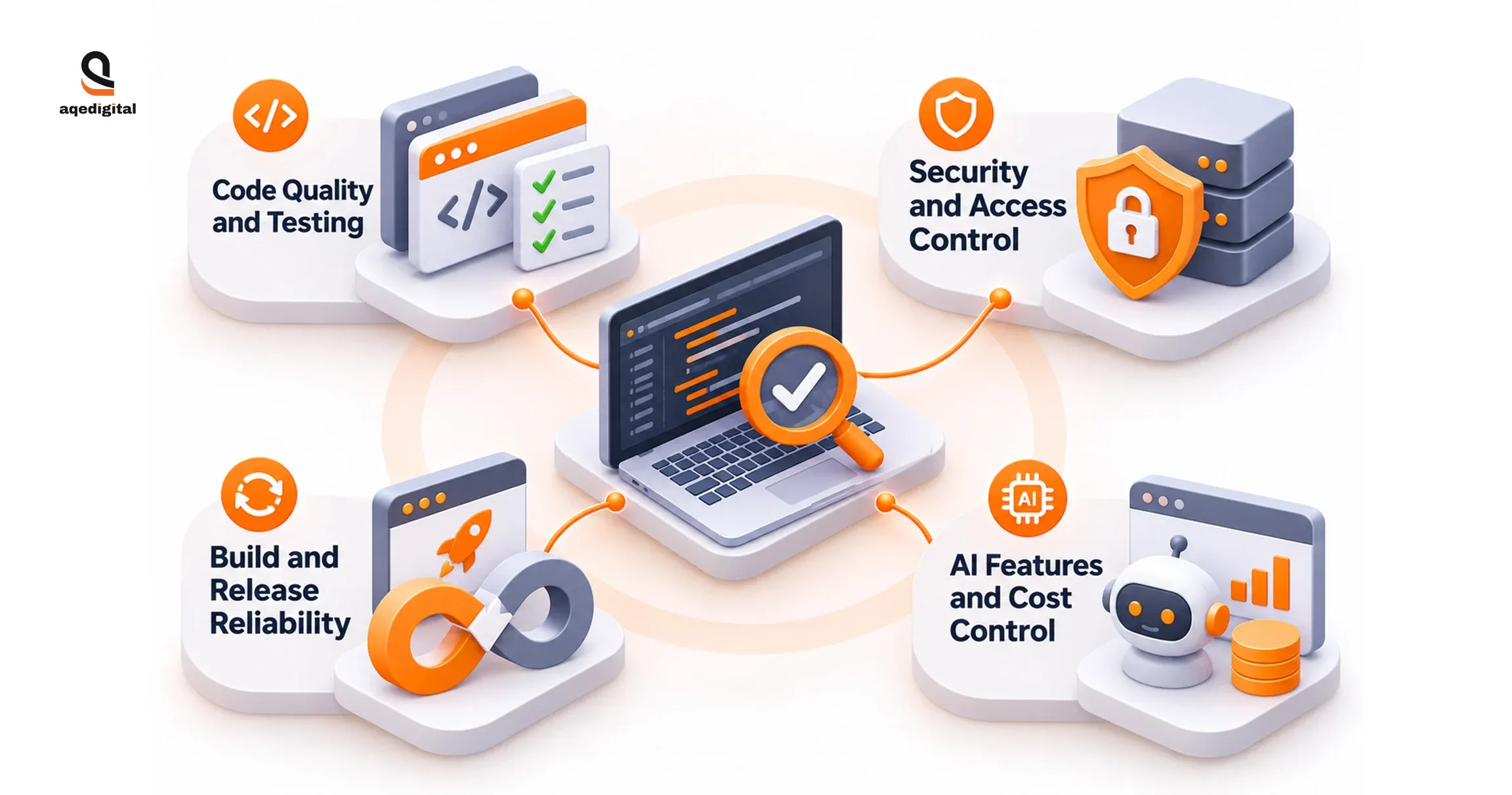
This should be done manually by an experienced engineer because an automatic tool's report may miss some of the issues.
What do you need to check?
- Check if the code is organized clearly and is tested. If it is not, the warning signs will include huge tangled sections, unused code, and a lack of testing.
- Check if any outsider without proper data access can get into the system or see the data they shouldn't. Here, the warning signs will include passwords written directly into the code, unprotected data, and open access points.
- Check if the product can be built and released the same way every time. Here, the warning signs will include manual release steps, backups that have never been tested, and no alerts when something breaks.
- Check if the product uses AI search or chatbots. Check whether its answers are accurate, and whether it can be moved to another provider, and whether its running cost will grow out of control.

Step 4: Prioritize Technical Debt and Define the Roadmap
Prioritizing the technical debt is key while taking over a software project from another vendor. This is not just about identifying what breaks the software but what is stopping it from upgrading to modern technologies. For example, you need to check whether there is redundant code and services in the software that may not allow AI integration.
Here’s the framework you can use for technical debt identification.
| Technical Debt Prioritization Framework | |
|---|---|
| Area | Overview |
| Code Health | Check whether the code is organized, tested, and free of tangled or unused parts. Messy code with no tests makes every change risky. |
| Security | Check who can get in and what data they can see. Look for passwords written into the code and open access points that need no login. |
| Outside Parts | Review the third-party libraries and tools the product uses. Flag ones that are no longer maintained or that could force you to publish your own code. |
| Deployment and Releases | Confirm the product can be built and released the same way every time. Manual steps, untested backups, and missing alerts are warning signs. |
| Hidden Risks | Look for secret triggers, master passwords, and data sent to outside accounts. Also check whether only one person understands how the product works. |
| AI Features (if any) | Check that AI answers are accurate, that the product isn’t locked to one provider, and that running costs won’t grow out of control. |
Once you identify the key technical debt issues in the system, apply the following remediation roadmap.
Days 1 to 30: Fix the urgent risks
- Days 1 to 14: Move all master accounts for the code, cloud, domains, and software services into your company’s name. Store all keys in a secure vault with two-factor login. Then have the new engineers build the product from scratch and run a test release in a safe copy of the system.
- Days 15 to 30: Replace the old keys in stages without causing downtime. Restore a real backup into a safe copy to prove it works. Replace any open-source libraries that could force you to publish your private code, and patch serious security holes.
Days 31 to 60: Improve quality
- Write automated tests for the most important customer actions, such as logging in, paying, and loading data.
- Have the outgoing developers work alongside your team for at least 14 days while your team runs releases, then write simple runbooks for common tasks.
- Break up overly complicated code so that small changes stop causing unexpected problems.
Days 61 and beyond: Lower costs and modernize
- Speed up slow database queries, add caching, and shut down unused servers and storage. The goal is a 15 to 30 percent cut in monthly hosting costs.
- If the product uses AI search, reduce dependence on one vendor and improve how it splits and searches documents, so answers are more accurate.
- Modernize in small steps. Don’t rewrite the whole product.
Checkpoints
You move to the next phase only when the proof is in place:
- Your company controls all accounts, and the code builds cleanly from scratch.
- Your team has shadowed the old developers for 14 days, backups have been tested, and new keys have run for 72 hours without errors.
- Your team runs the product alone for 30 days without asking the old vendor for help.
Deciding What to Do With an Inherited Software Product
When you assess every aspect, complete audits, and plan a roadmap, there are three ways to go about it.
- Keep it as it is and follow the business rules without taking too much risk. Making fixes to hidden customer-specific rules can add new bugs. So, don't risk it.
- Improve the existing software step by step when specific parts of it are hard to change or slow to update, but it has a sound core design.
- Rebuild it from scratch if it's fundamentally broken.
Which approach you choose depends on the specific condition you find the software in on takeover. However, in all three conditions, you will need a reliable technical partner. One that will help you audit the entire existing codebase, identify potential technical debt, and plan and implement a remediation roadmap.