A Complete Guide: How to Choose a Software Development Partner

Nirav Oza
For organizations looking for a software development partner, comparing technical skills or selecting the lowest development quote is not enough reasons to partner with that software development company.
The right partner can influence product quality, time-to-market, scalability, security, maintenance costs, and your ability to respond to changing business requirements.
For organizations building or modernizing critical applications, the decision becomes even more important because software development choices can create long-term technical and commercial consequences.
A capable software development company should therefore bring more than coding expertise. It should understand your business objectives, communicate clearly, manage delivery risks, and build software that can evolve with your organization.
Deloitte's research also shows that outsourcing is increasingly moving toward value-driven models, where businesses expect external partners to align with strategy while improving efficiency and accessing specialized capabilities.
Why Choosing the Right Software Development Partner Matters
Your software development partner becomes part of the system responsible for turning business requirements into working technology.
That relationship affects much more than the initial application or software launch. Architecture decisions, code quality, testing practices, documentation, and technical support can influence the product for years.
Development Quality Directly Impacts Business Outcomes
Good software should remain reliable as users, features, integrations, and workloads increase.
Poor implementation can create performance problems, security weaknesses, usability issues, and expensive maintenance requirements that appear long after the original project is completed.
The Wrong Partner Can Increase Your Total Development Cost
A low development quote may become expensive when projects require repeated rework, unclear communication, missed deadlines, or extensive internal supervision.
IBM describes technical debt as future work created by shortcuts or suboptimal development decisions, including additional debugging, refactoring, and maintenance.
A Strong Partner Becomes an Extension of Your Technology Team
The strongest relationships involve shared ownership of outcomes rather than simply completing assigned development tasks.
Your partner should understand why a feature matters, challenge technical assumptions when necessary, and recommend practical solutions that support long-term product goals.
8 Factors to Consider When Choosing a Software Development Partner
Selecting a development partner requires a broader evaluation than checking portfolios and comparing hourly rates.
The following factors can help you assess whether a potential partner is capable of supporting your technical requirements and business objectives.
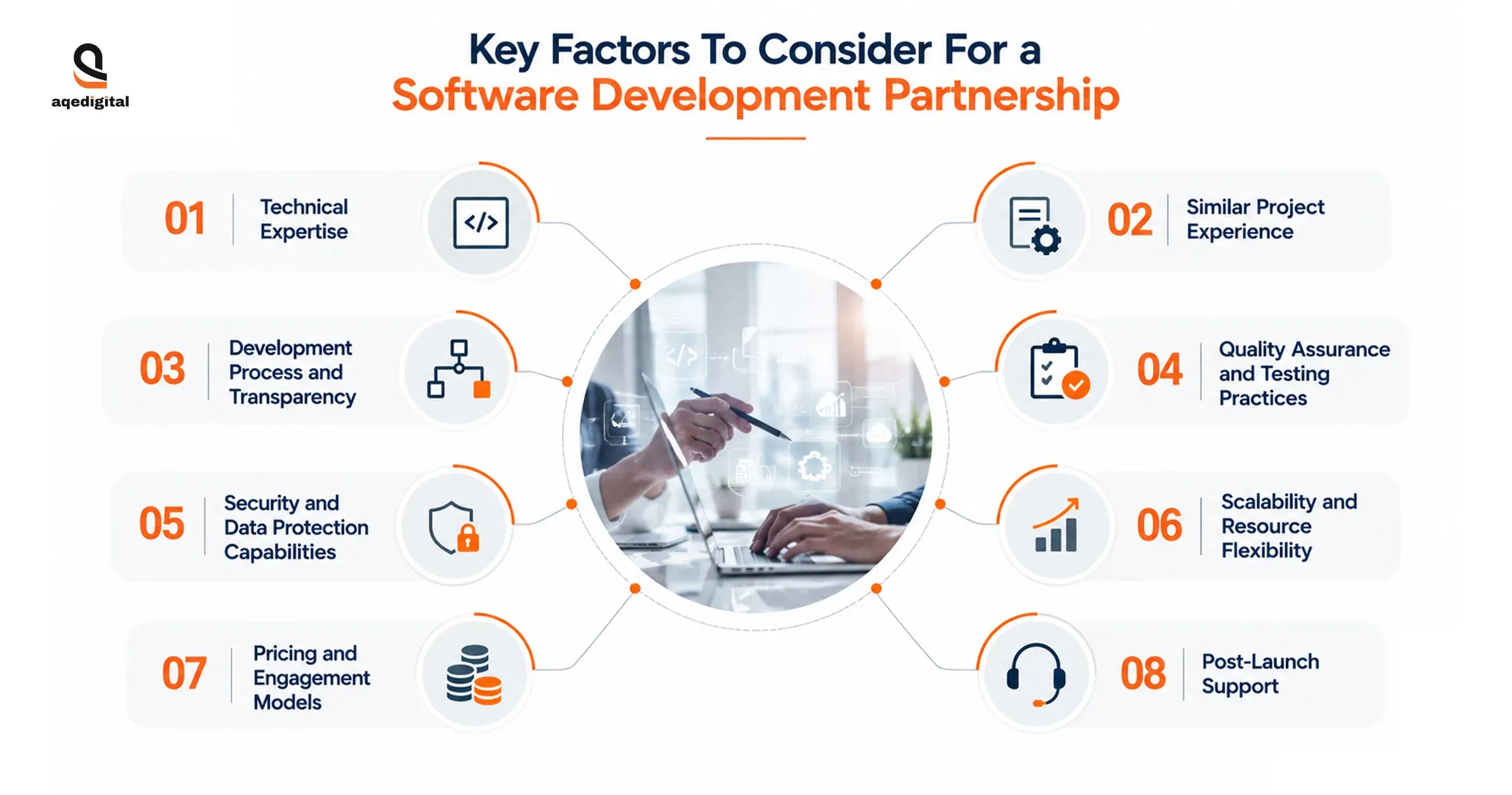
1. Technical Expertise That Matches Your Requirements
Start by evaluating whether the partner has experience with your required technologies, architecture patterns, integrations, databases, cloud environments, and development frameworks.
The right technical capability should match both your immediate requirements and the architecture you expect to build toward.
What to Check
- Relevant technology and framework expertise
- Architecture and integration experience
- Cloud and DevOps capabilities
- Database and API development knowledge
- Security and performance practices
A capable software development IT company should also explain why a particular technology is appropriate instead of simply offering the stack its developers already know.
2. Experience With Projects Similar to Yours
A portfolio should demonstrate more than attractive interfaces or completed applications.
Look for projects involving comparable complexity, workflows, integrations, user volumes, security requirements, or industry constraints.
Ask potential development partners for software to explain the challenges they solved, architectural decisions they made, and measurable outcomes achieved.
That conversation can reveal considerably more about engineering maturity than a collection of screenshots.
3. Development Process and Project Transparency
A strong development process gives stakeholders visibility into requirements, priorities, progress, risks, and upcoming releases.
Your software development company should have defined practices for discovery, estimation, sprint planning, documentation, reviews, change management, and stakeholder communication.
Transparency becomes especially important when multiple business and technical teams are involved in the same product.
4. Quality Assurance and Testing Practices
Quality assurance should be integrated throughout development rather than treated as the final checkpoint before deployment.
Evaluate whether the development company for software uses appropriate functional, regression, performance, security, compatibility, and automated testing practices.
High-quality code also matters after launch because maintainable software makes future debugging, refactoring, and feature development easier.
5. Security and Data Protection Capabilities
Security requirements should be considered during architecture and development rather than added after the application is completed.
Ask how the software dev company approaches secure coding, authentication, authorization, encryption, vulnerability assessment, access control, logging, and compliance requirements.
For regulated or data-sensitive applications, the software development solutions provider should also understand how security requirements influence architecture, development workflows, testing, and deployment.
6. Scalability and Resource Flexibility
Your development requirements may change as the product gains users, enters new markets, or introduces new functionality.
A reliable software making company should have the capacity to support changing workloads without creating unnecessary delivery bottlenecks.
This makes scalability important not only for software architecture but also for the development team supporting the product.
7. Pricing, Engagement Models, and Commercial Transparency
Do not compare software development partners exclusively by their hourly rates.
Evaluate the complete commercial model, including project management, QA, communication, infrastructure responsibilities, maintenance, change requests, and post-launch support.
Common engagement approaches include:
- Fixed-price development
- Time-and-material engagements
- Dedicated development teams
- Milestone-based delivery
- Long-term maintenance and support
A transparent software development service provider should explain what each model includes and where additional costs may arise.
8. Post-Launch Support and Long-Term Partnership
Software development does not end when an application reaches production.
Future releases, security updates, performance improvements, feature enhancements, integrations, and technical issues require continued engineering attention.
Choose an IT software development company that can support the software life cycle rather than disappearing after the initial delivery.

What Should You Ask a Software Development Partner Before Hiring?
The right questions can reveal whether a potential partner has the technical maturity, delivery discipline, and commercial transparency your project requires.
Questions About Technical Capabilities
- Have you delivered projects with similar technical requirements?
- How do you approach architecture and technology selection?
- How will your solution support future scalability?
- How do you handle third-party integrations and APIs?
Questions About Delivery and Communication
- Who will manage the project and technical delivery?
- How will progress, risks, and changes be communicated?
- What happens when requirements change during development?
Questions About Quality and Security
- What does your QA process include?
- How do you identify security vulnerabilities?
- How are production issues handled after deployment?
Questions About Pricing and Ownership
- How will the project cost be estimated?
- What does the proposed engagement include?
- How are additional requirements priced?
- Who owns the source code and intellectual property?
These questions help separate a software development service company that simply executes requirements from a partner capable of contributing to the broader technology strategy.
Software Development Partner vs. Software Development Vendor: What Is the Difference?
The difference often comes down to the level of ownership and involvement.
| Software Development Vendor vs. Software Development Partner | |
|---|---|
| Software Development Vendor | Software Development Partner |
| Focuses primarily on assigned requirements | Understands broader business objectives |
| Usually works around predefined specifications | Can contribute to solution and architecture decisions |
| Measures success around project delivery | Looks at long-term product outcomes |
| May provide limited strategic input | Works collaboratively with internal stakeholders |
| Relationship may end after project completion | Can support continuous product evolution |
| Primarily delivers development capacity | Combines expertise, capacity, and strategic guidance |
For complex products, that distinction matters because technical decisions made today can influence development speed, maintenance effort, and scalability for years.
A reliable and experienced IT company for software development should therefore be evaluated on its ability to become a reliable technology extension, not simply its ability to complete tickets.
How to Choose the Right Software Development Partner: Final Checklist
Before signing an agreement, make sure your potential software development partner can answer these questions convincingly:
- Does the partner understand your business objectives?
- Does its technical expertise match your requirements?
- Is its development process transparent?
- Does it have structured QA and testing practices?
- How does it approach security and data protection?
- Can it scale development resources when needed?
- Are pricing and engagement terms clearly defined?
- Does it provide post-launch support?
- Can it become a long-term technology partner?
Why AQe Digital Is the Right Software Development Partner
Choosing AQe Digital means you are working with a technology team that combines software engineering, architecture, consulting, product development, and modernization capabilities.
We have 27+ years of industry experience and 650+ engineering professionals, with a focus on enterprise-grade digital transformation and scalable technology solutions.
End-to-End Software Development Expertise
Our team supports software initiatives across consulting, architecture, custom development, integrations, modernization, testing, deployment, and ongoing improvement.
This allows businesses to address multiple technology requirements through one experienced engineering partner.
Technology Expertise Across Modern Development Stacks

At AQe Digital, our team works across custom software, full-stack development, cloud solutions, APIs, enterprise applications, product engineering, and modernization initiatives.
Our approach includes architecture design, technology evaluation, scalable application development, and cloud-native engineering.
Flexible Engagement Models
Different organizations require different levels of development support.
We support project-based development, dedicated capabilities, staff augmentation, product engineering, and broader software consulting requirements depending on the engagement.
Quality-Focused Development Process
Quality is addressed through functional, regression, performance, security, compatibility, and continuous validation practices across relevant software development engagements.
This approach helps reduce avoidable defects while creating more reliable applications and smoother future releases.
Scalable Development Capacity
As requirements change, development teams may need to expand capabilities, introduce new technologies, or address complex modernization requirements.
Our development approach combines engineering depth with flexible delivery capabilities to support evolving enterprise software requirements.
Long-Term Technology Partnership
We position our engagements around long-term collaboration rather than one-time development delivery.
Our software consulting approach includes architecture, DevOps, security, performance optimization, modernization, and change management capabilities alongside software engineering.

Conclusion
Choosing a software development partner is ultimately a decision about how confidently your business can turn technology investment into sustainable results.
The right partner should understand your objectives, challenge weak assumptions, build maintainable software, manage delivery risks, and remain capable as your requirements evolve.
That combination becomes particularly valuable when software is central to your operations, customer experience, or competitive advantage.
Our software development team brings software consulting, product engineering, enterprise development, modernization, cloud, DevOps, and custom software capabilities together to support complex digital initiatives.
Contact us to discuss your software development requirements and explore the right software solutions for your business.