How Smart Factories are Revolutionizing Production, Planning & Scheduling

Nirav Oza
Manufacturing changes rapidly – Industry 4.0 has drastically revolutionized manufacturing by integrating smart technologies, automation, and data-driven decision-making, promising production processes to be more efficient, flexible, and cost-effective. And, 93% of businesses believe AI is a crucial technology that accelerates innovation and drives growth in the industrial space. Moving towards smart factories with everything from artificial intelligence-powered production to predictive maintenance and real-time analytics means manufacturers are changing how they function, produce, and deliver.
Then, the big question: Will you be ready for the challenges and opportunities this change will bring?
The shift in AI in manufacturing carries the same responsibility as your production planning. Smart production, planning, and scheduling are no longer a privilege but are indeed the tools of survival and success in fast-moving data- and information-rich environments.
Challenges of Transforming Manufacturing Processes with AI-ML-Data, IoT, and Automation
The shift to a smart factory has tremendous benefits but imposes many challenges on manufacturers. The path to becoming a smart factory has many obstacles, ranging from technology adoption to workforce readiness. Here are what we believe as the major challenges manufacturers face:
1. Inaccurate Demand Forecasting – Imagine spending weeks crafting the perfect production plan, only to find out that you’ve either got too much inventory sitting unused or not enough to meet unexpected demand. Traditional forecasting methods can’t always predict the sudden shifts in the market that cause these headaches.
2. Inefficient Production Scheduling – Having a production schedule that’s locked in place, even when things change on the fly, can be a real pain. Machines break down, materials run low, and workers might not always be available when expected. Sticking to outdated schedules can waste time and resources, costing you money.
3. Lack of Real-Time Visibility and Monitoring – It’s hard to know what’s happening on the factory floor when you can’t see it all in real time. Without this visibility, problems can creep up and disrupt production unexpectedly.
4. Unplanned Maintenance and Equipment Downtime – Unplanned Maintenance and Equipment Downtime – No one likes unexpected disruptions. They’re costly and often entirely preventable. By leveraging AI in reducing downtime, businesses can move beyond fixed maintenance schedules to predictive insights, ensuring equipment is serviced when needed and preventing failures that could derail operations.
5. Manual and Error-Prone Workflow Management – Manually managing workflows can be a major bottleneck in production. People get tired, mistakes happen, and tasks get delayed, all of which affect the overall efficiency of your operations.
6. Labor-Intensive Material Handling – Moving materials around, sorting them, packing them—it’s repetitive, time-consuming work that often leads to errors or delays. Plus, it takes up valuable labor that could be put to better use.
How AI-ML-Data, IoT, and Automation Are Transforming Manufacturing Production Planning Software
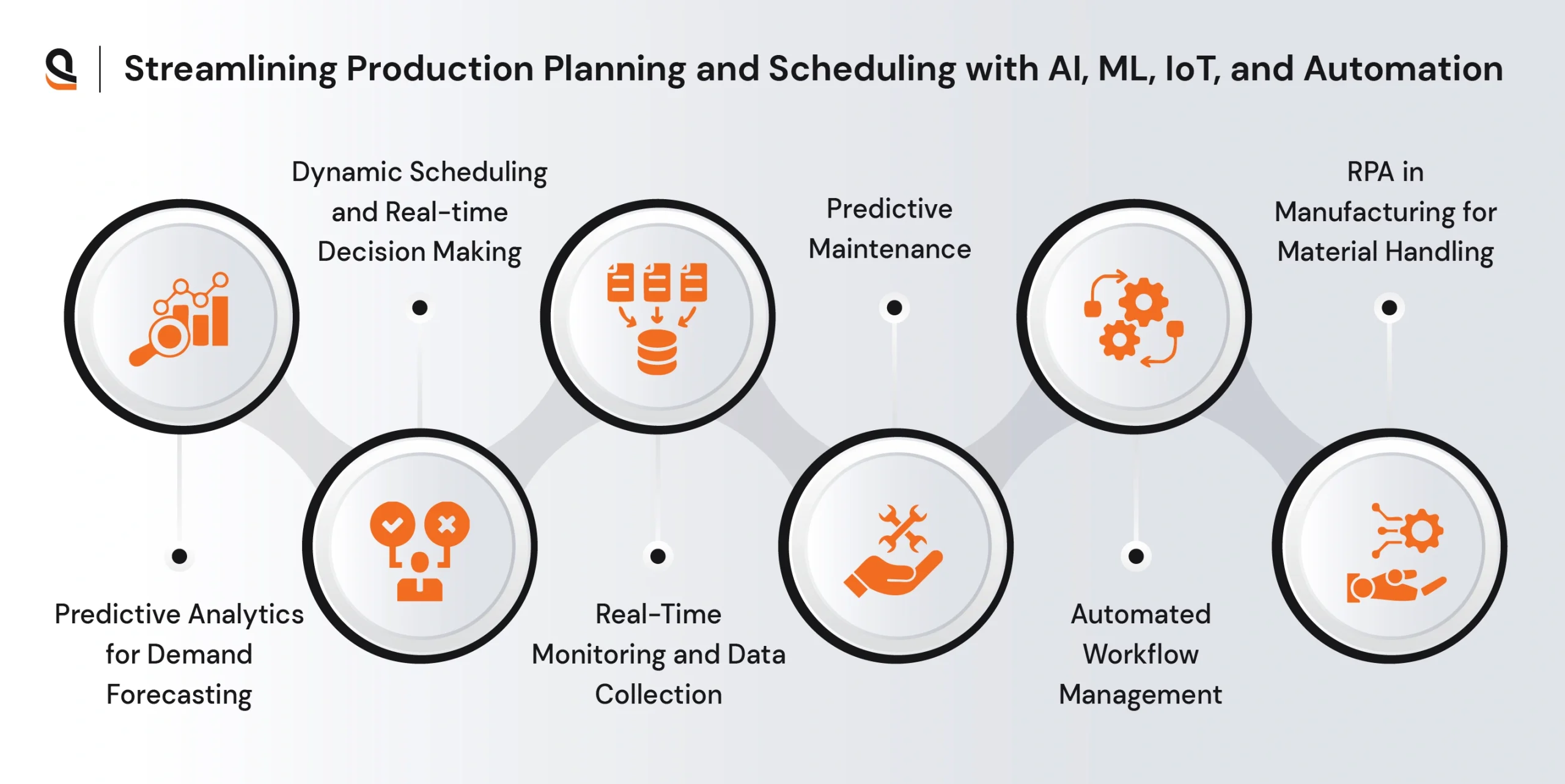
1. Predictive Analytics for Demand Forecasting
In manufacturing, one of the most challenging aspects is ensuring you have the right amount of raw materials, parts, and finished goods at the right time. Too much inventory ties up cash, while too little leads to production delays, stockouts, or missed customer orders. Traditional forecasting methods, which rely on simple averages or past sales data, often miss nuances in market trends or fail to predict sudden spikes in demand.
Artificial Intelligence (AI) and Machine Learning (ML) revolutionize this process by analyzing vast amounts of data, both from historical production records and external sources like market trends, seasonal changes, and even consumer sentiment.
- Benefits of Using Predictive Analytics in Manufacturing:
✔ Improved Accuracy
✔ Cost Savings
✔ Better Decision-Making
Role of AQe Digital:
Using artificial intelligence services we implement predictive analytics in manufacturing for accurate demand forecasting which aids in synchronizing the necessary program with market requirements, thus their overall working is improved and cost are reduced.
- AI Model Forecast: We apply top of the line machine learning models and deeply analyze the historical sales, customer’s actions towards the product, and the current market tactic to accurately predict what is going to be needed in the future.
- Customizable Model: Our proposal is available with regard to the specific requirements of all industries with provided seasons and sudden changes in the market, which include countless primary factors.
- Integrated Data System: To achieve precise forecasts and productive production plans, the flow of correct data from various systems is required. Therefore, we combine existing systems ERP, CRM, and others often.
- Actionable insights: We provide producers with real-time dashboards and detailed reports, enabling dynamic revision of the production program, which decreases waste and increases customer satisfaction.
2. Dynamic Scheduling and Real-time Decision Making
Dynamic scheduling and real-time decision making are considered a vital part in the wheel of smart manufacturing systems, particularly in the complexity-ridden industries that require efficiency, flexibility, and rapid response to disruptions. AI in manufacturing offers the capability to maintain a continuous analysis of data generated by the system during production so it can instantly readjust schedules, workflows, and allocations of resources in an optimal manner to effectuate efficiency. In such a way, considerations are given to overall optimization of the production process with respect to several rapidly changing parameters, such as machine availability, workforce skills, material availability, and other external factors.
- Benefits of Dynamic Scheduling for Manufacturers:
✔ Better Resource Utilization
✔ Minimized Downtime
✔ Faster Time-to-Market
Role of AQe Digital:
Our team develops smart production planning software built on AI and optimization tools that automatically change production schedules based on real-time data to maximize a manufacturer’s efficiency and speed up delivery times, making it more efficient over time and effort.
- AI-powered Scheduling: Using AI algorithms, manufacturing production planning software automatically comes up with the best production schedules stemming from the available resources like labor, materials, deadlines, machines, and customer orders.
- Adjustments in Real-time: Changes to schedules are instantly updated. Automatic production schedules change according to machine breakdowns, delays, or even demand.
- Resource Assignment: Our manufacturing production planning systems guarantee the best assignment of people, machinery, and even raw materials and guarantee the best results by eliminating inefficient tasks and underused resources.
- Decreased Lead Times: Meeting deadlines becomes easier and quicker, plus increased order fulfillment equals happiness to customers all while improving the bottom line with the optimized production schedules.
3. Real-Time Monitoring and Data Collection
When equipped with IoT devices, the machinery collects a huge amount of data whenever a particular equipment is in operation; these can be analyzed for predictive failure analysis. For example, sensors can extract data related to temperature, vibration, and other indicators that signal imminent issues. This enables manufacturers to carry out predictive maintenance, thus circumventing expensive breakdowns due to halted production lines.
- Benefits of Real-Time Monitoring and Data Collection:
✔ Proactive Issue Resolution
✔ Increased Transparency
✔ Improved Efficiency
Role of AQe Digital:
With IoT-based monitoring solutions, manufacturers keep track of production as events unfold. Our platform offers actionable insights toward predicting issues before they manifest as problems and helps in enhancing productivity.
- IoT Integration: Merges real-time data from all of your machines, sensors, and workstations.
- Data-Driven Decisions: Advanced algorithms can analyze recorded data and show insights into machine performance, production efficiency, and possible reported problems.
- Alerts and Notifications: Immediate and real-time alerts are generated when any deviations, failures, or inefficiencies take place, so you can act before a situation becomes nasty in production.
- Better Visualization: You will be given a very user-friendly dashboard where you would see up to the minute where your whole AI in manufacturing process is and make decisions for operations based on that.
4. Predictive Maintenance
Predictive maintenance uses data collected from machines and equipment to predict when maintenance will be required. By using sensors and historical performance data, AI models predict failure points and alert operators to perform maintenance only when necessary, rather than following a fixed schedule.
- Benefits of Predictive Maintenance:
✔ Reduced Unplanned Downtime
✔ Lower Maintenance Costs
✔ Better Equipment Reliability
Role of AQe Digital:
With advanced AI in manufacturing technologies using machine learning methods to predict possible failures and proactively schedule maintenance interventions to ensure maximum uptime and long-term reliability of the assets, we offer integrated predictive maintenance solutions for seamless working with the company’s systems.
- Condition-Based Monitoring: We use sensors and IoT devices for the continuous health of your machines and analyze enormous data in terms of working conditions – things like temperature, vibration, and pressure to predict failure.
- AI-Powered Prediction: Our predictive maintenance systems run on historical data and AI models to warn when maintenance or parts replacement is required, thereby lessening unplanned downtime.
- Maintenance Scheduling: We automate the maintenance process by choosing the best time for repair or replacement based on the production schedule to minimize disruption.
- Manufacturing Cost Reduction: Performing maintenance of your systems only when it is necessary, rather than using a predetermined set of time, we help you in manufacturing cost reduction on maintenance, increase equipment lifecycle, and allow production to maximize uptime.
5. Automated Workflow Management
At AQe Digital, we use automation in manufacturing tools like Manufacturing Execution Systems (MES) to arrive at optimal production scheduling automatically. Therefore, these tools consider resource constraints, order priorities, and machine availability for the creation of the most efficient production sequence. This level of automation in manufacturing opens very smooth transitions between tasks, minimizing human interventions and errors in scheduling.
- Benefits of using AI in Industrial Automation:
✔ Reduced Unplanned Downtime
✔ Lower Maintenance Costs
✔ Better Equipment Reliability
Role of AQe Digital:
We provide automated workflow management solutions that remove bottlenecks in production and enable tasks to be done properly without delay provide a framework within which human error could be avoided while ensuring smooth throughput from beginning to end.
- Automated Task Scheduling: We develop a manufacturing production planning software application that automatically schedules tasks to be performed by workers and machines, thus enhancing operational efficiency while ensuring that each activity of the production process flows smoothly.
- Seamless Integration: Our workflow management tools enjoy complete integration into your existing systems (ERP, MES, etc.), thereby guaranteeing that a single user interface controls the flow of all workflows.
- Error Reduction: By automating repetitive tasks and processes, we reduce the chance of human error, thereby ensuring uniform quality and compliance at the entire production line.
- End-to-End Tracking: From raw material procurement to finished goods, the system is tracking every single step, giving you complete visibility and control over your workflows.
6. Robotic Process Automation in Manufacturing (RPA) for Material Handling
Integrating robotic systems and automated guided vehicles (AGVs) into material handling and assembly lines makes the whole production process very efficient. RPA works on mundane functions such as picking, packing, sorting, and assembly. Robots work with high precision, making them invaluable to the production process by being fatigue-free and thus increasing productivity and minimizing human error.
- Benefits of Integrating RPA in Material Handling:
✔ Improved Productivity
✔ Lower Labor Costs
✔ Better Equipment Reliability
Role of AQe Digital:
We offer RPA solutions in material handling and workflow optimization. Automating material movement processes would help manufacturers increase throughput and lower the time and expense spent on labor-intensive processes, thus freeing up human resources for meaningful and strategic activities.
- Robotic Automation Solutions: We suggest using robotic process automation in manufacturing to take care of all repetitive tasks such as material movement, sorting, and inventory management and necessitating no physical handling.
- Integration with Existing Systems: Our automation in manufacturing does sync entirely with warehouse management and production systems allowing material flow and inventory control to be more streamlined without human involvement.
- Improved Automation Efficiency: Robots will take care of processes like picking, packing, and sorting, speeding up these processes and increasing productivity.
- Scalability: We design our RPA solution with scalability in mind, meaning additional expansion can be added in the same manufacturing production planning software or hardware at a later stage thus enabling automation in manufacturing at a higher level without an extra cost of manual workers as the business grows.
Shape the Future of Smart Manufacturing Production Planning with AQe Digital
We make the factories smart, faster, and more efficient. At AQe Digital, your digital transformation partner, we employ next-gen technologies to transform operations into smart factories that can thrive in today’s ever-evolving market. Here is how we can help:
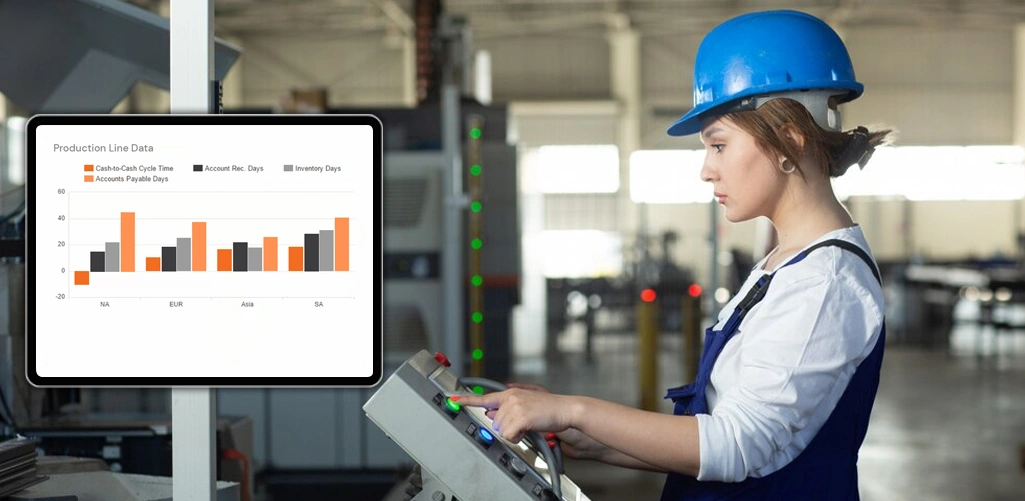
- End-to-End Solutions: Predictive analytics and automated workflows come with all the consulting for the full continuous optimization of production lines.
- Customized for You: Solution development is done in collaboration with you, ensuring proper everyday functioning and efficiency of the factory-in-days.
- Real-Time Insights: Just imagine taking decisions at breakneck speed with real-time data-an edge that our solutions give, improving your agility and reducing downtime.
- Easy Integration: There is no ground-up effort needed on your part. Our solutions corroborate seamlessly into your existing ERP and MES, making it easier for you to integrate it.
- Future-Ready: Our solutions are configured to change based on business footprints so that your production planning is nimble, scalable, and future-proof at all times.
- Get Better Efficiency: With AQe Digital, you will cut waste, optimize resources, and run production at max throughput-all at lower costs for you.
