SaaS Application Development: Architecture, Features, Costs & Development Process

Jigar Mistry
Software has increasingly moved from something businesses install and maintain to something they access, subscribe to, and continuously improve.
That shift has made SaaS applications an attractive model for businesses building new digital products, modernizing legacy software, or creating recurring-revenue technology businesses.
The market opportunity continues to expand. Gartner reported that worldwide SaaS revenue reached $218.5 billion in 2024, representing 16.7% growth. Its latest 2026 research also confirms that SaaS market growth remained strong in 2025, driven by AI innovation, broader cloud adoption, and demand for secure, scalable platforms.
However, launching a SaaS product is not simply a matter of putting an application in the cloud.
A commercially successful SaaS product must support multiple customers, protect their data, handle subscriptions, scale with usage, integrate with other systems, and evolve without disrupting existing users.
That makes the decisions made during SaaS application development particularly important.
From selecting the right SaaS architecture and technology stack to defining an MVP, implementing security, and planning for long-term scalability, every decision can influence development effort, operating costs, customer experience, and product growth.
What Is SaaS Application Development?
SaaS application development is the process of designing, building, deploying, and maintaining software that customers access as an ongoing online service rather than installing and managing independently.
Unlike traditional software, where customers may purchase a version and deploy it within their own environment, SaaS products are generally operated centrally by the provider.
Customers typically access the application through a browser, mobile application, or API while the provider manages the underlying infrastructure, updates, security, and service availability.
A SaaS development company therefore needs to approach the product as both a software application and an ongoing service.
Why Businesses Are Investing in SaaS Products
The SaaS model can create advantages for both providers and customers.
For providers, recurring subscription models can create more predictable revenue while centralized software delivery simplifies product updates.
For customers, SaaS products can reduce infrastructure management and provide faster access to new functionality.
The model is also expanding across business categories, from CRM and accounting to collaboration, analytics, healthcare, logistics, HR, cybersecurity, and industry-specific applications.
SaaS Architecture: How Should a SaaS Application Be Designed?
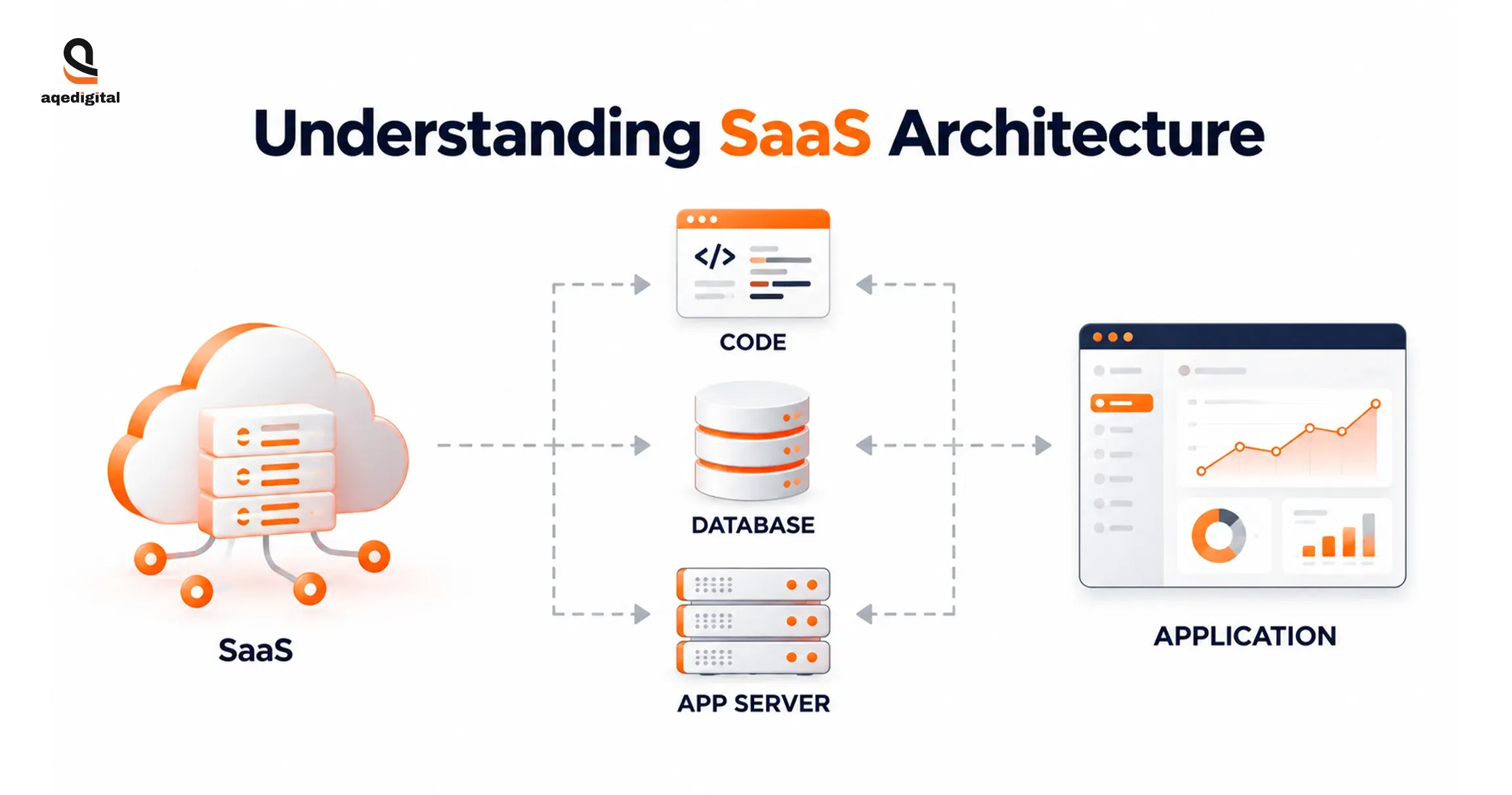
A strong SaaS architecture provides the foundation for scalability, reliability, security, maintainability, and product evolution.
The architecture should reflect the product's expected customer base, workload, integrations, security requirements, and commercial model rather than simply following the latest technology trend.
A typical SaaS architecture may contain:
- Presentation Layer: Web or mobile interfaces through which users interact with the product
- Application Layer: Business logic and application services that process user requests
- API Layer: Interfaces for internal services, integrations, and external consumers
- Identity Layer: Authentication, authorization, roles, permissions, and account management
- Tenant Management Layer: Customer identification, configuration, entitlements, and isolation
- Data Layer: Databases, object storage, caching, and other persistence mechanisms
- Integration Layer: Third-party applications, webhooks, external APIs, and enterprise systems
- Infrastructure Layer: Cloud resources, containers, networking, deployment, and scaling
- Observability Layer: Logs, metrics, traces, alerts, and application monitoring
The right architecture does not necessarily mean the most complicated architecture.
Cloud infrastructure is also becoming a larger part of the technology foundation behind modern applications. Gartner forecasts worldwide IaaS spending to reach $287.3 billion in 2026, representing 29.3% growth, while AI-optimized IaaS spending is expected to grow 96.4% to $42.3 billion.
An early-stage product may benefit from a modular monolith, while a high-volume platform may eventually require independently scalable services.
Single-Tenant vs Multi-Tenant SaaS Architecture
One of the major architectural decisions concerns how customer environments and data will be separated.
| Single-Tenant vs Multi-Tenant SaaS Architecture | ||
|---|---|---|
| Factor | Single-Tenant Model | Multi-Tenant Model |
| Customer environment | Dedicated | Shared or logically separated |
| Data isolation | Strong physical separation | Logical or architectural isolation |
| Infrastructure efficiency | Lower | Higher |
| Customization | Easier | More controlled |
| Operational overhead | Customer-specific | Lower with centralized management |
| Resource utilization | Customer-specific | Shared across customers |
| Typical use | Specialized enterprise requirements | Scalable SaaS products |
A multi-tenant SaaS architecture allows multiple customers to use the same underlying application environment while maintaining appropriate isolation between their data and operations.
What Features Should a SaaS Application Include?
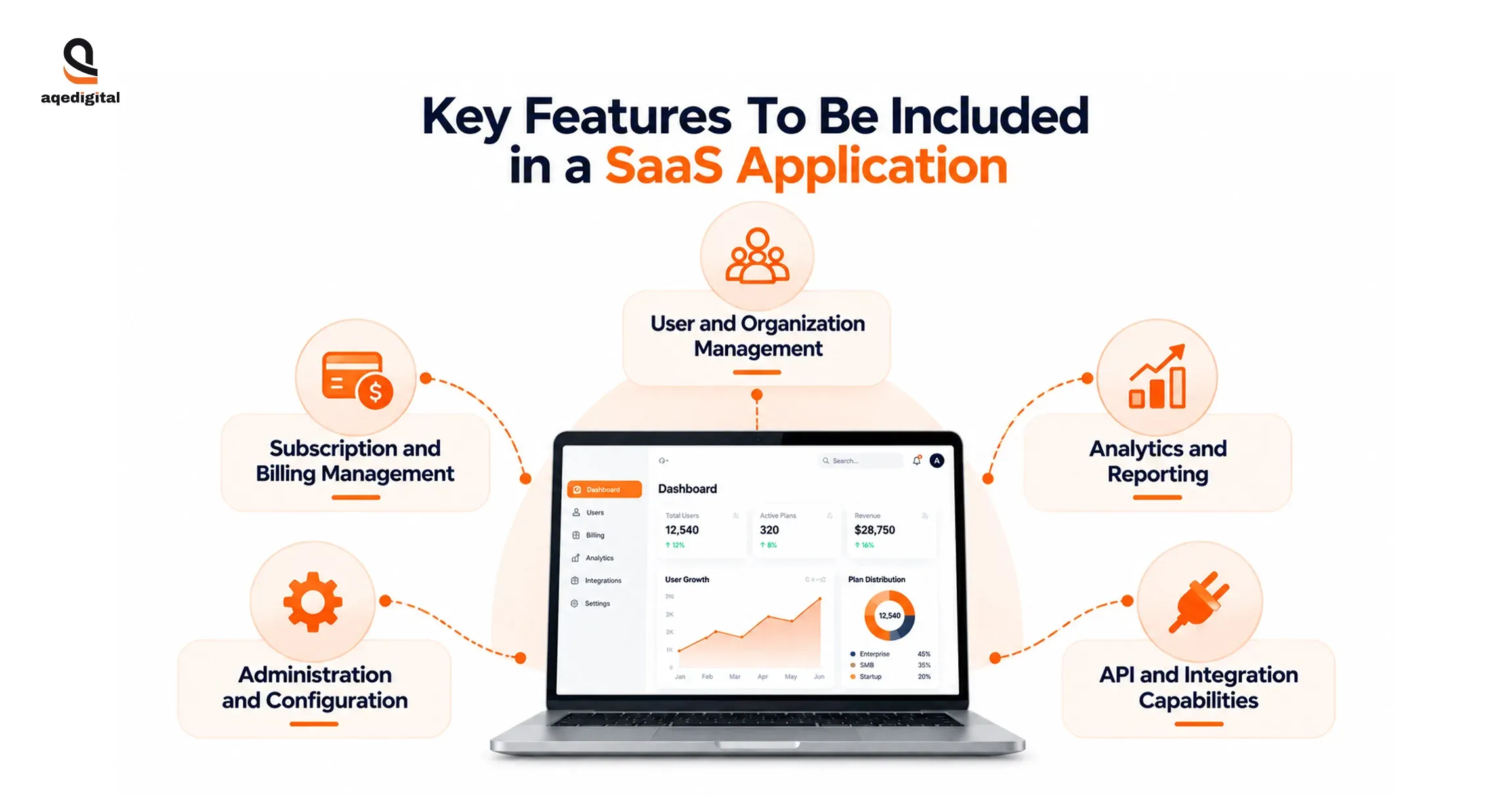
There is no universal feature checklist for every SaaS product.
A CRM, financial platform, HR application, analytics product, and project-management platform will have completely different core functionality.
However, most commercially viable SaaS products need several foundational capabilities beyond their primary business functionality.
User and Organization Management
A SaaS product should provide mechanisms for managing users and organizations.
Depending on the product, this may include:
- User registration and login
- Organization or workspace creation
- User invitations
- Role management
- Permission controls
- Profile management
- Account settings
- Team administration
For B2B products, organization-level management becomes particularly important because one customer account may contain multiple teams and permission levels.
Subscription and Billing Management
Subscription functionality is another major SaaS capability.
Depending on the commercial model, the product may need:
- Subscription plans
- Free trials
- Recurring payments
- Upgrades and downgrades
- Coupons and discounts
- Invoices
- Payment history
- Usage-based billing
- Cancellation and renewal management
Billing should be connected with product entitlements so that subscription changes can automatically affect available functionality.
Administration and Configuration
A strong administrative layer allows internal teams and customer administrators to manage the application without depending on developers for routine changes.
Useful capabilities can include:
- Customer management
- Feature configuration
- User administration
- Permission management
- Usage monitoring
- Account status
- Audit history
- System settings
Analytics and Reporting
Customers increasingly expect SaaS applications to provide visibility into their own activity and business outcomes.
Depending on the product, this could include dashboards, usage reports, operational metrics, export functionality, alerts, or scheduled reports.
API and Integration Capabilities
Modern SaaS products rarely operate completely independently.
Customers may want to connect the application with CRM platforms, accounting software, communication tools, data warehouses, identity providers, or internal systems.
API-first thinking can therefore make future integrations easier while allowing the product to become part of a broader technology ecosystem.
Choosing the Right SaaS Tech Stack
The SaaS tech stack should be selected according to the product's requirements rather than developer preference alone.
A typical stack may include:
| Typical SaaS Tech Stack | |
|---|---|
| Layer | Common Options |
| Frontend | React, Next.js, Angular, Vue |
| Backend | Node.js, .NET, Java, Python |
| Database | PostgreSQL, MySQL, MongoDB, other suitable databases |
| Cloud | AWS, Azure, Google Cloud |
| Cache | Redis or equivalent |
| APIs | REST, GraphQL, event-driven APIs |
| Infrastructure | Containers, serverless, virtualized infrastructure |
| DevOps | CI/CD, infrastructure as code, automated testing |
| Monitoring | Logs, metrics, tracing, application monitoring |
The stack should be evaluated against:
- Product requirements
- Expected user volume
- Data characteristics
- Integration requirements
- Security expectations
- Development speed
- Hiring availability
- Cloud operating costs
- Long-term maintenance
- Scalability requirements
A SaaS development company should be able to explain why a particular technology is appropriate rather than simply presenting a preferred stack.
SaaS Product Development Process: From Concept to Launch

A structured SaaS product development process helps turn an initial product idea into a maintainable commercial platform.
The exact sequence can vary, but most projects benefit from the following stages.
1. Product Discovery and Validation
The first stage should establish what the product needs to accomplish.
Teams should identify:
- Target customers
- Core problem
- Product differentiation
- Primary workflows
- Revenue model
- Competitive landscape
- Initial feature priorities
- Business success metrics
2. Requirements Definition
The validated product concept is translated into functional and technical requirements.
This includes defining user journeys, roles, permissions, workflows, integrations, data requirements, non-functional requirements, and acceptance criteria.
Clear requirements reduce ambiguity later in development.
3. UX and Product Design
The design stage converts requirements into usable product experiences.
It can include information architecture, wireframes, user journeys, prototypes, interface design, responsive behavior, and design systems.
For SaaS products, UX should also account for onboarding, account administration, subscription management, empty states, permissions, notifications, and error handling.
4. Architecture and Technology Planning
The development team defines the application's technical foundation.
This includes:
- SaaS architecture
- Tenancy model
- Database strategy
- API architecture
- Authentication
- Authorization
- Cloud infrastructure
- Integration approach
- Deployment strategy
- Monitoring
- Security controls
Architecture decisions made here can have a significant impact on future SaaS app development cost.
5. SaaS MVP Development
The next step is to build a commercially meaningful minimum viable product.
SaaS MVP development should focus on the smallest version capable of solving the target customer's primary problem.
The objective is to avoid investing heavily in features before there is evidence that customers need them.
A practical MVP should generally include the core workflow, essential account capabilities, appropriate security controls, required integrations, and enough product quality for real users to evaluate it.
6. Core Application Development
Once the product foundation is established, the team develops the application's primary functionality.
This includes frontend and backend engineering, database development, APIs, business logic, integrations, authentication, administration, and other required capabilities.
7. Testing and Quality Assurance
Testing should cover more than whether individual features work.
A SaaS product should be evaluated for:
- Functional correctness
- Security
- Performance
- Compatibility
- API behavior
- Tenant isolation
- Usability
- Reliability
- Failure handling
- Scalability
Automated testing should be incorporated wherever practical to reduce regression risk as the product evolves.
8. Deployment and Production Readiness
Before launch, the product needs production infrastructure, deployment automation, monitoring, backups, logging, access management, and operational procedures.
The deployment model should also support future releases without requiring disruptive manual processes.
9. Launch and Customer Feedback
The first production release provides information that cannot be obtained entirely through internal testing.
Customer behavior, support requests, usage patterns, conversion data, and product feedback can reveal which capabilities deserve further investment.
10. Continuous Product Improvement
SaaS products are never truly finished.
The development cycle continues through feature improvements, performance optimization, security updates, infrastructure changes, integrations, and customer-driven enhancements.
This continuous model is one reason choosing an experienced SaaS development company matters beyond the initial launch.
How to Build a SaaS Application That Can Scale
Businesses often ask how to build a SaaS application that can handle future growth without overengineering the first release.
The answer lies in designing clear growth paths rather than attempting to predict every future requirement.
Design for Increasing Tenant Volume
The system should be capable of onboarding new customers without requiring substantial manual infrastructure work.
Plan for Database Growth
Database architecture should consider indexing, query patterns, partitioning opportunities, backup strategies, replication, and future scaling requirements.
Separate Workloads Where Necessary
Background processing, notifications, reporting, file processing, and other resource-intensive operations may benefit from asynchronous processing rather than running directly within customer-facing requests.
Introduce Caching Strategically
Caching can reduce unnecessary database and service calls where data access patterns justify it.
Build Observability Into the Platform
Metrics, logs, traces, alerts, and usage information help engineering teams understand where performance or reliability problems are emerging.
Automate Infrastructure and Deployment
CI/CD and infrastructure automation reduce deployment friction and make repeatable environments easier to maintain.
A scalable platform does not necessarily need a highly distributed architecture from day one.
The better approach is to establish sound boundaries and introduce additional infrastructure only when product usage and business requirements justify it.
How Much Does SaaS Application Development Cost?
The SaaS app development cost depends on product complexity, functionality, architecture, integrations, security requirements, development team composition, infrastructure, testing, and long-term support.
Major Factors Affecting SaaS App Development Cost
- Product Complexity: A simple workflow application will require less engineering than a platform with sophisticated business logic.
- Number of Features: More functionality increases development, testing, documentation, and maintenance requirements.
- Architecture: Complex tenancy, distributed services, high availability, or specialized infrastructure can increase engineering effort.
- Integrations: Every external system introduces API development, authentication, error handling, testing, and maintenance requirements.
- Security: Enterprise-grade identity, auditability, encryption, access control, and security testing add engineering effort.
- Data Requirements: Large datasets, analytics, search, real-time processing, and complex reporting can increase infrastructure and development costs.
- User Volume: Applications designed for thousands or millions of users require more extensive performance and scalability planning.
- Customization: Customer-specific workflows and configurations can increase both initial development and long-term maintenance.
The SaaS app development cost should be estimated from the complete scope rather than from the number of development hours alone.
How to Choose the Right SaaS Development Company
Choosing a SaaS development company should involve more than reviewing its portfolio or asking which programming languages it uses.
The development partner needs to understand the commercial and technical realities of operating a SaaS product.
Evaluate These Capabilities
- Product Understanding: Can the team translate business requirements into a practical product roadmap?
- Architecture Expertise: Can it design appropriate SaaS architecture and tenancy models without unnecessary complexity?
- Security Engineering: Does the team understand identity, authorization, tenant isolation, encryption, and secure development?
- Cloud Expertise: Can it build infrastructure that supports deployment, scaling, monitoring, and cost management?
- Integration Experience: Can it connect APIs, enterprise systems, payment platforms, identity providers, and third-party applications?
- Product Engineering: Can the team support frontend, backend, database, QA, DevOps, and ongoing product development?
- Long-Term Support: Can the partner remain involved after launch as the application evolves?
A capable SaaS development company should be able to discuss trade-offs clearly rather than presenting technology as a collection of buzzwords.
Common SaaS Development Mistakes to Avoid
SaaS projects can encounter avoidable problems when businesses focus heavily on launch speed without considering the platform's future operating model.
- Building Too Many Features Before Validation: A large first release increases development cost without proving that customers need every feature.
- Treating Multi-Tenancy as an Afterthought: Retrofitting tenant isolation and customer management can require substantial architectural changes.
- Choosing Technology Before Defining Requirements: A fashionable technology stack does not automatically produce a better SaaS product.
- Underestimating Security: Weak identity, permissions, tenant isolation, or API controls can become serious problems as the customer base grows.
- Ignoring Operational Costs: Cloud infrastructure, monitoring, storage, data transfer, third-party services, and support can materially influence the product's economics.
- Designing Without the Long-Term Roadmap: An MVP should be focused, but its architecture should not prevent the product from evolving.
How AQe Digital Can Help With SaaS Application Development
Successful SaaS products require more than application coding. They need product thinking, architecture expertise, cloud engineering, security, integration capabilities, quality assurance, and an approach that supports continuous evolution.
AQe Digital provides custom SaaS development capabilities designed around specific business models, customer requirements, technology environments, and growth objectives.
SaaS Product Consulting
We help businesses translate product ideas into practical requirements, technical roadmaps, architecture decisions, and development priorities.
Custom SaaS Development
Our teams build purpose-driven SaaS applications around unique workflows, business rules, user experiences, integrations, and scalability requirements.
SaaS Architecture and Modernization
We design and modernize architectures to support performance, maintainability, cloud adoption, scalability, and evolving product requirements.
SaaS MVP Development
AQe Digital can help businesses define and build focused MVPs that validate core product value without unnecessarily expanding the initial development scope.
Multi-Tenant SaaS Development
We design tenant-aware applications with appropriate approaches to identity, data isolation, permissions, configuration, and resource management.
Enterprise SaaS Development
Our engineering capabilities support enterprise requirements involving integrations, advanced access controls, scalability, security, observability, and complex organizational structures.
SaaS Integration and API Development
We connect SaaS products with third-party applications, enterprise systems, payment platforms, cloud services, databases, and internal APIs.
Security and DevOps
We incorporate secure development practices, deployment automation, monitoring, infrastructure management, and operational controls into the product lifecycle.
Conclusion
Building a SaaS product is about creating a technology foundation that can support customers, revenue, integrations, and growth over time. The right architecture and development strategy can help businesses reduce costly rework while creating room for continuous product innovation.
With expertise in custom SaaS development, cloud engineering, application modernization, integrations, and scalable software architecture, AQe Digital helps businesses turn SaaS ideas into reliable, market-ready digital products.
Contact us to build a scalable SaaS application aligned with your business and growth goals.