RAG vs Fine-Tuning vs AI Agents: Which AI Approach Is Right for Your Business?

Snehal Bhatt
For organizations looking to implement generative AI, choosing between Retrieval-Augmented Generation (RAG), fine-tuning, and AI agents requires more than comparing technical capabilities or selecting the most advanced approach.
The right AI approach can influence data accuracy, implementation complexity, scalability, development costs, security, maintenance requirements, and how effectively AI can support business processes.
For organizations building enterprise AI applications, the decision becomes even more important because the wrong architecture can create unnecessary development effort while limiting the system's ability to adapt as business requirements change.
The growing adoption of AI makes this decision increasingly relevant. McKinsey's 2025 State of AI survey found that 88% of respondents said their organizations regularly use AI in at least one business function, up from 78% the previous year.
A capable AI solution should therefore do more than generate accurate responses. It should access the right business information, perform specialized tasks consistently, integrate with existing systems, and support measurable business outcomes.
Understanding the difference between RAG implementation, fine-tuning, and AI agents can help organizations select an approach that fits their actual requirements rather than adopting technology simply because it is currently popular.
Why Choosing the Right AI Approach Matters?
Your AI architecture becomes part of the system responsible for turning business data, processes, and requirements into useful outcomes.
That decision affects much more than the initial AI application. Data retrieval, model behavior, integrations, security, monitoring, and ongoing maintenance can influence how effectively the solution performs after deployment.
The Wrong Approach Can Increase AI Development Costs
Not every AI problem requires model training or an autonomous agent.
Using fine-tuning when the real requirement is access to frequently changing information can create unnecessary training and maintenance work.
Similarly, using an AI agent for a simple knowledge retrieval requirement can introduce additional orchestration and integration complexity.
AI Architecture Influences Long-Term Scalability
Business requirements rarely remain static after an AI application goes into production.
New data sources, users, workflows, integrations, and compliance requirements may need to be incorporated over time. A well-designed RAG architecture or agentic architecture should therefore provide enough flexibility to support future changes without requiring the entire solution to be rebuilt.
The Right AI Solution Should Match the Business Problem
RAG, fine-tuning, and AI agents solve different types of problems.
RAG primarily addresses knowledge access. Fine-tuning addresses specialized model behavior. AI agents focus on planning, tool use, and completing multi-step tasks.
Understanding this distinction is the starting point for making a more practical AI investment.
RAG vs Fine-Tuning vs AI Agents: What Is the Difference?
Although RAG, fine-tuning, and AI agents can all improve generative AI applications, they work at different levels.
| RAG vs Fine-Tuning vs AI Agents: Comparison | |||
|---|---|---|---|
| Approach | Primary Purpose | Best Suited For | Example |
| RAG | Retrieve relevant external information | Current and proprietary knowledge | Internal knowledge assistant |
| Fine-Tuning | Adapt model behavior | Specialized and repetitive tasks | Document classification |
| AI Agents | Plan and execute tasks | Multi-step workflows | Customer service automation |
| RAG + Fine-Tuning | Combine knowledge and behavior | Specialized knowledge applications | Domain-specific assistant |
| RAG + AI Agents | Combine knowledge and execution | Knowledge-intensive automation | AI agent using enterprise data |
In practice, they can complement each other when an application requires current information, specialized behavior, and workflow execution.
What Is RAG and When Should Businesses Use It?
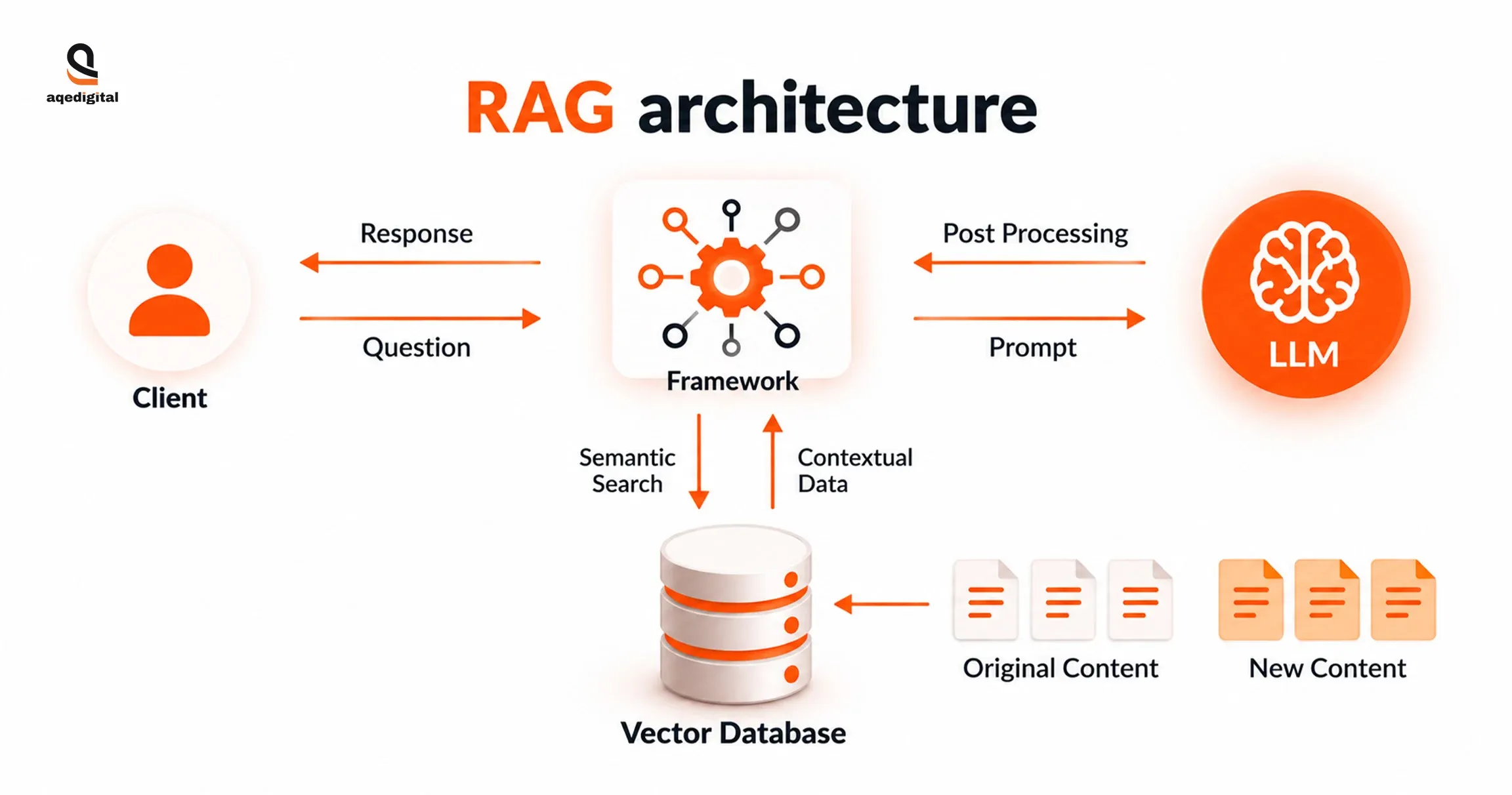
Retrieval-Augmented Generation allows an AI model to retrieve relevant information from external sources before generating a response.
Instead of relying entirely on information contained within the model, a RAG system can connect the model with business documents, databases, knowledge bases, product information, policies, and other enterprise data.
A typical RAG architecture can include:
- Data sources and document repositories
- Data ingestion and preprocessing
- Embedding models
- Vector databases
- Retrieval mechanisms
- Reranking
- Prompt construction
- Large language models
- Evaluation and monitoring
The need for practical approaches to enterprise AI is already evident in adoption data. IBM's Global AI Adoption Index found that 38% of surveyed enterprise IT professionals reported their organizations were actively implementing generative AI, while another 42% were exploring it.
Why RAG Is Important for Enterprise AI
An enterprise RAG solution can help employees, customers, and internal teams access relevant organizational knowledge through natural-language interactions.
For example, an employee could ask about a company's latest procurement policy. Rather than depending on potentially outdated model knowledge, the application can retrieve the relevant policy document and use that information to formulate the response.
RAG can therefore be valuable for organizations working with:
- Internal policies and SOPs
- Product documentation
- Technical manuals
- Customer information
- Contracts and business documents
- Frequently changing knowledge bases
- Enterprise databases
When RAG Is the Better Choice?
RAG is generally a strong option when the primary problem is knowledge access.
Consider RAG when:
- Business information changes regularly
- The AI needs access to private information
- Users need answers based on company documents
- Source attribution or traceability matters
- The organization has large knowledge repositories
- Updating information should not require retraining the model
If the requirement is essentially "How can we give AI access to our latest business knowledge?", RAG should usually be one of the first approaches evaluated.
What Is Fine-Tuning and When Does It Make Sense?
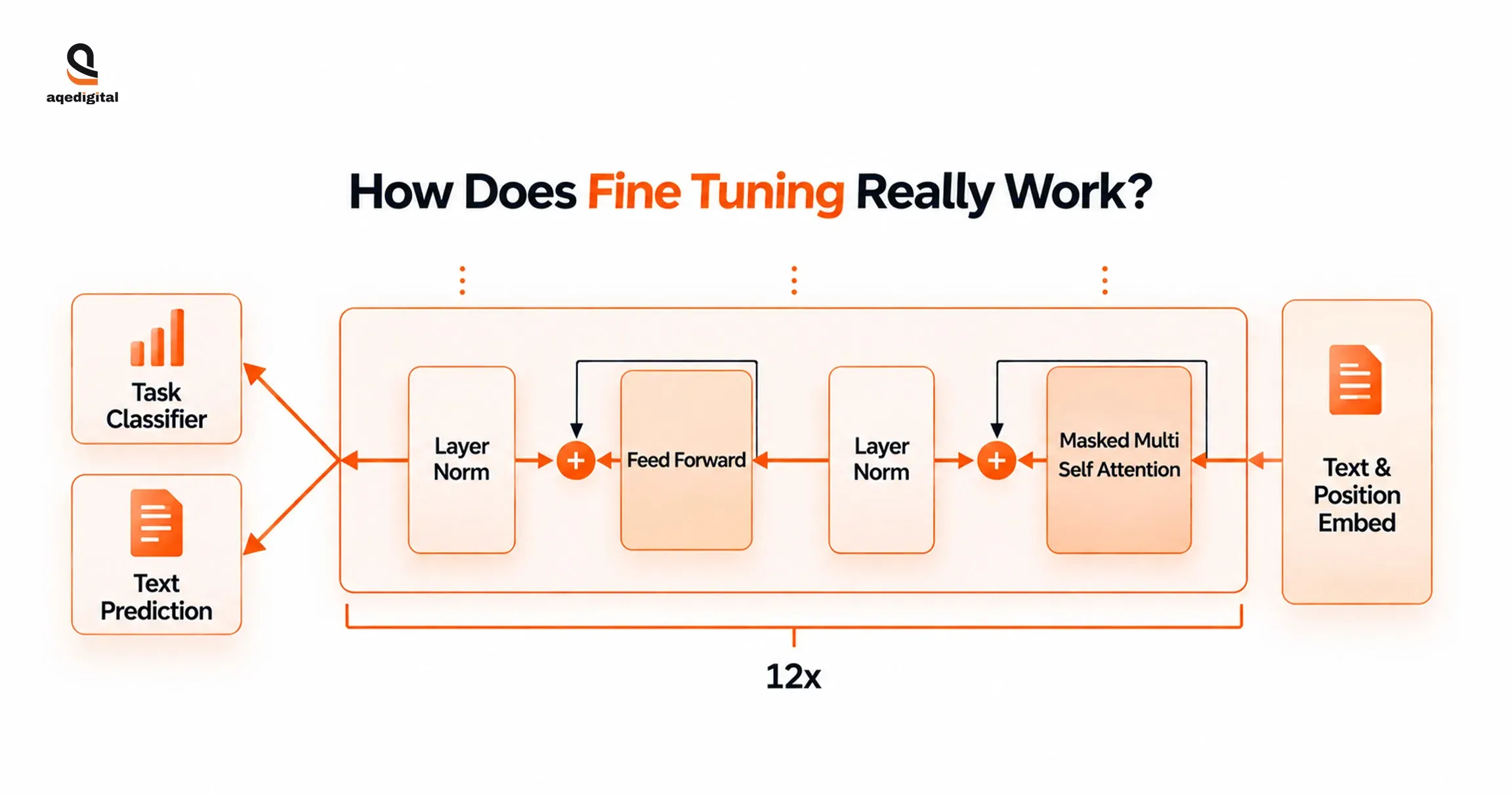
Fine-tuning involves training a pre-trained model further using a curated dataset to improve its performance on a particular task, behavior, or output pattern.
RAG provides the model with information when it generates an answer. Fine-tuning changes the model's learned behavior so it can perform certain tasks more consistently.
For example, an organization processing thousands of documents may need an AI system to classify them according to a specific internal framework.
The challenge is not necessarily giving the model access to more documents. The challenge is getting consistent task-specific behavior.
Where Fine-Tuning Can Deliver More Value
Fine-tuning may be appropriate when an organization needs:
- Consistent response structures
- Specialized classification
- Specific communication styles
- Repeated task-specific behavior
- Domain-specific output patterns
- More predictable performance on a defined task
When Fine-Tuning Is the Better Choice
Fine-tuning is worth considering when the primary challenge is a behavior or task-performance gap.
Ask whether the model needs to know more information or perform a particular task more consistently.
If the second requirement is more important, fine-tuning may provide greater value than continuously expanding the retrieval layer.
What Are AI Agents and How Are They Different?
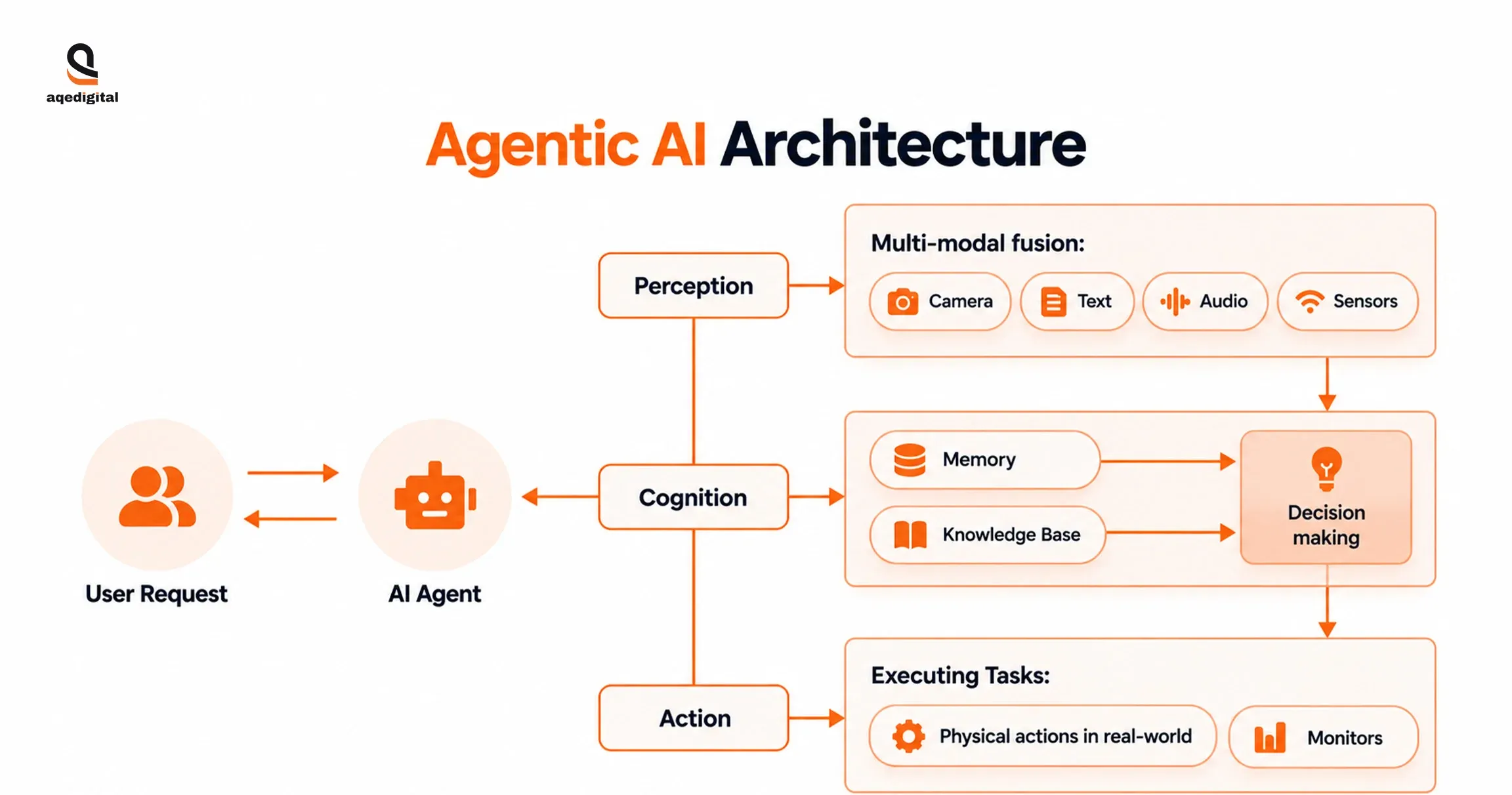
AI agents introduce another capability: action.
A conventional generative AI application generally receives an input and generates a response. An AI agent can be designed to understand a goal, determine the steps required, use tools, retrieve information, evaluate results, and continue through a workflow.
For example, consider a customer asking:
"Check my order, find out why it is delayed, and arrange the next appropriate action."
An AI agent could potentially:
- Identify the customer's order
- Query the order management system
- Retrieve logistics information
- Determine the reason for the delay
- Apply relevant business rules
- Trigger an approved action
- Communicate the outcome to the customer
How AI Agents Are Different From RAG Chatbots?
A RAG chatbot is primarily designed to retrieve relevant information and use it to produce better responses.
An AI agent is designed around a goal or task that needs to be completed.
The two approaches are therefore not mutually exclusive.
An AI agent can use RAG to retrieve information while also interacting with CRM systems, ERP platforms, APIs, databases, or other business tools.
This combination can be useful when an organization wants AI to move beyond answering questions and start supporting actual business workflows.
RAG vs Fine-Tuning vs AI Agents: Which One Should You Choose?
The right choice should begin with the business requirement rather than the technology itself.
Choose RAG When the Problem Is Knowledge
RAG is generally appropriate when the AI needs access to:
- Private business information
- Frequently changing documents
- Product or service information
- Internal policies
- Multiple enterprise knowledge sources
A well-planned RAG implementation can provide current context without requiring the underlying model to be retrained whenever business information changes.
Choose Fine-Tuning When the Problem Is Behavior
Fine-tuning may be more appropriate when the model needs to:
- Follow a specialized output format
- Perform a repetitive classification task
- Maintain a particular communication style
- Produce consistent domain-specific responses
- Improve performance on a well-defined task
The key consideration is whether the business needs the model to behave differently rather than simply access more information.
Choose AI Agents When the Problem Is Execution
AI agents become more relevant when the application needs to:
- Use external tools
- Query multiple systems
- Follow multi-step processes
- Make decisions based on retrieved information
- Trigger business actions
- Coordinate different tasks
The requirement changes from "answer this question" to "complete this business task."

Can Businesses Combine RAG, Fine-Tuning, and AI Agents?
In many advanced AI applications, combining these approaches can prove to be more effective than selecting only one.
A business application could use:
AI Agent → RAG → Fine-Tuned Model → Business Tools
The agent determines what needs to happen.
RAG retrieves the relevant business information.
Fine-tuning can support specialized model behavior where required.
Tools and APIs allow the system to interact with business applications and complete actions.
Combined architecture of AI can be valuable for enterprise use cases where knowledge, specialized behavior, and workflow execution are all required.
What Should Businesses Consider Before AI Development?
Selecting an AI approach is only the beginning. The underlying architecture and implementation decisions can determine how well the system performs in production.
For a RAG solution, organizations may need to evaluate:
- Data ingestion and preprocessing
- Chunking strategies
- Embedding models
- Vector databases
- Retrieval quality
- Reranking
- Prompt engineering
- Access controls
- Evaluation and testing
- Monitoring and observability
A custom RAG architecture can become important when organizations require greater control over data sources, retrieval methods, vector stores, models, permissions, or system integrations.
For AI agents, the architecture becomes broader because it may also require tool orchestration, workflow management, memory, planning, guardrails, and action monitoring.
This is why successful RAG development or agent development requires more than connecting an LLM to a database or API. The solution needs to be designed around how information, decisions, and actions move through the business process.
How AQe Digital Can Help Build the Right AI Solution?
Choosing between RAG, fine-tuning, and AI agents should begin with the business problem, data environment, workflow complexity, and expected outcome.
AQe Digital can help organizations evaluate these requirements and design AI solutions around their existing technology ecosystem and future objectives.
RAG Development and Implementation
Our team can support RAG development and RAG implementation for applications that need access to private, current, and domain-specific information.
This includes retrieval architecture, data pipelines, vector databases, model integration, evaluation, and application development.
Enterprise RAG Solutions
For organizations working with sensitive or distributed information, we can design enterprise RAG solutions around requirements such as access control, scalability, data security, monitoring, and integration with existing enterprise systems.
RAG Application Development
Our RAG application development capabilities can support customer-facing and internal applications, including knowledge assistants, document intelligence applications, employee support systems, and domain-specific AI solutions.
AI Agent Development
Where the requirement extends beyond information retrieval, AQe Digital can help design AI agent solutions that connect models with APIs, enterprise systems, tools, and business workflows.
AI and Fine-Tuning Strategy
Fine-tuning should be introduced when it solves a genuine model-behavior requirement. Our AI development approach can help determine whether fine-tuning, RAG, agentic workflows, or a combination provides the most practical solution for the use case.
Conclusion
It is an ultimate decision about what role AI needs to play inside your business when selecting between RAG, fine-tuning, and AI agents.
An AI solution should remain useful as your data grows, workflows change, new systems are introduced, and users expect more from the technology. That requires an architecture designed around long-term business requirements rather than a technology selected in isolation.
AQe Digital brings AI development, application engineering, enterprise technology, integration, and modernization capabilities together to help organizations build practical and scalable AI solutions.
Contact us to discuss your AI requirements and explore the right approach for your business.