Software Product Engineering vs Software Development vs Outsourcing: Scope, Ownership, and Cost

Joy Chauhan
Picture three proposals sitting in your inbox for the same customer portal.
One is a fixed-price build at $260,000 over eight months.
One is a product engineering pod billed at $38,000 a month.
The third is a staff augmentation quote: four engineers at $45 an hour.
On the comparison sheet your procurement team built, they look like three prices for one job. Your board wants the portal live before the next renewal season, with AI features baked in. So the cheapest line wins the first meeting.
They are not three prices. They are three different contracts.
One buys code. One buys an outcome. One buys hands.
When McKinsey surveyed product and engineering leaders in May 2026, only 25% reported meaningful acceleration from AI, and 30% said team productivity had fallen. Everyone had the same tools. What separated the leaders was how the work was owned and organized, which is exactly what those three proposals price differently.
This guide compares software product engineering, software development, and outsourcing on the three things that decide the outcome: scope (what each model covers), ownership (who answers for the product after launch), and cost (what you really pay over three years).
What is Software Product Engineering, and What Makes it Different From Software Development and Outsourcing?
Software product engineering is the discipline of conceiving, architecting, building, launching, and continuously evolving a software product against business outcomes such as adoption, retention, and revenue.
Think of a policyholder self-service portal. A product engineering team decides which journeys to build first, ships them, watches where users drop off, and reworks the flow in the next sprint.
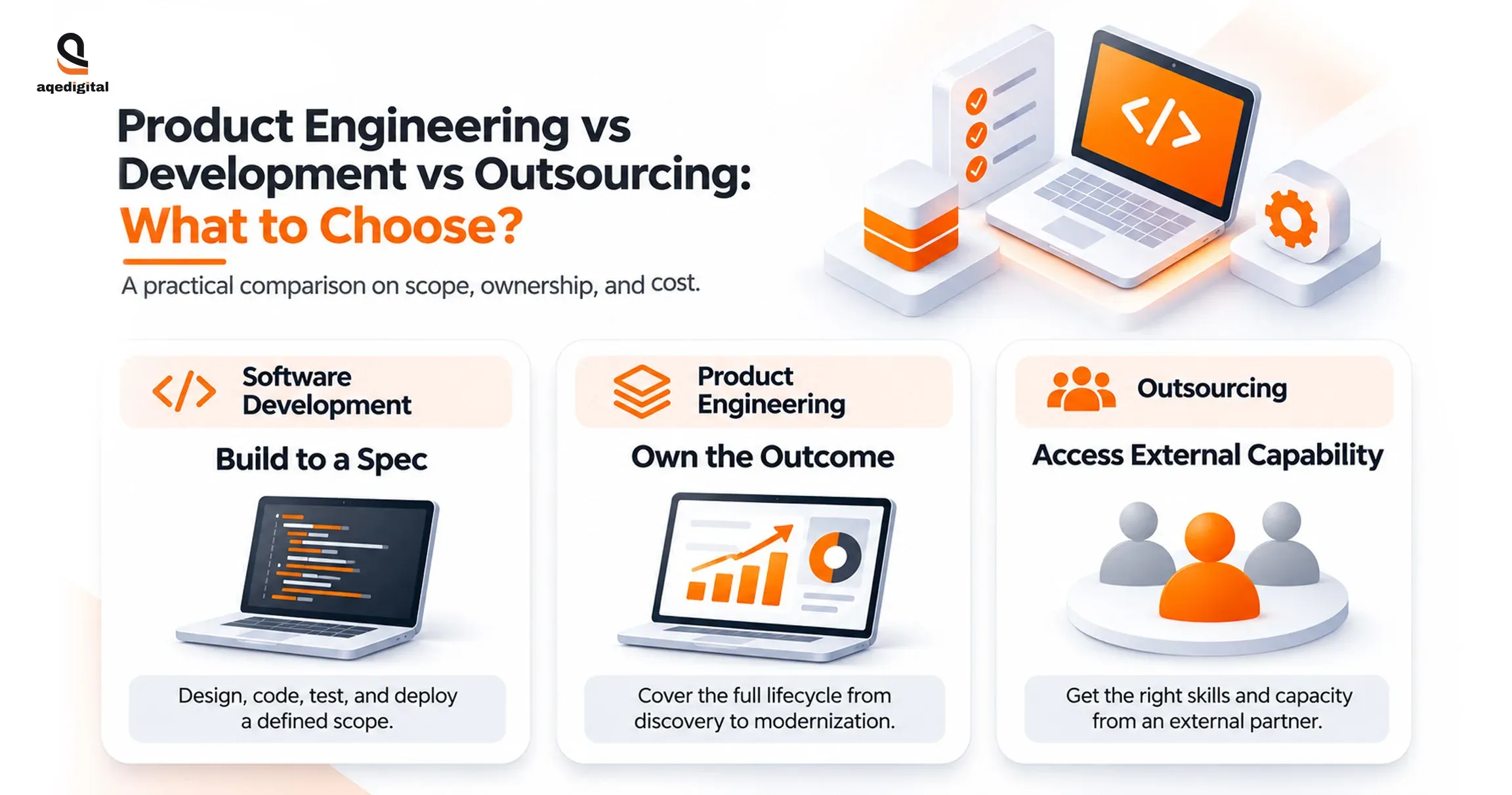
The key difference is simple. Software development delivers working code to a specification, while outsourcing only decides whether your own team or a partner does either job.
Software Development vs Software Product Engineering vs Outsourcing
| Software Development vs Software Product Engineering vs Outsourcing | ||
|---|---|---|
| Approach | Scope | Typical use |
| Software development | Design, code, test, and deploy a defined scope; ends at handover | Internal tools, integrations, fixed-scope builds with stable requirements |
| Software product engineering | Discovery, UX, architecture, build, release, analytics, and modernization across the lifecycle | SaaS products, customer portals, and platforms where adoption drives revenue |
| Outsourcing | Any of the above, delivered by an external partner under a task, deliverable, or outcome contract | Capacity gaps, missing skills, a faster start, or no in-house engineering |
Construction settles the comparison. Software development is a contractor who builds exactly what the drawings say. Software product engineering is a design-build firm that draws the plans with you, builds the house, and comes back to extend the kitchen when your family grows.
Outsourcing is neither. It is the decision to hire from outside instead of using your own crew, and you can outsource either kind of work.
Digital Product Engineering, Outsourced Product Development, and Other Terms Buyers Confuse
Digital product engineering applies product engineering to the full stack of a modern digital product: UX, cloud, APIs, data, and AI features. The product engineering lifecycle is the sequence it follows, from discovery to modernization.
Outsourced product development (often searched as product development outsourcing) hands that whole lifecycle to a partner, while project outsourcing hands over only a spec. And the old software development vs software engineering debate?
Engineering adds systematic discipline (architecture, scalability, reliability) to development, and product engineering adds ownership of business results on top.
Vendors use these labels loosely. Treat product engineering as a commitment, not a line item.
What Clients Ask Us Before, During, and After a Project
"I'm head of IT at a 180-person specialty insurer. We run Guidewire PolicyCenter on Azure and want a policyholder portal with claims tracking. Two vendors quoted: one calls it custom software development at $210,000 fixed, the other calls it software product engineering at roughly double over a year. Be honest: is product engineering just a pricier label for the same work, or does the scope actually differ?"
Sometimes it is just a label, so check the scope, not the name. Ask each vendor to list which lifecycle stages the price covers: discovery, UX validation, architecture, build, release, post-launch analytics, and ongoing iteration. If the higher quote only adds project management hours, you are paying for a label.
If it names discovery workshops with your claims team, usage tracking after launch, and a funded iteration phase, the scope genuinely differs. For a portal your policyholders will judge you by, that iteration phase is where software product engineering earns its premium.
"I'm the founder of a 25-person B2B SaaS startup. Our MVP is a Bubble prototype with 40 paying pilot customers, and we just raised $600,000 to rebuild it on a real stack. I have no CTO. Should I hire a dev shop to rebuild exactly what the prototype does, or a product partner? Give me a straight answer and the one risk I'm not seeing."
Hire the product partner. A dev shop will faithfully rebuild your prototype, including features your 40 pilots never touch, and nobody on your side will challenge it.
The risk you are not seeing is architecture debt baked in on day one. A partner offering software product engineering should run two to three weeks of discovery with your pilot customers, trim the feature list, and design for multi-tenancy before writing code. Ask who plays the CTO role until you hire one, and get that person named in the contract.
Scope: What Each Model Covers Across the Product Engineering Lifecycle
Here is the test that exposes most scope gaps: map every proposal against the six stages of the product engineering lifecycle and see which stages it actually prices.
The Six Stages of the Product Engineering Lifecycle
Every product moves through six stages: discovery and validation, architecture, UX and prototyping, build and release, measurement and iteration, and modernization. Skip one, and the work does not disappear. It shows up later as rework.
The table below shows which model typically covers which stage. Use it as a checklist against any proposal.
| The Six Stages of the Product Engineering Lifecycle | |||
|---|---|---|---|
| Lifecycle stage | Software development | Software product engineering | Outsourcing |
| Discovery and validation | Rarely; requirements arrive as a spec | Yes; user research and a backlog tied to outcomes | Only if the contract names it |
| Architecture | For the current scope | For scale, multi-tenancy, and future features | Depends on the partner's remit |
| UX and prototyping | Often a separate vendor | Yes; validated with real users | Only if the contract names it |
| Build and release | Yes; the core of the contract | Yes; with CI/CD and feature flags | Yes; the most commonly outsourced stage |
| Measurement and iteration | No; ends at handover | Yes; analytics drive the next sprint | Only under an outcome-based contract |
| Modernization | A separate project and budget | Planned as part of the roadmap | Often a new contract |
If you want all six stages under one roof, AQe Digital's product engineering services run from user research through long-term maintenance. If you genuinely need a defined build, enterprise software development scoped to a spec is the leaner buy.
Where Fixed-Scope Development Contracts Stop
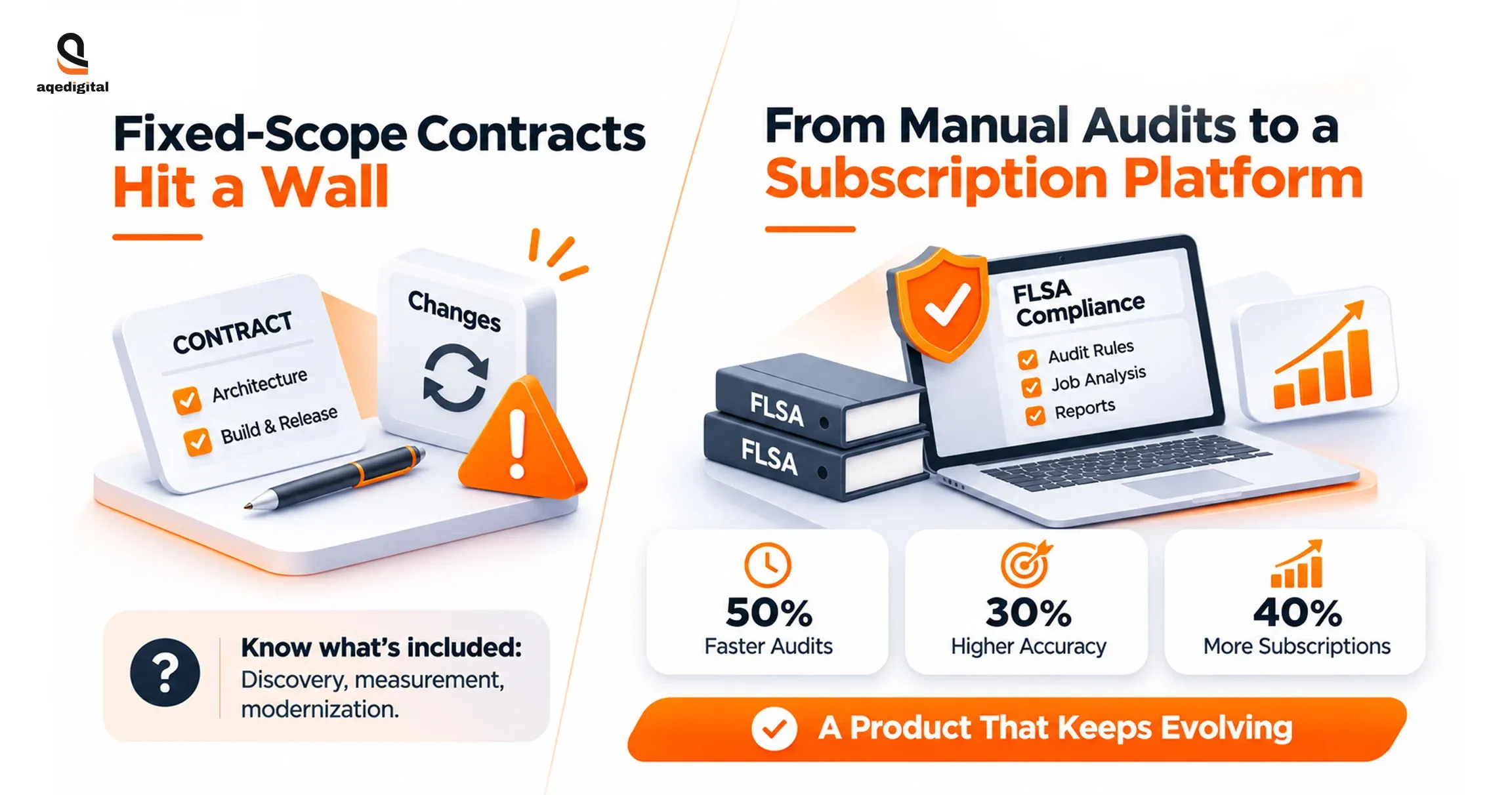
Most development contracts cover two stages well: architecture for the current scope, and build and release. That is not a flaw. It is what you bought.
The trouble starts when the software is a product. The backlog changes within weeks of launch, and a fixed-scope contract prices every change as a separate change request.
So ask any vendor to name, in writing, which of the six stages their price includes. Silence on discovery, measurement, and modernization means you are buying development, whatever the proposal calls it.
Turning Manual Compliance Audits Into a Subscription Platform
A US-based management software provider served organizations in regulated labor environments. Its customers ran FLSA wage-and-hour and job classification audits by hand, which was slow, error-prone, and dependent on expertise most HR teams did not have.
AQe Digital built a subscription-based FLSA compliance audit platform with a configurable rule engine, job classification analysis for exempt and non-exempt status, audit reporting, and a configuration framework for updating rules as regulations change.
The work ran in phases: compliance data modeling, UX design, backend development, testing with regulatory validation, then deployment with ongoing maintenance and monitoring.
The result was a 50% reduction in compliance audit time, a 30% increase in report accuracy, and 40% growth in platform subscriptions. That last number came from a product designed to keep changing as the rules did, not from the first release alone.
What Clients Ask Us Before, During, and After a Project
"I'm VP Engineering at a 450-person industrial equipment manufacturer. We run SAP S/4HANA and a custom MES on-premises, and we're building a mobile-first dealer ordering app for 300 dealers. Our preferred vendor's proposal covers architecture, build, and testing for $320,000. My team of six can't own the app after launch. Rank the top three things missing from that proposal.
Three gaps, in order of cost. First, discovery with your dealers: without it, you will build ordering flows around your internal SAP logic instead of how dealers actually order. Second, post-launch measurement and iteration, because with six engineers, nobody will own adoption. Third, a modernization path for the SAP integration.
Ask the vendor to price a software product engineering scope that adds a four-week discovery phase and a 12-month evolve phase with named adoption metrics. Then compare that higher number against the cost of a dealer app your 300 dealers quietly ignore.
"I'm product director at a 90-person proptech company. Our tenant app is built in React Native, our QA is already outsourced, and leadership wants to outsource discovery too so my two product managers can focus on the roadmap. Is it smart to outsource discovery, or does that hand away the one thing we should own? Keep it short enough for one slide for our leadership offsite."
Keep discovery ownership; outsource discovery capacity. Your product managers should own the questions, the decisions, and the final backlog. A partner can run interviews and prototypes faster than two people can.
The partner runs the research and the prototypes; every finding lands in our backlog, not theirs. That split keeps software product engineering accountability in-house while you buy speed.
Ownership: Deciding Which Model Should Own Your Product Outcomes
Ownership is the filter that settles most of these decisions. Run the questions below in order; most teams have their answer by the third.
Is the Software Itself the Product?
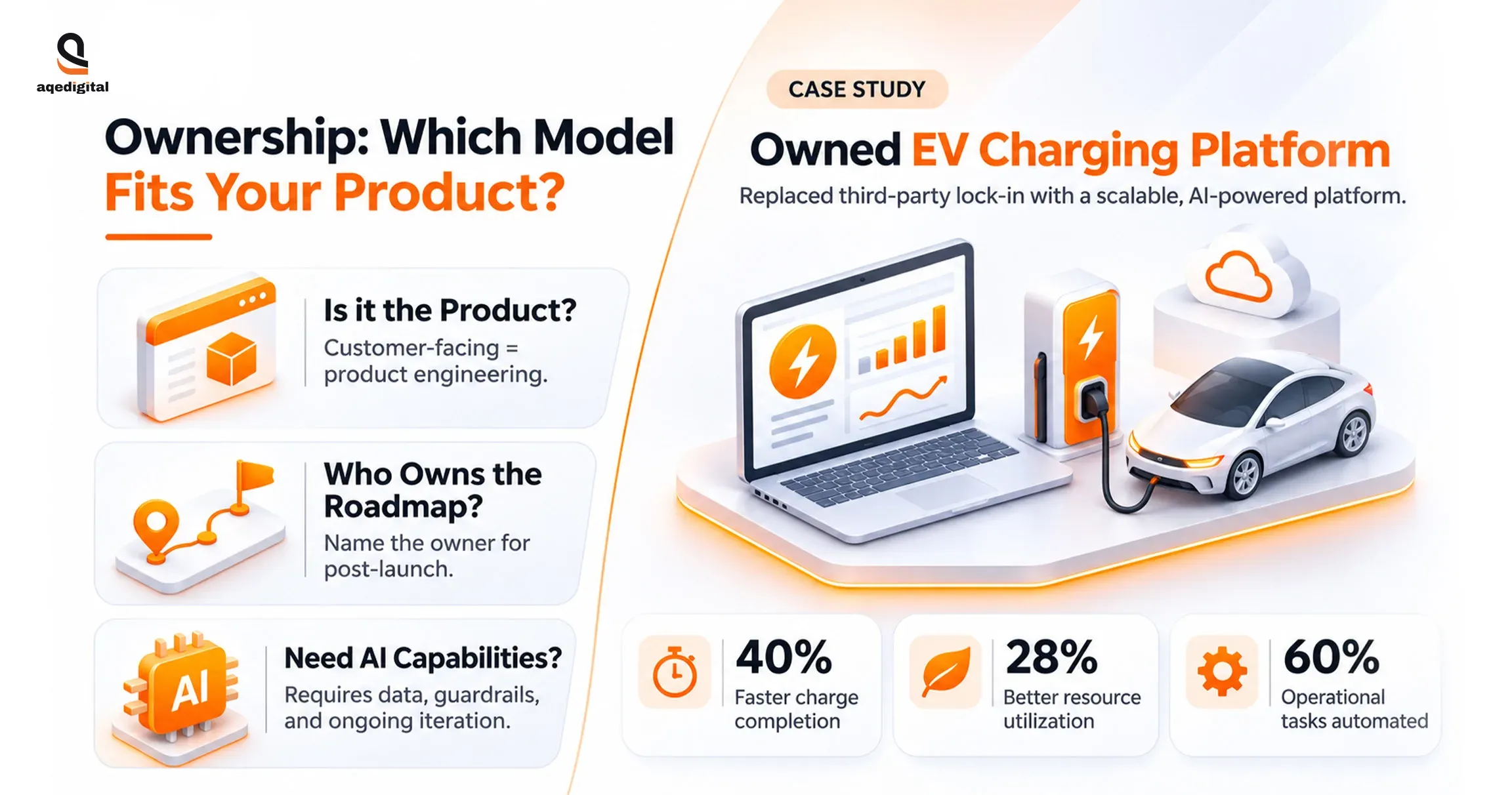
If customers pay for it, log into it daily, or judge your brand by it, treat it as a product. A dealer ordering app, a patient portal, or a connected-device platform needs product engineering. An internal reporting tool with fifty users and a stable scope does not, and paying for discovery and iteration there is waste.
Requirements stability breaks the tie. Fixed scope, known integrations, and a regulatory spec that will not move suit a fixed-price development contract.
Who Owns the Roadmap After Launch?
Write down the name of the person who will decide what ships in month seven. If that line is blank, a development vendor is the wrong buy, because they exit at handover and the product does not.
You have two clean options. Appoint a product owner in-house and outsource engineering capacity, or choose outsourced product development where the partner brings product management and reports against your metrics.
If the product is part of a wider digital transformation program, tie its owner to that program's governance rather than the vendor's statement of work.
Does the Product Need AI Capabilities?
This is where the gap between models widens fastest. In a Gartner survey of 400 software engineering leaders, 77% named building AI capabilities into applications as a significant or moderate pain point, the largest in the study.
AI features need data pipelines, model evaluation, guardrails, and monitoring after launch. That is lifecycle work by definition, which is why AI and data engineering belong inside the product team, not in a one-off build. An AI feature shipped to spec and never measured is a demo, not a product.
Replacing Third-Party Lock-In With an Owned EV Charging Platform
A US smart mobility company managing multiple EV charging stations ran hardware from several manufacturers on vendor-locked protocols. Billing and reporting depended on SaaS vendors whose roadmaps it could not control, and monitoring ran largely by hand.
AQe Digital built an owned platform in five phases: discovery and architecture with architects embedded alongside the client's teams, session intelligence design, platform engineering, an AI personalization layer, and monitoring at scale. The build replaced third-party dependencies with an OCPP-based gateway, ML models deployed as microservices, and AWS-based observability.
The outcome was a 40% reduction in average charge completion time, 28% better energy and operational resource utilization, and 60% of previously manual operational tasks automated. The bigger shift was ownership. The roadmap now belongs to the client, not to its SaaS vendors.
What Clients Ask Us Before, During, and After a Project
"I'm CIO of a 1,200-employee regional hospital network on Epic. We want a patient app for scheduling, bill pay, and pre-visit forms, and HIPAA review is non-negotiable. My board asked whether we can outsource the whole product, including ownership, so we don't have to hire a product team, which would take nine months. Be honest if that's a bad idea."
Outsourcing the build is fine. Outsourcing ownership is the bad idea. HIPAA accountability, Epic integration priorities, and clinical workflow tradeoffs all need a decision-maker inside your network.
The workable model is one internal product owner with clinical and compliance authority, plus outsourced product development for discovery, engineering, security testing, and post-launch iteration, with audit trails and access controls named in the contract. That keeps software product engineering speed without handing your compliance posture to a vendor.
"I'm COO of a 220-person specialty retail chain with 40 stores. We run Shopify Plus and NetSuite, and we want a loyalty app with personalized offers. We have no product manager and two developers who maintain integrations. Is staff augmentation enough if I add three senior engineers, or do I need a full product partner? Give me a straight answer."
Staff augmentation will not be enough. Augmented engineers add capacity, but they take direction from you, and nobody on your team can set loyalty strategy, design offers, or read the data behind them.
You need a partner offering software product engineering with product management, UX, and data science in the pod, at least for the first 12 months. Plan to hire an internal product owner by month six so the roadmap transfers in-house.
Cost: Pricing Models, Hidden Costs, and the Real Price of Outsourcing
What does each model really cost? Compare the total over the product's life, not the first invoice.
How Each Model is Priced
The three proposals in your inbox use three pricing logics, and each one moves risk to a different party.
| How Each Model is Priced | |||
|---|---|---|---|
| Model | Typical pricing | What you are paying for | Who carries the risk |
| Software development (fixed price) | One price for a defined scope; change requests billed extra | Delivery to spec | The vendor during the build; you for everything after |
| Software product engineering (pod or retainer) | Monthly fee for a cross-functional team, often with outcome milestones | Product judgment plus delivery | Shared, tied to agreed product metrics |
| Staff augmentation (time and materials) | Hourly or monthly rate per engineer | Capacity | You, entirely |
The Hidden Costs Most Proposals Ignore
Every model carries costs that never appear on the quote. Price these before you compare totals:
- Change requests: Fixed-price contracts bill every post-signature change separately, and products change constantly.
- Your own team's time: Someone internal must write specs, review sprints, and accept releases. Under staff augmentation, that includes daily direction.
- Handover and knowledge transfer: When a development vendor exits, your team inherits code it did not write, usually with thin documentation.
- The rebuild: When requirements shift after launch, and the architecture cannot absorb them, you pay for a core module twice.
Measuring Software Product Engineering ROI and Software Product Engineering Benefits
Measurable Benefits That Matter
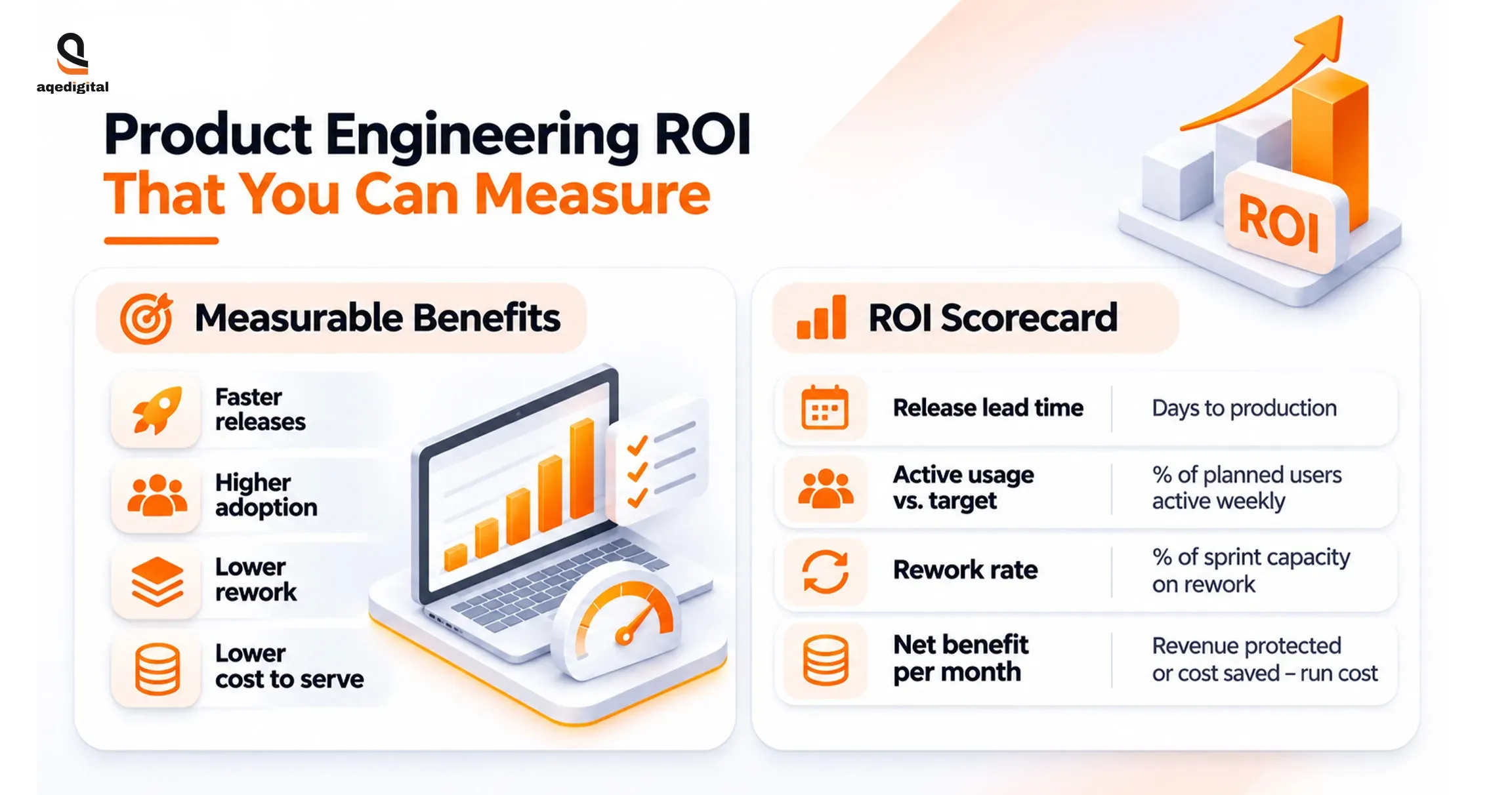
Product engineering benefits are only real when each one carries a number:
- Faster release cycles: lead time from approved story to production.
- Higher adoption: weekly active users or feature adoption against launch targets.
- Lower rework: share of each sprint spent fixing or rebuilding shipped work.
- Lower cost to serve: infrastructure and support cost per active user.
If a partner cannot name the baseline for each before work starts, the benefit is a hope, not a result.
A Simple ROI Scorecard
Track four numbers every quarter:
- Release lead time: days from approved story to production.
- Active usage against target: share of planned users active each week.
- Rework rate: share of sprint capacity spent on rework.
- Net benefit per month: revenue protected or cost saved, minus run cost.
This holds up with finance because every line has a baseline, an owner, and a unit of time or currency. No vanity metrics.
What Clients Ask Us Before, During, and After a Project
"I'm finance director at a 350-person regional energy utility. We spent $520,000 on a field service app built by a product engineering partner, and the run cost is $14,000 a month. The app is live with 85 technicians. I need to calculate ROI and payback in Excel for our board meeting. Give me the exact formulas and tell me which benefit numbers I'll struggle to defend.
Use two formulas. Put annual benefit in B2, annual run cost in B3, and the $520,000 build investment in B4. Annual ROI is =(B2-B3)/B4, and payback in months is =B4/((B2-B3)/12). At $14,000 a month, B3 is $168,000, so the app needs annual benefits above $168,000 before it pays back anything at all.
The numbers you will struggle to defend are soft ones like technician satisfaction. Stick to measurable software product engineering benefits: fewer repeat truck rolls, shorter job completion time, and overtime hours saved, each with a pre-launch baseline from your work order system.
"I'm CTO of a 150-person HR tech company. Two years ago, we outsourced our benefits enrollment module as a fixed-scope project for $310,000. Fourteen months after launch, our own team of eight rebuilt most of it in-house because every carrier change needed a new change request. Give me an honest post-mortem: what did we likely get wrong, and what should the next contract look like?"
You most likely bought a project for a product problem. Benefits enrollment rules change with every carrier and plan year, so the spec was out of date before launch, and the vendor had no reason to design for change. The architecture fit the spec, not the business.
The next contract should start with discovery against two plan years of change history, price an evolve phase instead of change requests, and tie part of the fee to rework rate and enrollment completion. That is software product engineering in contract form: you pay for a product that absorbs change, not a snapshot.
Conclusion
Go back to those three proposals in your inbox. They were never three prices for one job; they were a contract for code, a contract for an outcome, and a contract for hands. Software product engineering is the right buy when the software is the product, and someone must own what happens after launch; development is the right buy when scope is stable, and outsourcing is simply how you staff either one.
This month, do three things:
- Map each proposal against the six lifecycle stages and note the gaps.
- Write down who owns the roadmap in month seven.
- Run the three-year break-even before price decides for you.
When you want a partner that owns the outcome with you, talk to AQe Digital.