Why Product Engineering Projects Fail: Causes and Recovery Plan for Higher ROI

Nirav Oza
The steering committee met to approve another quarter of funding for the platform rebuild. Then the CFO asked one question.
What has the product earned so far?
The VP of Engineering had velocity charts and a Q3 release plan. Nobody had a number for value. Eighteen months in, the fix on the table was the same as last time: add engineers and move the date.
That fix rarely works. Product engineering projects seldom fail because of bad code. They fail because of decisions nobody priced.
Technical debt is a good example. IBM's 2025 study of 1,300 executives projects that tech debt will stretch AI implementation schedules by 15% to 22%, yet only 29% of organizations price its full cost into the business case. The delay is planned in. Nobody writes it down.
This guide covers why product engineering projects fail, what a working recovery plan looks like, and how to prove the rescue paid off. Get the order wrong, and you fund a second failure.
What is Product Engineering, and How is it Different From Product Development?
Product engineering is the end-to-end discipline of designing, building, testing, releasing, and evolving a software product under one accountable team. Picture a SaaS billing platform where the team that ships version one also owns uptime and the version four roadmap. That is what product engineering services are built around.
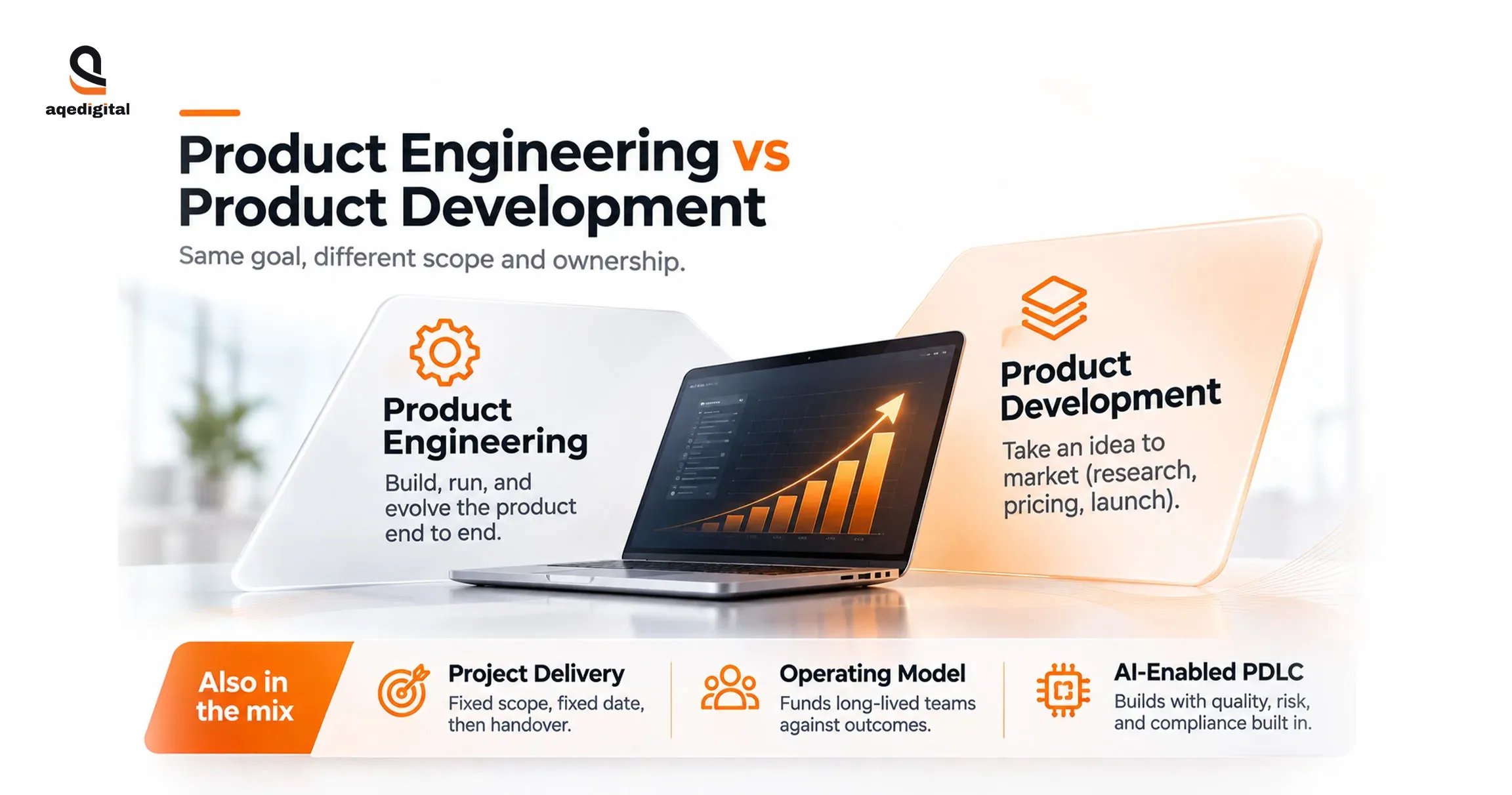
Product development is the wider idea-to-market process, covering research, pricing, and launch. The difference matters when things go wrong, because a failing product needs an owner who stays after launch.
Product Engineering vs Product Development vs Project Delivery
| Product Engineering vs Product Development vs Project Delivery | ||
|---|---|---|
| Approach | Scope | Typical use |
| Product engineering | Build, run, and evolve the software across its life | SaaS platforms, connected devices, internal products with long roadmaps |
| Product development | Idea to market, including research, pricing, and launch | New product lines, market entry |
| Project delivery | Fixed scope and date, then handover | Migrations, one-time integrations |
A contractor who builds a restaurant kitchen and leaves is project delivery. The crew that cooks every night and changes the menu when diners stop ordering is product engineering. Many failed builds are products funded like the contractor.
Product Operating Model and the AI-Enabled PDLC
A product operating model funds long-lived teams against outcomes instead of projects against milestones. The product development life cycle (PDLC) is shifting too, with quality, risk, and compliance checks running alongside the build and product managers owning the path from idea to realized value. Treat the operating model as a way of funding and running teams, not a reorg slide.
What Clients Ask Us Before, During, and After a Project
"I'm CTO of a 300-person logistics SaaS company. We outsourced our customer portal rebuild as a fixed-scope project. It launched four months late, and now nobody owns it. My board wants to know whether we need product engineering services or just a better vendor. Give me a straight answer I can take to Thursday's board call."
You need a product team, not a better vendor. A fixed-scope contract ends at handover, so every defect becomes a change request. That is why the portal feels orphaned.
Move the portal to a fixed-capacity team with a named product owner, one quarterly outcome target such as ticket deflection, and a budget that funds capacity instead of features. Internal or partner matters less than who owns the result.
Why Product Engineering Projects Fail: 6 Root Causes
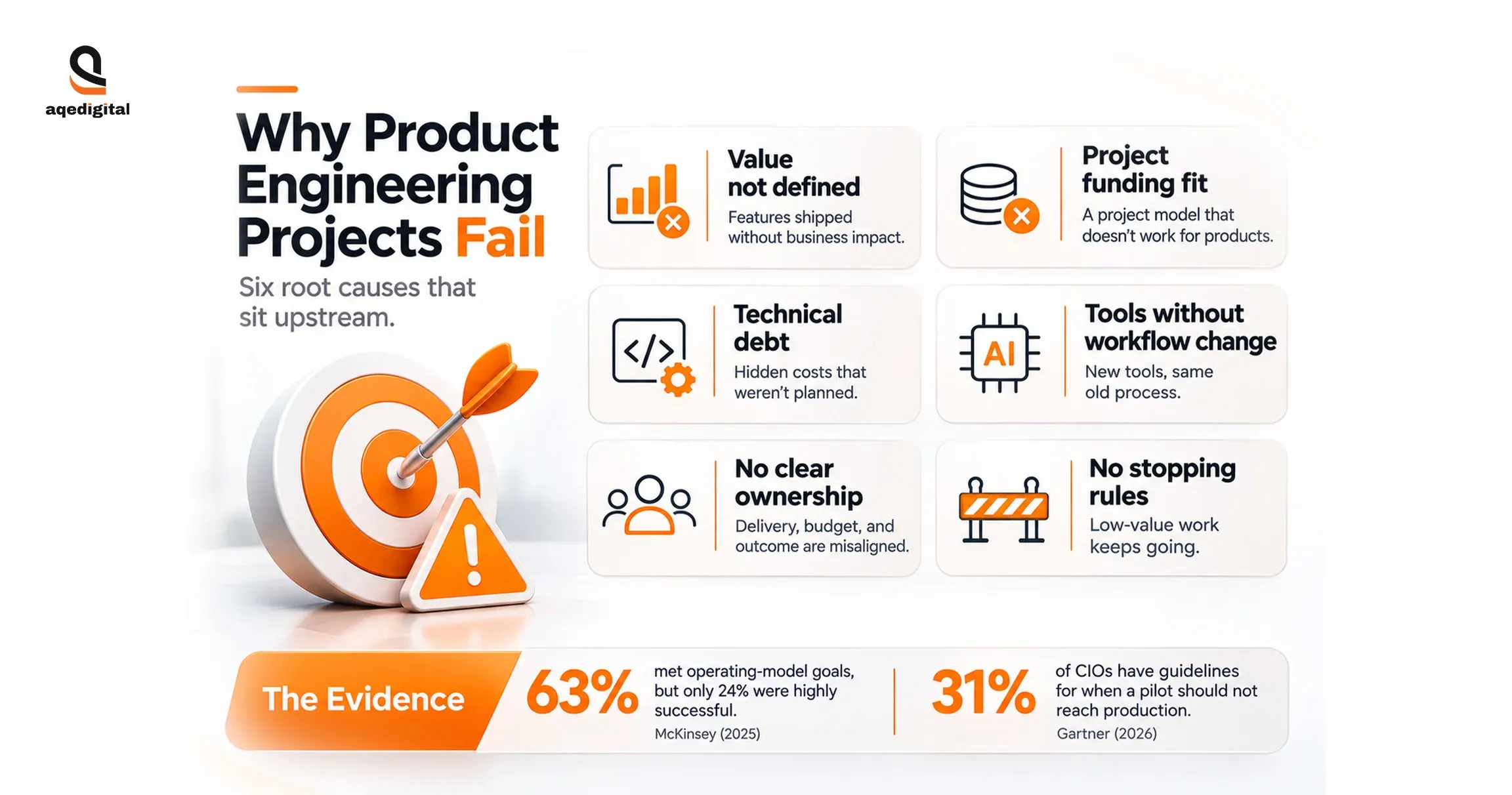
Search for why software projects fail, and you get bad estimates and scope creep. Those are symptoms. The causes sit upstream, in decisions made before the first sprint: what counts as value, how the work is funded, and what nobody budgeted for.
1. Value Was Never Defined Before the Build
Teams build against a feature list, not a business result. Twenty shipped features feel like progress until someone asks which one moved revenue, cost, or retention. Volume is not value.
2. Project Funding Was Applied to a Product Problem
Annual project budgets assume a finish line. Products do not have one. McKinsey (2025) found that 63% of companies met most operating-model transformation goals, but only 24% were highly successful, and it names traditional project funding as a pitfall that works against end-to-end teams.
3. Technical Debt Nobody Priced Into the Plan
Debt is the invoice that arrives after the roadmap is approved. Every estimate that touches old code carries a hidden buffer, and nobody adds those buffers up. That is where legacy modernization earns its place in the plan.
4. AI and Tools Were Added Without Changing Workflows
New coding assistants rarely fix a broken delivery flow. If reviews, testing, and approvals still move at the old pace, faster code just piles up in a longer queue. The gains come from redesigning the workflow, not from adding the tool.
5. Nobody Owns the Outcome
Engineering owns delivery, the business owns budget, and nobody owns the result. When the steering committee reviews status instead of outcomes, the gap stays invisible until the funding gate.
6. No Stopping Rules
Low-value work never ends because nobody defined the end. Gartner (2026) found only 31% of CIOs have guidelines for when a pilot should not reach production, and just 17% have rules to abandon low-value initiatives already live. Those that do are 2.3x and 2.6x more likely to be AI vanguards.
Warning Signs You Can Spot This Quarter
- Velocity drops three sprints in a row while headcount stays flat.
- The release date has moved more than once, and each move is "one more sprint".
- Unplanned fixes eat a growing share of every sprint.
- Features ship, but nobody tracks whether anyone uses them.
- Nobody can say what result would justify stopping the build.

What Clients Ask Us Before, During, and After a Project
"I'm VP of Product at a 120-person fintech. Our lending app rebuild is in month 14, velocity has dropped for three sprints running, and engineering blames the legacy loan engine while sales blames missing features. Be honest: debt problem or people problem, and how do I tell inside two weeks?”
Probably both, but debt is quicker to prove. Pull three numbers from Jira and your CI tool: sprint capacity spent on unplanned fixes, commit-to-production lead time, and reopened defects. If unplanned work climbs while lead time stretches, the loan engine sets the pace.
Then put engineering and sales in one room with a single question: which outcome must this product engineering effort move this quarter? Different answers mean an ownership problem too, and no refactor fixes that.
What Does Product Engineering Recovery Look Like? A Five-Phase Plan
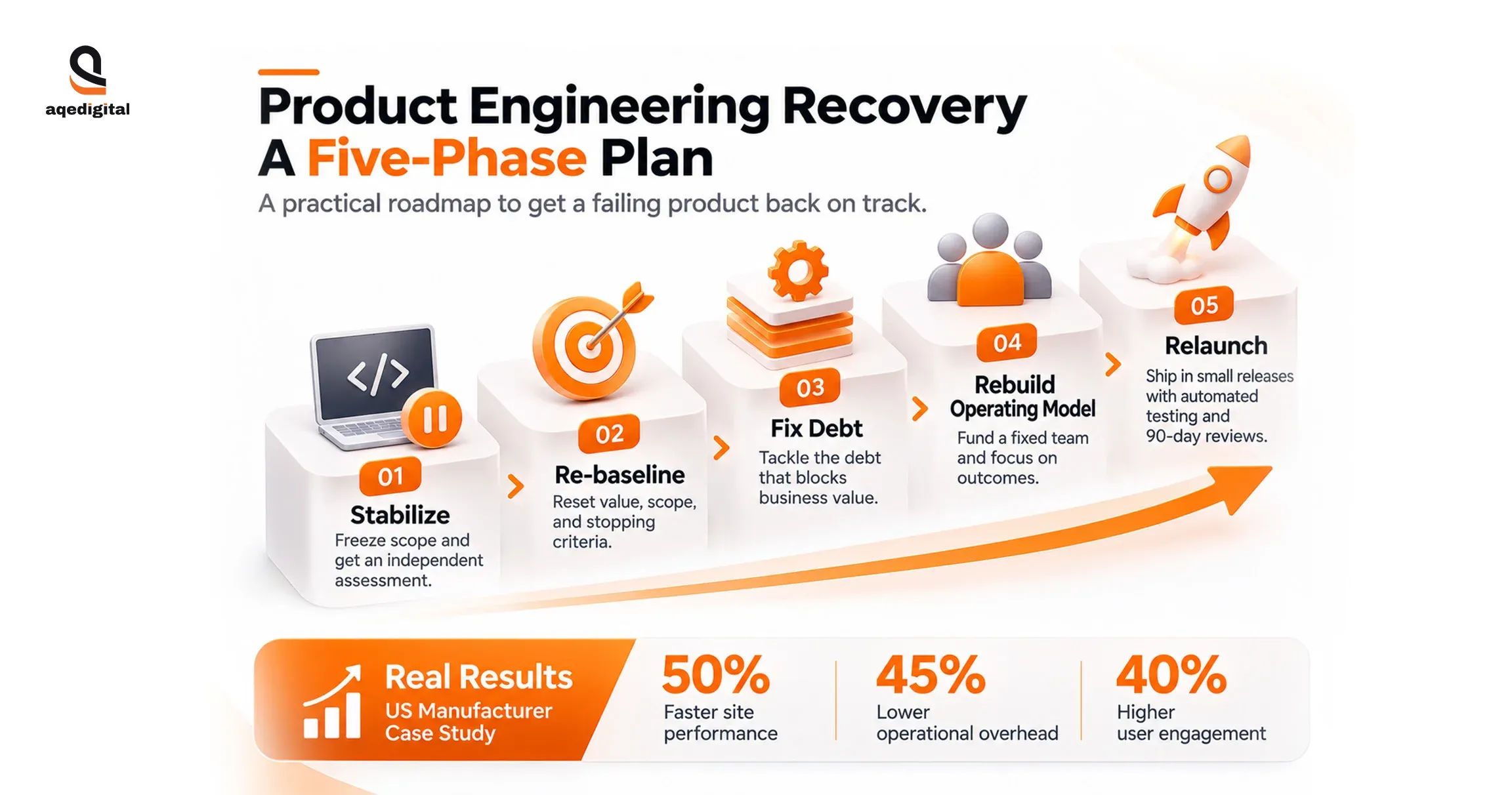
Recovery works like hospital triage: stabilize first, diagnose second, and treat what threatens the patient before what merely looks bad. Here is a practical roadmap.
Phase 1: Stop, Stabilize, and Get an Independent Assessment
Freeze new scope, keep releases to critical fixes, and have someone outside the team assess code, architecture, and backlog. Waiting a quarter to see if things improve rarely works. An independent software consulting review also removes the politics from the diagnosis.
Phase 2: Re-Baseline Value, Scope, and Stopping Criteria
Pick the one metric the product must move, such as onboarding time or cost per claim. Cut every backlog item that does not serve it. Then write walk-away criteria before asking for more money.
Phase 3: Price and Fix the Debt That Blocks Value
Do not rewrite everything. Some debt blocks value and some only looks ugly. Fix the modules that sit in the path of your Phase 2 metric first, then decide what product re-engineering the rest needs.
A US manufacturer AQe Digital worked with shows the pattern. Its global website ran on Sitecore 7.2, where years of custom code and business rules blocked personalization and integrations. The site also had to stay live.
The team rebuilt it on the latest Sitecore architecture on Microsoft Azure, migrated content and rules in structured waves, and connected marketing tools through APIs. The result: 50% faster site performance, 45% lower operational overhead, and 40% higher user engagement.
Phase 4: Rebuild the Operating Model Around the Product
Fund a fixed-capacity team instead of a feature list. Shift a small share of capacity each quarter toward where value shows up, and review it in a quarterly business review focused on the next 90 days of outcomes.
Phase 5: Relaunch on a Measured Cadence
Ship small and gate each release with automated software testing. Review the Phase 2 metric every 90 days, and apply the stopping rules as written.
Project Recovery Plan Template
| Project Recovery Plan Template | ||||
|---|---|---|---|---|
| Phase | Owner | Key actions | Exit criteria | Typical duration |
| 1. Stabilize | CTO plus outside reviewer | Scope freeze, critical fixes only, independent assessment | Written diagnosis signed off by business and engineering | 2 to 4 weeks |
| 2. Re-baseline | Product owner | One value metric, cut backlog, walk-away criteria | Funding gate approves or stops the build | 2 to 3 weeks |
| 3. Fix debt | Engineering lead | Price debt, fix blocking modules first | Lead time and unplanned work trending down | 1 to 3 months |
| 4. Operating model | CTO and CFO | Fixed-capacity funding, quarterly business review | Team funded by capacity, not features | 1 quarter |
| 5. Relaunch | Product owner | Small releases, automated tests, 90-day reviews | Value metric moving for two reviews in a row | Ongoing |
What Clients Ask Us Before, During, and After a Project
"I run engineering at a 600-person healthcare software firm. Our scheduling platform needs a rescue, but two hospital contracts renew in March. What can a recovery plan realistically freeze, and what has to keep shipping? Keep it short enough for one slide."
Freeze scope, not releases. Keep shipping contract-critical features, security patches, and fixes for defects users can see. Freeze net-new features with no named metric and any refactor outside the modules those contracts touch.
Point Phase 3 at the modules those features use, so every release pays down debt where it matters. One slide, two columns: ship and freeze.

Measuring Product Engineering Recovery ROI and Benefits
Benefits You Can Measure
- Lead time from commit to production
- Share of sprint capacity spent on unplanned work
- Defects that escape to production
- Adoption of the feature tied to your value metric
- Monthly run cost of the platform
Each needs a baseline from Phase 1. Without it, every improvement is an opinion.
Why ROI is Harder Than It Looks
Velocity is the default metric, and it misleads: story points climb while the P&L stays flat. Output and return are different numbers, and finance only cares about the second one.
A Simple ROI Scorecard
- Value gained: change in the Phase 2 metric, converted to money
- Cost avoided: engineering hours freed from unplanned work, at loaded cost
- Recovery cost: assessment, remediation, and partner fees
- Time to value: weeks until the value metric moves
Finance trusts this scorecard because every line has a baseline and an owner.
What Clients Ask Us Before, During, and After a Project
"I'm CFO at a 250-person edtech company. Engineering wants $400,000 for a recovery program. Give me a formula I can drop into a spreadsheet, and be honest about what it won't capture."
Use: Recovery ROI = (value gained + cost avoided - recovery cost) / recovery cost. Say freeing 30% of six engineers at $150,000 loaded cost saves $270,000 a year, and faster onboarding adds 250,000 + $270,000 - $400,000) / $400,000 = 30% in year one.
It won't capture risk avoided, such as an outage or a lost renewal. Track those separately.
Conclusion
In that steering meeting, the right answer to the CFO was never a new release date. It was a value number, a price for the debt, and a rule for when to stop. Product engineering recovery starts there.
This month, name the one metric the product must move, price the debt in the modules that block it, and write the stopping criteria before the next funding gate.
If you want a second set of eyes on a stalled build, AQe Digital's product engineering team can run the assessment.