AI-Powered Patient Engagement Software: Features, Benefits, and Use Cases

Jigar Mistry
Most health systems still treat patient communication like a chore. A reminder text here. A portal login nobody opens there. And the space between a booked appointment and a patient who actually shows up engaged?
That is exactly where money leaks, no-shows stack up, and outcomes quietly slide. Patient engagement software exists to close that gap. The newer, AI-driven kind is finally making the close something you can measure on a dashboard instead of guessing at.
This is not vendor noise. McKinsey's healthcare AI research found that 62% of healthcare leaders rank consumer and patient experience among the highest-potential areas for generative AI, and 85% of the organizations surveyed were already poking at or rolling out generative AI by late 2024.
When the people running hospitals and payers point straight at engagement as the prize, the question stops being whether and turns into how soon.
So here is what we will cover. What patient engagement software actually does. The features that matter versus the ones that just look good in a demo.
The benefits of patient engagement software that hit your bottom line. And the real use cases showing how AI improves patient experience in hospitals right now.
What is Patient Engagement Software?
Patient engagement software is a digital platform that ties patients to their care team across scheduling, messaging, education, billing, and follow-up. It pulls every touchpoint a patient has with a provider into one place so none of them slip through. Picture it as the connective tissue sitting between your EHR and the actual human on the other end of the care journey.
Old-school patient engagement platforms handled the basics. Appointment reminders. Portal messages. Intake forms. Helpful, sure, but reactive. They sat back and waited for the patient to do something first. AI patient engagement turns that on its head.
Now the system guesses who is about to miss a visit, shapes outreach around the individual, and fields routine questions before a staff member even notices. For teams already running on fumes, that shift is oxygen. Plenty of providers get there through a focused software consulting engagement instead of tearing everything out and starting over.
Core Features of AI Patient Engagement Software
Features close demos. Outcomes close renewals. These are the AI-driven capabilities that genuinely move something.
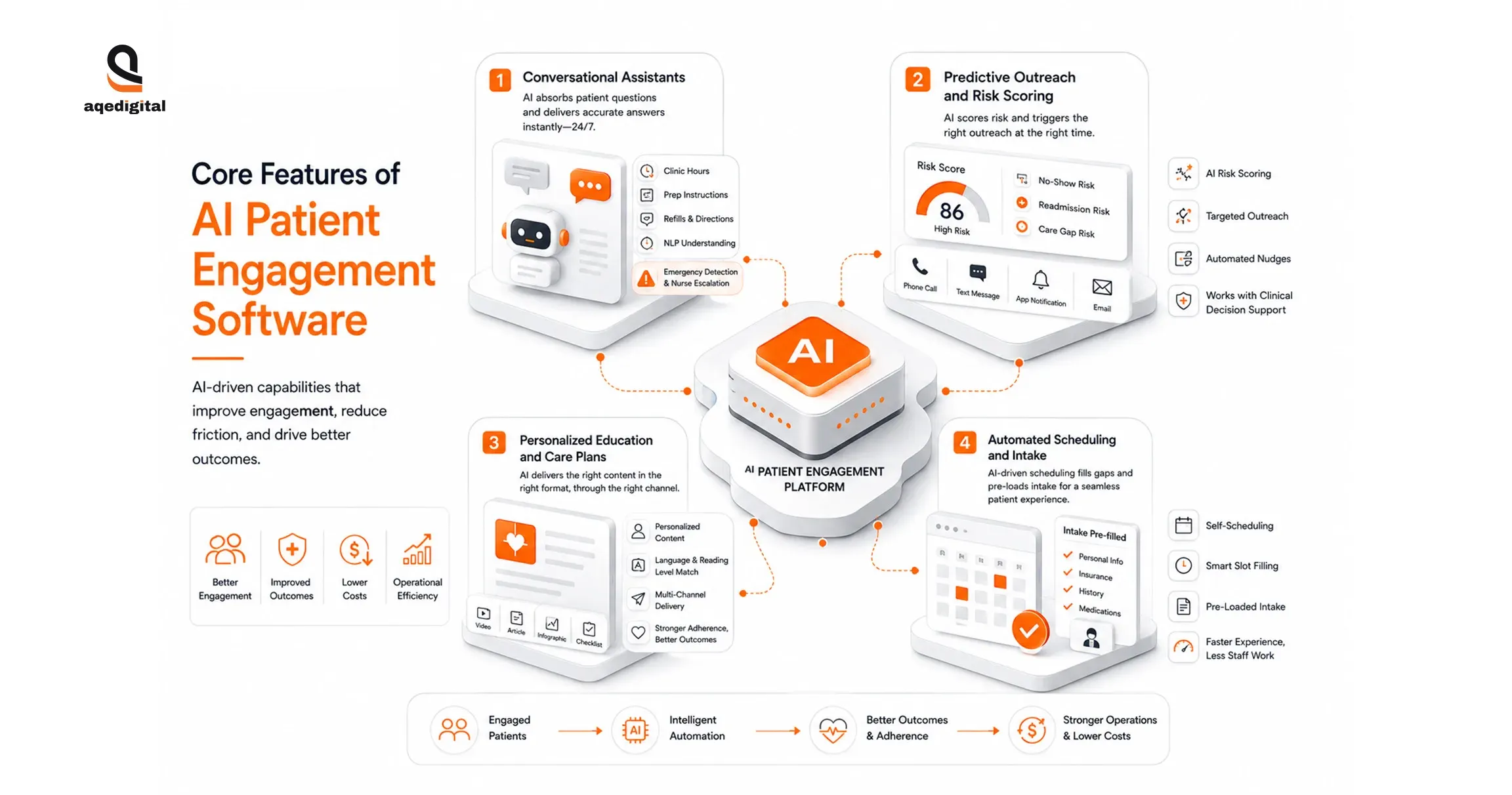
AI for Patient Engagement: Conversational Assistants
Conversational AI absorbs the questions that bury front desks. Clinic hours. Prep instructions. Refills. Directions. Natural language processing enables a patient to ask a question in plain English and receive a correct response within seconds, at any time of the day or night.
That's where AI for patient engagement comes into play and absorbs the mundane volume, allowing your people to do what they're best at: thinking about the cases that require a brain. The very same NLP layer can also alert to an emergency symptom and send it to a nurse line rather than leaving a person in a conversation with a bot.
Predictive Outreach and Risk Scoring
AI models score patients on no-show risk, readmission risk, and the odds of a care gap opening up. Then the platform fires the right nudge at the right moment. A phone call for the high-risk diabetic. A quick text for the routine checkup.
This is the engine behind automated patient engagement, where outreach grows without your headcount growing with it. Predictive scoring earns its keep when it sits next to AI clinical decision support tools that hand clinical context straight to the care team.
Personalized Education and Care Plans
Generic pamphlets get tossed. AI shapes educational content around the patient's actual condition, reading level, and language, then sends it through whatever channel that person actually checks. Engaged patients stick to the plan. Better adherence means fewer complications down the road and a lower cost to carry that patient over time.
Automated Scheduling and Intake
Self-scheduling backed by AI quietly fills cancellation slots and pre-loads intake from records you already have. Patients book in under a minute. Staff quit playing phone tag. Small thing on paper. Huge on a Monday.
Business Benefits of Patient Engagement Platforms
Here is the part finance cares about. The benefits of patient engagement software do not just show up on a satisfaction survey. They land on the P&L. Let us walk through how, one line at a time.
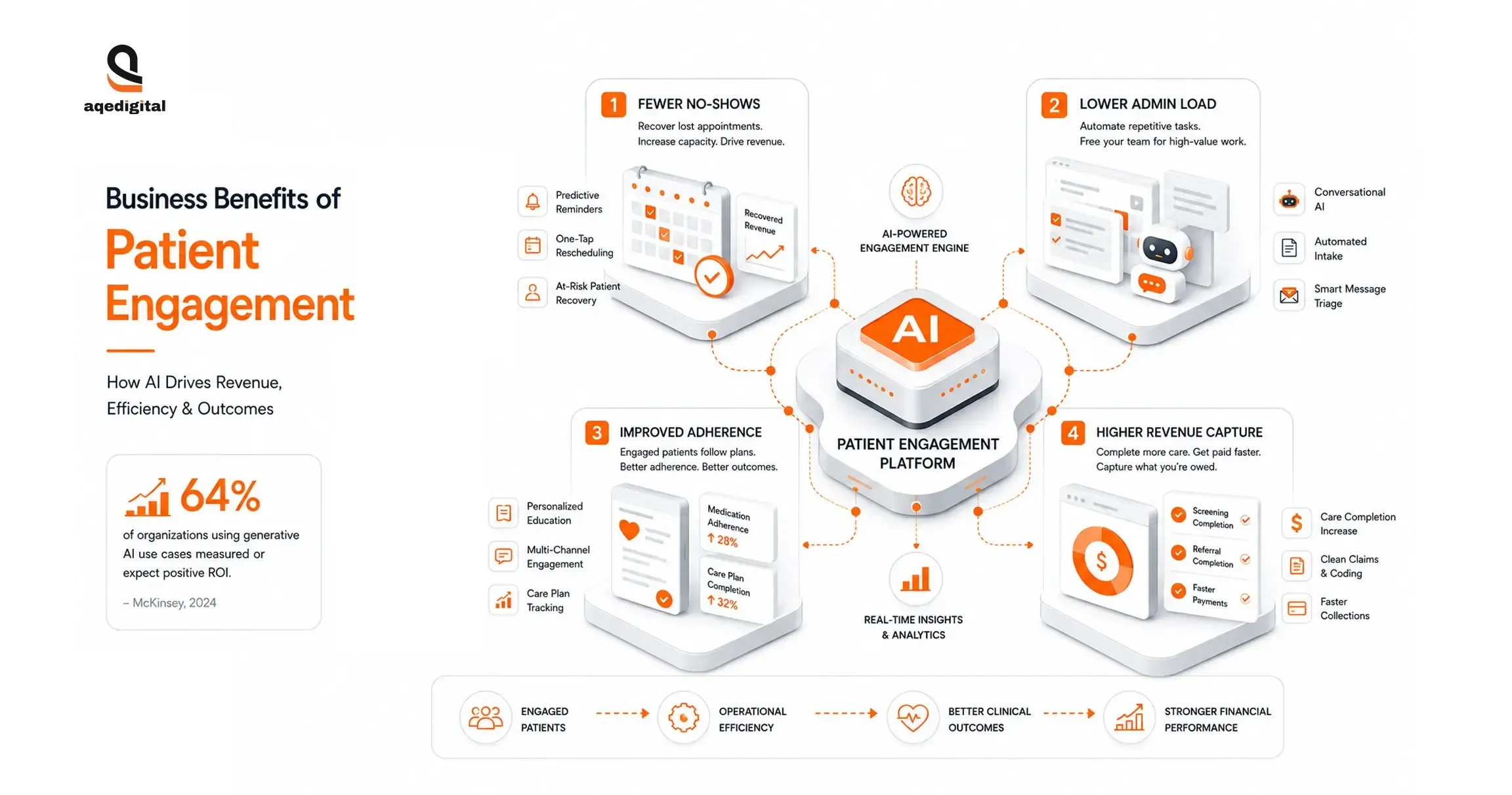
Fewer No-Shows and Recovered Revenue
Every empty slot is paid-for capacity walking out the door. A clinician sits idle. The room stays dark. That cost does not come back. Predictive reminders paired with one-tap rescheduling catch the patients most likely to vanish and pull them back onto the calendar before the slot dies.
Recovered revenue is the obvious win, usually the first number a CFO asks about. The quieter benefit is throughput. Trim no-shows and the patients waiting weeks for an opening get seen sooner, which lifts access and panel economics at once.
Lower Administrative Load on Your Staff
Burnout is not only a clinical problem. It is an administrative one. Front-desk and care-coordination teams drown in repetitive calls, form chasing, and message triage.
Conversational AI and automated intake lift that weight off them.
The payoff is not just a happier team, though that matters when turnover costs what it does. It is capacity. There's a significant amount of time that used to be spent on scheduling appointments that gets channeled into work that really does require a human touch, and a well-thought-out custom software development team is responsible for making that happen.
A Better Adherence and Improved Results
Engagement doesn't just happen because you're in a vanity metric. It's a step before the outcomes. A patient who receives a reminder of the right type, in the right language, at the right time, takes the medicine and is sure to attend the follow-up. No matter, you'll have the readmission, the complication, and the unnecessary escalation.
Personalized, well-timed engagement keeps people on their care plan, and over a population that adds up to fewer expensive events and measurably better clinical numbers.
For value-based contracts, that is the whole game.
Higher Revenue Capture Across the Journey
Engaged patients complete more of the care that is actually recommended to them. They book the screening. They finish the referral. They pay the bill faster because the billing experience is clearer and less adversarial. Each of those is revenue you were already entitled to but quietly losing to friction.
McKinsey's healthcare AI research reported that 64% of organizations rolling out generative AI use cases either measured or expected positive ROI (McKinsey, 2024). That is a rare signal this early in a technology cycle, and it is a big reason patient engagement software keeps climbing the budget priority list.
One caveat ties all of this together. The benefits of patient engagement software only show up if the platform integrates deeply. Software that cannot talk to your EHR, your billing, or your lab systems does not remove silos. It builds a new one. That is where the engineering partner matters far more than the feature checklist.
The takeaway for healthcare leaders is almost annoyingly simple. Buy the model. Design the flow. The technology amplifies whatever structure already exists, good or bad. A disciplined healthcare technology consulting partner earns its fee by mapping that structure before a single workflow goes live, not after it breaks.
How AI Improves Patient Experience in Hospitals: Use Cases
AI helps improve patient experience in hospitals, stops being a slide, and starts showing up in the daily grind of real operations. Each of these is a workflow a hospital is running today, not a someday.
Emergency Department Triage Support
Capacity and patience are the two thinnest at the ED. Conversational AI collects both symptoms and history, before a patient ever arrives at the desk, reducing intake time and bringing to light the high acuity cases that can't wait. No one's expecting AI to carry out the triage decision.
The clinician still owns that. What the AI does is hand that clinician a cleaner, faster picture, so the judgment happens sooner. In a department where minutes change outcomes, that head start is the point.
Chronic Care Management Between Visits ED
Chronic conditions are not managed in the exam room. They are handled during the 360-odd days of the patient's year when he/she is not here. This is an automated check-in system that monitors diabetic patients, cardiac patients, and their readings, which can get out of control before a crisis.
If the system is moving in the wrong direction, then once it is not the next scheduled visit, it goes to a clinician. This is the difference between catching a problem and reacting to a problem.
Discharge Follow-Up That Prevents Readmissions.
A lot of patients experience a cliff edge when they make it to the point of discharge. They leave home, the building goes away, and the med-mix begins. AI follows up with calls or texts to the patient, confirms they are actually taking what they were prescribed, and catches early signs of trouble.
Readmissions are one of the most expensive and most penalized events in the system, so closing this loop pays for itself fast. It is also one of the clearest places where automated patient engagement turns directly into avoided costs.
Multilingual and Equitable Outreach
Manual outreach teams rarely cover every language their patient population speaks. That gap is not a minor inconvenience. It is an equity problem with real clinical consequences. NLP-driven translation reaches non-English-speaking patients in their own language, at scale, without you staffing a call center in six tongues.
Patients who were effectively invisible to the old workflow become reachable, and reachable patients are engaged patients.
Staff Augmentation When Teams Run Short
Staffing gaps are not rare events anymore. They are on Tuesday. When clinical teams are stretched, an AI-assisted workforce platform redistributes engagement tasks so patient communication never just stalls because three people called in sick.
The work still gets done. The patient never feels the shortage. That resilience is quietly one of the most valuable things AI brings to a hospital floor.
Notice the pattern running through all five. AI handles the predictable volume. Humans handle the judgment. That clean division of labor is exactly what makes AI improve patient experience in hospitals durable, and it is why patient engagement software earns a permanent spot in the workflow instead of one more pilot that looked great in the demo and died in month three.
Compliance Is a Design Choice, Not a Feature
One more thing worth saying plainly, because it is where a lot of projects quietly fail. None of this matters if the platform is not secure and compliant. Patient data is among the most regulated information there is.
A serious build encrypts data in transit and at rest, enforces role-based access, keeps a clean audit trail, and treats HIPAA rules as an architectural requirement from day one rather than a box checked at the end.
The same goes for interoperability. If the system cannot speak HL7 FHIR standards and HL7, it cannot really live inside your stack, and you are back to the silo problem you were trying to solve.
Conclusion
Patient engagement was never really about software. It is about whether a patient feels seen between visits, and whether your team can pull that off at scale without burning out.
AI patient engagement software can do both to create a connected journey while maintaining the margin and improving the outcomes of the journey. There's no trend being pursued by the organizations moving now.
They are baking automated patient engagement into the core of how care actually gets delivered, and the early ROI numbers suggest the bet is a smart one.