OpenClaw vs LangChain vs AutoGPT: Which AI Agent Framework Fits Your Business?

Priyanka Wadhwani
Gartner projects 33% of enterprise software will include agentic AI by 2027. Most organizations are already in procurement mode, evaluating frameworks, shortlisting vendors, and standing up pilot environments. But 80–90% of AI agent deployments fail to reach production.
The failure isn't usually the model. It's the framework choice.
LangChain, AutoGPT, and OpenClaw represent three fundamentally different bets on how AI agents should be built and deployed. Each carries distinct architectural assumptions, hidden cost structures, and scalability ceilings. Picking the wrong one doesn't just slow you down; it creates technical debt that compounds until you're forced into a full rip-and-replace.
This breakdown provides the decision framework AQe Digital uses to match clients to the right stack before architecture is locked in.
What is an AI Agent Framework, and Why Does the Choice Matter?
The current enterprise market has become more competitive in AI-agentic adoption for operational automation. While there are a lot of tools, enterprises categorize AI agentic adoption into three primary categories,
- AI agent frameworks
- AI agent platforms
- Ready-to-deploy AI Assistants
AI Agent Frameworks (The Infrastructure Layer)
AI agent frameworks are developer-centric software architectures. These are modular toolkits with code libraries that developers can use to build foundational blocks of software. Enterprises and businesses then customize such building blocks for engineering custom agentic behaviors.
However, these frameworks do not offer graphical user interfaces, managed hosting, or pre-built enterprise software integrations. Such frameworks often need high technical proficiency, which leads to higher time-to-production and engineering overhead.
OpenClaw is a prime example of an AI agent framework. It is a self-hosted, open-source running daemon that must be installed on the local machine, a Raspberry Pi, or a Virtual Private Server.
While OpenClaw is highly capable, it provides a very primitive structure for building agentic workflows. Though there is one aspect that makes OpenClaw a lucrative option for many developers, and that is control over AI model usage. Developers can run AI models locally on their machines and connect them to OpenClaw.
Other examples include,
- LangGraph- It treats agent logic as state machines. This means developers get more control over the execution flows and conditional logic branching.
- Microsoft Agent Framework (MAF)- This is a production-ready SDK that combines AutoGen and Semantic Kernel to introduce session-based state management.
- CrewAI- It specializes in multi-agent orchestration. However, OpenClaw also offers multi-orchestration and MCP capabilities.
AI Agent Platforms (The Orchestration Layer)
If you are an enterprise and don’t want the hassle of building a custom orchestration layer, AI agent platforms are the best option. It offers a comprehensive end-to-end enterprise software environment to build, test, deploy, host, and manage AI agents.
Complexities of state management and API connectivity are often abstracted by these platforms. AI agent platforms often provide low-code or no-code capabilities, ensuring drag-and-drop type development. Plus, these platforms also provide unified data foundations, native integrations, and role-based access controls.
Salesforce Agentforce is one of the leading examples of such platforms. It anchors agents directly to the underlying customer relationship management data.
Other key examples include,
- IBM watsonx.ai- This is a comprehensive platform for enterprises that need cross-functional collaboration, enabling operations managers and citizen developers to build multi-agent workflows.
- UiPath Agentic Automation- It combines Large Language Models (LLMs) with robotic process automation (RPA)
Ready-to-Deploy AI Assistants (The Application Layer)
RTD (ready-to-deploy) AI assistants are turnkey SaaS applications that assist humans with specific tasks. These assistants are different from highly autonomous agents, as they are bound by prompts and a human-in-the-loop approach.
However, some of these RTDs now have autonomous features. For example, Claude has launched the “Don’t Ask” feature, which automates the permissions needed to complete a task. Apart from Claude, there are many other examples like
- General Enterprise Assistants- Microsoft 365 Autopilot, ChatGPT Enterprise, Google Workspace Gemini, and GitHub Copilot
- Specialized Domain Assistants- Glean and Service Now are examples of specialized assistants designed for specific enterprise tasks.
Now that you know what AI agent frameworks are and how they differ from other approaches, let’s understand which one is the best option for your enterprise. First, let’s understand LangChain and how it differs from OpenClaw.
Read more: How Can Agentic AI Reshape The Future Of Your Business?LangChain: Engineering Control at Every Layer
Across every serious AI agent framework evaluation, LangChain holds its ground as the code-first choice for engineering teams. Where no-code agent platforms deliberately hide execution logic behind drag-and-drop abstractions, LangChain exposes every layer. It gives developers the raw material to construct precisely the intelligence their product demands.
The Modular Architecture
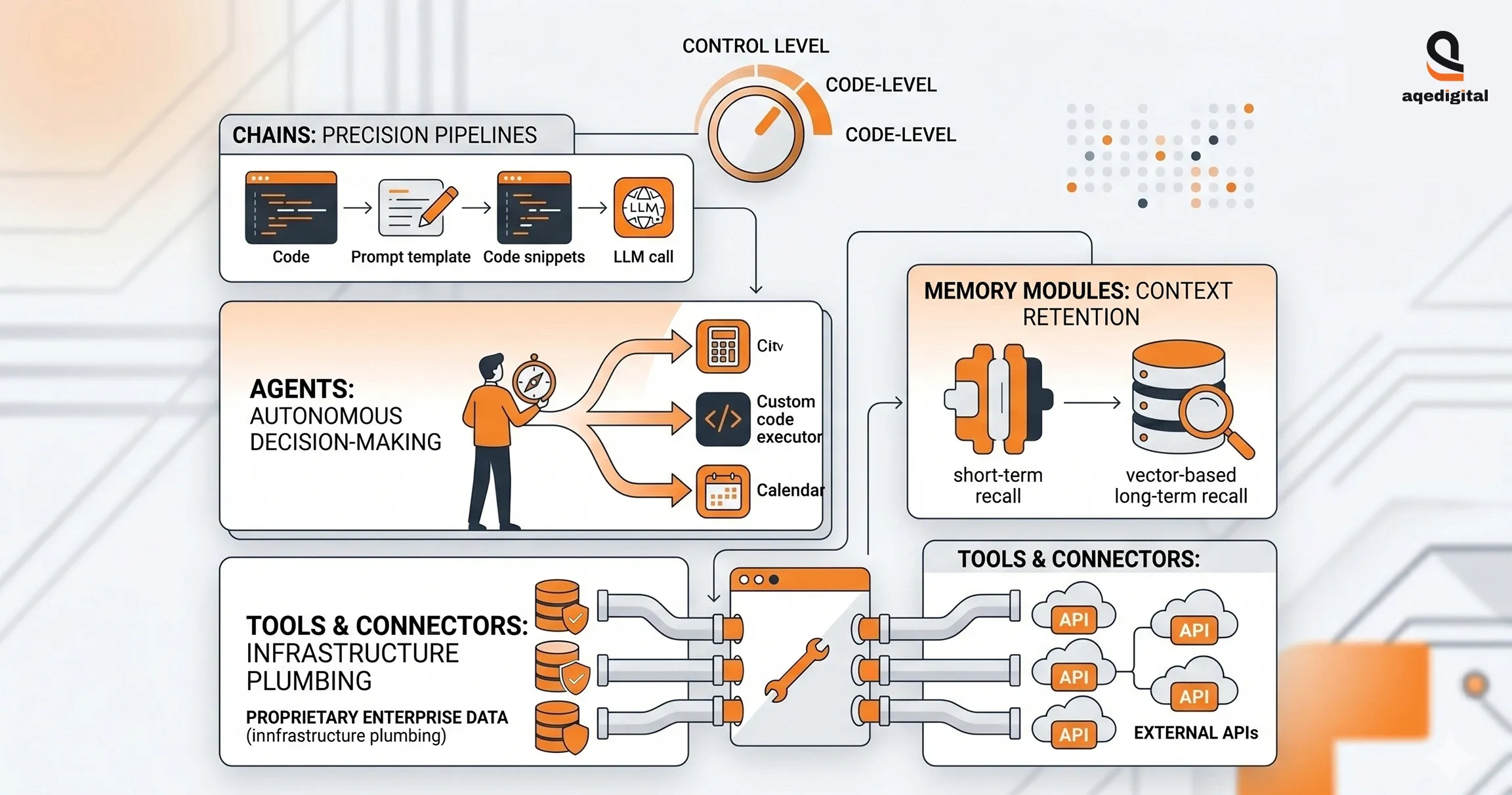
LangChain's design philosophy centers on composability. Each component is purpose-built to interlock with others, letting development teams assemble sophisticated cognitive workflows without forcing any single pattern:
- Chains: Connect sequences of LLM calls and prompt templates into tightly controlled custom pipelines, the antithesis of grabbing a ready-to-deploy agent off the shelf.
- Agents: Enable autonomous decision-making at runtime, allowing systems to select tools dynamically and drive multi-step execution logic without hardcoded instruction paths.
- Memory Modules: Provide dual-layer context retention, short-term conversational state alongside long-term vector-based recall for persistent knowledge access.
- Tool Integrations & Vector DB Connectors: The infrastructure plumbing that routes proprietary enterprise data into the pipeline and establishes secure, structured connections to external APIs and services.
Ideal Use Cases and Framework Fit
LangChain earns its place when standard execution patterns simply won't cut it. For enterprises running a 2025 AI agent framework evaluation, it remains the definitive solution for custom RAG (Retrieval-Augmented Generation) pipelines, precision-tuned prompt chains, and retrieval logic that goes far beyond what packaged tools support.
Technical leaders consistently find that no other framework offers the same depth of control for integrating proprietary databases into specialized business automation systems.
That said, the build vs. buy calculation must be honest. LangChain is not a deployment tool. It is a development foundation. It sits squarely on the "build" side of that decision, and teams must enter it with eyes open.
When is LangChain the Right Call for Your Enterprise?
At AQe Digital, every framework recommendation starts with a precise question: Does architectural control matter more than deployment velocity for this client, at this stage?
- Control Over Speed: When a client's core IP depends on a bespoke cognitive architecture, a specialized legal research engine, a proprietary FinOps analysis system, or custom multi-agent routing logic, code-level control is non-negotiable. LangChain is the right foundation, and no platform-layer shortcut adequately replaces it.
- Matching the Use Case to the Tool: The fundamental distinction between an AI assistant and a truly autonomous AI agent shapes every recommendation. Clients who need rapid chatbot deployment across messaging surfaces don't need a six-month custom build.
OpenClaw's structured skill and tool architecture handles that cleanly. Clients who need fully autonomous agents operating over tightly controlled, on-premise data pipelines need LangChain's depth. - Understanding the Deployment Lift: Any honest production deployment guide makes this clear: raw frameworks demand significant operational investment before they're stable. For clients prioritizing speed and low implementation friction, pre-configured deployment tooling wins.
For clients willing to extend their time-to-value in exchange for complete ownership of their multi-agent orchestration, AQe Digital architects and scales production-grade LangChain environments that hold up under real-world conditions.
Comparison of LangChain vs. AutoGPT vs. OpenClaw always comes down to matching infrastructure tier to actual product requirements. So, understanding the difference between each of these frameworks based on these parameters becomes important.
AutoGPT: Autonomous Agent Pioneer, Production Liability
AutoGPT was among the first systems to demonstrate what goal-driven autonomy could look like in practice. Developers can feed it a single high-level objective. It plans, sequences, and executes multi-step tasks by chaining tool calls together without human prompting at each step.
For startup founders and digital agency owners entering the autonomous AI space, that capability was electrifying. It became the definitive sandbox for research, rapid prototyping, and stress-testing agentic concepts at low cost.
But the distance between a viral open-source experiment and a production-grade enterprise system is vast. AutoGPT's trajectory illustrates, more clearly than almost any other tool, what happens when theoretical autonomy gets prioritized over operational discipline.
The Illusion of Control: AutoGPT's Production Reality
Research environments are forgiving. Live business systems are not. When AutoGPT is deployed in production, architectural cracks surface quickly. Its probabilistic loop design is prone to recursive failure states in which the agent enters cycles it cannot exit, driving unpredictable, often explosive token consumption with no self-correcting mechanism to halt the spend.
Engineering teams working from any standard AI agent production deployment guide will run into what practitioners call the "polling tax." The agent pings APIs in repeated, unresolved loops, burning through cloud budgets at scale while standard IT telemetry dashboards report normal system health. The cost is invisible until it isn't.
The integration story compounds the problem. Native AutoGPT ships without built-in connectors for consumer-facing applications or messaging platform integrations. Enterprises targeting seamless chatbot deployment across messaging surfaces must manually engineer the entire connectivity layer from scratch just to establish a viable deployment surface.
For any organization treating AI as a business automation tool, that engineering overhead represents a significant and often underestimated cost exposure.
OpenClaw: Deployment-Ready AI Assistant Platform (The 10-Minute Trap)
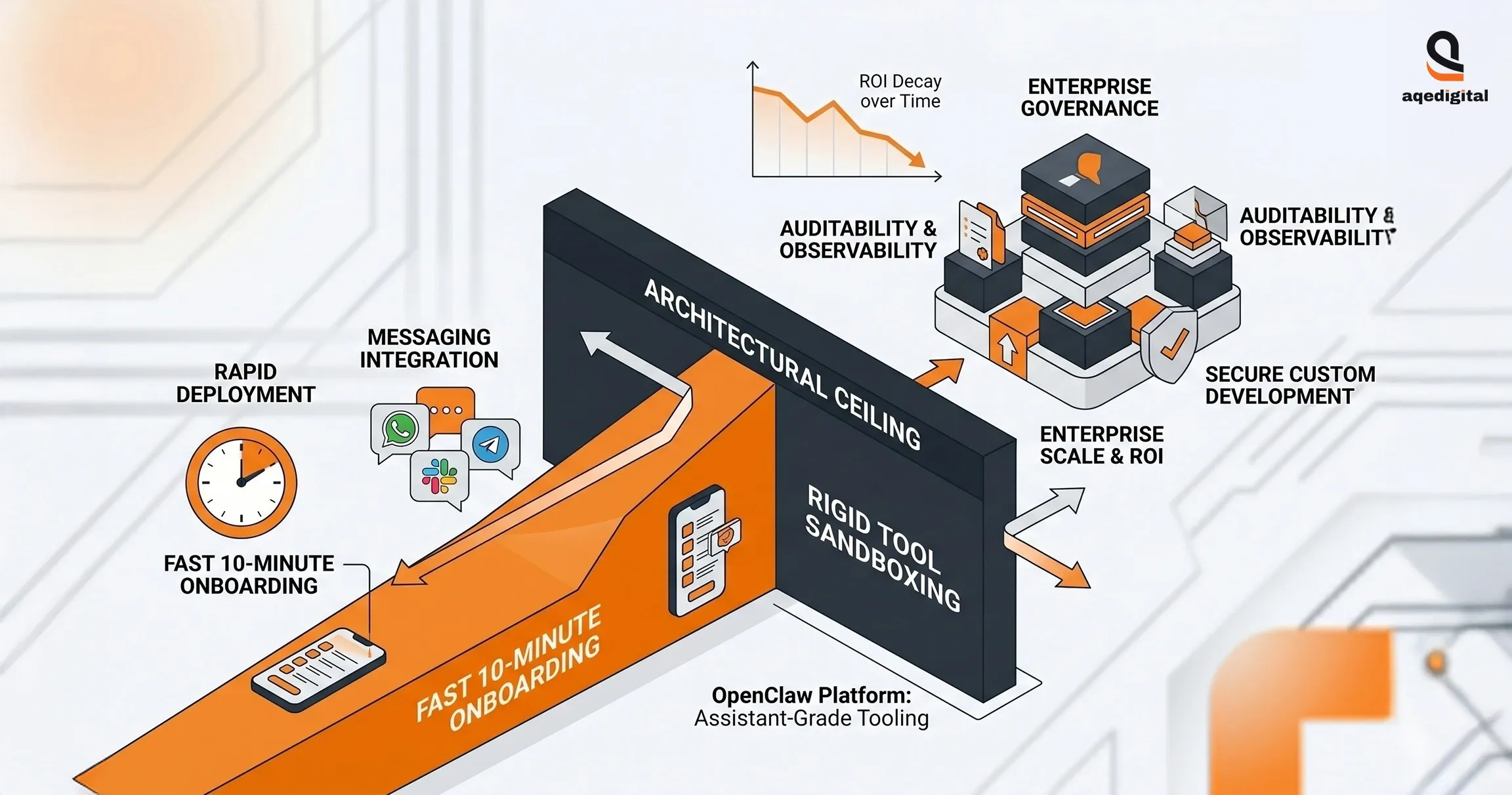
In any serious AI agent framework comparison, OpenClaw positions itself aggressively as the definitive no-code agent platform, a "skip the build, go straight to ship" proposition. The pitch is clear, and the onboarding is genuinely fast. But for serious engineering teams, enterprise product managers, and scaling digital agencies, OpenClaw fails the production readiness test at the level that matters most.
The 10-Minute Illusion
The speed is real. Deploy a Lighthouse instance, paste an API key, run Clawbot onboarding, and scan a QR code. In under ten minutes, you have live native integration across WhatsApp, Slack, or Telegram. That frictionless entry point is OpenClaw's most effective sales tool, and for low-complexity use cases, it works exactly as advertised.
The problem is architectural. Using a consumer messaging platform as the primary deployment surface for complex operational workloads is not a shortcut. It is a structural miscalculation. OpenClaw's sandboxed tool execution layer covers web browsing, code execution, file reading, API calls, and sub-agent management, but the sandboxing itself is the constraint.
The declarative skill and tool architecture is rigid by design. Rather than enabling genuinely autonomous agents, it produces assistant-grade tooling that degrades quickly under enterprise workload pressure. What looks like rapid deployment is, in practice, a ceiling that most serious use cases will hit within months.
The Enterprise Governance Gap
For technical co-founders and agency CTOs working through a build vs. buy decision for AI agents, the governance picture is where OpenClaw's limitations become most consequential. A 2026 AI agent platform comparison reveals that OpenClaw lacks the depth of enterprise-grade observability, auditability, and access control required to manage agents operating across business-critical workflows responsibly.
It sidesteps the recursive loop failures that make AutoGPT unreliable in production. That is a genuine advantage. But trading one reliability problem for an equally serious scalability ceiling does not constitute a solution.

AI ML Development Services providers' teams that build production systems on OpenClaw's current architecture will face a rip-and-replace cycle as operational scope expands. The initial time-to-value gain gets consumed by the eventual cost of migration.
Scale Failure and the ROI Reality
Comparing OpenClaw against LangChain across real-world use cases exposes the fundamental distinction between an AI assistant and a truly autonomous AI agent. OpenClaw carries surface-level appeal as a no-code builder for non-technical teams or a low-friction alternative to raw framework development. But no-code deployment without architectural depth is one of the clearest contributors to the industry's 80% to 90% failure rate in AI agent production.
A strong time-to-value metric is meaningless if the system cannot scale to generate actual ROI within the first year. For any organization consulting a credible AI agent production deployment guide, searching for the best enterprise AI agent framework, OpenClaw consistently falls short.
In any rigorous LangChain vs. AutoGPT vs. OpenClaw analysis, teams that require a secure, extensible, custom development foundation will find OpenClaw to be a commercial dead end at scale.
Head-to-Head Comparison: LangChain vs AutoGPT vs OpenClaw
To crystallize the comparison of AI agent frameworks, we must evaluate these systems against the metrics that actually impact your bottom line. The following table breaks down the core differences between a custom AI development framework, an experimental autonomous system, and AI assistant deployment tools.
The AQe Digital Verdict: For clients who need an AI assistant deployed in weeks, not months, OpenClaw wins on the AI agent's time-to-value.
However, for teams building proprietary AI pipelines where data security and complex orchestration are paramount, LangChain definitely wins on control.
AI Agent Development vs Deployment: Why Most Teams Get Stuck
The most dangerous misconception in the industry is treating development and deployment as the same phase. Understanding the nuances of AI agent development vs deployment is why some companies scale effortlessly while others burn millions.
It is relatively simple for a junior developer to build an impressive prototype on their laptop; it is an entirely different beast to achieve true AI agent production readiness.
When transitioning a prototype to live environments, teams slam into a wall of enterprise requirements:
- Enterprise AI agent governance and observability: Granular tracking of what the LLM is doing at every step.
- Role-Based Access Control (RBAC): Ensuring the agent doesn't expose sensitive HR data to a sales rep.
- Immutable Audit Logs & Version Control: Tracking which prompt version caused a specific outcome.
- Compliance & Connector Breadth: Securely bridging the agent to proprietary databases without violating SOC 2.
In fact, recent industry data reveals that 71% of organizations cite agentic system complexity as their number one hurdle to adoption. This is where a no-code AI agent platform acts as a critical bridge. If your goal is an AI agent for business automation, custom development can take 4-9 months with exorbitant costs. Conversely, platform deployment reduces this to days or weeks.
Choosing between a rigorous framework and a no-code AI builder for non-technical teams is the ultimate build vs buy decision for AI agents. At AQe Digital, our scoping call serves as the exact inflection point where we help you definitively choose your path before a single line of code is written.
The Hidden Costs Nobody Talks About: Framework Choice Fallout
When executing an AI agent platform comparison 2026, technical leaders often fall into the trap of "free" open-source software. Free software does not equal a free implementation. The AI agent framework's hidden costs can cripple a project’s ROI if miscalculated.
- LangChain’s Ongoing Tax: As the premier best AI agent framework for enterprise, it requires ongoing salaries for senior AI engineers, compounding cloud costs for standalone vector databases, and relentless prompt engineering maintenance to prevent logic drift.
- AutoGPT’s Runaway Bills: Utilizing experimental architectures often leads to infinite reasoning loops. You aren't just paying for development; you are paying runaway API token bills to OpenAI or Anthropic while trying to debug a system with zero vendor SLAs.
- OpenClaw’s Predictable Floor: While OpenClaw requires you to manage your own server/hosting costs, the fixed nature of its OpenClaw skill and tool architecture ensures your token usage remains predictable, bypassing the financial black hole of unchecked multi-step autonomy.
The data support this economic reality: companies utilizing deployment-focused platforms report a 40% faster time-to-market compared to those stubbornly clinging to custom builds for standard workflows.
If you want a positive AI agent ROI within the first year, you must acknowledge that avoiding a langchain alternative for non-developers when it’s appropriate is a false economy.
How AQe Digital Helps You Choose And Build The Right AI Agent Stack?
AQe Digital operates as your platform-agnostic partner, moving you seamlessly from strategic scoping to framework recommendation to final implementation.
We cut through the noise with a focused 30-minute AI Scoping Call. During this session, we map your specific business use cases, audit your existing tech stack, provide a definitive shortlist of frameworks, and deliver a transparent cost estimate.
Conclusion
Choosing between LangChain, AutoGPT, and OpenClaw is not merely an IT decision. It is a foundational business commitment that dictates your time-to-market and operational risk. LangChain offers limitless control for proprietary pipelines, AutoGPT provides a sandbox for experimental autonomy, and OpenClaw delivers rapid deployment for standard messaging workflows.
Make the wrong choice, and you will inherit crushing technical debt; make the right choice, and you will dominate the automaton economy. Secure your strategy today by booking a free consultation with AQe Digital.