Offshore Software Development: A Practical Guide to Models, Costs, Risks & Vendor Selection

Nirav Oza
Worldwide IT services spend is set to hit $1.57 trillion, growing 5.3 % year over year, and a good share of that growth is from enterprises rethinking who builds their software and where.
Offshore software development is an approach to hiring a dedicated engineering team based in another country to build and maintain your product. It is no longer the fallback option for a stretched budget. But a necessity for most enterprises, especially if you consider AI-based software development needs.
And this is why 40% of all companies are opening or expanding global delivery centers to access international talent pools. The reason is not just cost but lack of talent and skill gaps that enterprises face while integrating AI models into existing systems.
Despite such a massive demand for offshore software development, many enterprise leaders still have doubts on the entire engagement model. The assumption that going offshore trades quality for cost, or that an offshore development center is inherently harder to secure and manage than an in-house team.
So where does the real risk sit, and how do you price it before you sign a contract?
This guide breaks down the offshore development models on the market, what they actually cost by country, the vendor vetting questions that catch a bad partner before the first sprint, and the specific failure points that turn a promising offshore engagement into a rebuild.
What is Offshore Software Development?
Offshore software development means handing software engineering, application design, quality assurance, and project management to external teams or vendors based in other countries. It is not the same as nearshore development, where partners sit in nearby countries or similar time zones. It is also not onshore development, where the outsourced work stays inside the same country.
Most enterprises judge offshore partners by hourly rate, pick the cheapest vendor that looks credible, and find out two quarters later that the savings never showed up in the P&L. The rate was never the variable. The engagement model was.
Why Enterprises Move Development Offshore?
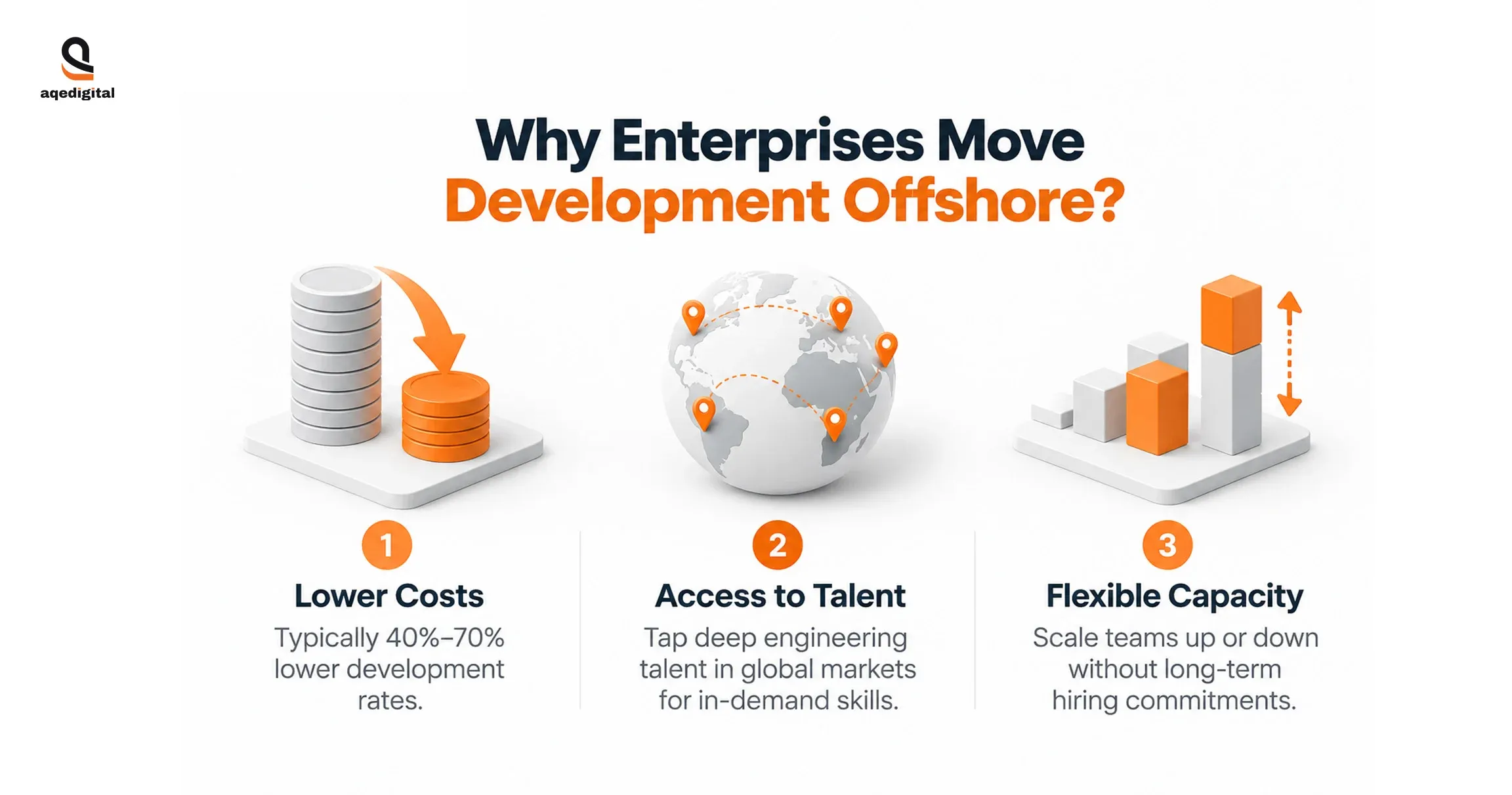
The case for offshoring rests on three advantages. Each one only pays off when the delivery structure behind it is sound.
Cost efficiency that shows up on paper first
Offshore hourly rates typically come in 40% to 70% below domestic hiring in North America or Western Europe. Here is an illustrative model: a 10-engineer team billing 1,800 hours a year, with a $130 domestic rate against a $45 offshore rate, opens a gap of roughly $1.5M a year. That figure is gross, not net. How much of it survives depends on the sections below.
Access to talent the local market cannot supply
Offshoring opens up deep engineering talent in Eastern Europe, Asia, Latin America, and Africa. The difference is sharpest in high-demand skills such as AI/ML, cloud engineering, DevOps, and cybersecurity. Picture a fintech that needs three Kubernetes security engineers before a Q2 audit. It will rarely find them locally at any salary. Offshore, the same search closes in weeks.
Capacity that flexes without payroll liability
Organizations can scale team capacity up or down to match project demand and workload peaks. They do it without taking on long-term local employment obligations. A retailer can double its QA headcount for peak season and release it in January, and no severance cycle follows.
Which Engagement Model Fits Which Problem
Every offshore model trades control against responsibility. Enterprises that pick a model by price end up owning the wrong half of that trade.
| Which Engagement Model Fits Which Problem | |||
|---|---|---|---|
| Model | Who directs daily work | Who holds legal employment | Best fit |
| Managed Services / BPO | Vendor, against predefined specs | Vendor | Discrete projects with fixed scope and milestone delivery |
| Dedicated Team / Staff Leasing | Client, as an extension of in-house engineering | Vendor | Long-running product roadmaps that need continuity |
| Employer of Record (EOR) | Client | Third-party local entity handling payroll, tax, and compliance | Direct control over individual hires without a foreign entity |
| Captive Offshore Development Center (ODC) | Client | Client's own registered subsidiary abroad | Maximum control and direct ownership of assets at scale |
A managed-services contract works well for a defined migration. It breaks down when a product team keeps rewriting requirements mid-sprint, because the vendor is paid to deliver the spec, not the moving target.
- Best practice: choose your model by who must own technical direction, not by who quotes the lowest rate.
What the Rate Card Hides About Offshore Software Development?
Once a model is chosen, the real cost of the engagement moves somewhere the invoice doesn't show.
The rate-card illusion
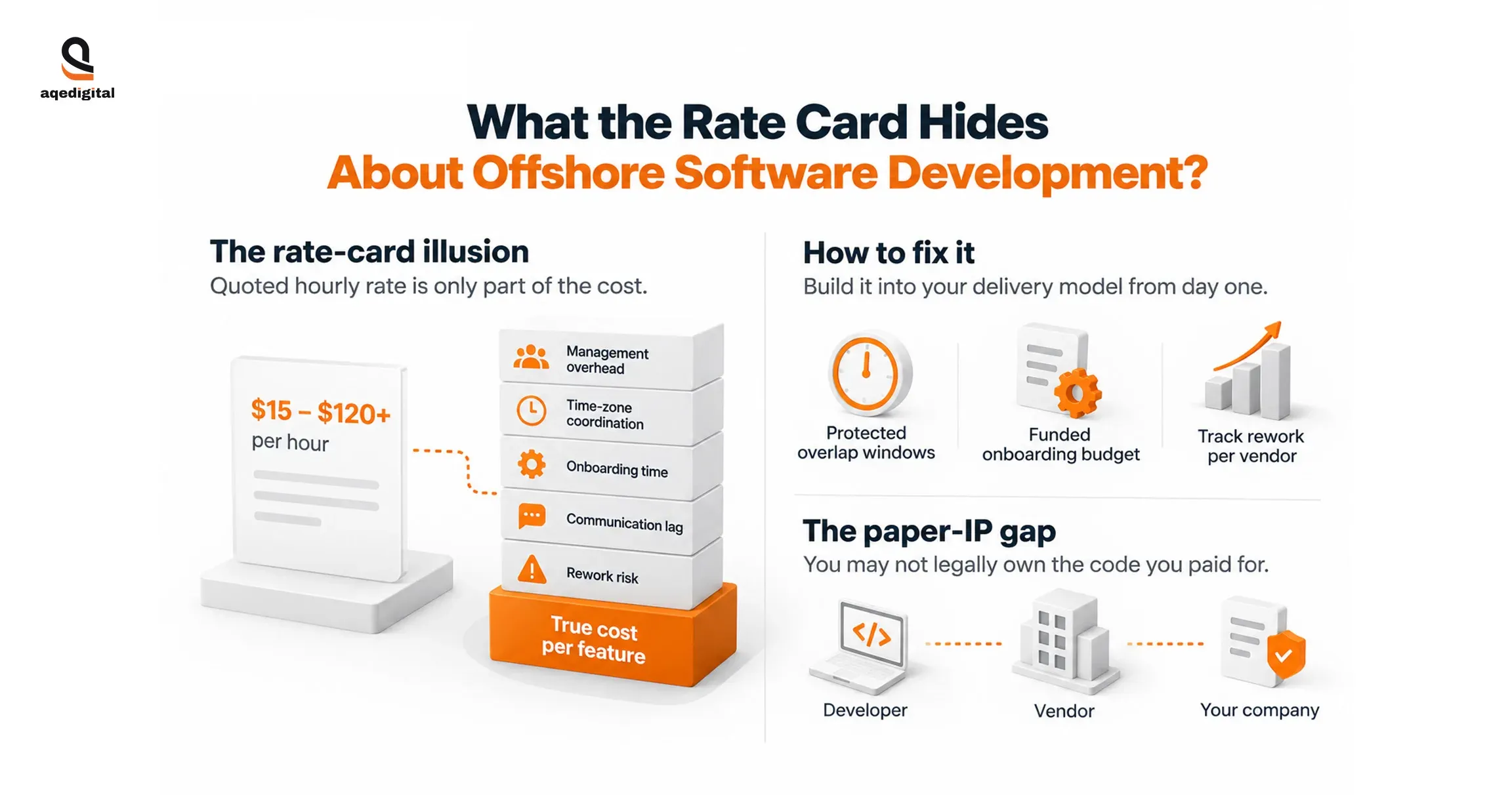
The rate-card illusion is the gap between the quoted hourly rate and the loaded cost of each feature that actually ships. Baseline rates run from $15 to $120+ per hour, depending on region and seniority. Total cost of ownership also has to include internal management overhead, time-zone overlap, onboarding time, communication lag, and rework risk.
Consider a US team with one hour of overlap with its offshore partner. A developer posts a blocking question at 6 p.m. local time; the answer comes the next morning; the fix ships a day late. Over a two-week sprint, three of those delays wipe out most of the rate advantage.
How to fix it: protected overlap windows, a funded onboarding budget, and rework tracked per vendor
Build a minimum of three shared working hours into your contract. Treat onboarding as a line item with its own timeline. Measure the defect-reopen rate by team, so rework shows up in cost reviews before renewal.
The paper-IP gap
The paper-IP gap is code your company paid for but does not legally own. It happens when developers assign rights to the vendor and the vendor never assigns them onward to you. Cross-border compliance adds more layers: GDPR and HIPAA obligations, a two-step IP assignment chain, and exposure to Permanent Establishment (PE) corporate tax liability. A PE finding can turn a cost-saving contract into a taxable foreign presence.
- Best practice: audit your IP chain from developer to vendor to company before the first commit, not during due diligence for a funding round.
What Misdiagnosis Costs?
Enterprises that treat offshoring as a procurement decision optimize the one number on the invoice and leave everything else ungoverned. The bill shows up later: missed releases, rework no one budgeted for, and code whose ownership can't be proven. The rate was the easy part. Structure decides whether the savings are real.
Choosing an Offshore Development Model: ODC, Staff Augmentation, Dedicated Team, or BOT
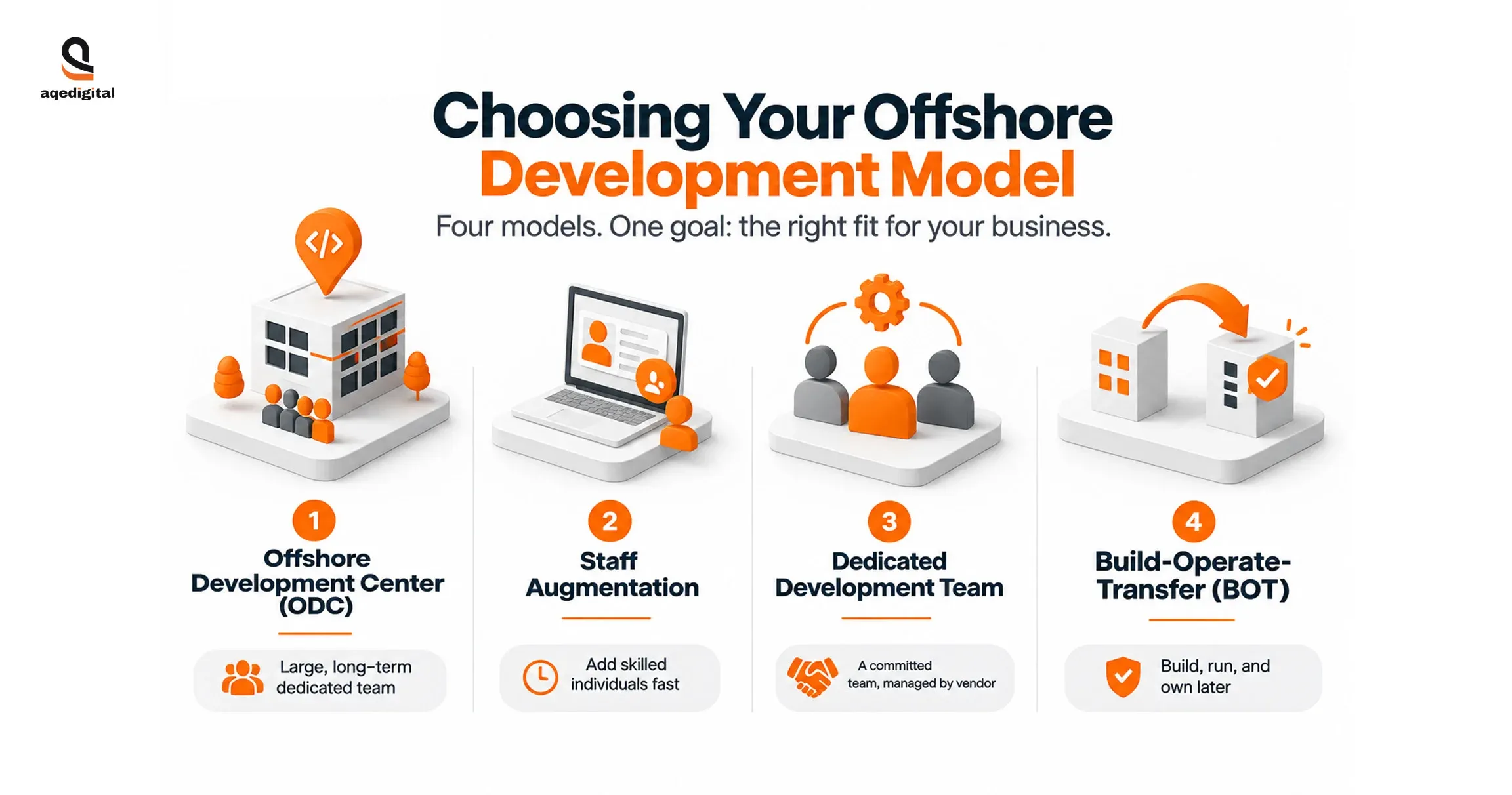
Four engagement models cover almost every offshore software development deal on the market, and each one trades setup cost against control in a different place.
1. Offshore Development Center (ODC)
An offshore development center is a wholly dedicated team, operating under your processes and security standards, that works on nothing but your product.
It fits organizations planning for 50 or more engineers on a three-year horizon, typically above $10 million in revenue, with compliance requirements heavy enough to justify $150,000 to $300,000 in setup cost before the first payroll run. Setup runs six to twelve months.
Treat an ODC as a build decision, not a hiring decision, and do not start one without a three-year headcount plan you actually believe.
2. Staff Augmentation
Staff augmentation adds individual offshore engineers directly into your existing team and sprints, under your own project management. It sets up in two to four weeks, carries no separate facility cost, and suits teams of 5 to 50 engineers whose roadmap still shifts quarter to quarter.
Because augmented engineers report to your own PM, not a vendor layer, the vendor's only leverage over quality is who they place, which is exactly why the vetting step below is not optional.
3. Dedicated Development Team
A dedicated team sits between the two: a fixed group of engineers assigned only to you, managed day to day by the vendor but reporting into your product roadmap. It gives more continuity than staff augmentation without the ODC's facility overhead, and it is the default model for a scaling SaaS company standing up its first real offshore presence.
4. Build-Operate-Transfer (BOT)
BOT lets the vendor build and run the team for an agreed period, then transfers full ownership, staff and all, to you once it hits maturity. It answers the question an ODC cannot: how to get offshore delivery running fast without waiting a year to own it outright.
Negotiate the transfer trigger and valuation formula in the original contract, not at the handover date, when your leverage is highest before day one and lowest after two years of dependency.
The Vetting-Debt Gap
The vetting-debt gap is the difference between what a vendor's sales deck promises and what its actual delivery team can execute, and it only becomes visible after the contract is signed.
Close it before signing with numbers, not references alone: demand a developer acceptance rate under 5%, a three-year retention rate above 70%, and a minimum of four hours of daily overlap, and treat a vendor who will not produce those figures as a vendor who does not track them.
The payoff for doing this legwork compounds. Organizations that appoint a dedicated global business services leader, rather than running offshore delivery as a side responsibility, report average savings above 20% more than half the time.
Ownership of the vendor relationship is itself a cost lever.
Best practice: fund the vendor due-diligence process like you would fund a technical audit, because that is what it is.
Where Does Offshore Risk Actually Live?
Every offshore engagement carries the same four risk categories: access, ownership, vendor vetting, and AI tooling. None of them has anything to do with geography. Enterprises blame the country, but the failures come from governance decisions that got made, or skipped, in the first two weeks.
Why shared credentials turn a staffing change into a security incident
Some offshore teams get broad, shared access to production instead of scoped, individually logged credentials. For them, a routine staffing change becomes an audit finding.
When an engineer rolls off, nobody can revoke one person's access without breaking everyone else's, so the shared password stays live for months. The fix isn't distrust of offshore engineers.
It's the access hygiene any distributed team, onshore or off, should already have: role-based access control, individual logins, and an incident response plan someone has actually tested.
The ownership fog
The ownership fog forms when no named person on either side of the time zone gap owns decisions about a feature. Every unclear requirement then waits a full day for an answer. Take a ten-day sprint with five unclear tickets, each stuck for one business day.
That's five ticket-days lost to waiting before anyone questions a single line of code. The ownership fog slows offshore delivery more than anything else, and developer skill has nothing to do with it.
Vetting debt
Vetting debt builds up when a vendor is signed on its rate card and résumés alone. Questions about access policy, escalation paths, and tool usage get pushed to "after onboarding." Each skipped question comes due later, usually in the middle of an incident, and it costs more then.
The cost premium of ungoverned AI tooling
This risk grows as AI budgets grow. 83% of C-suite leaders are increasing AI investment this year. An offshore team using AI coding tools on your codebase with no policy on what goes into a public model takes on that exposure at scale. One engineer pasting a proprietary module into a consumer chatbot is enough to put source code beyond your contract's reach.
How to fix it: named decision owners, individually logged access, a contractual AI-use policy
- Named decision owners: Assign one named owner for every unclear decision before the sprint starts, on both sides of the relationship.
- Individually logged access: Move offshore access to role-based, individually logged credentials before the second week, not after an incident.
- Contractual AI-use policy: Put the AI-tool policy in the contract, not in a chat message six months in.
Govern your offshore team the way you'd govern a new onshore hire with production access. Not more loosely, and not more strictly.
Which Offshore Model Fits Your Company's Stage?
Company stage matters more than headcount when picking an offshore development model. A 40-person startup and a 40-person enterprise division have different runways, compliance loads, and hiring horizons.
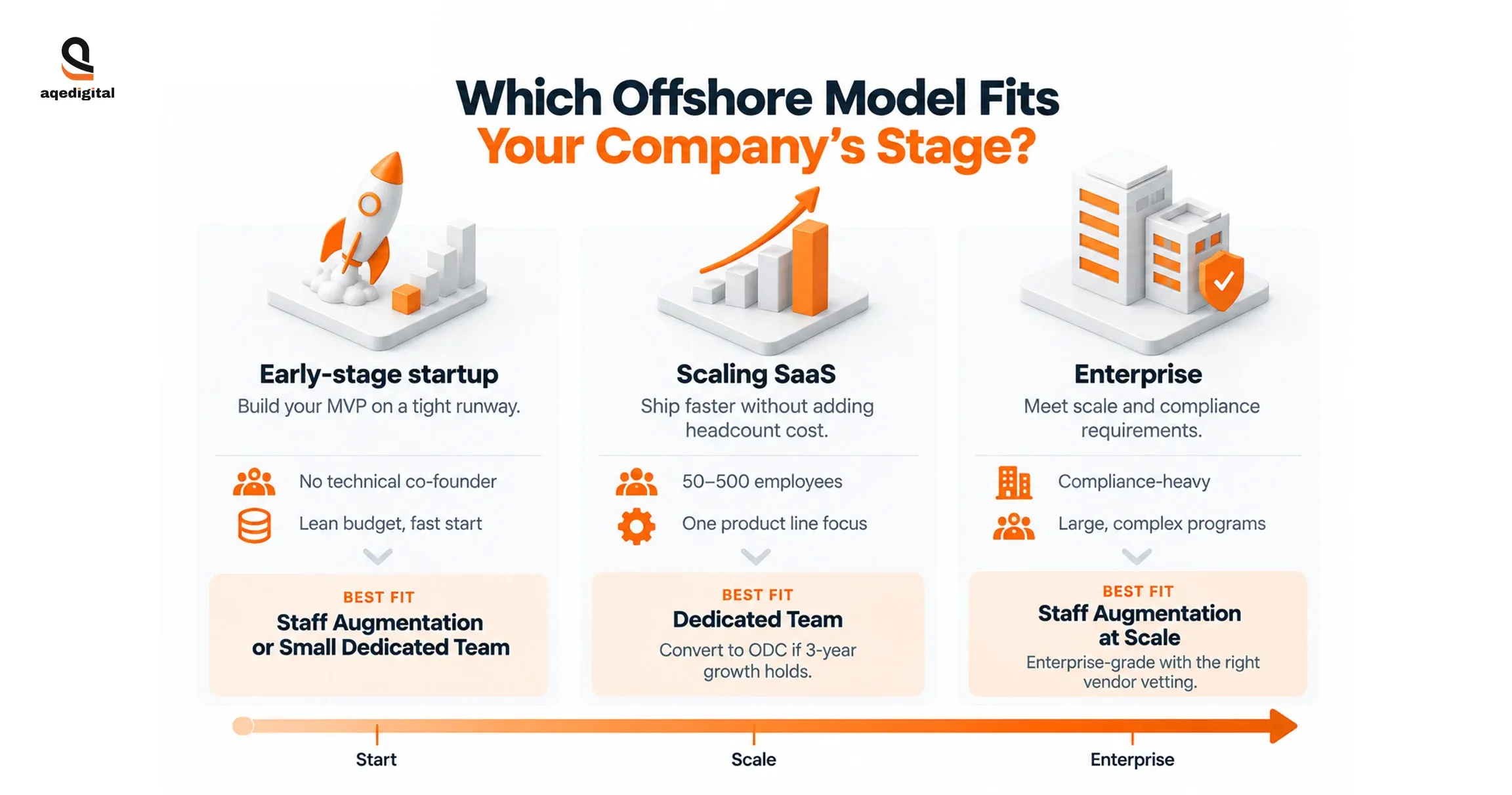
Early-stage startup, no technical co-founder
A founder building a first MVP on a tight runway needs staff augmentation or a small dedicated team in a low-cost location. An ODC is too early. WhatsApp shipped its early iOS build with an outsourced developer and never grew past 60 employees before its acquisition. A lean offshore engagement can carry a product to a major outcome without a large in-house team.
Scaling SaaS, 50 to 500 employees
A VP of Engineering who has to ship without adding headcount cost usually fits a dedicated team model sized to one product line. Write the contract so it converts into an ODC only if the three-year headcount case holds up. If it doesn't, the team stays flexible.
Enterprise, compliance-heavy
A Fortune 500 IT organization can run staff augmentation at real scale without opening a foreign subsidiary. AMC Theatres keeps a dedicated .NET engineering team through a Philippines-based offshore partner. Staff augmentation, not just an ODC, can deliver at enterprise grade when vendor vetting happens up front.
Why AQe Digital for Engineering-First Offshore Delivery?
Most offshore vendors sell you a rate card and a list of résumés. That covers the easy 20% of the offshore decision. The other 80%t is integration, governance, and choosing the right model.
- Engineering-first integration: AQe Digital's product engineering and enterprise development teams work inside your existing sprint cadence and codebase, not in a separate vendor workstream. The ownership fog never gets a chance to form.
- Governance built in, not bolted on: Role-based access, logged credentials, and a written AI-use policy come with the engagement from week one, so vetting debt never builds up.
- Stack-agnostic, flexible engagement models: Staff augmentation this quarter and a dedicated team next year is a normal path. AQe Digital fits the model to your roadmap instead of forcing your roadmap into one fixed contract type.
The result is an engagement a CTO can sign off on, built around your delivery risk rather than a vendor's staffing convenience.
Choose the Model Before You Choose the Country
Which country you pick matters less than when you pick it. Enterprises that choose a location first end up bending the engagement model around whatever talent pool and rate card they landed on. Do it the other way around.
First choose the engagement model (staff augmentation, dedicated team, ODC, or BOT) based on your real headcount horizon and compliance load. Then choose the country for the time zone overlap and skill depth that model needs.
Vendors who lead with a country and a rate card are selling the rate-card mirage. That's a low hourly number that hides management overhead, time zone friction, and rework, and they show it to you before the work is even scoped.
Get the order right, and offshore software development stops being a cost line you defend to the board every quarter. It becomes the delivery capacity that lets your roadmap keep pace with your market.
AQe Digital scopes offshore and hybrid engineering engagements in that order. Every engagement starts with a governance and delivery-model assessment.