

Artificial Intelligence (AI) and Machine Learning (ML) have been the prime investment magnets for most businesses. But when 95% of AI pilots fail and only 5% are successful, you may wonder whether to invest in AI model development or not. On the other hand, the minority of 5% that successfully manages the machine learning life cycle achieves a higher ROI.
Take the example of Microsoft. The tech giant saved $500 million by using AI for their customer service tasks, replacing a call center. It’s not the tech that fails, but execution and AI project lifecycle management, which often fail.
So, if you are a tech startup owner, a CTO, or a product manager looking to invest in AI model development for your project, understanding what the machine learning lifecycle is becomes essential.
This guide provides a comprehensive understanding of the machine learning lifecycle, AI model development stages, project lifecycle management, tools for managing it, and best practices.
What is the Machine Learning Life Cycle?
The machine learning lifecycle is a structured process for developing, deploying, and maintaining machine learning models. It covers everything, right from problem definition, data collection, model training, evaluation, and deployment.
This process is different from the conventional software development approach. Here is how it differs from the traditional software development process,
Traditional vs ML Development Lifecycle
As you can see, there are a lot of differences between a conventional software development cycle and the ML lifecycle. However, the most significant difference lies in the stages of development.
A conventional software development approach typically involves stages of ideation, design, development, testing, and deployment. However, this is not the case with AI model development.
But wait! Is AI model and ML development the same?
No!
So, why is understanding AI model development important?
The answer lies in understanding what an AI model is at its core!
What is an AI model?
An AI model is a program that analyzes datasets to identify patterns and forecast demand or establish relationships between data based on these patterns. Most AI models are designed to replicate human intelligence using algorithms.
However, machine learning models are designed to train machines. These machines then operate and optimize operations without human intervention. It’s important to understand that while all ML models are AI models, not every AI model is an ML model.
Let’s understand this by example,
ML vs AI Model: An Example
Consider a rule-based chatbot that follows pre-programmed decision trees. This AI model uses if-then statements to respond to customer queries based on specific keywords.
For instance, if a customer types “refund,” the bot follows predetermined rules to provide refund information. This is AI because it mimics human-like responses, but it’s not machine learning since it doesn’t learn from new data.
In contrast, a machine learning chatbot like ChatGPT analyzes millions of conversations to understand context, sentiment, and intent. It learns from each interaction and improves its responses over time without explicit programming for every scenario.
But with a custom AI model development, you can get the best of both worlds! It allows you to combine rule-based logic with machine learning capabilities in a single system.
You can embed business rules and compliance requirements as fixed parameters while enabling the model to learn and adapt from new data. This is why understanding the stages of AI model development becomes essential.
What Are The Key Stages of AI Model Development?
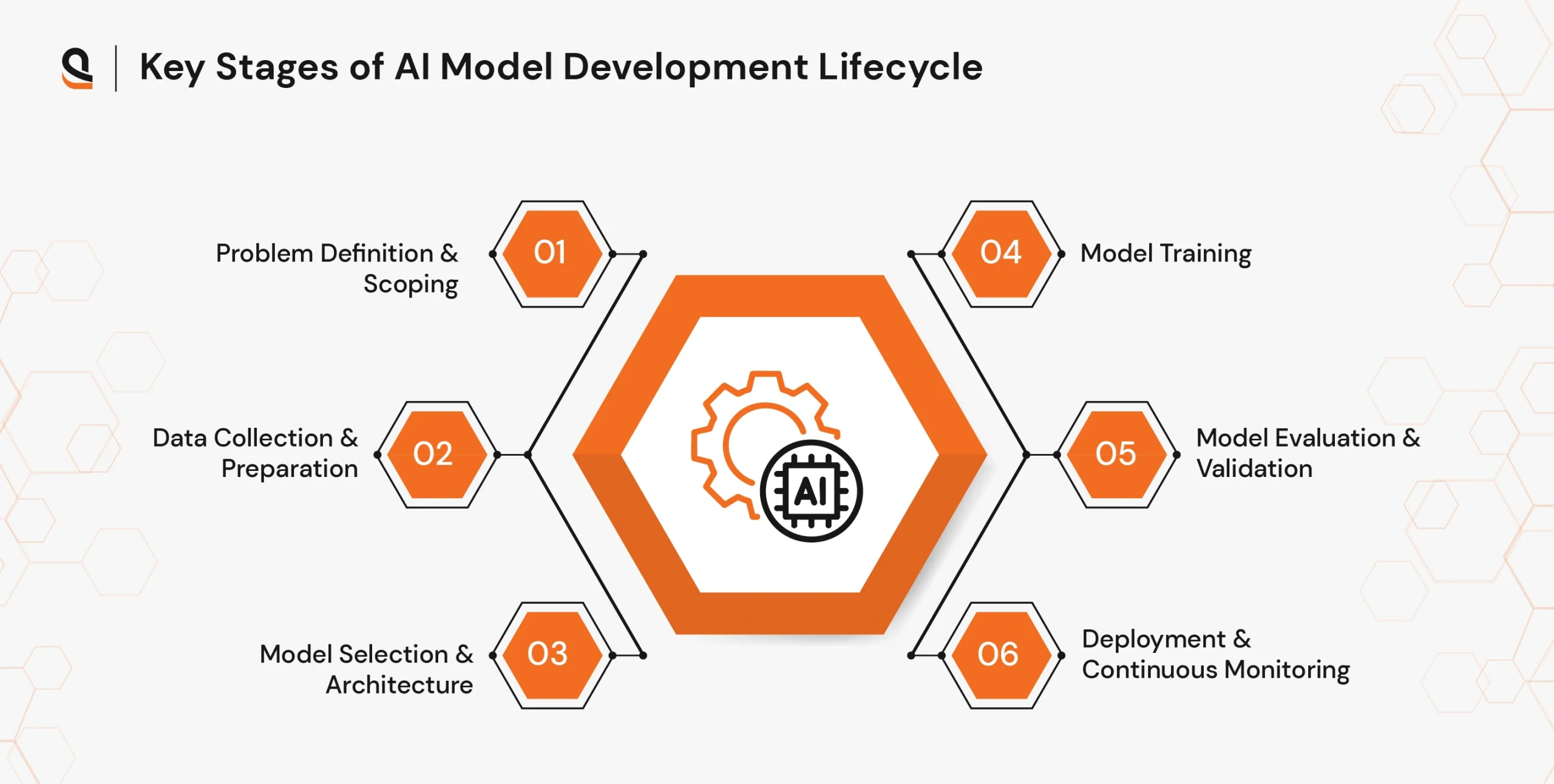
Unlike conventional software development, AI models are built in a continuous approach, involving multiple iterations. Here are all the stages of AI model development that you need to understand if you are building one for your organization.
Phase 1 : Problem Definition and Scoping
The first stage of AI model development is to define the problem that you are solving. For example, if you are to create a generative AI model that can generate text-to-image, you need to define the problem. Interpreting the text and converting it into the exact image a user wants is the problem in this case.
Apart from the problem definition, you need to identify all the relevant stakeholders and align them with the project scope. You need to establish quantifiable metrics that you can measure for AI model effectiveness,l ike,
- Accuracy thresholds
- Performance benchmarks
- Parameters for AI model training
- Data sensitivity (Recall)
- Error rates
- Business impact indicators
Here are some other crucial aspects of this stage that you need to plan,
- Conduct a feasibility assessment by evaluating technical constraints, resource availability, and deciding timelines.
- Create an ethical framework for responsible AI principles that will guide the entire project.
- Review relevant AI and data regulations to implement mechanisms that make sure your model stays compliant.
With all the scope, resource requirements, risk assessment, and stakeholder alignment done, the process of data collection begins.
Phase 2 : Data Collection and Preparation
Data collection is a phase where you gather information that will be used to train the model. This phase encompasses not only the collection of data but also the maintenance of its quality and preparation for training AI models. It is also one of the stages of the AI lifecycle that is repeated multiple times.
With a total of 181 zettabytes of data expected to be generated across industries by the end of 2025, managing and preparing for AI model training can be a significant challenge. This is where you need data analytics consulting services, helping you to plan your data collection, gathering, and preparation optimally.
This phase includes activities like,
- Identifying different sources of data from which you will source the information.
- Designing data architecture that provides for data pipelines, storage solutions, and processing frameworks
- Establish data protection protocols, ensure regulatory compliance, and manage identity and access controls.
- A framework to process raw data into structured information used for training and AI model development.
- Implementing the data collection mechanisms that ensure a better quality of information.
Phase 3 : Model Selection and Architecture
At this stage, the focus shifts from data to the AI model itself, involving the selection of the right algorithms and designing an architecture that matches the problem scope.
Here’s what happens:
- Algorithm Selection: Decide whether your use case requires supervised, unsupervised, reinforcement, or deep learning. For example, if your use case involves agentic AI in healthcare, you may need to choose a multimodal algorithm.
- Framework & Tools: Select development frameworks and infrastructure.
- Architecture Design: Define the neural network structure, layer configurations, and hyperparameters.
- Scalability Planning: Ensure the architecture can handle future data growth and evolving business needs.
- Baseline Modelling: Build an initial version (baseline model) to benchmark against established metrics.
This phase sets the blueprint for how your AI will function. The goal is to strike a balance between performance, scalability, and compliance, while minimizing unnecessary complexity.
Phase 4: Model Training
Once the architecture is in place, the real work begins, which is training your AI model using the prepared datasets. This is where the system starts to learn patterns, relationships, and representations from the data.
Key aspects of this phase include:
- Data Splitting: Dividing datasets into training, validation, and testing sets.
- Hyperparameter Tuning: Optimizing learning rates, batch sizes, and other parameters for better outcomes.
- Iterative Training: Running multiple training cycles to improve accuracy while minimizing overfitting.
- Resource Management: Leveraging GPUs/TPUs and cloud infrastructure for large-scale training.
- Ethical Guardrails: Monitoring for bias or skewed data distributions to maintain fairness.
The outcome of this phase is a trained model that performs on sample data—but it still needs to be rigorously evaluated before real-world deployment.
Phase 5: Model Evaluation and Validation
Model evaluation ensures that the AI performs not only on test datasets but also under real-world conditions. At this stage, you’re validating whether the model truly solves the problem defined in Phase 1.
Evaluation involves:
- Performance Testing: Measuring accuracy, recall, precision, F1-score, and other metrics.
- Stress Testing: Checking performance under extreme data variations or adversarial inputs.
- Bias & Fairness Audits: Identifying if the model disproportionately favors or penalizes certain groups.
- Business Alignment: Validating that outcomes translate into measurable business impact.
- User Acceptance Testing (UAT): Gathering stakeholder feedback to refine usability and trust.
If the model underperforms, adjustments are made either by retraining with better data, tweaking hyperparameters, or even rethinking architecture choices. Once validated, the model is ready to move into production.
Phase 6: Deployment and Continuous Monitoring
Deployment refers to the process by which the AI model transitions from the lab to the real-world environment. But unlike traditional software, deployment isn’t the end—it’s the beginning of continuous monitoring and improvement.
Critical tasks in this phase include:
- Integration: Embedding the AI model into business workflows, apps, or customer-facing platforms.
- Scalability: Ensuring the model handles live data streams and large-scale usage without performance drops.
- Monitoring: Tracking drift in data or predictions to maintain accuracy over time.
- Feedback Loops: Collecting user interactions to improve the model in future iterations.
- Governance & Compliance: Ongoing adherence to regulatory standards and internal AI policies.
The cycle doesn’t end here. AI software development is iterative by nature, meaning organizations must continually retrain and refine models to keep pace with evolving data, changing business needs, and shifting ethical expectations.
While understanding the technical stages of AI model development is critical, success doesn’t depend on development alone. Without structured planning, stakeholder coordination, and iterative oversight, even the most advanced AI models can fail to deliver business impact.
This is where AI Project Cycle Management comes in, a framework that ensures your AI initiatives are not just technically sound but also strategically aligned with enterprise goals.

What is AI Project Cycle Management?
AI project cycle management (AI-PCM) is a structured and systematic process for developing, deploying, and maintaining AI-based solutions. This includes everything, from the identification of the initial problem to building an AI solution, to training, monitoring, and refinements.
While the machine learning lifecycle focuses on the technical development of models, project cycle management emphasizes the organizational, operational, and strategic aspects, ensuring AI solutions deliver sustainable business value.
Why Does AI Project Cycle Management Matter?
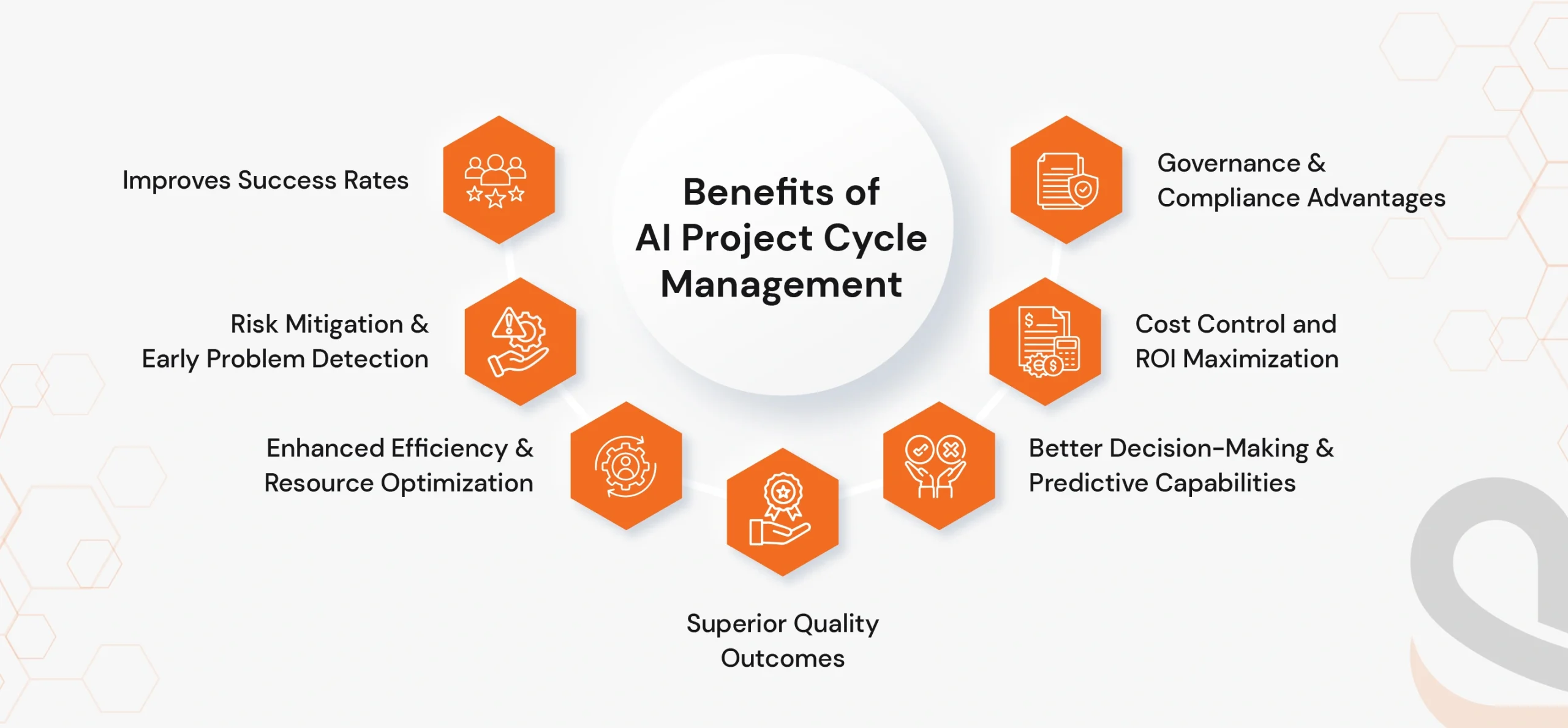
A study by Rand.org found that 80% of all AI projects fail. This is why you need effective AI project lifecycle management to ensure you get the desired outcome and enhanced ROI. AI project cycle management has become increasingly critical for organizational success as artificial intelligence initiatives become more complex and have a greater business impact.
Dramatically Improves Success Rates
The structured approach of the AI project cycle management significantly increases the likelihood of project success. By ensuring each necessary step in AI solution development is followed systematically, organizations avoid common pitfalls that lead to failed implementations.
The methodology provides clear checkpoints and validation stages that catch issues before they become costly problems.
Risk Mitigation and Early Problem Detection
One of the most compelling reasons for implementing AI project cycle management is its ability to identify and mitigate risks early in the development process. For example, during the problem definition phase, unclear objectives can derail entire projects.
A structured lifecycle flags these issues upfront, allowing teams to refocus and avoid expensive revisions later.
The approach also addresses AI-specific risks like:
- Data quality issues that can compromise model performance
- Model bias that could lead to compliance violations
- Technical drift that degrades solution effectiveness over time
Enhanced Efficiency and Resource Optimization
AI project cycle management streamlines workflows and clarifies team responsibilities at each development stage. This structured approach delivers several efficiency benefits:
- Automated task management reduces administrative overhead
- Optimized resource allocation based on project requirements and team capabilities
- Faster innovation cycles through clear handoffs between development and operations teams
- Reduced time-to-deployment by eliminating workflow bottlenecks
Superior Quality Outcomes
The rigorous evaluation and refinement processes built into AI project lifecycles enhance the quality of final solutions. By enforcing thoroughness at each stage, organizations ensure their AI systems perform as expected and require fewer resources for ongoing maintenance and retraining.
Better Decision-Making and Predictive Capabilities
AI project management enables data-driven decision-making through advanced analytics and pattern recognition. Teams can analyze large volumes of project data to identify trends, predict potential obstacles, and make informed strategic adjustments. This predictive capability allows managers to anticipate delays, resource constraints, or technical challenges before they impact project timelines.
Cost Control and ROI Maximization
Implementing structured AI project cycles helps organizations maximize return on investment by avoiding dead-end proof-of-concepts and minimizing model downtime. The approach enables:
- More predictable project timelines and budgets
- Reduced waste through early validation and testing
- Better resource utilization across project phases
- Enhanced operational efficiency through process automation
Governance and Compliance Advantages
For enterprises, AI project cycle management provides built-in checkpoints for security, fairness, and explainability. Especially if you are in a business in a highly regulated industry like healthcare you need a reliable ML development partner. The best approach is to leverage custom healthcare software development services with AI expertise.
Structured governance ensures that models comply with internal policies and external regulatory requirements, which are becoming increasingly important as AI regulations evolve globally.
The systematic approach also supports stronger institutional knowledge through documented processes, automated meeting transcription, and centralized project tracking. However, you will need a perfect blend of tools and technologies to optimize the machine learning model lifecycle.
What Are The Tools & Technologies Used for ML Lifecycle Management?
You know the tools, the importance of machine learning lifecycle management, and the key stages; now is the time for execution.
How AQe Digital Can Help You Manage Deployment & Model Lifecycle Management?
At AQe Digital, we transform the 80% AI project failure rate into measurable business outcomes through proven ML lifecycle management. Our end-to-end machine learning development services cover every phase from strategic problem definition to production deployment and continuous monitoring.
Our Core Capabilities-
- Strategic AI Planning – Custom lifecycle frameworks aligned with your business objectives and technical constraints
- Technical Implementation – Expert deployment across AWS SageMaker, Google Vertex AI, and Azure ML platforms with MLOps best practices
- Production Excellence – Comprehensive monitoring, drift detection, and model retraining using industry-leading tools like MLflow, Kubeflow, and Evidently
- Enterprise Governance – Built-in compliance frameworks ensuring ethical AI practices and regulatory adherence
From proof-of-concept to enterprise-scale deployment, we ensure your AI initiatives deliver sustainable business value through structured lifecycle management. So if you are looking to transform your ML strategy, contact AQe Digital today.
FAQs
The machine learning lifecycle is a structured, iterative process for developing, deploying, and maintaining ML models through continuous experimentation. Unlike traditional software development's linear, code-driven approach, ML lifecycle is cyclical with data as the core asset, focusing on probabilistic outcomes rather than deterministic logic, and requiring continuous model retraining instead of version-based releases.
The six phases are: Problem Definition and Scoping, Data Collection and Preparation, Model Selection and Architecture, Model Training, Model Evaluation and Validation, and Deployment and Continuous Monitoring. Each phase includes feedback loops ensuring optimal performance through iterative refinement.
AI projects fail due to poor execution, unclear objectives, data quality issues, and lack of continuous monitoring rather than technical limitations. AI project cycle management provides structured frameworks with clear checkpoints, early risk detection, and validation stages that catch issues before they become costly problems.
Essential tools include MLflow and Weights & Biases for experiment tracking, DVC for data management, Kubeflow for pipeline orchestration, TensorFlow Serving for model deployment, AWS SageMaker/Google Vertex AI for cloud platforms, and Evidently for monitoring data drift. These enable version control, reproducibility, scalable deployment, and continuous performance tracking.
AI models are programs that analyze data to identify patterns using algorithms that replicate human intelligence, while ML models specifically train machines to learn and optimize without human intervention. All ML models are AI models, but not all AI models use machine learning—for example, rule-based chatbots are AI but not ML.