Machine Learning in Finance: Use Cases, Implementation Challenges & Business Value

Cheta Pandya
inancial businesses have access to more data than most industries, but having massive datasets does not automatically produce better financial decisions.
Every transaction, payment, loan application, customer interaction, market movement, and account activity creates valuable information that can reveal patterns about risk, behavior, and opportunity.
The competitive advantage comes from identifying those patterns quickly enough to improve decisions, reduce losses, and create better experiences for customers.
That is where machine learning is changing financial services.
Banks, fintech companies, lenders, insurers, investment firms, and other financial organizations are using machine learning to detect suspicious activity, assess creditworthiness, forecast financial outcomes, personalize services, automate decisions, and strengthen risk management.
Data quality, legacy infrastructure, explainability, cybersecurity, regulatory expectations, model drift, and governance can determine whether an initiative produces measurable value or becomes another expensive technology experiment.
The Bank for International Settlements reports that surveys indicate around 70% of financial services firms are using AI for applications including cash-flow prediction, liquidity management, credit scoring, and fraud detection.
What Is Machine Learning in Finance?
Machine learning in finance refers to using algorithms that learn patterns from historical and continuously generated data to produce predictions, classifications, recommendations, or automated decisions.
Traditional financial software generally depends on predefined rules that tell a system what action to take when specific conditions occur.
For example, a traditional fraud system might trigger a review whenever a transaction exceeds a predetermined amount or occurs from an unusual location.
A machine learning model can evaluate many variables simultaneously and identify combinations of behaviors that may indicate unusual activity, even when those patterns were not explicitly programmed beforehand.
Why Financial Businesses Are Investing in Machine Learning
Financial organizations operate in an environment where relatively small improvements can create significant commercial consequences when applied across millions of transactions or customer relationships.
A more effective fraud model can reduce financial losses, while a better credit model can improve portfolio quality and accelerate lending decisions.
Similarly, more accurate forecasting can strengthen liquidity planning, while automation can reduce repetitive operational work across high-volume processes.
The Bigger Opportunity
The biggest opportunity is not simply automating tasks that employees currently perform manually. It is creating a stronger decision-making layer across processes that depend on large volumes of financial data.
A human analyst can investigate a limited number of cases in detail, while a machine learning system can evaluate thousands or millions of transactions, accounts, or financial signals and prioritize the cases requiring attention.
Why Now?
Financial businesses already possess much of the raw material required for machine learning, including transaction histories, customer records, payment behavior, market data, financial outcomes, and digital interaction data.
Cloud infrastructure and modern data platforms have also made it easier to build, train, deploy, and monitor models without maintaining every component internally.
The technology has therefore moved from an experimental capability toward a practical business tool.
7 Major Machine Learning Use Cases in Finance
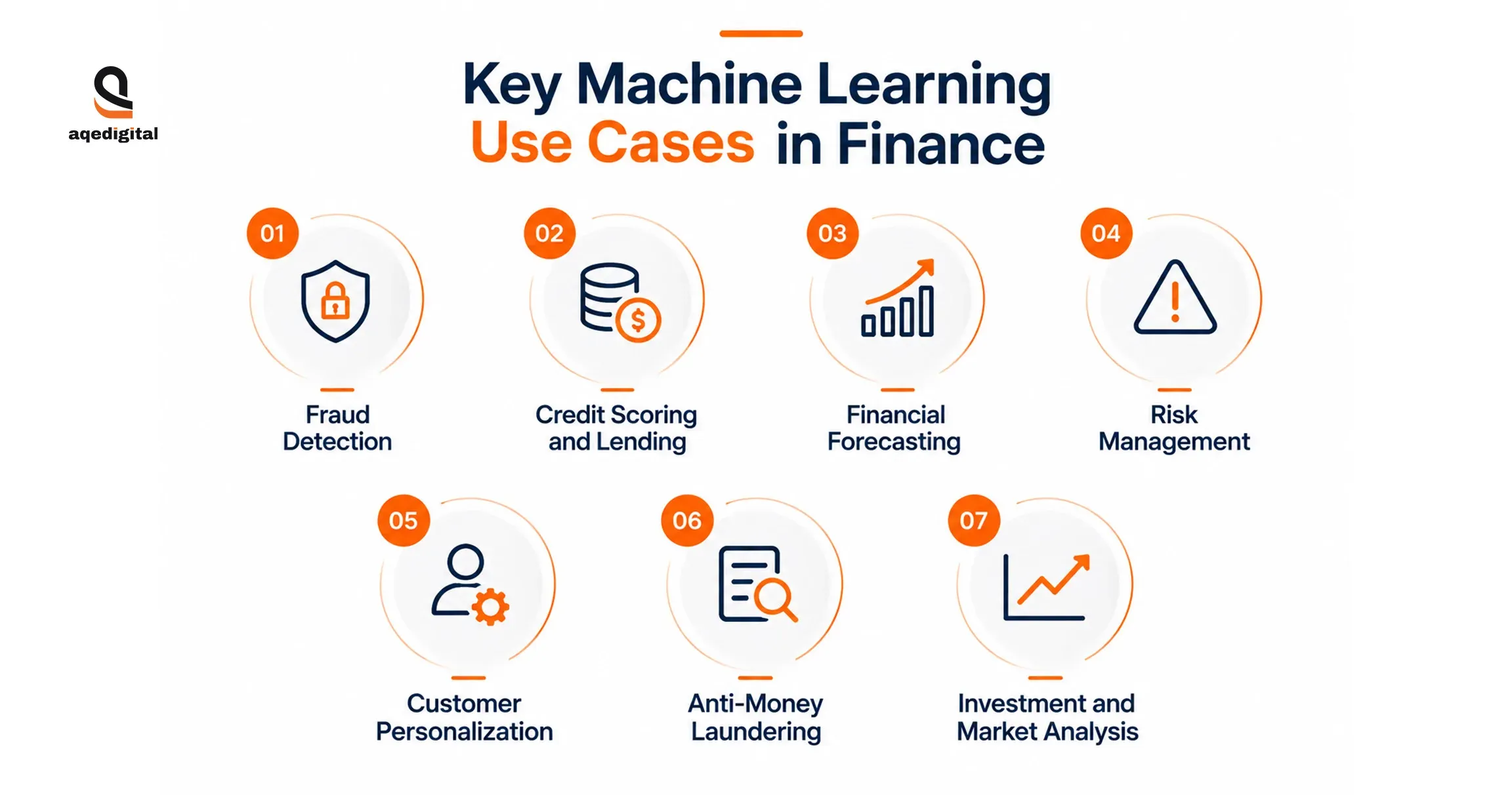
Machine learning is not a universal solution that produces the same benefits across every financial process.
The value depends on matching the appropriate model, data, and implementation approach to a clearly defined business decision.
1. Fraud Detection
Fraud rarely follows one predictable pattern.
Fraudsters change transaction amounts, locations, devices, timing, merchants, and account behavior to avoid simple rules.
This makes machine learning fraud detection particularly valuable because models can evaluate multiple behavioral signals together and identify anomalies that may not be obvious through static rules.
A fraud model can consider variables such as:
- Transaction amount
- Transaction frequency
- Device information
- Geographic location
- Customer behavior
- Merchant patterns
- Login activity
- Historical transaction behavior
Effective machine learning fraud detection can also reduce false positives, allowing legitimate transactions to move through the system with less unnecessary friction.
2. Credit Scoring and Lending
Lending decisions require financial organizations to estimate the likelihood that a borrower will meet their repayment obligations.
Traditional credit scoring typically relies on structured information such as credit history, income, existing debt, repayment records, and other established financial indicators.
Machine learning can identify more complex relationships between variables and, where legally permitted and appropriate, incorporate additional data sources that may provide useful signals about credit risk.
This is where machine learning credit scoring can create meaningful value for lenders.
A well-designed machine learning credit scoring system can help lenders:
- Improve borrower risk segmentation
- Automate preliminary assessments
- Accelerate lending decisions
- Identify potentially underserved customers
- Detect complex relationships between financial variables
- Support ongoing portfolio risk management
However, credit models require particularly strong governance.
A model that predicts default accurately but cannot be appropriately explained, monitored, validated, and governed may create unacceptable business or regulatory risk.
3. Financial Forecasting
Financial forecasting is another natural application because businesses continuously generate historical data.
Revenue, expenses, cash flow, customer payments, defaults, deposits, and market variables can all provide signals for predictive models.
Machine learning for financial forecasting can help organizations identify patterns that traditional forecasting methods may not capture effectively.
Potential applications include:
- Cash-flow forecasting
- Revenue forecasting
- Liquidity planning
- Demand forecasting
- Expense prediction
- Default forecasting
- Portfolio projections
The goal of machine learning for financial forecasting is not to predict the future perfectly.
It is to improve decision quality by producing forecasts that can be updated as new information becomes available.
A forecasting system should therefore be designed to continuously evaluate its own performance rather than treating historical patterns as permanent truths.
4. Risk Management
Financial organizations face multiple forms of risk, including credit risk, market risk, liquidity risk, operational risk, fraud risk, and compliance risk.
Machine learning can help risk teams identify patterns, prioritize cases, and generate predictive signals from large datasets that would be difficult to evaluate manually.
For example, a model can identify accounts showing early indicators of financial stress before those customers reach an established risk threshold.
This creates an opportunity for earlier intervention because teams can investigate emerging problems before they become more expensive or difficult to manage.
The value is therefore not limited to identifying existing risk. It can also help organizations become more proactive in managing potential future exposure.
5. Customer Personalization
Financial customers increasingly interact with organizations through mobile applications, websites, digital payment platforms, chat interfaces, and online banking systems.
Machine learning can analyze these interactions to identify customer preferences, behaviors, and patterns that can support more relevant experiences.
Potential applications include:
- Personalized financial product recommendations
- Customer segmentation
- Churn prediction
- Next-best-action recommendations
- Personalized offers
- Spending insights
Effective personalization should help organizations present relevant services at appropriate moments while making the customer's financial experience more useful and convenient.
6. Anti-Money Laundering and Suspicious Activity Detection
Financial institutions process enormous volumes of transactions every day, making comprehensive manual monitoring practically impossible.
Machine learning can help identify unusual transaction networks, behavioral patterns, and combinations of signals that may require further investigation by compliance professionals.
Instead of treating every alert with equal priority, organizations can use predictive systems to help investigators focus their attention on cases that appear more significant.
7. Investment and Market Analysis
Machine learning can process large amounts of structured and unstructured information to identify patterns that may support investment research and portfolio management.
Potential applications include:
- Market trend analysis
- Portfolio risk assessment
- Sentiment analysis
- Pattern recognition
- Asset allocation support
- Trading signal generation
However, predictive analysis should not be confused with guaranteed investment performance.
The International Monetary Fund has highlighted potential benefits from AI in capital markets while also identifying concerns related to opacity, volatility, cybersecurity, and concentration risks.

Machine Learning in Banking vs. Fintech
Machine learning in banking and machine learning in fintech often involve similar technologies but different operating environments.
Banks typically have decades of historical customer data, established regulatory frameworks, complex core banking systems, and large existing customer bases.
Fintech companies may have newer architectures, more digitally native customer journeys, and greater flexibility to experiment quickly.
| Machine Learning in Banking vs. Fintech | ||
|---|---|---|
| Area | Traditional Banking | Fintech |
| Data | Large historical datasets | Often highly digital and real-time |
| Infrastructure | Legacy + modern systems | Usually cloud-native |
| Innovation speed | More governance constraints | Often faster experimentation |
| Primary challenge | Integration and modernization | Scaling and governance |
| ML opportunity | Modernize established processes | Build ML into digital products |
The Common Ground
Both sectors are moving toward predictive decision-making.
Machine learning in banking is increasingly being applied to fraud detection, credit decisions, customer analytics, risk management, and forecasting.
At the same time, machine learning in fintech can become part of the product itself.
A fintech lending platform, for example, may use machine learning throughout application processing, risk assessment, pricing, monitoring, and customer engagement.
The Business Value of Machine Learning in Finance
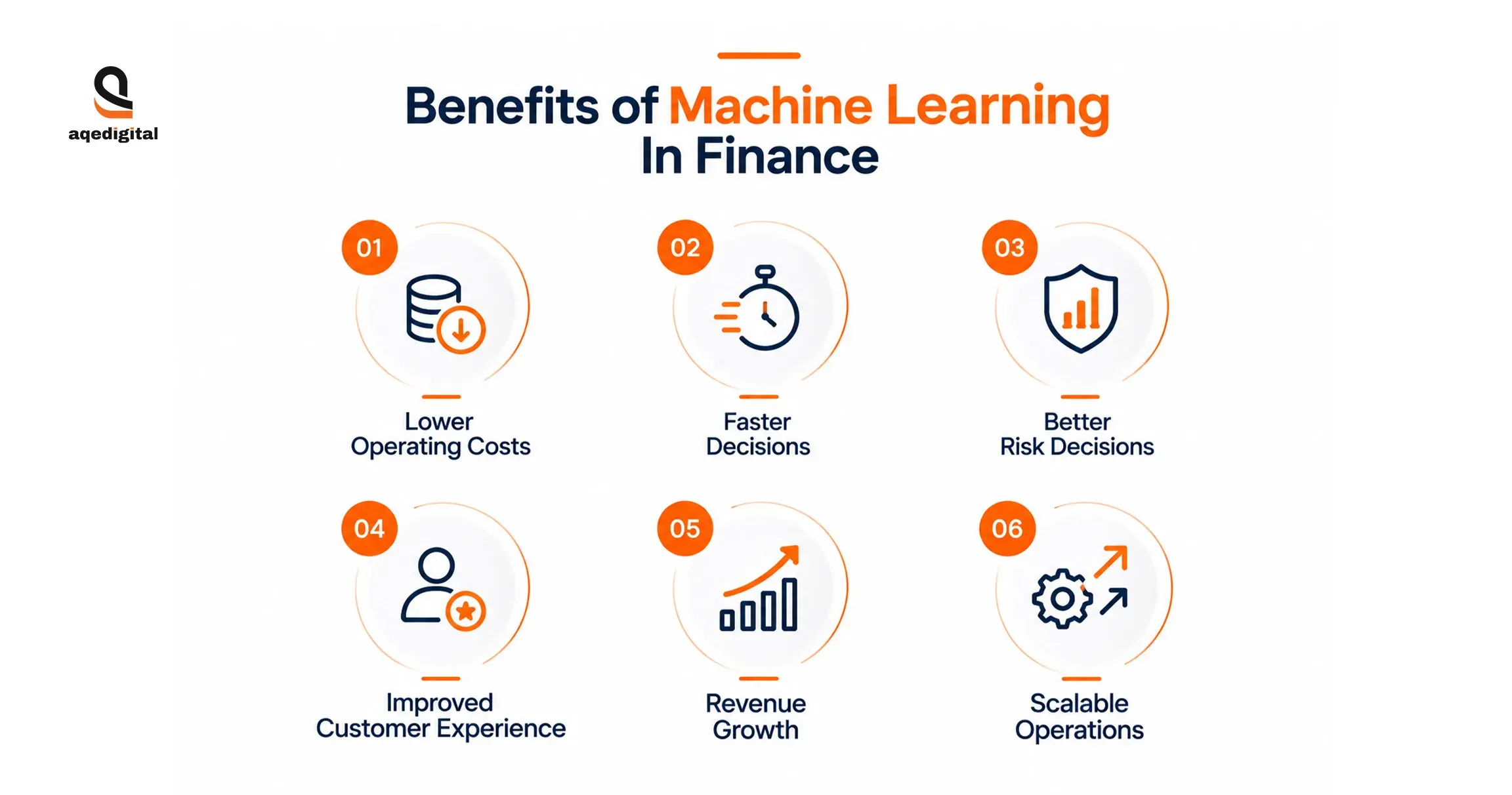
A machine learning initiative should ultimately be connected to measurable business outcomes rather than being evaluated only on technical sophistication.
Machine learning creates value when it improves a financial process in a way the business can quantify.
Lower Operating Costs
Automation can reduce manual review, repetitive data processing, and administrative work.
The value is especially strong where employees repeatedly perform similar tasks across large transaction volumes.
Faster Decisions
Loan applications, fraud alerts, customer requests, and financial forecasts can often be processed faster with automated models.
Speed can directly affect customer acquisition and satisfaction.
Better Risk Decisions
More sophisticated pattern recognition can help identify risks earlier.
That can support better credit decisions, fraud prevention, and portfolio monitoring.
Improved Customer Experience
Customers increasingly expect financial services to be fast and digital.
A system that verifies transactions quickly or provides an immediate lending decision can reduce friction.
Revenue Growth
Better customer segmentation and personalization can help financial institutions identify relevant cross-selling and retention opportunities.
Scalable Operations
Perhaps the most important long-term benefit is scalability because human teams cannot increase their analytical capacity indefinitely without increasing headcount.
A properly designed machine learning system can process substantially larger data volumes without requiring a proportional increase in manual effort.
How to Implement Machine Learning in Finance Successfully
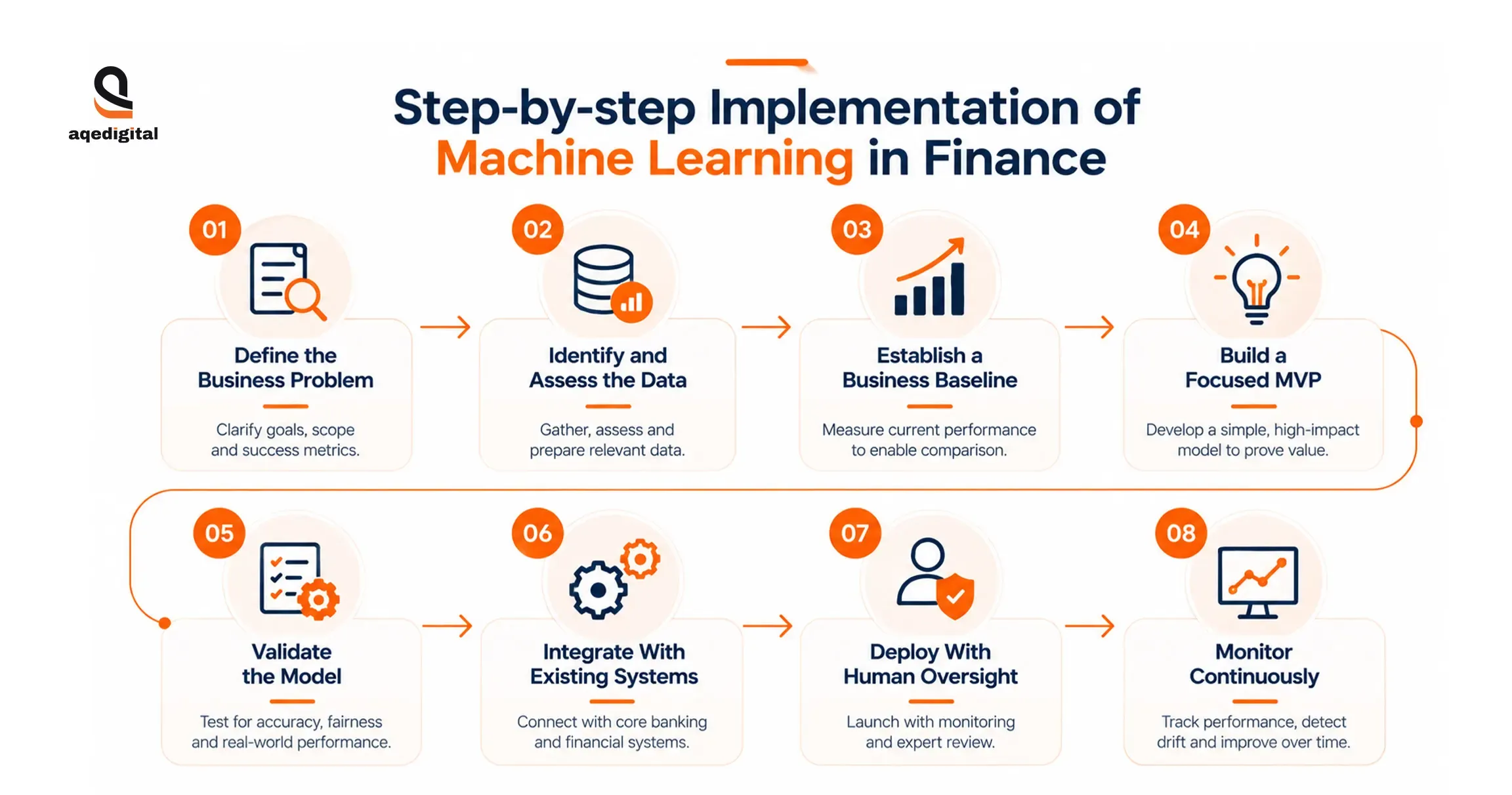
A practical implementation should move from a clearly defined business problem toward production through controlled stages rather than attempting a large-scale transformation immediately.
Step 1: Define the Business Problem
Do not begin the project by saying that the organization needs machine learning.
Instead, identify the specific process that is creating the highest operational cost, greatest risk, slowest decision-making, or strongest limitation on growth.
For example, the objective could be reducing fraudulent transactions, shortening loan approval times, improving cash-flow forecasting, or reducing manual compliance reviews.
Step 2: Identify and Assess the Data
Map where the relevant information currently exists across databases, ERP systems, transaction platforms, CRM applications, data warehouses, and other business systems.
Determine:
- What data exists?
- Who owns it?
- How accurate is it?
- How frequently is it updated?
- How far back does it go?
- Is it properly labeled?
- Can it legally be used for the intended purpose?
Step 3: Establish a Business Baseline
Before building a model, measure how the existing process performs.
For example:
- Current fraud-loss rate
- False-positive rate
- Average credit decision time
- Forecast error
- Manual processing cost
- Customer conversion rate
Step 4: Build a Focused MVP
The first implementation should solve a clearly defined problem rather than attempting to address every related process.
A focused MVP allows teams to test data quality, model performance, integration requirements, user acceptance, security controls, and business impact before making a larger investment.
This also provides stakeholders with tangible evidence that can guide future investment decisions.
Step 5: Validate the Model
Technical accuracy should be treated as one measurement rather than the complete definition of success.
The model should also be evaluated for:
- Stability
- Bias
- Explainability
- False positives
- False negatives
- Security
- Business impact
- Performance under changing conditions
For high-impact financial applications, validation should also be supported by appropriate documentation and governance processes.
Step 6: Integrate With Existing Systems
A machine learning model operating successfully in a development environment is not yet a business solution.
The model must connect with the systems employees and customers already use, including transaction platforms, payment systems, customer databases, lending applications, case-management tools, or financial planning systems.
Integration should therefore be designed around the actual operational workflow rather than simply exposing the model through an isolated technical endpoint.
Step 7: Deploy With Human Oversight
Not every prediction should automatically trigger a final business decision.
High-risk or ambiguous cases can be routed to qualified human reviewers, creating a practical balance between automation and accountability.
Step 8: Monitor Continuously
Deployment should be treated as the beginning of operational management rather than the end of the machine learning project.
Organizations should monitor model accuracy, data quality, prediction distributions, drift, business KPIs, false-positive rates, customer outcomes, and relevant security events.

Common Mistakes Financial Businesses Should Avoid
Machine learning projects can lose their business value when organizations focus more on technology than execution. Avoiding these common mistakes helps create solutions that are reliable, scalable, and aligned with real financial outcomes.
- Choosing Technology Before Defining the Problem: Selecting advanced models before establishing the business problem, desired outcome, and success criteria can lead to unnecessary complexity.
- Ignoring Data Readiness: Incomplete, inconsistent, or poor-quality financial data can significantly reduce model reliability and limit the value of machine learning investments.
- Treating Accuracy as the Only KPI: Strong model accuracy does not guarantee business impact unless predictions improve financial decisions, operational efficiency, customer outcomes, or risk management.
- Removing Humans Too Early: High-impact or sensitive financial decisions may still require human oversight when models encounter uncertainty, exceptions, or unfamiliar patterns.
- Building Without Production Integration: A successful prototype delivers limited value if it cannot connect with existing applications, workflows, databases, and operational systems.
- Ignoring Governance Until the End: Security, compliance, explainability, documentation, and model governance should be considered from the beginning rather than added just before deployment.
How AQe Digital Can Help Businesses Implement Machine Learning
Successful financial AI initiatives require more than selecting an algorithm or building a predictive model.
AQe Digital can help financial businesses translate machine learning opportunities into practical technology solutions aligned with their operational and commercial objectives.
- AI Consulting: We help financial organizations identify practical AI opportunities, evaluate technical feasibility, and define an implementation roadmap aligned with business goals.
- Machine Learning Development: Our teams develop production-ready machine learning solutions designed around business requirements, financial data, model performance, and operational workflows.
- Data Engineering: We build reliable data pipelines and processing architectures that prepare fragmented, high-volume financial data for analytics, machine learning, and AI applications.
- AI Application Development: AQe Digital develops AI-powered applications that bring predictive intelligence into customer platforms, internal systems, financial workflows, and business operations.
- Enterprise Integration: We integrate AI and machine learning capabilities with existing applications, APIs, databases, cloud environments, and enterprise systems without creating disconnected technology layers.
- AI Modernization: We help organizations modernize legacy applications and technology environments so they can support scalable data, machine learning, and AI capabilities more effectively.
- AI Agents & Automation: We build AI-powered agents and intelligent workflows that can connect with business systems, retrieve information, execute defined tasks, and reduce repetitive operational work.
- Model Deployment & Monitoring: We support the transition from experimentation to production through deployment, performance monitoring, evaluation, model lifecycle management, and continuous improvement.
- Scalable AI Architecture: We design AI foundations that can evolve beyond individual projects, allowing financial organizations to expand successful solutions across departments, workflows, and future AI initiatives.
- Business-Focused AI Implementation: Our approach connects technology decisions with measurable business outcomes, helping organizations move from AI experimentation to solutions that improve efficiency, decision-making, customer experiences, and operational scalability.
Conclusion
The organizations that gain lasting value will be those that connect machine learning with reliable data, existing systems, measurable business priorities, and responsible decision-making. This shift can turn financial data into an operational advantage that strengthens resilience, improves responsiveness, and supports sustainable growth.
AQe Digital helps organizations design, develop, integrate, and scale AI and machine learning solutions built around real business requirements.
For businesses looking to move beyond experimentation, the right technology partner can help translate AI opportunities into scalable solutions. Contact us to build scalable machine learning solutions for your organization.