LLM vs Generative AI in Healthcare: Which One Will Truly Revolutionize Patient Care?

Jigar Mistry

AI in healthcare isn’t science fiction anymore—it’s here, and it’s making a real difference. From summarizing patient records in seconds to generating entire radiology reports, artificial intelligence is rapidly reshaping how care is delivered. But as the tech landscape evolves, a new question has emerged for healthcare professionals and digital leaders – Will Large Language Models (LLMs) or Generative AI lead the charge in truly revolutionizing patient care?
While the terms are often used interchangeably, the distinction matters—especially when you’re making technology decisions that impact real lives. According to a 2024 McKinsey report, 88% of healthcare executives recognize AI’s high potential impact, yet about 20% do not plan to invest in AI over the next two years, highlighting a significant gap between acknowledgment and action.
At this crossroads of digital transformation, healthcare providers need more than just AI—they need the right kind of AI tailored to clinical, operational, and patient-centric goals. Further in this article, let us understand the difference between LLMs and Generative AI in plain terms, while exploring which has the real potential to redefine patient care as we know it. If you’re planning your next step in AI adoption, this is where clarity begins.
What Is Generative AI? (And Why Should Healthcare Care?)
Generative AI refers to a type of artificial intelligence that can create new content. That could be text (like discharge summaries), images (like medical scans), audio (like voice assistants), and even synthetic patient data that mimics real-world health scenarios.
Think of it as a super-smart creative partner—one that’s trained on massive amounts of data and knows how to generate useful, context-aware information on demand.
Unlike traditional AI, which typically follows set rules or just classifies data, generative AI in healthcare goes a step further: it can generate entirely new insights or outputs. That’s huge.
Applications of Generative AI In Modern Healthcare
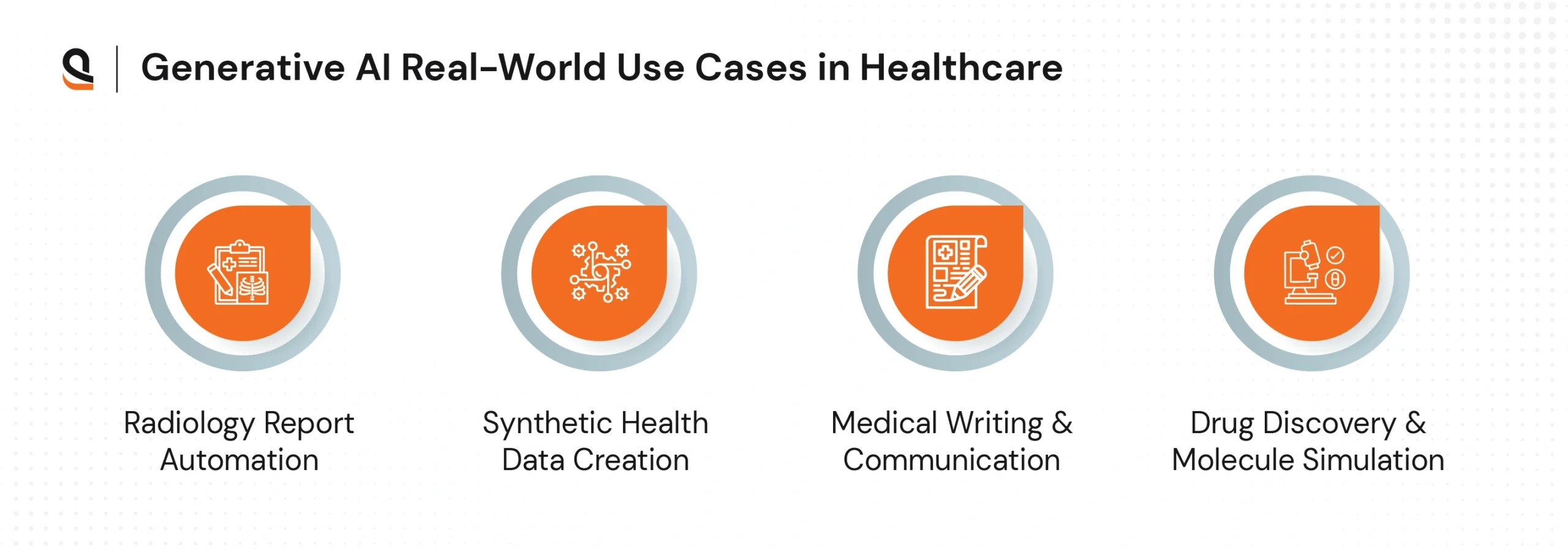
- Radiology report automation: AI models generate high-quality reports from imaging data, helping radiologists work faster and reduce backlogs.
- Synthetic health data creation: Great for training AI tools without risking patient privacy.
- Medical writing & communication: From automated discharge instructions to multilingual patient education materials.
- Drug discovery & molecule simulation: Generative AI can even suggest new compounds for testing.
If it sounds revolutionary, it is! And it’s not hype. This is real, and has a tangible impact.
So, if you’re leading a healthcare practice, hospital, or healthtech product team, generative AI isn’t just “cool tech”—it’s a strategic asset.
Whether you’re trying to streamline documentation, enhance patient engagement, or build smarter digital tools, Generative AI use cases in healthcare are no longer experimental—they’re essential.
And here’s a subtle truth: LLMs vs Generative AI isn’t really a competition. They often work hand-in-hand. But knowing what each does best helps you choose the right tools for your goals.
What Are LLMs (Large Language Models)?
A Large Language Model is a type of AI trained on billions of words—from books, medical journals, clinical notes, patient conversations, and more. Its job? To learn the intricacies of language so it can interpret, generate, and even predict what you might say next.
You’ve probably heard of ChatGPT, Google’s Med-PaLM, or even Microsoft’s Copilot. These tools don’t just talk like humans—they understand like them, too. That’s the magic of LLMs, or Large Language Models.
But here’s where it gets powerful for healthcare: LLMs can “read” and “write” like a medical professional, at scale.
They can sift through electronic health records, summarize long patient histories, draft SOAP notes, or help decode complex clinical guidelines into plain-language summaries.
If Generative AI is the big picture, then LLMs in healthcare are the zoomed-in specialists who understand your language—whether it’s physician shorthand or patient-friendly explanations.
How Large Language Models Are Powering Smarter Healthcare Today
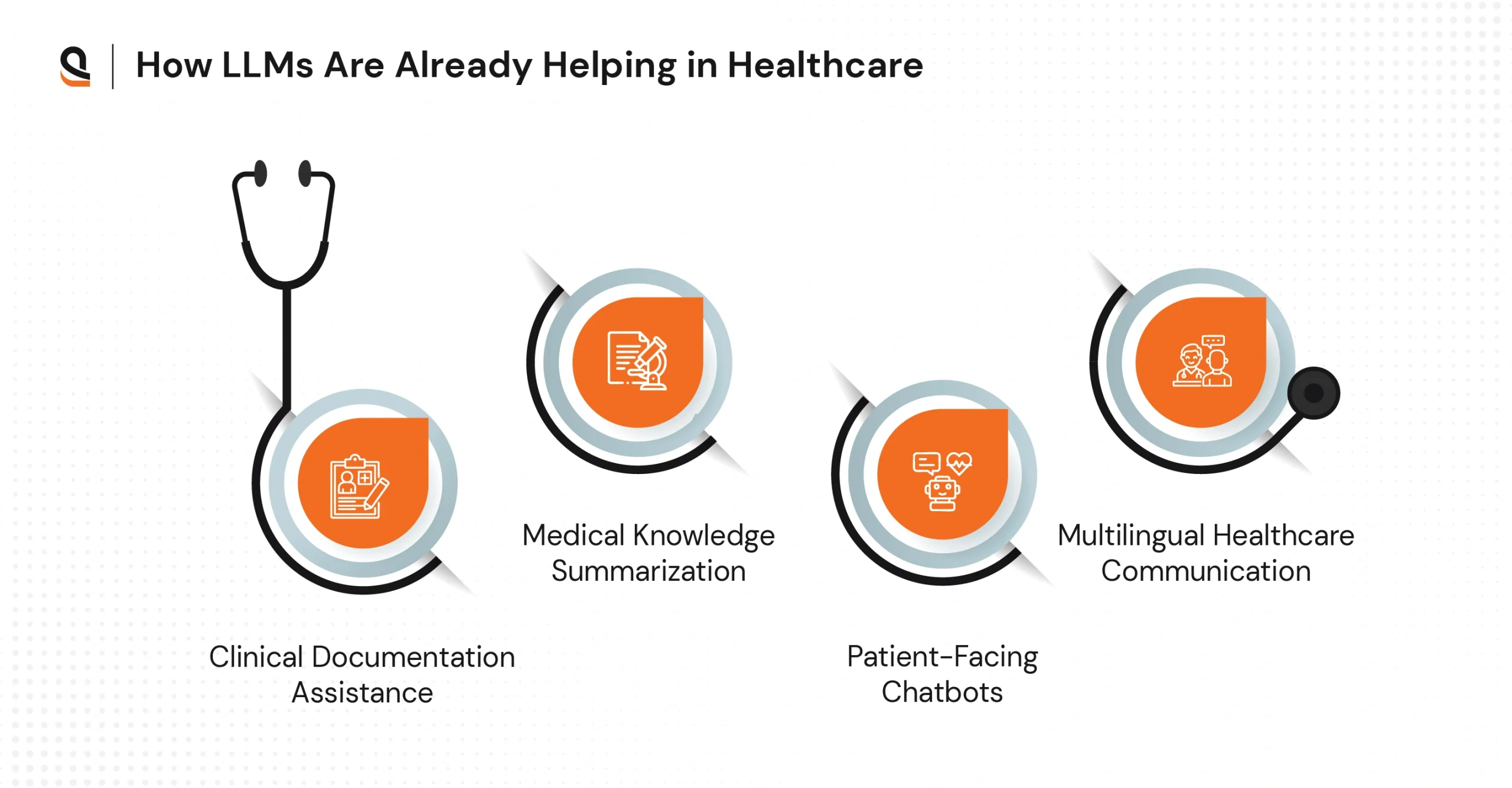
Clinical documentation assistance: Doctors can now dictate notes, and LLMs format them into structured records—accurate, fast, and compliant.
Medical knowledge summarization: From peer-reviewed studies to patient instructions, LLMs turn dense content into usable insights.
Patient-facing chatbots: Need a symptom checker, pre-op FAQ bot, or post-discharge assistant? LLMs make it feel personal, without the long hold times.
Multilingual healthcare communication: LLMs bridge language gaps, translating complex diagnoses or treatment plans in seconds.
Where LLMs Shine (and Why They’re a Big Deal)
The power of GenAI vs LLM conversations is realizing where each truly shines. LLMs are your go-to for:
- Anything text-based
- Understanding natural language
- Clinical workflows that demand speed + clarity
- Enhancing how patients and clinicians communicate
LLM vs Generative AI: Choosing the Right Tool for Healthcare Transformation
Now that we’ve unpacked what each technology does, it’s time to address the big question:
When it comes to transforming healthcare, Generative AI vs LLMs—which one truly leads the charge?
Here’s the real talk: it’s not about who wins. It’s about knowing where each shines, so you can use both smartly to elevate patient care. Let’s break it down in a way that actually makes sense.
LLM vs Generative AI: Think Specialization vs Scope
Large Language Models (LLMs) specialize in working with language. They’re laser-focused on understanding, generating, and interacting through text. This makes them incredibly useful for things like clinical documentation, patient communication, and medical literature analysis.
Generative AI, on the other hand, is the broader category. It includes LLMs but goes beyond just words—it can create images, audio, video, and even simulate physical phenomena like disease progression or surgical procedures.
While all LLMs are a form of Generative AI, not all Generative AI is an LLM.
If your goal is to improve AI in patient care through communication, summarization, and clinical documentation, LLMs in healthcare offer a clear path forward.
But if you’re innovating around diagnostics, visual simulations, or drug development, Generative AI use cases in healthcare will unlock next-level capabilities.
Interestingly, you don’t have to pick one over the other. In fact, some of the most promising healthcare software development services providers combine LLMs with Generative AI for powerful outcomes.
- Imagine a diagnostic tool where an LLM explains an AI-generated image to a doctor in real-time.
- Or a patient app where synthetic medical data is used to simulate possible outcomes—while an LLM guides the patient through what it means, in plain language.
So, GenAI vs LLM synergy in action. Not competition—collaboration.
Whether you’re an executive planning your next digital transformation project or a clinical team exploring automation tools, understanding the difference between LLM vs Generative AI can help you:
- Make smarter tech investments
- Choose solutions that match your clinical and operational needs
- Reduce risk and boost ROI with AI that’s actually relevant
Both technologies are shaping the future of healthcare. The smart move is knowing how and when to use each.
Generative AI in Healthcare: Game-Changing Use Cases
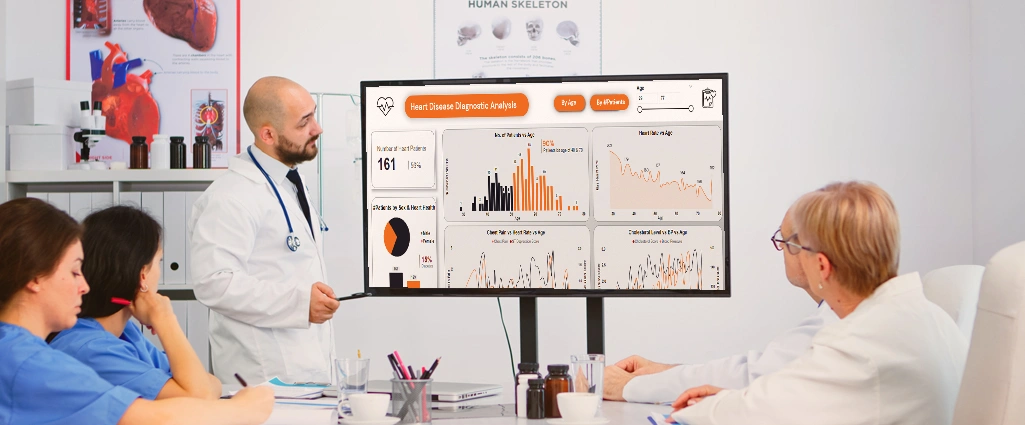
Generative AI is redefining what’s possible in modern healthcare, moving beyond conceptual promise to deliver measurable, real-world impact. Here’s a look at key applications where this technology is already transforming care delivery, operations, and innovation.
Automated Clinical Documentation – Generative AI, often powered by LLMs in healthcare, streamlines medical documentation by converting voice notes and EHR data into structured summaries, progress notes, and discharge instructions.
Synthetic Data for Research & Model Training – To overcome data scarcity and protect healthcare data privacy, generative AI in healthcare generates high-fidelity synthetic datasets that replicate real patient data without introducing compliance risks.
Medical Imaging Simulation & Enhancement – Generative models are being used to reconstruct low-quality or missing scans, simulate disease progression, and support diagnostic workflows—far beyond the capabilities of traditional imaging tools.
Patient Education & Communication – By generating multilingual, personalized educational content, generative AI improves patient comprehension and engagement, while LLMs support conversational interfaces for self-service support.
Drug Discovery & Molecular Research – Generative AI accelerates compound discovery, molecular modeling, and early clinical trial simulations.
LLMs in Healthcare: Important Use Cases
Large Language Models (LLMs) are becoming indispensable tools in healthcare, not by replacing clinicians, but by enhancing how they deliver care. From administrative support to direct patient interaction, LLMs are transforming patient care experiences at every touchpoint.
Clinical Note Generation & Workflow Automation – LLMs streamline administrative tasks by drafting SOAP notes, intake forms, referral letters, and more—based on voice inputs or structured data.
Decision Support & Medical Summarization – By synthesizing vast volumes of clinical guidelines, journal publications, and EHR data, LLMs provide real-time, evidence-based support at the point of care.
Patient-Facing Conversational AI – LLM-powered chatbots and virtual assistants enhance accessibility by delivering accurate, empathetic, and personalized responses to patient queries.
Multilingual Translation & Health Literacy Support – LLMs break down language and literacy barriers by converting complex medical content into simplified explanations across multiple languages.
Clinical Research Support & Literature Review – LLMs can rapidly scan and summarize thousands of research papers, helping healthcare professionals and researchers stay current and focused on application.
Get Advancing AI in Patient Care with Us
As healthcare rapidly embraces AI to improve outcomes, streamline operations, and personalize care, our team remains committed to supporting this evolution with solutions grounded in both technical depth and real-world clinical understanding.
We work closely with healthcare providers, digital health startups, and enterprise platforms to design and implement AI-powered systems that are secure, scalable, and aligned with regulatory standards.
What We Offer
- From fine-tuning LLMs for healthcare workflows to integrating generative AI models into patient-facing tools, we help organizations deploy AI where it matters most.
- We build applications that prioritize data protection—an essential in every healthcare innovation. Our approach ensures HIPAA compliance and patient trust from day one.
- Our solutions are built to support AI in diagnostics, treatment recommendations, medical summarization, and AI-driven patient engagement, enabling clients to unlock measurable value from day one.
Wrapping Up
As both the technologies evolve, their combined potential to improve diagnostics, streamline operations, and personalize patient care is becoming clearer and more actionable.
As a go-to digital transformation partner, we don’t just build digital products, we co-create solutions that are thoughtful, scalable, and deeply aligned with the needs of real-world healthcare. Whether you’re exploring AI in patient care, implementing generative AI use cases, or navigating how LLMs in healthcare can support your teams, our role is to bridge innovation with execution—clearly, responsibly, and strategically.
We’re here to support healthcare organizations at every stage of the journey—from ideation to integration—so they can deliver better outcomes and more human-centered experiences with the help of intelligent technology.
