Legacy Software Modernization: How to Modernize Without Rewriting Everything

Joy Chauhan
Legacy software rarely becomes a business problem overnight. It usually becomes difficult gradually, as aging architecture, fragile integrations, rising maintenance costs, and changing customer expectations begin limiting what the business can do.
That is why legacy system modernization should not automatically mean replacing an entire application. In many organizations, the better approach is to preserve valuable business logic while progressively improving the architecture, infrastructure, integrations, and development processes around it.
Legacy modernization is no longer limited to organizations dealing with failing or unsupported applications. Forrester's 2026 Enterprise Applications Software Survey found that 37% of enterprise application software decision-makers are pursuing roadmaps to modernize all core legacy systems.
For organizations thinking about how to modernize legacy software, the answer often starts with assessment rather than rewriting. A phased approach can reduce disruption while creating a practical path toward better scalability, maintainability, security, and delivery speed.
Why Modernization Does Not Mean Starting Over
Many organizations hesitate to modernize because they associate modernization with replacing years of development work. That assumption can turn a necessary technology initiative into an unnecessarily expensive transformation program.
A mature application may contain decades of business rules, customer workflows, integrations, reporting logic, and operational knowledge. Rebuilding everything could recreate functionality that already works while introducing new implementation and migration risks.
An application can run on older technology while still containing valuable capabilities that should remain part of the future architecture.
This is also why businesses asking why legacy application modernization is important should look beyond replacing outdated technology.
What Is Legacy System Modernization?
Legacy system modernization in practical business terms is the process of improving an existing software system so that it can support current and future business requirements without necessarily replacing the entire system.
Modernization can involve several different changes, including:
- Updating outdated frameworks, languages, or runtime environments
- Moving infrastructure toward cloud or modern hosting environments
- Introducing APIs around tightly coupled functionality
- Improving databases, integrations, monitoring, and security controls
- Refactoring high-risk or frequently changed components
- Separating selected capabilities from a large monolithic application
- Introducing automated testing and modern deployment practices
The Business Case for Modernizing Existing Software
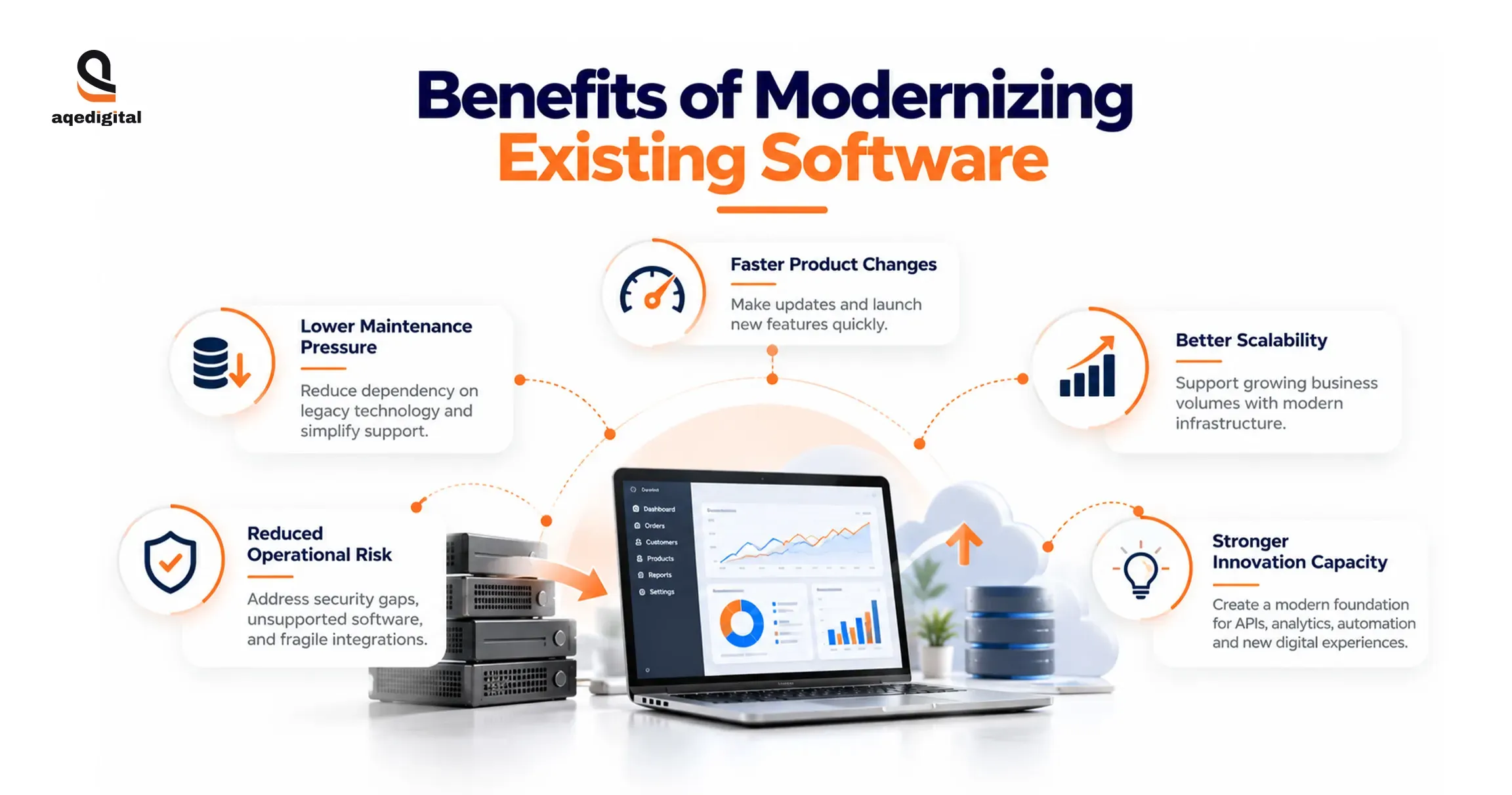
Understanding the benefits of legacy system modernization starts with looking beyond technology and measuring how modernization affects cost, agility, scalability, and operational risk.
Modernization is often driven by the need to respond faster to changing markets. Deloitte research found that 86% of respondents wanted to bring products to market rapidly while continuing to modify their offerings.
Lower Maintenance Pressure
Older systems often require specialized knowledge and manual intervention to maintain. As platforms become harder to support, routine changes can require disproportionate development and testing effort.
Modernization can reduce this dependency by improving documentation, automation, deployment processes, observability, and maintainability around critical applications.
Faster Product Changes
When tightly coupled components depend on each other, even small changes can require extensive regression testing. This increases delivery time and makes teams cautious about introducing improvements.
Modern architectures can isolate selected capabilities, allowing teams to make changes within clearer boundaries.
Better Scalability
Legacy platforms can become difficult to scale when business volumes increase unexpectedly. Modernization can introduce more flexible infrastructure, caching, asynchronous processing, or independently scalable services where those improvements provide genuine value.
Reduced Operational Risk
Unsupported software, fragile integrations, and undocumented dependencies can increase operational exposure. Modernization provides an opportunity to identify these risks and address them before they become production incidents.
Stronger Innovation Capacity
Modernization can also create a better foundation for APIs, analytics, automation, AI-enabled capabilities, and new digital experiences. The objective is not simply newer technology, but greater freedom to build what the business needs next.
The Modernization Approach That Avoids a Full Rewrite
A phased approach is often more practical than attempting a complete replacement. It allows organizations to modernize the highest-value areas while keeping critical business operations running.
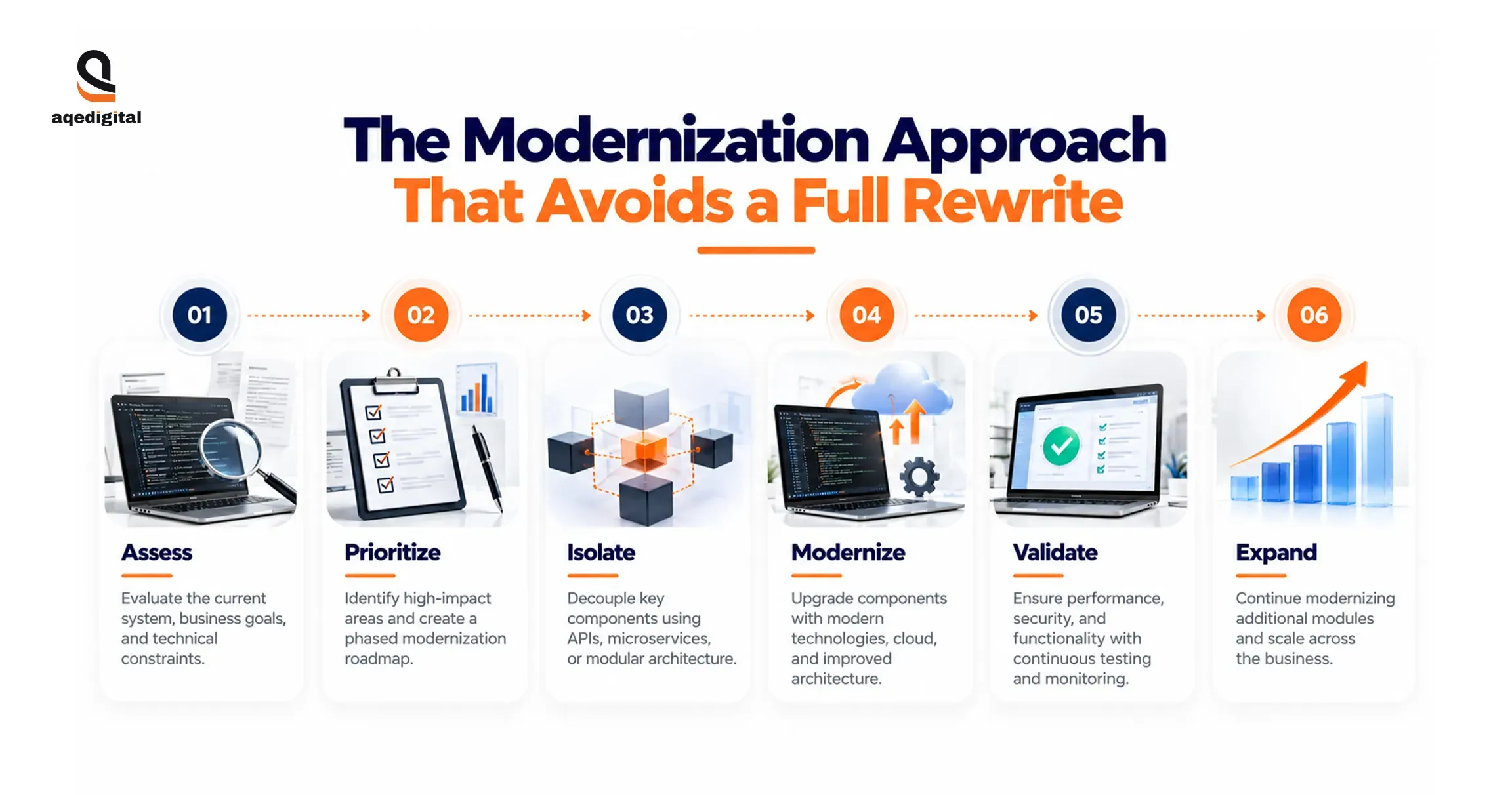
1. Assess
Begin by understanding the existing application rather than assuming its architecture is fully understood.
Map the major components, databases, integrations, dependencies, business processes, user journeys, and infrastructure requirements. Identify which capabilities are business-critical and which have become technical liabilities.
2. Prioritize
Not every component deserves immediate modernization.
Prioritize areas using factors such as business value, maintenance effort, security exposure, scalability limitations, change frequency, and dependency complexity.
A high-value component that changes frequently may deserve modernization before an older component that remains stable and inexpensive to operate.
3. Isolate
Create boundaries around the functionality you want to modernize first.
APIs, service layers, integration layers, and well-defined interfaces can help separate modernized components from older functionality without immediately replacing the entire application.
This is particularly useful when the existing system contains valuable business logic that would be risky or expensive to recreate.
4. Modernize
Once a component has been isolated, choose the appropriate modernization technique.
Some components may require refactoring. Others may benefit from replatforming, containerization, database improvements, or targeted architectural changes.
The modernization technique should follow the business requirement rather than becoming a technology-driven exercise.
5. Validate
Modernization should happen alongside continuous functional and technical validation.
Automated testing, performance testing, security testing, integration testing, and business-process validation become particularly important when modernized and existing components operate together.
6. Expand
After the first modernization phase demonstrates measurable value, use those lessons to determine the next modernization wave.
This creates an incremental transformation model rather than forcing the organization into one high-risk implementation event.
Choosing the Right Modernization Path
There is no universal modernization pattern for every application. The appropriate approach depends on application complexity, business criticality, technical debt, investment capacity, and future requirements.
| Legacy Modernization Approaches Compared | ||
|---|---|---|
| Approach | What Changes | Suitable When |
| Rehost | Infrastructure changes with limited application changes | Speed is the primary migration objective |
| Replatform | Platform changes with moderate application adjustments | Existing software needs a better operating environment |
| Refactor | Internal code structure improves without major functional changes | Maintainability and quality need improvement |
| Re-architect | Architecture changes substantially | Existing architecture limits scalability or agility |
| Replace | Existing functionality moves to a new product or system | The current application no longer provides sufficient business value |
The key is avoiding the assumption that every application should become a completely new architecture.
When Monoliths Should Become Microservices
Monolith-to-microservices migration receives significant attention because microservices can provide independent deployment and scaling capabilities.
However, breaking a monolith apart simply because microservices are popular can create unnecessary complexity.
Distributed systems introduce additional networking, observability, deployment, testing, security, and operational requirements. An application that does not require independent scalability or frequent independent releases may gain little from a complete architectural split.
Instead, identify business capabilities that have clear boundaries and genuine reasons for independent evolution.
A Practical Legacy Modernization Strategy
A sustainable legacy modernization strategy should connect technical decisions with measurable business outcomes.
The importance of legacy system modernization becomes clearer when technology limitations begin affecting release speed, operational costs, scalability, security, and the ability to introduce new digital capabilities.
Then establish measurable baseline metrics.
For example:
- Average time required to release changes
- Number of production incidents caused by application changes
- Average maintenance effort for critical modules
- Application response times during peak workloads
- Infrastructure and licensing costs
- Time required to onboard developers
- Percentage of critical functionality covered by automated testing
These measurements create a baseline for evaluating whether modernization is producing meaningful results.
Without measurable outcomes, modernization can easily become an expensive technology refresh without a clear business case.
Managing the Biggest Legacy Modernization Challenges
The most difficult modernization problems are often not purely technical. They emerge where technology, business operations, data, people, and organizational risk intersect.
Hidden Dependencies
Legacy applications frequently contain undocumented dependencies between modules, databases, external systems, and business processes.
A seemingly isolated change can therefore affect functionality elsewhere.
Dependency mapping and application discovery should happen before major architectural decisions.
Data Migration Risk
Data often represents the most sensitive part of modernization.
Organizations need to determine which data should move, how data structures will change, how synchronization will work, and how consistency will be maintained while old and modern components operate together.
Business Disruption
Critical applications cannot simply be switched off while a replacement is developed.
Phased releases, parallel operation, controlled cutovers, and carefully planned rollback procedures can reduce operational disruption.
Knowledge Concentration
Some legacy applications depend heavily on a small number of experienced developers. When that knowledge is undocumented, modernization can become difficult before development even begins.
Documentation, automated testing, architecture mapping, and knowledge transfer should therefore form part of the modernization program.
Scope Expansion
Modernization projects can quickly become larger when teams attempt to fix every historical problem simultaneously.
Clear scope boundaries help teams focus on the capabilities that create measurable business value first.
Building a Legacy Modernization Roadmap
A legacy modernization roadmap should show more than technology milestones. It should explain how the organization moves from the current operating model toward a more maintainable and scalable environment.
A practical roadmap can include five stages:
- Discover: Document applications, dependencies, infrastructure, data flows, business processes, and operational constraints.
- Prioritize: Rank modernization candidates according to business impact, technical risk, complexity, and strategic importance.
- Pilot: Select a contained capability where modernization can demonstrate measurable value without putting the entire business at risk.
- Scale: Apply lessons from the pilot to additional applications or business domains using repeatable architecture and delivery practices.
- Optimize: Continue improving performance, security, automation, observability, and operating costs after the main modernization phases are complete.
This iterative approach also aligns with Amazon Web Services (AWS) guidance that recommends progressively assessing application portfolios and establishing migration waves rather than requiring complete information before beginning.
How AQe Digital Can Help Modernize Legacy Applications
AQe Digital helps organizations approach modernization as a structured transformation rather than a complete technology replacement. Our expertise covers the technical, architectural, and operational decisions required to modernize existing applications while keeping business continuity in focus.
Application Assessment
Our team evaluates application architecture, dependencies, integrations, infrastructure, code quality, technical risks, and business-critical functionality. This assessment helps identify modernization priorities while reducing the risk of overlooking dependencies that could affect future implementation.
Modernization Planning
Not every application component requires the same level of modernization. Our experts identify opportunities based on business value, maintenance effort, scalability requirements, technical debt, security concerns, and the frequency of application changes.
Architecture Design
Rather than forcing organizations into an immediate replacement, we design phased architectures that allow selected components to evolve progressively. This approach helps modernize critical capabilities while keeping stable functionality operational and reducing unnecessary disruption.
Application Refactoring
Our development teams identify application components where refactoring can improve code quality, maintainability, performance, and development flexibility. We focus on addressing technical limitations while preserving business rules that continue to provide value.
API Modernization
Legacy applications often depend on tightly coupled integrations that make future changes difficult. Our experts can modernize integration layers and introduce appropriate API-based approaches, helping existing functionality communicate more effectively with newer systems and digital channels.
Cloud Modernization
We support cloud and platform modernization initiatives based on application requirements, scalability expectations, operational needs, and future technology plans. The objective is to create a more flexible operating environment without introducing unnecessary architectural complexity.
Testing & Deployment
Modernization can introduce risk when application changes are difficult to test or release consistently. Our team can strengthen testing, deployment, monitoring, and development practices to create greater visibility and control throughout the modernization process.
Migration Planning
We help organizations plan migration phases, data transitions, integration dependencies, rollout strategies, and fallback considerations. Controlled transitions allow modernized capabilities to be introduced progressively rather than depending on a single high-risk cutover.
Outcome Measurement
Modernization should produce more than architectural improvements. Our experts can establish measurable outcomes around application performance, development efficiency, maintenance effort, scalability, reliability, and operational costs, providing a clearer view of modernization progress.
Conclusion
Modernization does not need to be a choice between keeping outdated software and rebuilding everything from scratch. A carefully sequenced transformation can preserve valuable business logic while progressively removing the limitations created by aging technology.
The bigger opportunity is often organizational rather than architectural. Modernization can create a development environment where teams respond faster, integrate new capabilities more easily, and make technology decisions without being constrained by yesterday's architecture.
AQe Digital brings the technical expertise and transformation perspective needed to evaluate existing systems, define practical modernization priorities, and execute change around real business requirements.
Contact us to discuss your modernization goals and identify a practical path forward for your existing applications.