How Learning Analytics Helps L&D Teams Improve Employee Training ROI?

Jigar Mistry
The evaluation of training effectiveness has been conducted through completion rates, attendance records, feedback, and assessment scores. That is a traditional approach everyone followed. Though these metrics provide useful data up to a certain level, it is difficult to understand whether employees are applying new skills, improving performance, or contributing to business outcomes.
This gap has created a growing demand for data-driven learning strategies.
Organizations are under constant pressure to justify training investments, address evolving skill requirements, and improve employee performance. But traditional methods fell short here in understanding learning patterns, learning curves, engagement driving factors, and the impact on business results.
So, the solution is learning analytics. The contemporary workforce development is highly transforming with learning analytics.
What Is Learning Analytics?
The collection, measurement, analysis, and reporting of learning-related data that helps with better understanding and improvement of learning experience, results, and organizational performance is referred to as learning analytics.
It helps transform the learning data into actionable insights for better decision-making and performance tracking, rather than limiting data to be a source of information.
How Learning Analytics Differs from Standard Reporting?
The organization needs to understand clearly that learning analytics and LMS reporting are not the same. How?
Traditional reports typically answer questions such as:
- Who completed a course?
- How many employees attended training?
- What were the assessment scores?
Learning analytics examines further aspects such as behavior, engagement trends, content effectiveness, performance correlations, skill development progress, and overall improvements in outcomes.
Learning Analytics Sources Data From:
Modern learning environments generate data from multiple systems and touchpoints.
Common sources include:
- Learning Management Systems (LMS)
- Learning Experience Platforms (LXP)
- HR systems
- Performance management platforms
- Skills assessment tools
- Employee engagement platforms
- xAPI-enabled learning applications
- Learning Record Stores (LRS)
Reshape Workforce Development Approach With Predictive Insights
It helps organizations to identify learners who may struggle to complete programs using data insights. Organizations can also identify skill gaps proactively before they affect performance. With learning analytics, it is possible to recommend personalized learning pathways based on individual behaviours.
How Learning Analytics Improves Employee Training ROI?
Creating measurable value is not an easy task, but learning analytics can make it possible. The primary objective of the training initiative is performance improvement, not just course completion.
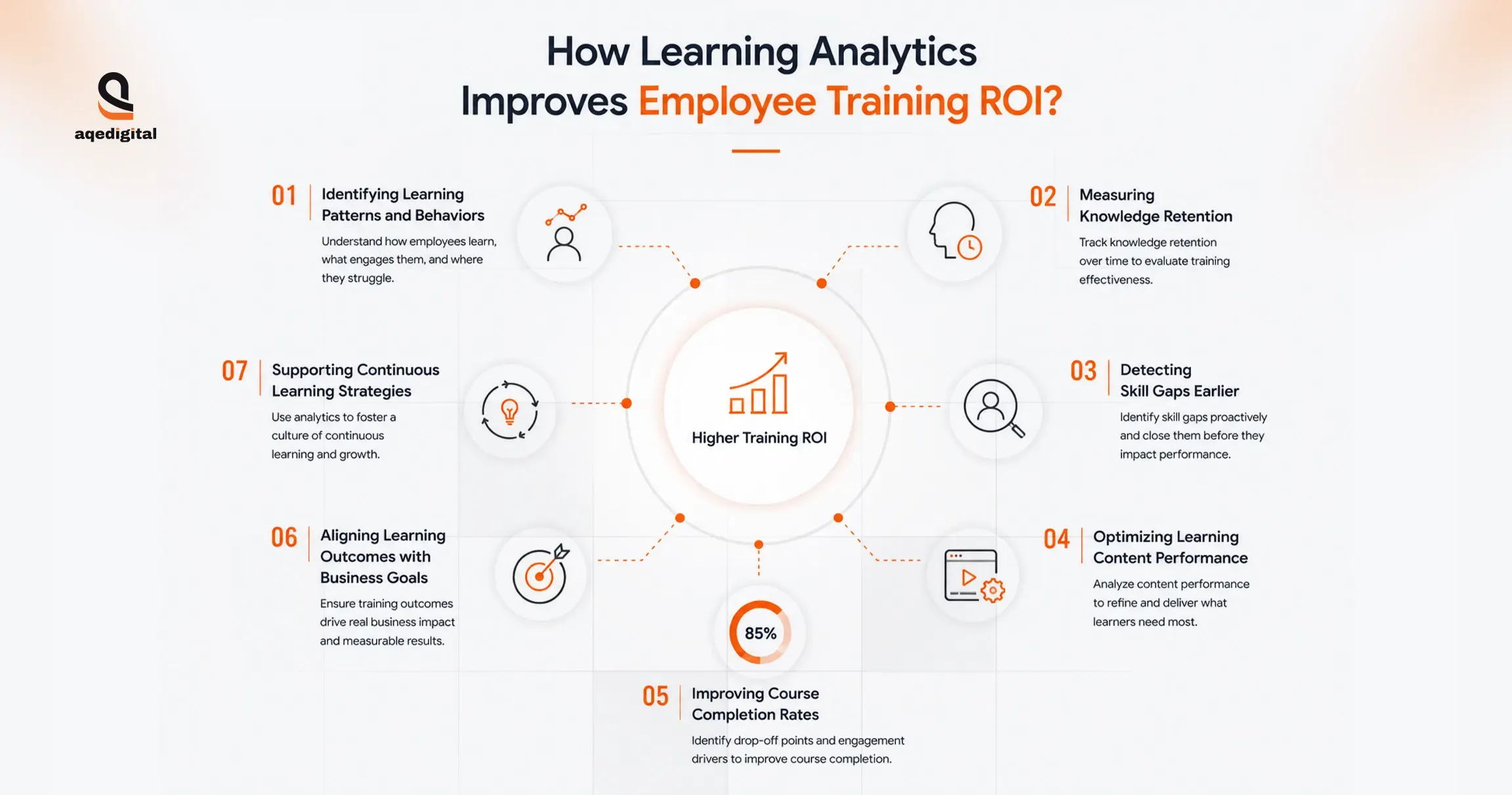
Identifying Learning Patterns and Behaviors
The interaction of the content and information differs from person to person. Optimizing learning strategies for different and multiple users is necessary, and learning analytics helps with it accurately.
Having learning strategies is crucial because every learner has different capabilities and patterns for understanding, grasping, and perceiving the information.
Measuring Knowledge Retention
Retention and acquisition are the two most important factors for training effectiveness.
To assess how employees are retaining critical information over time, the organization should analyze certain factors. Such analysis of assessment trends, knowledge reinforcement activities, and post-training performance indicators helps enable effective reinforcement strategies and continuous learning initiatives.
Detecting Skill Gaps Earlier
In this age of Artificial Intelligence, it is necessary to have workforce readiness. But how can you achieve it? With early intervention.
Organizations can identify knowledge deficiencies, competency gaps, and learning needs in the early stages with learning analytics. With analytics-driven insights, it is possible to prevent low productivity and decreasing ROI by identifying such gaps before it heavily impacts the businesses.
Optimizing Learning Content Performance
Evaluating content effectiveness is important for the organization, as not all learning content delivers equal results among diverse team members.
Learning analytics helps with accurate data-driven evaluation, helping L&D teams improve course design, content relevance, and instructional strategies.
Improving Course Completion Rates
Modern learning management system analytics helps you understand why learners are disengaging. With its accurate and real-time data, it can let you understand drop-off points, engagement barriers, content bottlenecks, and learner frustrations.
Having such crucial insights on hand helps organizations redesign learning experiences that can help them have improved participation and completion rates.
Aligning Learning Outcomes with Business Goals
One of the most powerful benefits of a modern learning analytics solution is the ability to connect learning activities with organizational objectives.
Organizations can evaluate how learning initiatives influence productivity, quality, compliance, customer satisfaction, sales performance, and operational efficiency.
This creates a direct link between workforce development and business value.
Supporting Continuous Learning Strategies
Continuous development requires ongoing measurement, feedback, and optimization to have a learning ecosystem that evolves alongside business priorities.
By leveraging training analytics, organizations can continuously refine learning programs, adapt to changing workforce needs, and create more personalized development experiences.
Why Measuring Employee Training ROI Has Become a Business Priority?
Companies are investing in leadership development, compliance training, technical upskilling, onboarding programs, digital learning initiatives, and continuous workforce development.
Stakeholders want to understand whether training investments are helping employees perform better, close skill gaps, improve productivity, reduce operational risks, and contribute to organizational goals.
Rising Corporate Training Investments
Emerging technologies, evolving business models, changing regulations, and workforce transformation initiatives require continuous learning. As a result, employee development has become a critical business function rather than an occasional HR activity.
Without visibility into learning effectiveness, organizations risk spending resources on programs that fail to create a measurable impact.
The Challenge of Demonstrating Training Impact
Traditional reporting often focuses on outputs such as course completions, attendance rates, or certification achievements. While these metrics indicate participation, they rarely demonstrate whether employees are applying newly acquired knowledge in their daily roles.
The real question is not whether employees completed training.
The real question is whether the training improved performance.
Why Traditional Training Metrics Fall Short
Most conventional metrics provide a limited view of learning effectiveness.
For example:
- Completion rates show participation but not knowledge application.
- Assessment scores measure short-term understanding but not long-term retention.
- Satisfaction surveys capture learner sentiment but not business impact.
- Attendance records provide activity data without performance context.
These metrics often leave organizations with more questions than answers.
The Shift Toward Data-Driven Learning Strategies
Rather than relying solely on completion reports, businesses are using training analytics to understand engagement patterns, knowledge retention trends, learning behaviors, and performance outcomes.
This shift enables L&D teams to align learning initiatives with business objectives and continuously optimize programs based on evidence rather than assumptions.
Key Metrics Every L&D Team Should Track
The most effective L&D teams focus on indicators that connect learning activities with employee performance, skill development, and business outcomes.
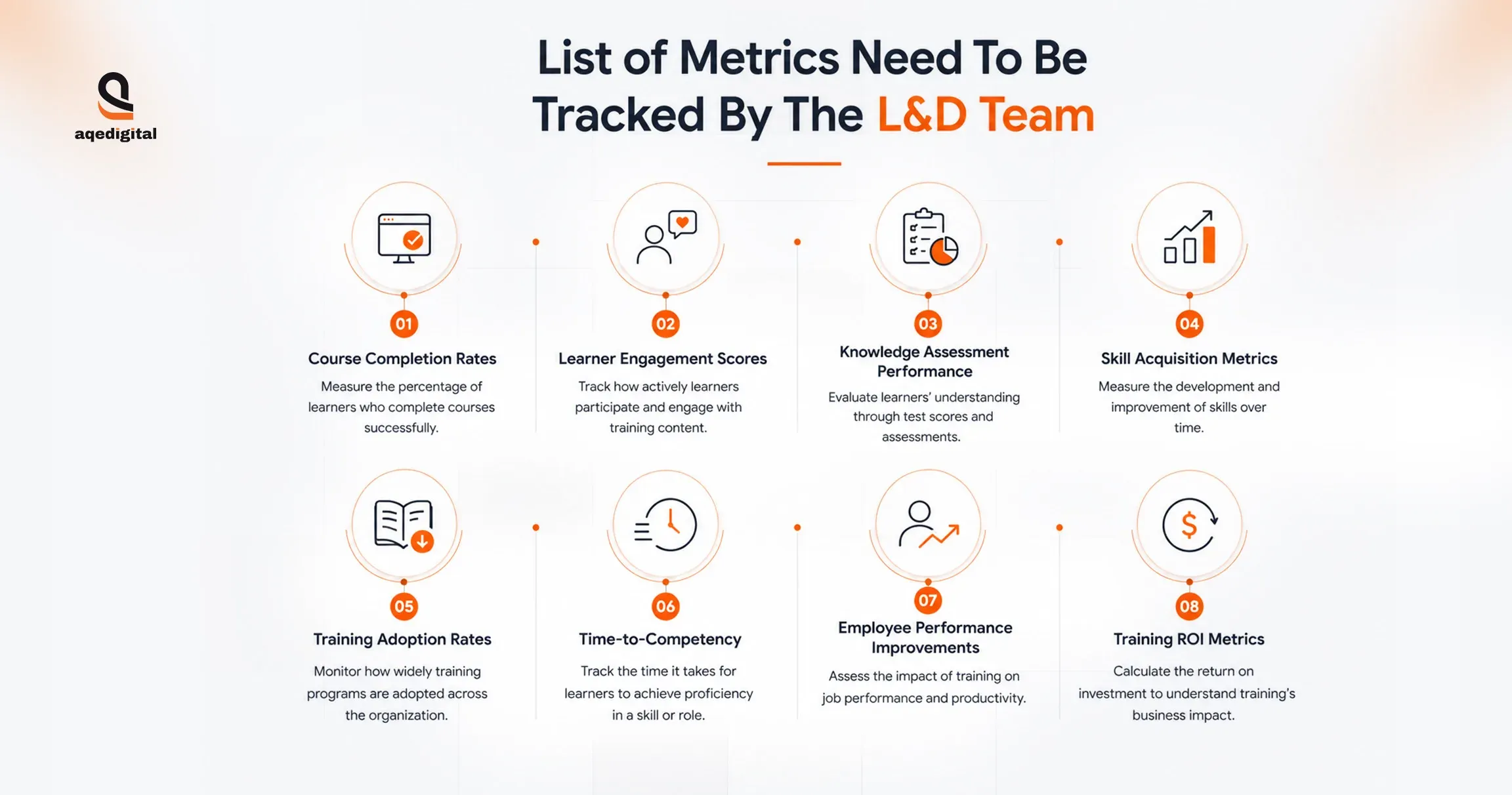
- Course Completion Rates: Completion rates help measure participation and identify potential barriers within training programs. Consistently low completion rates may indicate issues with content relevance, learner engagement, or course design.
- Learner Engagement Scores: Engagement metrics such as learning time, content interactions, and assessment activity provide visibility into how employees consume and interact with training content. Higher engagement often correlates with stronger learning outcomes.
- Knowledge Assessment Performance: Assessment results help evaluate knowledge acquisition and retention. Tracking performance trends can reveal content gaps and areas where additional learning support may be needed.
- Skill Acquisition Metrics: These metrics measure how effectively employees develop new competencies and role-specific capabilities. They help organizations understand whether training is translating into practical skill growth.
- Training Adoption Rates: Adoption rates indicate how actively employees participate in available learning opportunities. Strong adoption often reflects alignment between learning programs and workforce needs.
- Time-to-Competency: This metric tracks how quickly employees achieve expected proficiency levels after training. It is particularly valuable for onboarding, upskilling, and workforce readiness initiatives.
- Employee Performance Improvements: By connecting learning data with performance metrics, organizations can evaluate how training contributes to productivity, quality, customer satisfaction, and operational effectiveness.
- Training ROI Metrics: It measures the business value generated from learning investments. ROI metrics help organizations assess the relationship between training costs and outcomes such as improved performance, reduced errors, and increased employee retention.
Beyond analytics, institutions are also investing in modern digital experiences to improve engagement and accessibility. Our Academic Institution Website Redesign case study illustrates how user-centric digital platforms can support stronger learner interactions and institutional outcomes.

The Role of AI and Predictive Analytics in Modern Learning Programs
Learning environments are becoming increasingly intelligent. Rather than simply reporting historical activity, modern analytics platforms can now anticipate future learning needs and recommend actions before challenges emerge.
This evolution is transforming how organizations design, deliver, and optimize employee development programs.
Predicting Learner Drop-Off Risks
One of the most valuable applications of AI is identifying learners who are at risk of disengagement. This allows L&D teams to intervene proactively rather than reactively.
Predictive models analyze behavioral patterns, engagement trends, assessment performance, and activity levels to identify individuals who may struggle to complete training programs.
Personalized Learning Recommendations
Employees rarely learn in the same way. Artificial intelligence can analyze learning behavior, performance history, skills data, and career objectives to recommend personalized learning pathways that improve engagement and knowledge retention.
Forecasting Skill Development Needs
Predictive analytics helps organizations anticipate future skill demands by analyzing industry trends, workforce capabilities, organizational goals, and performance data. This enables more strategic workforce planning and targeted learning investments.
Workforce Readiness Planning
Organizations often struggle to determine whether employees possess the skills required to support future business initiatives.
Predictive learning models help evaluate workforce readiness, identify capability gaps, and prioritize development efforts before skill shortages impact operations.
AI-Powered Learning Experiences
AI-driven learning experiences can dynamically adapt content delivery based on learner behavior and performance.
AI is expanding beyond recommendations and predictive models to create more interactive learning environments. For example, our AI Speech Recognition for eLearning case study demonstrates how speech-based technologies can enhance learner engagement, accessibility, and assessment accuracy.
How AQe Digital Helps Organizations Build Data-Driven Learning Ecosystems
Many organizations generate substantial amounts of learning data through LMS platforms, training programs, assessment tools, and employee development initiatives. However, transforming that data into actionable business intelligence often remains a challenge.
AQe Digital helps organizations build data-driven learning ecosystems through advanced analytics, AI-powered insights, data engineering, cloud technologies, enterprise integrations, and custom software development. By connecting learning data with broader business systems, organizations gain a more comprehensive view of workforce development, skill progression, and training effectiveness.
From developing scalable analytics platforms and modernizing legacy learning systems to implementing intelligent reporting frameworks and predictive analytics capabilities, AQe Digital enables businesses to make more informed learning and talent development decisions. The result is a connected learning environment that supports measurable training outcomes, workforce readiness, and long-term business growth.
Conclusion
As organizations continue investing in workforce development, the real differentiator will not be the volume of training delivered but the ability to continuously adapt learning strategies based on evidence. Learning data holds valuable insights about workforce readiness, future skill requirements, and organizational capability gaps, but only when it is connected, analyzed, and transformed into meaningful action.
Building this level of intelligence often requires the right combination of analytics, integration, and technology expertise. AQe Digital helps organizations create scalable, data-driven learning ecosystems that connect learning outcomes with broader business objectives. If you're exploring ways to unlock greater value from your training investments, contact us to discuss your learning analytics and digital transformation goals.