Hotel CRM Software: Benefits, Features, ROI, and 2026 Trends

Priyanka Wadhwani
Most hotels don't lose guests due to the room. They lose them because the property doesn't remember who the visitor was when they are billed out. That can't be solved with a loyalty card. The fix is built into the data architecture and links all of your bookings, preferences, and complaints to one guest profile.
The layer is hotel crm. AI is already yielding 10-20% gains in 2026 for hotels leveraging it within their revenue and CRM systems.
91% of consumers want personalized offers, and 65% of hotel shoppers want AI agents to take care of their booking. Those numbers account for this shift from marketing tool to revenue infrastructure.
It includes everything from what it is to how it works, to features, to ROI, to vendor shortlist, and even trends for 2026 that you want to consider in your next stack decision.
Hotel CRM Is the Property's Guest Memory Layer
A hotel crm is a software system that will have all of the information on the guests, including the data from the reservations, the PMS, the loyalty program, and feedback channels, grouped in one profile. It then enables personalized communication, segmentation, and revenue analytics.
Most hotels do not have a CRM problem. They have a guest identity problem. The platform only becomes valuable after the underlying guest data is unified, deduplicated, and matched across channels. Buy a system without solving identity, and the dashboards look impressive while the repeat-stay rate stays flat.
Deloitte's 2026 hospitality outlook argues that traditional scale-driven growth models no longer hold in a market defined by fragmented demand and AI-driven discovery. Unified guest data is the precondition for either.
Identity resolution sits one layer below the CRM and depends on data automation across hospitality operations, which is where most properties lose accuracy before a single campaign goes live.

How CRM for Hotels Operates Across the Guest Journey?
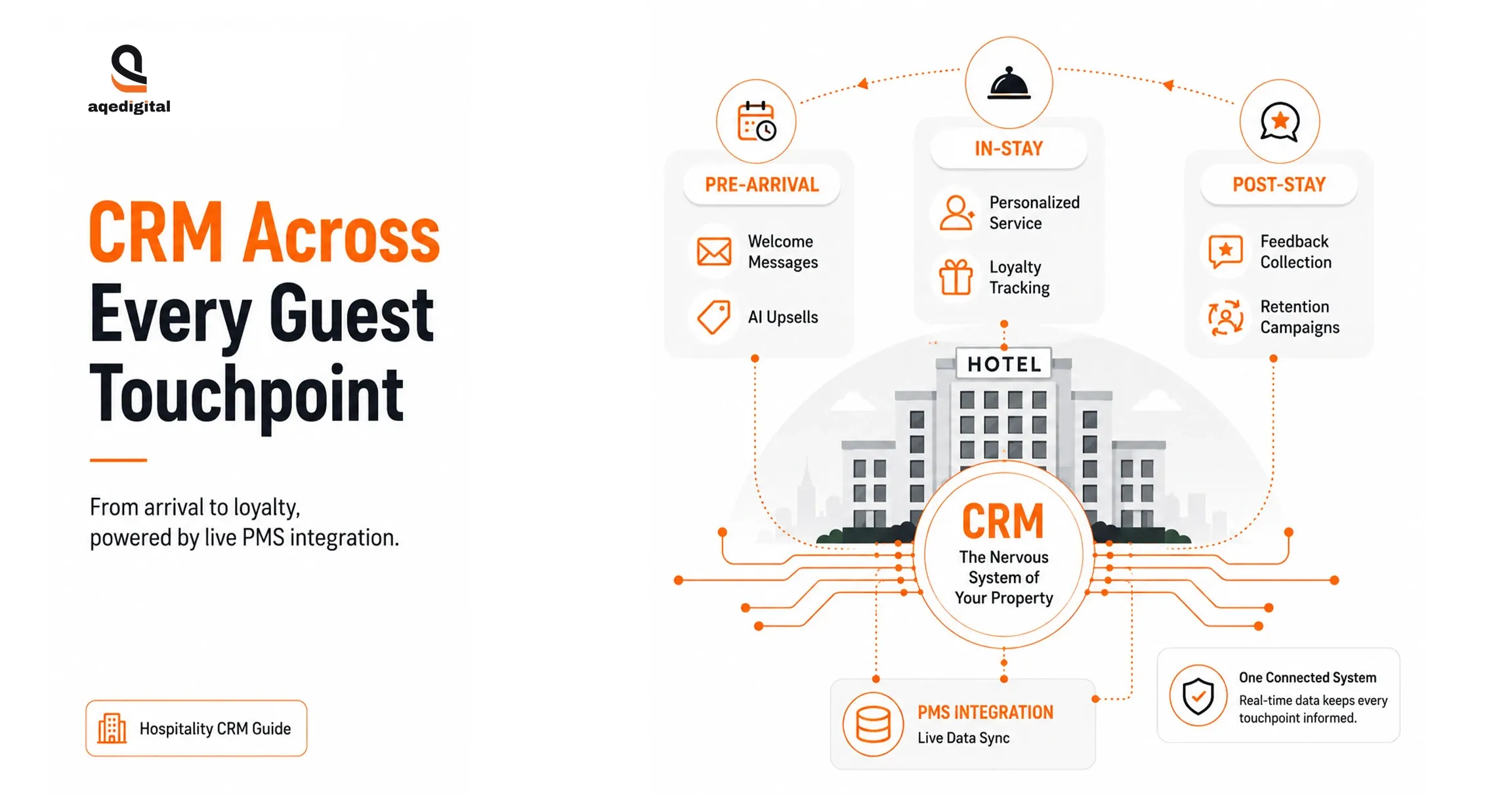
Think of hotel crm as the nervous system of the property. It fires across three phases of the journey, and the value compounds at each touchpoint.
1. Pre-Arrival
Welcome messages trigger when a reservation hits the PMS. Preference surveys go out 72 hours pre-arrival. Upsell offers fire based on stay history and segment value.
Generative AI in hospitality is rewriting this layer, moving pre-arrival from rule-based sequences to model-driven prediction that adjusts per guest in real time.
2. In-Stay
Real-time alerts push to the front desk and housekeeping when returning guests arrive. Dietary restrictions surface in F&B. Loyalty points accrue silently. In-room issue flags reach the duty manager before the guest reaches the lobby.
3. Post-Stay
Feedback collection runs within 24 hours of check-out. Win-back campaigns activate at the 90-day no-stay threshold. Anniversary and loyalty nudges sequence from the same profile.
Disconnect the data sync, and the system becomes a silo with a pretty dashboard. None of this works without live PMS integration.
Key Features Hospitality CRM Software Must Carry to Earn Its License Cost
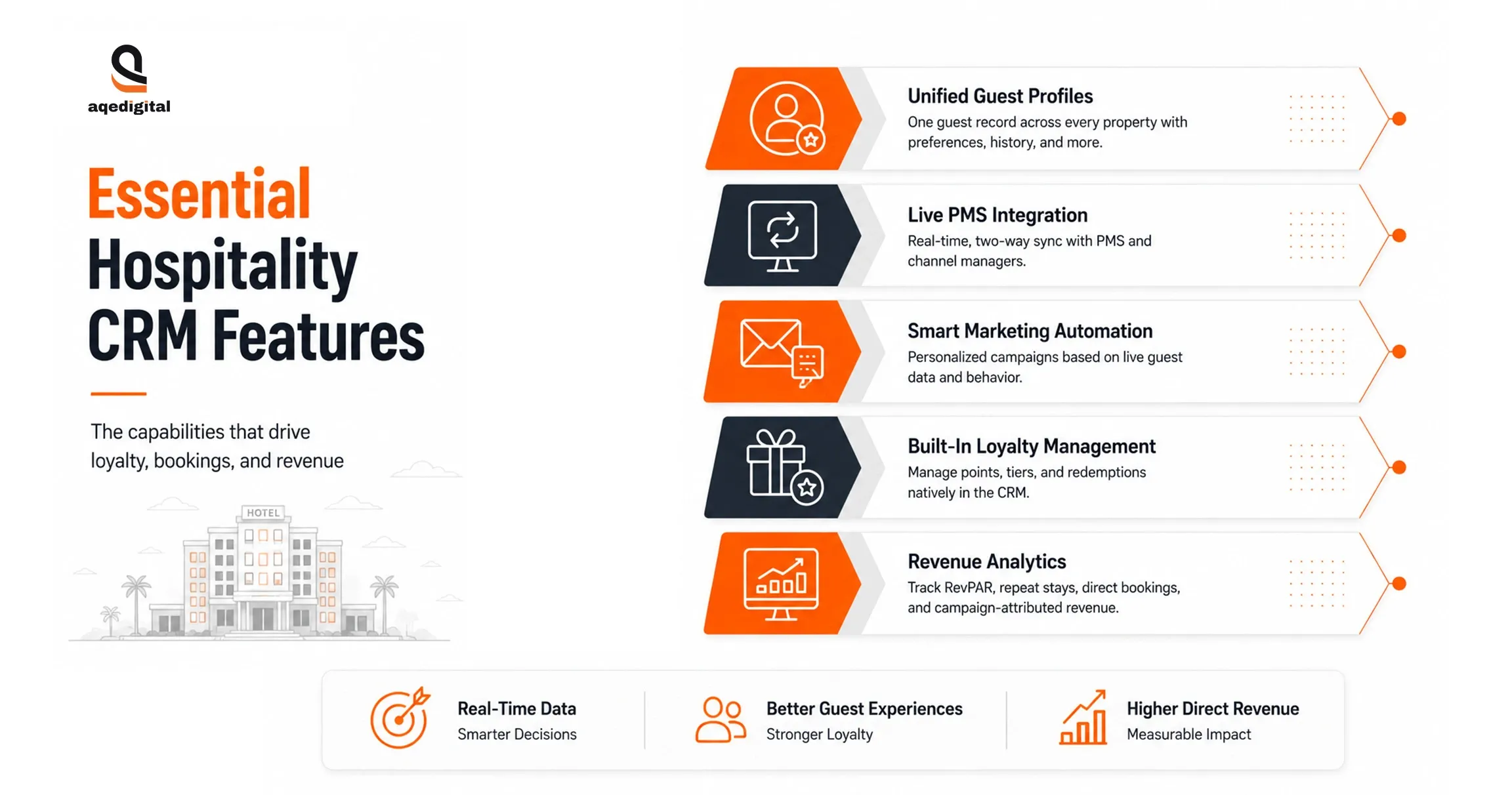
There are a few key features that hospitality CRM software should have to justify its license fees. The following are some of the elements that hospitality CRM software should possess to warrant the cost of its license.
1. Centralized Guest Profiles
One guest/one record on all properties in the portfolio. Preferences, stay history, dietary notes, anniversary dates, and complaint logs all in one profile updated in real time in between syncs.
Otherwise, it is a guess, and the guest won't be able to move around much. Properties that are seeing a decrease in repeat business in 2026 are those that continue to include VIP (Very Important Person) context in their shift handover notebooks.
2. Integrating with PMS and Channel Manager
Seamless, two-way, real-time sync with PMS (Property Management System) solutions such as Opera, Mews, Cloudbeds, and channel managers like SiteMinder, Booking.com. Avoid batch jobs that run at night.
When a guest registers at 14:30, it is represented at 14:31, and the rescue for the missing welcome amenity fires occurs before they arrive at the elevator. The 2018 architecture in a 2026 booking environment is a CRM that is using an overnight ETL (Extract, Transform, Load) job.
3. Marketing Automation and Segmentation
Dynamic email and SMS (Short Message Service) based on up-to-date PMS data. Overnight bookings were being transferred to direct, including accounts of VIPs, first-time guests, lapsed guests over 18 months, corporate accounts, and OTA (Online Travel Agency).
Campaign ROI (Return on Investment) went back to room nights and uplift in ADR (Average Daily Rate) and not open rates or CTR (Click-Through Rate). One of the most obvious KPIs (Key Performance Indicators) that would indicate that a marketing team hasn't been held accountable for revenue is open rate.
4. Loyalty Program Management
The points accrual, integrated tiered rewards, and automated triggering of redemptions happen natively inside the CRM. 6 to 9 weeks to each and every campaign release, plus marketing FTE (Full-Time Equivalent) to handle reconciliation work for reconciliation, from a separate vendor, takes up loyal engine on each campaign release in every 12 property portfolio.
As 2026 nears, the platforms that are getting RFPs (Requests for Proposal) are considering loyalty as an integral part of the system, rather than a separate SKU (Stock Keeping Unit) for sale.
5. IBM Analytics and Revenue Dashboards
One dashboard with RevPAR (Revenue Per Available Room), TRevPAR (Total Revenue Per Available Room), repeat stay rate, direct book rate, and campaign-attributed revenue, updated hourly and by property and brand.
Otherwise, the system is saying that marketing was going on, not commercial performance. The first question that should be answered in a revenue director's dashboard when he/she logs in at 8 a.m. is: “Did yesterday's pricing and campaign decisions impact RevPAR and how much?”
Operators serious about pricing pair the CRM with a dedicated hospitality revenue management layer so the system feeds action instead of just observing it.
Business Benefits of Hotel CRM: The Five Numbers That Move a Board Conversation
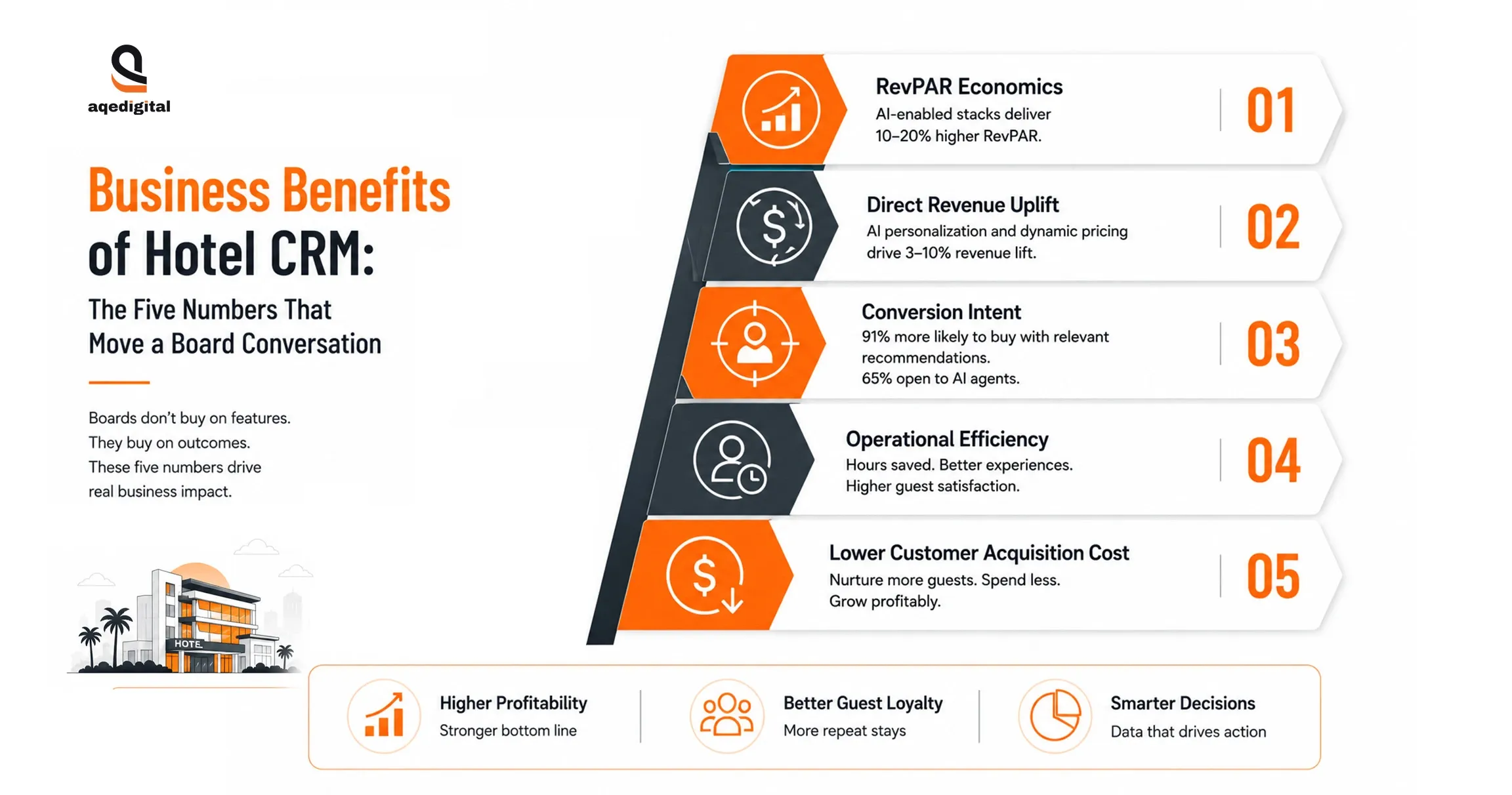
GMs and revenue directors do not buy hotel CRM on the demo. They buy on the math five line items move. Most pitches lose the room by leading with features. The decks that survive procurement open with RevPAR, revenue mix, conversion intent, recovered staff hours, and acquisition cost, in that order, with sources attached.
1. RevPAR Economics
Properties running AI-enabled revenue and CRM stacks outperform non-AI peers by 10 to 20% on RevPAR in 2026, per Deloitte's hospitality outlook. That gap is not a marketing line. It is the difference between a 75% and a 90% RevPAR Index inside your comp set.
Run that against a 200-key property at $220 ADR, and the annual delta clears $2M before fees. The portfolios still treating CRM as a marketing tool, not a revenue system, are absorbing that gap quietly.
2. Direct Revenue Uplift
McKinsey puts AI-driven personalization and dynamic pricing at 3 to 10% annual revenue lift, even at flat occupancy. The more revealing data point: top hospitality brands now attribute roughly 40% of revenue to personalized campaigns. That share did not arrive by accident.
It is the result of segmenting guests by intent, geo, and stay history, then pricing and offering against those segments at the booking moment, not the marketing moment.
3. Conversion Intent
Accenture measures 91% of consumers as more likely to buy from brands offering relevant recommendations. The more disruptive figure is the next one: 65% of hotel shoppers are open to AI agents booking on their behalf. That number rewires the funnel.
The brand that becomes the agent's preferred source wins demand that the human shopper never sees.
4. Operational Efficiency
Staff stop pulling guest preferences out of paper notes, sticky logs, and PMS comment fields. Reception time recovered turns into the in-person touchpoints guests actually remember at checkout.
A property converting 4 hours of clerical work per shift into 4 hours of guest-facing service is not running the same hotel anymore. That shift shows up in TripAdvisor scores within two quarters.
5. Lower Customer Acquisition Cost
The system nurtures returning guests at a fraction of what Google and Meta charge for fresh demand. The real test: if CAC stays flat while your portfolio expands by 20 to 40%, the CRM is doing the work. If CAC climbs in line with key count, the platform is a CMS with a contact list, and the business case collapses by year two.
Best Hotel CRM Software and Best Hotel Management Software Platforms in 2026
The vendor landscape is crowded. Eight platforms come up consistently in shortlists for the best hotel crm software category. Each of the best hotel management software contenders below wins on a different axis.
| Best Hotel CRM Software Platforms in 2026 – Comparison Overview | ||
| Platform | Best For | Property Type |
| Cendyn | Enterprise chains with complex loyalty stacks | Large chains |
| Revinate | Guest feedback and B2C email marketing | Mid-scale to upscale |
| Salesforce Hospitality Cloud | Multi-brand enterprise portfolios | Large chains |
| Thynk.Cloud | Salesforce-native B2B and multi-property operations | Group and B2B-led |
| Mews CRM | Cloud-native lifestyle and boutique hotels | Boutique and lifestyle |
| SevenRooms | F&B-heavy properties and guest experience | Resorts and F&B-led |
| HubSpot | Smaller independent properties on a budget | Independent hotels |
| Experience CRM | Affordable core CRM for small independents | Boutique and small hotels |
Gartner Peer Insights 2026 ratings are the cleanest cross-vendor signal for buyers cutting a shortlist. Treat the table above as a filter, not a final pick.
Best CRM for Travel Agency Use Cases
The best crm for travel agency requirements diverges from hotel-side architecture in one important way. Agencies manage B2B client relationships, itinerary lifecycles, and GDS feeds, not in-stay touchpoints. Salesforce and Amadeus Customer Management remain the default best crm for travel agency picks.
Choosing crm software for hospitality industry deployment without a partner who has run implementations is where most projects slow down. Specialist CRM consulting typically shortens evaluation by four to six weeks.
How to Choose a Hospitality CRM Without Buying the Wrong Stack
Five evaluation gates separate a purchase that ages well from one rebuilt in 18 months. One, define the property type and scale before demos start. Two, prioritize PMS integration depth. Ask for live API documentation, not a logo on a partner slide.
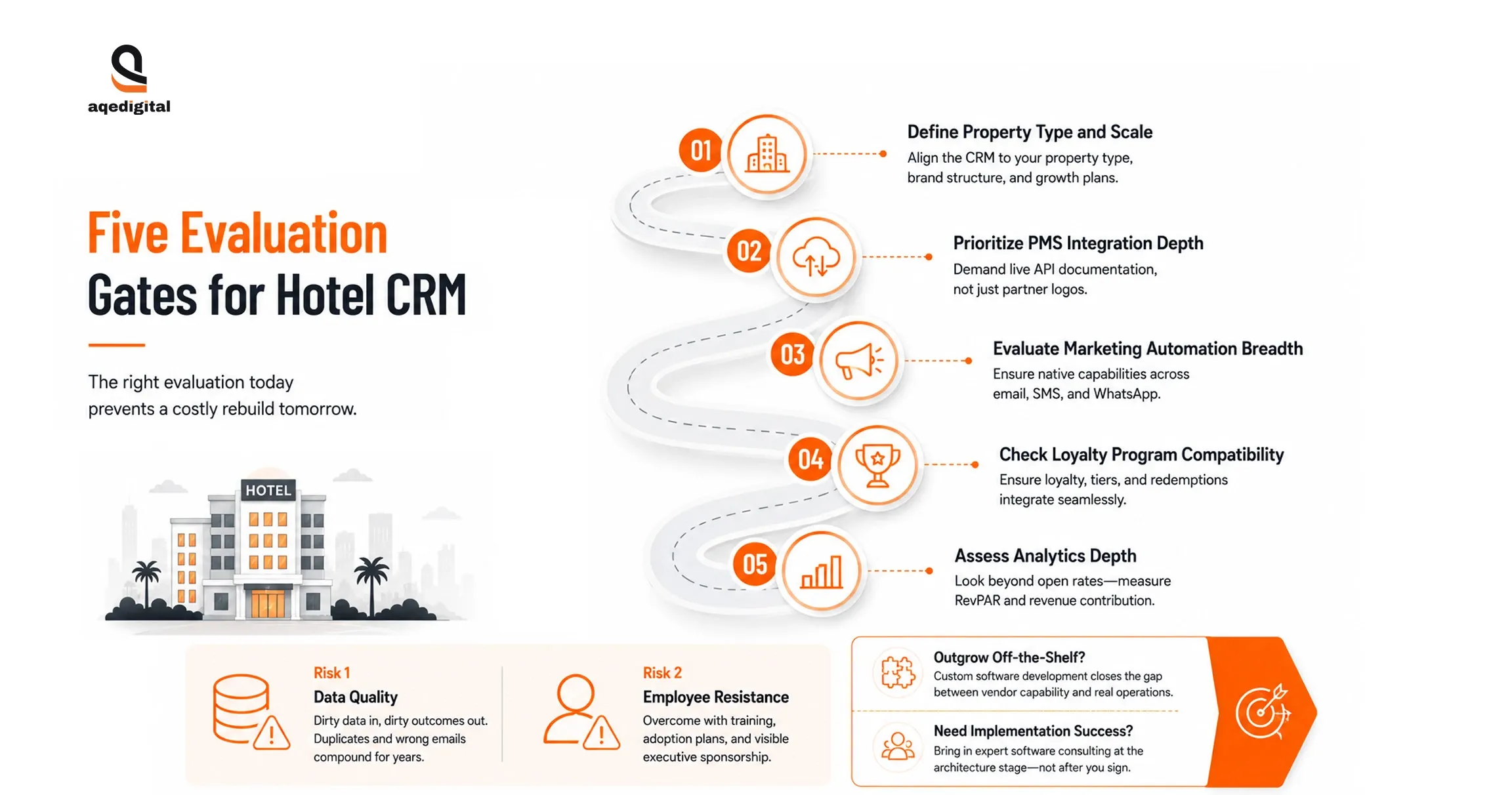
Three, evaluate marketing automation breadth across email, SMS, and WhatsApp. Four, check loyalty program compatibility. Five, assess analytics depth. If the dashboard surfaces open rates but not RevPAR contribution, the system is reporting marketing.
Data quality is the most underestimated implementation risk. Properties that migrate dirty data inherit every duplicate and wrong email, compounding for a decade. Employee resistance is the second risk, fixed only by training and visible executive sponsorship.
Properties that outgrow off-the-shelf stacks usually move into custom software development to close the gap between vendor capability and operational reality on the ground.
Implementation-heavy programs benefit when expert software consulting enters at the architecture stage rather than after the contract is already signed.
Hotel CRM Trends Reshaping Hospitality in 2026
Six shifts are rewriting buying criteria this year. Any RFP ignoring them is already out of date.
Agentic AI for guest servicing. McKinsey calls this moment the arrival of the agentic organization, the largest operating-model shift since the digital revolution. Hospitality CRM is moving from rule-based automation to autonomous agents handling pre-arrival, room changes, and concierge tasks.
Autonomous upsell orchestration. Machine learning scores each guest for next-best-action across room upgrades, F&B packages, and spa offers. Static upsell rules are being retired in favor of per-guest models that adjust in real time.
Predictive churn scoring. The platform flags guests at risk of not returning before the booking window closes, so retention budget targets the right segments. This is where the best hotel crm software is starting to outperform on retention math.
CDP and CRM convergence. The customer data platform sits as the identity backbone, the CRM activates against it, and the line between the two is blurring fast. Stacks that still treat them as separate categories will pay an integration tax for years.
Dynamic pricing integration. RMS, CRM, and channel manager data are converging into a unified pricing layer that ties promotional offers to real-time demand. Static promotions are losing to rate-aware personalization.
Unified data platforms and voice concierge. Accenture's 2026 travel research notes only 6% of travel companies feel future-ready, and the gap is widest where mobile, voice, and in-app capture all feed the same profile.
The Closing View
Guest loyalty is not earned at check-out. It is built into every data point your hotel crm captures between stays. The properties pulling ahead in 2026 are treating the platform as core revenue infrastructure, with the strategy, data hygiene, and integration depth to back it up.
The same logic extends to agencies evaluating the best crm software for travel agents, where the platform call shapes margin for years.
Planning a hotel crm implementation? Get a free CRM readiness assessment from AQe Digital and identify integration gaps, data quality risks, and revenue opportunities before you invest.
Book Your Assessment.