Ultimate Guide to Generative Engine Optimization (GEO) Services in 2026

Nikhil Makwana
Your buyers are no longer scrolling ten blue links. They are reading a synthesized answer, and if your brand is not cited in that answer, you do not exist in that moment of decision.
Gartner projects a 25% decline in traditional organic search traffic to commercial websites by 2026. That number is not a forecast. It is already happening.
Your buyers are no longer scrolling ten blue links. They are reading a synthesized answer, and if your brand is not cited in that answer, you do not exist in that moment of decision.
In fact, ChatGPT serves over 800 million weekly users. Perplexity processes more than 780 million queries monthly. Google AI Overviews appear in up to 60% of searches.
That is the problem that generative engine optimization services exist to solve. Generative engine optimization services are the strategic discipline of structuring your content, brand signals, and digital presence.
Large Language models (LLMs) and AI search platforms retrieve, cite, and recommend your organization when answering the queries your buyers actually ask.
This guide covers what GEO is, why it has become non-negotiable in 2026, how generative engine optimization services differ from traditional SEO and answer engine optimization, the strategies that work, and what to look for when you invest in professional generative engine optimization services.
Why Generative Engine Optimization Services Are no Longer Optional?
Search behavior has fractured. It did not shift gradually. It broke. A CMO at an enterprise software company recently noted that 12.1% of her product signups came from AI search traffic, while that traffic represented only 0.5% of total sessions.
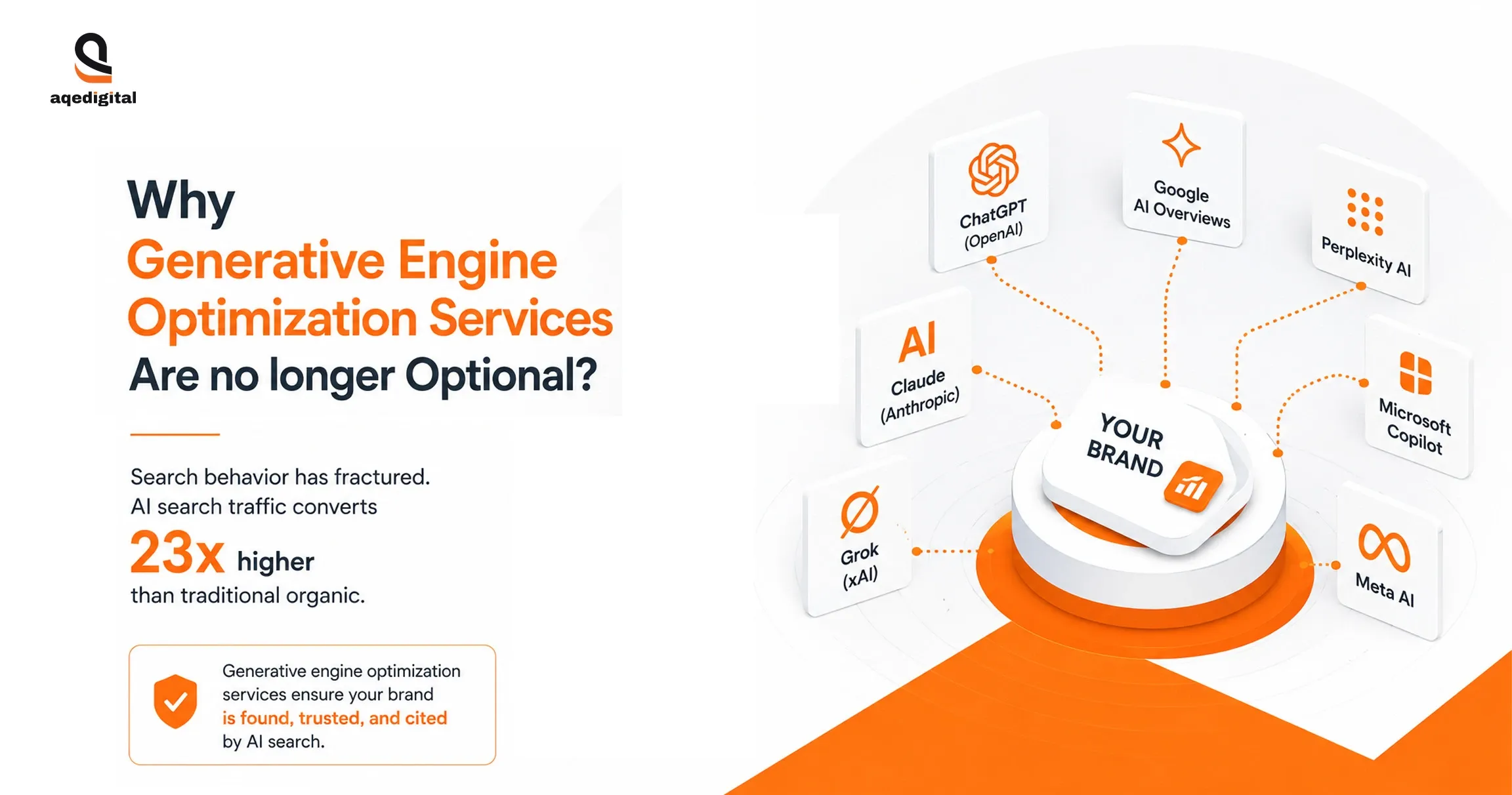
The conversion rate was 23 times higher than traditional organic. Buyers arriving through AI-generated answers already trust the cited source. They arrive primed.
Are the brands that buyers are finding? They have invested in generative engine optimization services.
The AI Search Stack You Need to Appear In
LLM-driven search is not one platform. It is a layered ecosystem. Generative engine optimization services account for all of these, not just Google:
- ChatGPT (OpenAI) with browsing and retrieval modes
- Google AI Overviews and AI Mode (Gemini-powered)
- Perplexity AI (deep-research citation model)
- Microsoft Copilot (Bing-integrated)
- Claude (Anthropic) with web retrieval
- Grok (xAI) and Meta AI
A brand that ranks well in traditional search but has no structured content strategy for LLM retrieval is flying blind in the channels that are gaining the most traction.
What Happens Without GEO?
Your competitor gets cited. Not because their product is better. Because their content is structured for retrieval. Because they have topical authority signals that LLMs recognize. Because their author credentials are crawlable and consistent across platforms. Generative engine optimization services close that gap before it becomes permanent.
Generative Engine Optimization vs Traditional SEO: Where They Diverge
This comparison matters because conflating the two leads to wasted budget.
| Traditional SEO vs Generative Engine Optimization Services - Key Differences Overview | ||
| Dimension | Traditional SEO | Generative Engine Optimization Services |
| Target | Google/Bing ranked URL lists | LLM-generated answers and citations |
| Primary signal | Backlinks, Core Web Vitals, and on-page optimization | Topical authority, citation-worthiness, entity coverage |
| Content format | Long-form, keyword-dense, crawlable | Structured, quotable, definitionally precise |
| Success metric | Keyword rankings, organic CTR | AI citation frequency, brand mention share in AI answers |
| Measurement tools | Search Console, Ahrefs, Semrush | Profound, Otterly AI, SE Visible, Evertune |
| Decay pattern | Algorithm updates erode rankings | Training data and retrieval weighting erode visibility |
Traditional SEO does not disappear. It becomes the floor, not the ceiling. You must rank in the top results for LLMs to read you at all. But ranking alone no longer guarantees discovery.
Generative engine optimization vs traditional SEO is not a binary choice. It is a sequencing decision. Fix technical SEO first. Then invest in the content architecture and authority signals that generative engine optimization services provide.
Answer Engine Optimization Services and Their Relationship to GEO
Answer engine optimization services and generative engine optimization services overlap but are not interchangeable. Explore AQe Digital's Best Answer Engine Optimization Services to understand the full framework.
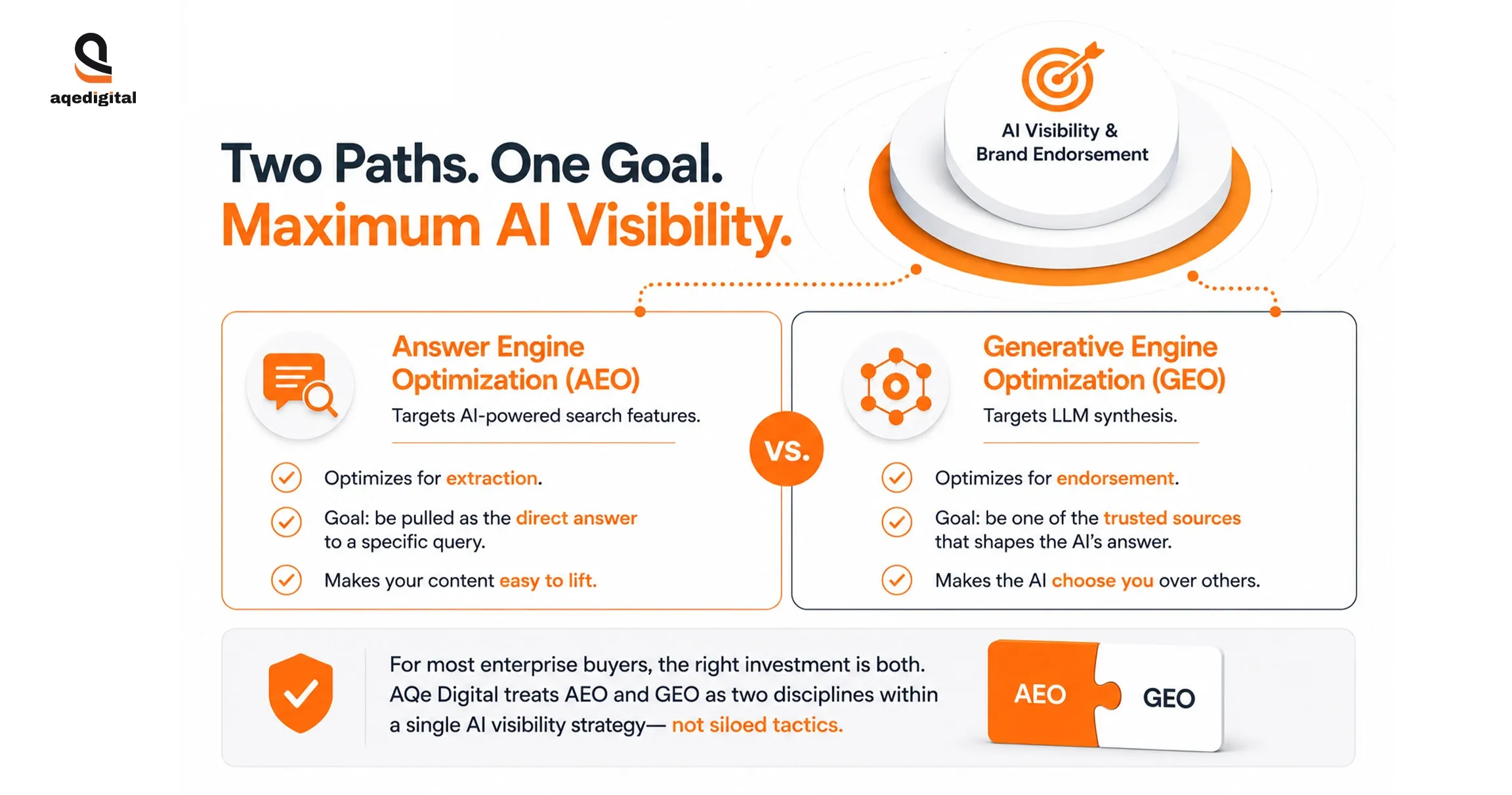
AEO targets AI-powered search features: Google AI Overviews, featured snippets, People Also Ask boxes, and voice search answers. It optimizes for extraction. The goal is to have your content pulled as a direct answer to a specific query.
GEO targets LLM synthesis. The goal is not extraction but endorsement. When ChatGPT or Perplexity synthesizes a response to a complex research question, generative engine optimization services ensure your brand is one of the sources that shapes that answer.
AEO makes your content easy to lift. Generative engine optimization services make the AI choose to lift you over everyone else.
For most enterprise buyers, the right investment is both. AQe Digital treats AEO and generative engine optimization services as two disciplines within a single AI visibility strategy rather than siloed tactics.
Core Generative Engine Optimization Strategies That Drive Results
These are not hypothetical. Princeton researchers studying GEO found that combining authoritative source citations, original statistics, and structured quotations improves AI visibility scores by 30 to 40% compared to unoptimized content. Here is what professional generative engine optimization services execute.
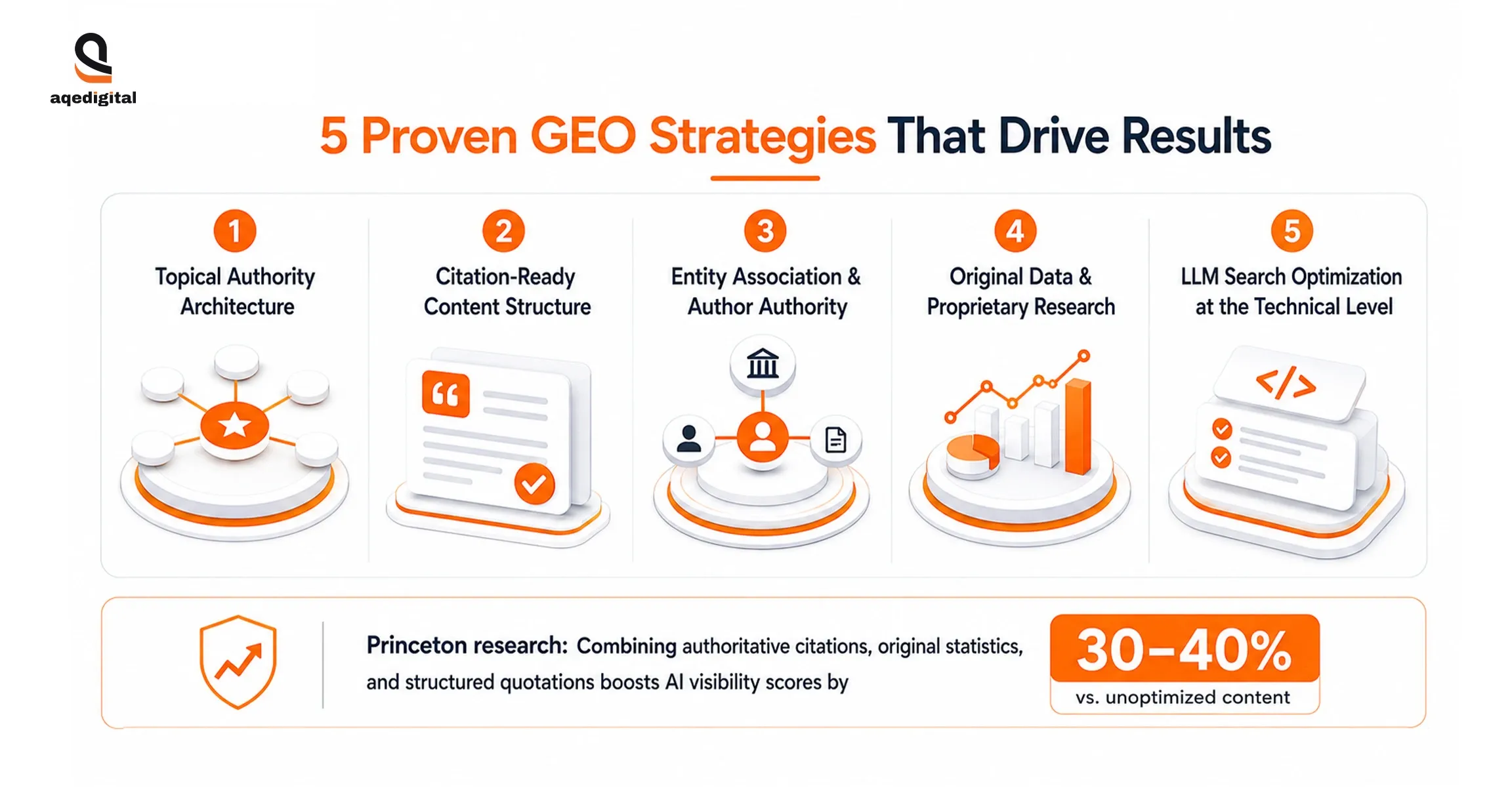
1. Topical Authority Architecture
LLMs trust sources that cover a topic completely. A single optimized blog post does not build GEO authority. A cluster of 15 to 20 content pieces that collectively address every angle of a topic signals to retrieval systems that your domain owns that subject area.
Generative engine optimization services begin with a topical audit: what do you currently cover, what is missing, and what are competitors being cited for that you are not. The gap analysis drives a 90-day content build.
2. Citation-Ready Content Structure
CMU research confirmed that pages whose opening sentence contains a clear definitional structure receive significantly higher impression scores in LLM-based retrieval pipelines. The first 150 to 200 tokens carry disproportionate weight in the summarization step.
Every major section in a GEO-optimized piece opens with a direct, quotable claim. Not context. Not preamble. The answer, immediately.
Generative engine optimization strategies also demand:
- Clear H2/H3 hierarchy with one topic per heading
- FAQ schema targeting real buyer questions
- Numbered processes that LLMs parse as sequences
- Comparison tables for structured 'X vs Y' queries
- Definition boxes for key terms (triggers featured snippets and AI Overview panels)
3. Entity Association and Author Authority
LLMs do not just evaluate content. They evaluate who wrote it and whether the author is associated with the right entities. Generative engine optimization services build author E-E-A-T signals: LinkedIn profiles, external bylines, consistent naming conventions, and credential transparency across every platform where your content appears.
Entity association goes further. If your content on a topic does not mention the relevant platforms, vendors, and researchers in that field, LLMs see it as peripheral rather than authoritative.
Generative engine optimization services map the entity landscape for each topic cluster and ensure your content is woven into it.
4. Original Data and Proprietary Research
This is the highest-value GEO input. LLMs preferentially cite content with original data that cannot be found elsewhere. Survey findings, proprietary benchmarks, internal case study metrics, and first-party operational data are citation magnets.
AQe Digital's work on Engineering AI Answer Visibility Through Strategic AEO & GEO Execution demonstrates exactly this pattern: combining original client outcome data with structured content builds the kind of authoritative sourcing that AI engines return to repeatedly.
5. LLM Search Optimization at the Technical Level
LLM search optimization is not only a content problem. It is an infrastructure problem. Professional generative engine optimization services audit all of these layers:
- robots.txt: Verify AI crawlers (GPTBot, PerplexityBot, ClaudeBot) are not inadvertently blocked
- Server-side rendering: Content hidden behind JavaScript does not get retrieved
- Schema markup: Article, FAQ, HowTo, and Organization schemas signal structure to both crawlers and AI retrievers
- Canonical consistency: Company name, product names, and service descriptions must be identical across your website, social profiles, press mentions, and third-party directories
- Information architecture: Dedicated pages for each service, use case, industry, and product signal expertise depth to LLM retrieval systems
Top Solutions for AI Visibility and Generative Engine Optimization: What AQe Digital Delivers
AQe Digital's generative engine optimization services are structured around a four-phase engagement model.
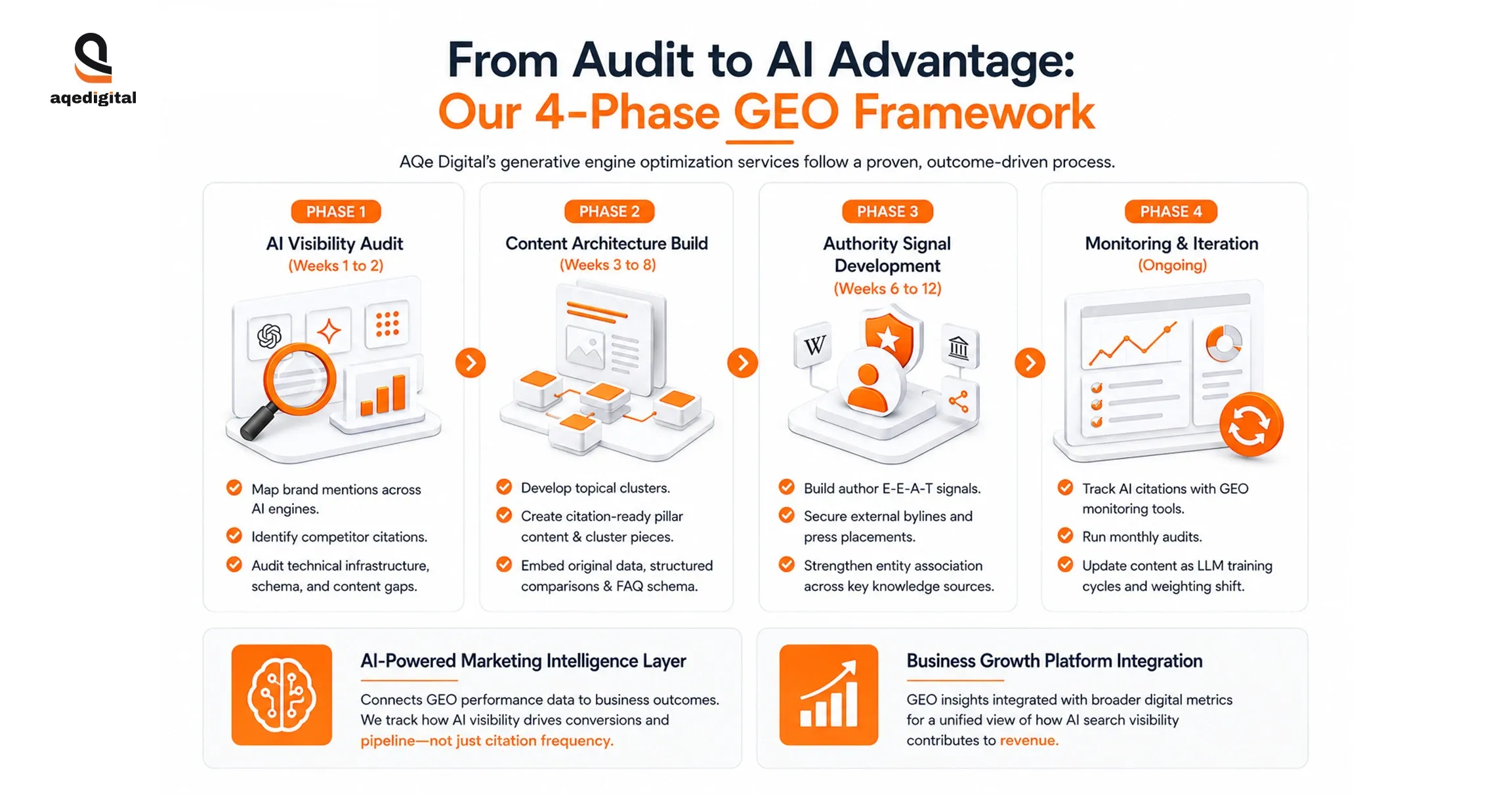
Phase 1: AI Visibility Audit (Weeks 1 to 2).
Map current brand mentions across AI engines. Identify what competitors are being cited for. Audit technical infrastructure for LLM crawler access, schema implementation, and content structure gaps.
Phase 2: Content Architecture Build (Weeks 3 to 8).
Develop topical clusters. Produce citation-ready pillar content and supporting cluster pieces. Embed original data, structured comparisons, and FAQ schema throughout.
Phase 3: Authority Signal Development (Weeks 6 to 12).
Build author E-E-A-T signals. Pursue external bylines and press placements. Ensure entity association across Wikipedia, Wikidata, and major industry reference sources.
Phase 4: Monitoring and Iteration (Ongoing).
Deploy generative engine optimization tools for continuous AI citation tracking. Run monthly audits. Update content as LLM training cycles and retrieval weighting shift.
AQe Digital's AI-powered marketing intelligence layer connects GEO performance data to business outcomes, so you are not measuring citation frequency in isolation but tracking how AI visibility converts into pipeline.
The business growth platform integrates GEO insights with broader digital performance metrics, giving marketing and leadership teams a unified view of how AI search visibility maps to revenue contribution.
Conclusion
AI search is not a trend to monitor. It is the channel your buyers are already using to decide whom to trust, whom to shortlist, and whom to contact. Generative engine optimization services determine whether your brand shows up in those moments or disappears from them.
The brands being cited by ChatGPT, Perplexity, and Google AI Mode in 2026 are not there by accident. They invested in the content architecture, technical infrastructure, and authority signals that generative engine optimization services provide. Every month without that investment is a month competitors consolidate their position in AI answers.
AQe Digital has been engineering enterprise-grade digital solutions since 1997. Our generative engine optimization services combine 27+ years of content and technology expertise with purpose-built AI visibility frameworks designed for the way enterprise buyers actually search today.