Generative AI Consulting Services: From Use Case to Production

Cheta Pandya
Artificial intelligence has become the new normal for enterprises, and the move from generic use cases to agentic AI is normalized. However, the success rate of these AI pilots in production is just 5%. What this means for most enterprises is heavy investment with nothing to show for ROI.
So, what’s the disconnect?
And why are enterprise generative AI pilots failing?
The answer is rather complex. Because it's not just about use case mismatch, infrastructure bottlenecks, or legacy system issues, but a mix of many issues. The gap between investment and ROI for generative AI deployments lies in ineffective fine-tuning and customization.
Most enterprises jump on the AI integration trend without scoping the use case or understanding the limitations of their infrastructure and systems. With effective generative AI consulting services, enterprises can overcome these bottlenecks.
This piece helps your organization understand the true need for generative AI consulting, what a real engagement delivers at each stage, and how to choose between an API-based LLM, retrieval-augmented generation, fine-tuning, and an autonomous agent.
What Are Generative AI Consulting Services?
Generative AI consulting services are engagements for the delivery of solutions for business problems of integrating AI capabilities into a production workflow. This covers strategy, identification of use cases, assessing data readiness, model fine-tuning, and designing custom architecture.
It acts as a connecting layer between the business problem and the needed use cases and workflow that needs automation. Generative AI consulting services help you manage,
- Data governance
- Model evaluations
- Fine-tuning AI models
- Measuring ROI
So is this different from regular AI consulting services? Yes!
AI Consulting vs Generative AI Consulting Service
To navigate AI investments effectively, organizations must distinguish between three distinct disciplines: Traditional AI/ML Consulting, AI Strategy Consulting, and Generative AI Consulting. Choosing the wrong service can result in hiring mismatched technical expertise or overpaying for strategic advice when hands-on engineering is required.
Comparative Framework: Core Differences1. Scope of Services & Technical Mechanisms
| Comparative Framework: Core Differences | |||
|---|---|---|---|
| Feature / Dimension | Traditional AI/ML Consulting | AI Strategy Consulting | Generative AI Consulting |
| Core Question | "What custom predictive model solves this narrow, specific problem?" | "What is our enterprise-wide AI operating model, portfolio, and roadmap?" | "How do we deploy LLMs, RAG, and agents safely and at scale?" |
| Primary Technology | Bespoke predictive algorithms, statistical models, and MLOps. | Vendor-neutral business strategy, organizational frameworks, and portfolio design. | Foundation models, Retrieval-Augmented Generation (RAG), and LLMOps. |
| Typical Deliverables | Custom forecasting pipelines, anomaly detection, classification models. | Transformation roadmap, corporate governance, AI Center of Excellence design. | Use-case backlog, LLM selection, RAG pipelines, secure system architectures. |
| Primary Cost Drivers | Deep data preparation, labeling, and custom model training. | Stakeholder alignment, organizational size, change management overhead. | Token/inference costs, secure on-prem/air-gapped engineering, and workflow redesign. |
| Cost Structure | Scoped per custom build, driven largely by dataset size and complexity. | Lower for pure strategy work; scales sharply upward for full corporate transformation. | Lower for proof-of-concept work; scales significantly for enterprise-wide, production-grade rollouts. |
| Primary Failure Modes | Insufficient data quality or failure to scale models from proof-of-concept to production. | Lack of executive sponsorship; treating AI transformation as a tech-only rollout. | Stalling in "pilot purgatory" due to data exposure risks, compliance gaps, and poor retrieval accuracy. |
Now that you know all the key differences, let’s understand why you need generative AI consulting services.
When Does a Business Actually Need Generative AI Consulting?
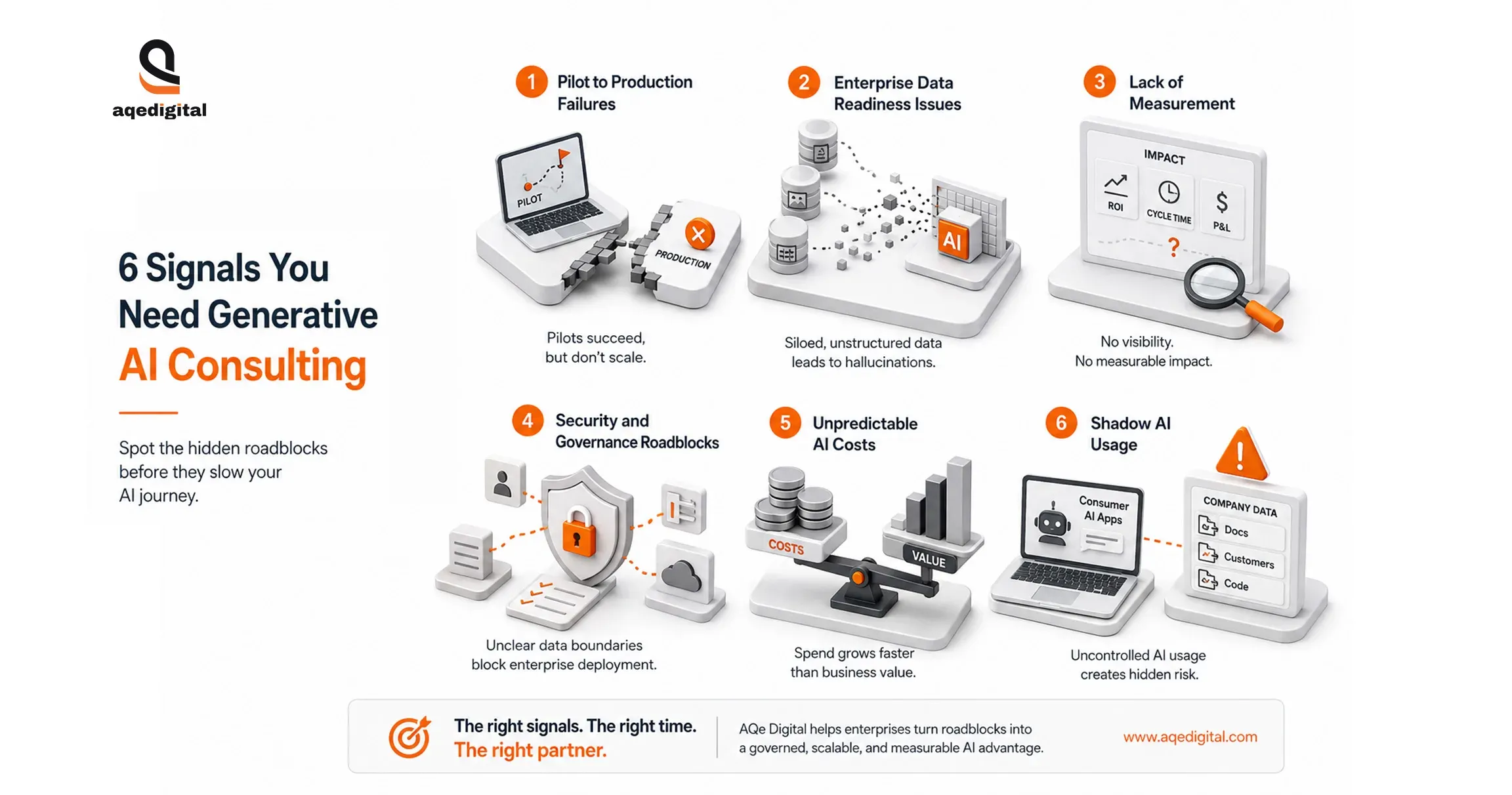
Most businesses feel generative AI integration is just like any other software rollout. However, once they scale this implementation, the roadblock is hit, and teams face operational, data, and regulatory bottlenecks. These bottlenecks are often invisible.
So, what are the key signals for your enterprise to hire a generative AI consulting service?
Pilot to Production Failures
Your engineering teams create proof of concepts and interactive demos, but these projects stall due to “pilot purgatory.” The reason behind such a scenario is a lack of infrastructure that can handle complex software integrations and millions of concurrent users.
AI pilots are often optimized for selected datasets. So, when your teams scale, the production systems fail to handle user requests, face latency issues, and edge-case examples.
Enterprise Data Readiness Issues
Deployed search assistants or Retrieval-Augmented Generation (RAG) frequently suffer from hallucinations. This gives teams responses that are often incorrect, outdated, and irrelevant. Teams lose confidence in the model, and ultimately the generative AI integration pilot suffers.
The issue at hand is weak vector indexing strategies layered over unstructured and siloed data. So, when your teams place a frontier AI model over this infrastructure, it simply hallucinates, providing unreliable data.
Lack of Measurement
With the AI hype, enterprises are missing the bigger picture- if you don’t measure your workflows, you end up paying a premium for invisible ROI! Most enterprises miss the actual financial impact in terms of operational performance ROI, cycle times, and bottom-line profits and losses.
The reasons behind such a scenario are simple- the focus is on “how can we use LLMs?" and not on "what specific bottleneck are we solving?" This is where generative AI consulting services help enterprises identify the right use cases and realize the economic impact of generative AI integrations.
Security and Governance Roadblocks
Generative AI moves from experimentation to enterprise deployment, and suddenly your security teams pump the brakes. Sensitive business data flows through prompts, retrieval pipelines, third-party APIs, and AI agents. Every one of these hops creates a fresh exposure point that nobody mapped during the pilot.
The reason behind such a scenario is a missing governance architecture. Your teams cannot answer basic questions: which data can the AI system access, where does that data get processed, can confidential information train someone else's model?
Without clear policies for data protection, auditability, and regulatory compliance, security teams simply block the initiative. This is where generative AI consulting services help enterprises set data boundaries, access controls, and responsible AI practices before deployment, not after.
Unpredictable AI Costs
A generative AI pilot looks cheap because usage stays small. However, at enterprise scale, inference costs, vector databases, GPU infrastructure, and observability tooling stack up fast, and your finance team starts asking uncomfortable questions.
The issue at hand is architectural, not financial. Different teams adopt different models for similar workflows, so one department burns a large frontier model on a task a smaller model handles just as well. So, when your teams scale, the spend curve bends before the value curve does.
Generative AI consulting services help enterprises design cost-aware architectures by selecting the right models, optimizing retrieval strategies, and controlling inference volume. The goal is not cheaper AI. The goal is a predictable relationship between AI spend and business value.
Shadow AI Usage
Your employees need AI to finish their work, but approved enterprise tools do not exist yet. So they open consumer AI applications on their own. This creates an uncontrolled layer of AI usage sitting outside every control your organization has built.
The reason behind such a scenario is simple- the policy arrived before the tooling did. Employees paste confidential documents, customer information, and proprietary code into external tools without knowing the risk, while IT teams get no visibility into which applications are running or what data leaves the building.
This is a signal that your enterprise needs an AI strategy, not just an AI policy. Generative AI consulting services help enterprises identify shadow-AI use cases, deploy governed alternatives employees will actually use, and move AI usage from uncontrolled experimentation toward secure, measurable adoption.

What Does a Generative AI Consulting Engagement Include?
A generative AI consulting engagement is a sequence, not a menu. Skip a stage and you inherit its failure mode at production scale.
- Use-case discovery - map the workflow and its decisions. Do this before selecting a model, or you retrofit a workflow around a tool you already bought.
- Readiness assessment - audit data quality, knowledge sources, integration surface, security, and governance. The output is not a report. It is the fix list.
- Use-case prioritization - score every candidate first. Teams that rank by enthusiasm find in month four that the winning idea had no data and no owner.
| Use-Case Prioritization Scorecard | |
|---|---|
| Dimension | The question it answers |
| Business value | What outcome measurably improves? |
| Feasibility | Can this be built with current models? |
| Data readiness | Is the information accessible and trustworthy? |
| Workflow fit | Can AI enter the workflow where the decision happens? |
| Risk | What happens if the AI is wrong, and who catches it? |
| Integration complexity | How difficult is production deployment? |
| Adoption | Will employees or customers actually use it? |
Score risk honestly or the scorecard is decoration.
Generative AI Consulting and Development Services
Generative AI consulting and development services run from strategy to a supported production system. Skip a component and its question resurfaces at the security review or the first invoice.
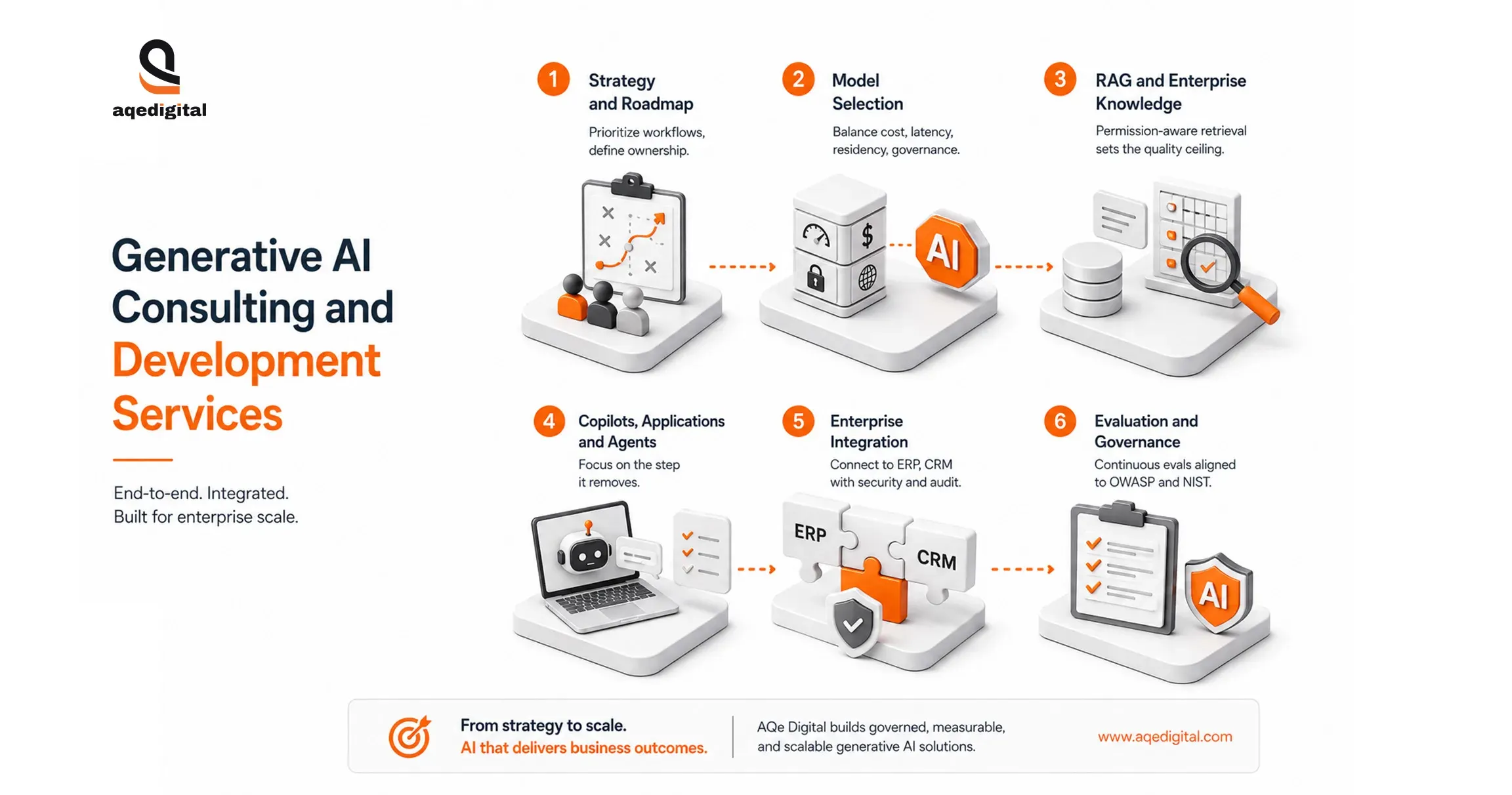
- Strategy and roadmap - which workflows get AI, in what order, and who owns each. A generative AI consulting service that leads with technology instead of a workflow inventory has skipped the step that decides impact.
- Model selection - a cost, latency, data-residency, and governance decision. Not a benchmark score.
- RAG and enterprise knowledge - chunking, embeddings, permission-aware retrieval, reranking. Retrieval quality is the ceiling on answer quality.
- Copilots, applications, and agents - the question is not what a copilot can do. It is which step it removes.
- Enterprise integration - where pilots die. Your ERP and CRM carry their own identity models, rate limits, and audit expectations.
- Evaluation and governance - evals and regression testing run continuously, against OWASP Top 10 for LLM Applications and the NIST AI Risk Management Framework.
How to Choose the Right Generative AI Approach
Architecture follows the problem, not the vendor. The wrong pick is usually only visible after integration.
| Choosing a Generative AI Approach | ||
|---|---|---|
| Approach | Use it when | Main constraint |
| API-based LLM | General language work, no proprietary knowledge needed | Token cost at volume, data residency, no grounding |
| RAG | Answers must be grounded in your documents and traceable | Retrieval quality is the ceiling; hallucination reduced, not removed |
| Fine-tuning | Narrow, stable task and you hold a curated dataset | Curation and compute cost, overfitting, drift |
| AI agent | Multi-step decisioning under ambiguity, with tool use | Cost escalation, error compounding, hardest to govern |
Two rules sit under it. Keep a human in the loop wherever the cost of a wrong answer exceeds the cost of a review step. And fine-tuning commits you to a maintenance cycle, so budget the second training run before approving the first.
Then the part most vendor pages skip. Don't use generative AI for regulated calculations needing an auditable rules engine, for unrecoverable wrong answers with no review step, where data is missing or unpermissioned, or where cost per interaction exceeds the value of the decision.
A partner who cannot name those four is selling capacity, not judgment.
Generative AI Architecture for Enterprise Applications
An enterprise generative AI system runs six layers. A demo usually has two.
- Application - inside an existing tool, because adoption follows the workflow.
- Orchestration - prompts, context, routing, tool calls, fallbacks. Decides your cost curve, and most often left undesigned.
- Model - assume substitution. Hard-coding one provider bets on a market that reprices every quarter.
- Retrieval and vector - chunking, embeddings, index design, permission-aware retrieval. An attack surface, not just an accuracy problem.
- Enterprise data and systems - ERP, CRM, and warehouse, through APIs that respect existing permissions.
- Identity, access, observability - access control is not a phase-two task. It decides whether phase two happens.
Generative AI Security, Governance and Risk
The question isn't whether an LLM can answer a question. It's whether the enterprise can safely trust the answer inside a business workflow.
- Sensitive data exposure - prompts, chunks, and logs carry enterprise content past your DLP tooling.
- Prompt injection - untrusted content in a retrieved document redirects model behavior.
- Excessive agency - an agent with write access and weak scoping acts beyond intent.
- Hallucination - measured, not assumed. Groundedness belongs in production metrics.
- Unauthorized access - AI-layer access control is the most common gap; shadow AI is the most common way around it.
- Auditability - if you cannot reproduce an output from eighteen months ago, you cannot defend it.
Governance is not extra reporting. It is what lets your security team say yes.
How to Measure the ROI of Generative AI
Measure at the workflow level. Enterprise-wide averages hide every real result you have, which is why they never survive a CFO's second question.
| How to Measure GenAI ROI | ||
|---|---|---|
| Metric family | What you track | What good looks like |
| Operational | Time saved, processing time, cost per transaction | Hours removed from a named role's week |
| Customer | Resolution rate, response time, CSAT | Faster resolution, satisfaction flat or better |
| Employee | Task time, adoption, escalation rate | Adoption sustained past the novelty period |
| AI quality | Accuracy, groundedness, override rate | Override rate falling while volume rises |
| Financial | Cost per interaction, infrastructure cost | Spend per interaction flat as usage scales |
Human override rate tells you whether adoption is real or performative, and almost nobody instruments it before launch.
From Generative AI Pilot to Production
Generative AI implementation moves through seven stages: experiment, validate, pilot, integrate, govern, scale, optimize. Most enterprises stall between pilot and integrate.
So what causes the stall?
- No production owner - nobody holds the SLA, the budget line, or the roadmap.
- Poor data quality - surfaces only when the corpus grows past the pilot set.
- No integration plan - the pilot ran beside your systems. Production runs inside them.
- Weak evaluation - without regression testing, every model update is an uncontrolled change.
- Unclear KPI - nobody agreed what improvement looks like, so nobody approves scale.
- Late security review - a governance gap at month six costs an architecture, not a sprint.
- Unpredictable inference costs - the spend curve bends before the value curve.
Systems that crossed over had an owner, an evaluation harness, and an integration path agreed before the pilot began.
How Much Do Generative AI Consulting Services Cost?
Generative AI consulting cost is driven by scope and production complexity, not a rate card. Integration depth and security requirements move the number most, because both change what has to be engineered rather than how long it takes. An air-gapped deployment is a different build, not the same build with a checkbox.
Engagements ladder in five steps: assessment, strategy, proof of concept, production implementation, managed optimization. Scope the assessment first, then price the build against the backlog.
How to Choose a Generative AI Consulting Partner
Score every vendor of generative AI consulting services on ten questions.
- Can they describe your workflow back to you before describing their solution?
- Do they assess data readiness before recommending AI?
- Can they name the permission model and write-back path for your ERP or CRM?
- Do they staff production engineering, not just pilot engineering?
- How do they evaluate model quality, and on what schedule?
- Can they name controls at the access, retrieval, and logging layers?
- Which metric families do they instrument, and when?
- Can they support drift, cost creep, and corpus growth after launch?
- Will they tell you when not to use GenAI?
- Can they work with your architecture instead of proposing a rewrite?
A vendor strong on nine and evasive on one has told you where the project will fail.
Why AQe Digital for Generative AI Consulting and Development
Most vendors sell you a model integration and a demo. That is the easy part, and it is the part nobody is failing at.
- Data engineering that closes the readiness gap. Retrieval is only as good as the corpus underneath it. Our AI and data solutions teams handle the ingestion, structuring, and permissioning that decides whether an assistant returns something trustworthy.
- Production engineering, not proof-of-concept engineering. Our application integration, enterprise development, and product engineering practices build the API, identity, and write-back paths into your estate.
- Governance designed in, not bolted on. We build against the OWASP Top 10 for LLM Applications and the NIST AI Risk Management Framework, with an evaluation harness in place before launch.
What your CIO signs off on is a use case with an owner, an SLA, and a cost per interaction you can forecast.
Start With the Workflow, Not the Model
The production gap is not a technology gap. Enterprises fail at generative AI when they start with the model instead of the workflow, and every downstream failure traces back to that inversion.
Run every in-flight pilot against the Generative AI Production Readiness Framework before your next budget cycle: Business Value, Workflow Fit, Data Readiness, Technical Feasibility, Integration Complexity, Security and Risk, Adoption, Economics. Anything under threshold on Data Readiness or Workflow Fit is not a pilot. It is a demo with a deadline.
Adoption is no longer the hard part. Attribution is.
Talk to AQe Digital about generative AI consulting services scoped as a readiness assessment and prioritization workshop. You will leave with a scored backlog, not a capability deck.