ESG Data Management: A Complete Guide to Collection, Governance, Integration, and Analytics

Cheta Pandya
Environmental, Social, and Governance (ESG) data management is no longer a voluntary reporting exercise but has evolved into a highly strategic imperative. With new regulations such as the EU's Corporate Sustainability Reporting Directive (CSRD) and the International Sustainability Standards Board (ISSB) disclosures, the expectations around ESG compliance have increased.
Plus, investors and internal stakeholders now rely on ESG data to make strategic decisions. This is important for organizations that ensure compliance and rely on ESG for the same. However, numbers tell another story altogether.
96% of finance leaders note problems with the quality of the non-financial data they receive for reporting, according to the EY 2024 Survey. More than 70% say they lack confidence in the ESG figures they hand to stakeholders.
That is not a disclosure formatting issue. That is a data foundation that was never built. ESG data management is the discipline of fixing that foundation, and this guide walks the full lifecycle: how you collect the data, govern it, integrate it across systems, and turn it into analytics your board will actually trust.
ESG Data is Now Financial-Grade Data, and Most Firms Still Staff It Like a Side Project
Many organizations are still struggling to ensure ESG data and compliance because they manage it like any other resource and treat it as a side project. Stringent regulation from CSRD and California's Climate Corporate Data Accountability Act (SB 253) makes ESG data subject to scrutiny to the level of financial reporting.
So, considering sustainability data as an investor-grade metric is not wrong but needs to be complete, verifiable, consistent, and accurate. However, there is a larger disconnect in how firms staff and manage such data.
Here is why the approach of considering ESG data management as a "Side Project" is failing:
- Spreadsheets and Silos — Organizations often rely on fragmented processes, disconnected spreadsheets, emails, and manual workflows to manage data. This leads to severe critical vulnerabilities. A 2024 KPMG survey found 47% of companies still name spreadsheets as their primary ESG data management system.
- Lack of Executive Accountability — Preparation of company-sourced reporting data is often treated as an informal end-user activity, lacking formal review or approvals.
- Audit Delays and Errors — Without a structured, system-driven approach, organizations suffer from inconsistent methodologies, missing data points, and version control issues.
Bridging this gap needs an overhaul in the approach and ESG consulting services to help you build a process considering data as a financial investment. From a resource like any other, your ESG data is now financial data, and so you need to manage the entire ESG data lifecycle end-to-end. This is why understanding the data management of ESG is important.
What is ESG Data Management?
ESG data management is the discipline of collecting, structuring, validating, and using sustainability data across environmental, social, and governance categories. It sounds straightforward on paper. In practice, it rarely is.
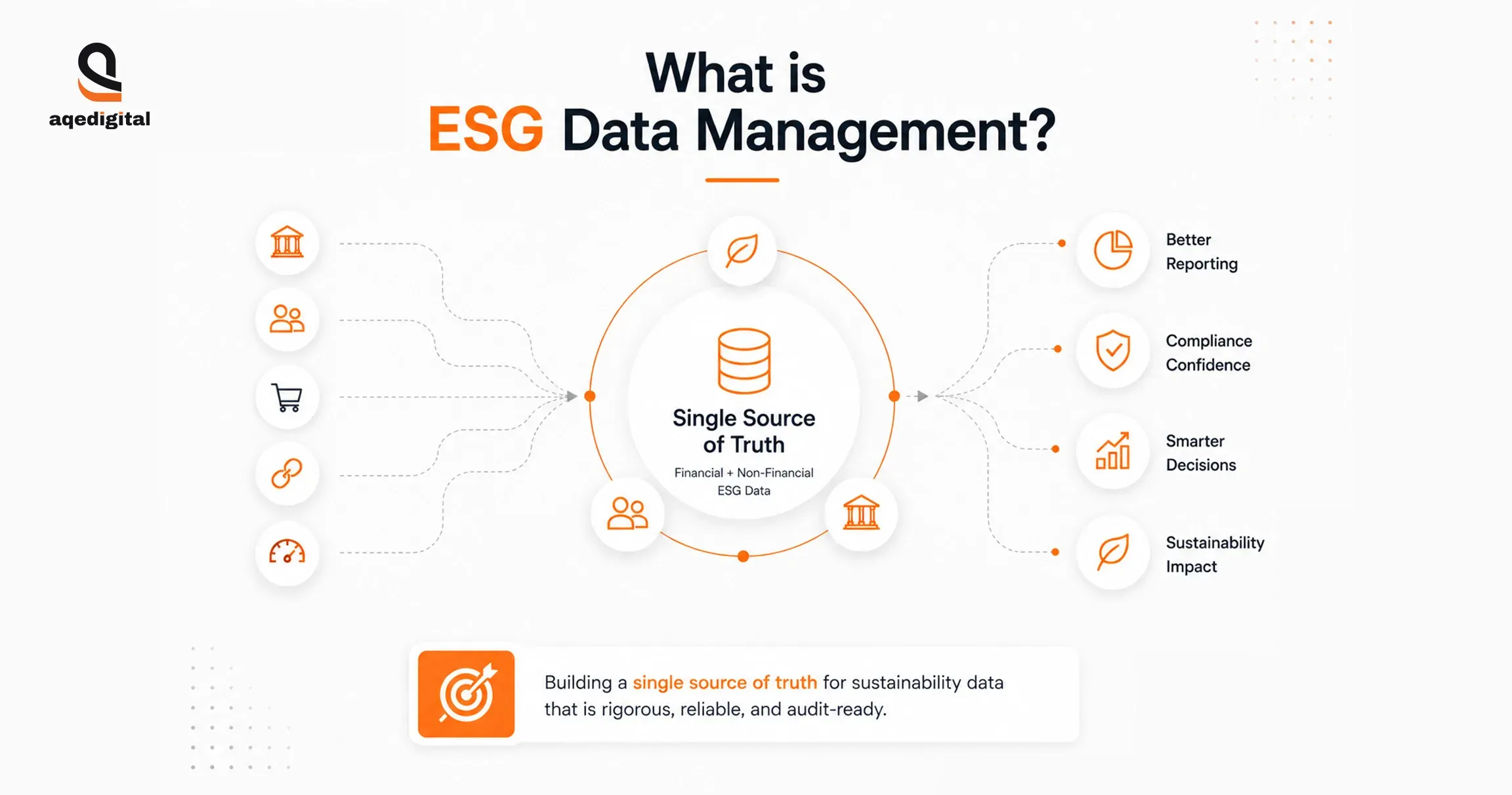
The information lives everywhere: finance systems, HR records, procurement logs, supply chain platforms, energy meters, and external partner data. None of it arrives in a common format.
Organizations have to apply consistent calculation methodologies across the board, validate every figure through strict controls and workflows, and structure the output so it holds up under analysis and reporting, not just internal review.
The real objective here isn't compliance paperwork. It's building a single source of truth for non-financial data, one that behaves as rigorously as financial data does. Without that centralized structure, sustainability data stays trapped in disconnected spreadsheets, methodologies drift from team to team, and nothing survives serious audit scrutiny.
This is where most people underestimate what ESG data management actually does. It's not just a compliance box for CSRD or ISSB. When done well, it fuses financial and non-financial data into one connected system of record, satisfying regulatory and assurance requirements. Organizations looking to ensure regulatory compliance need Big Data analytics services to ensure efficient ESG information management.
Why does ESG Data Governance matter?
Collection is a method for obtaining raw data. Making that data defensible is all about governance; it's what differentiates numbers you can report from numbers you can prove in an audit.
Roles and ownership
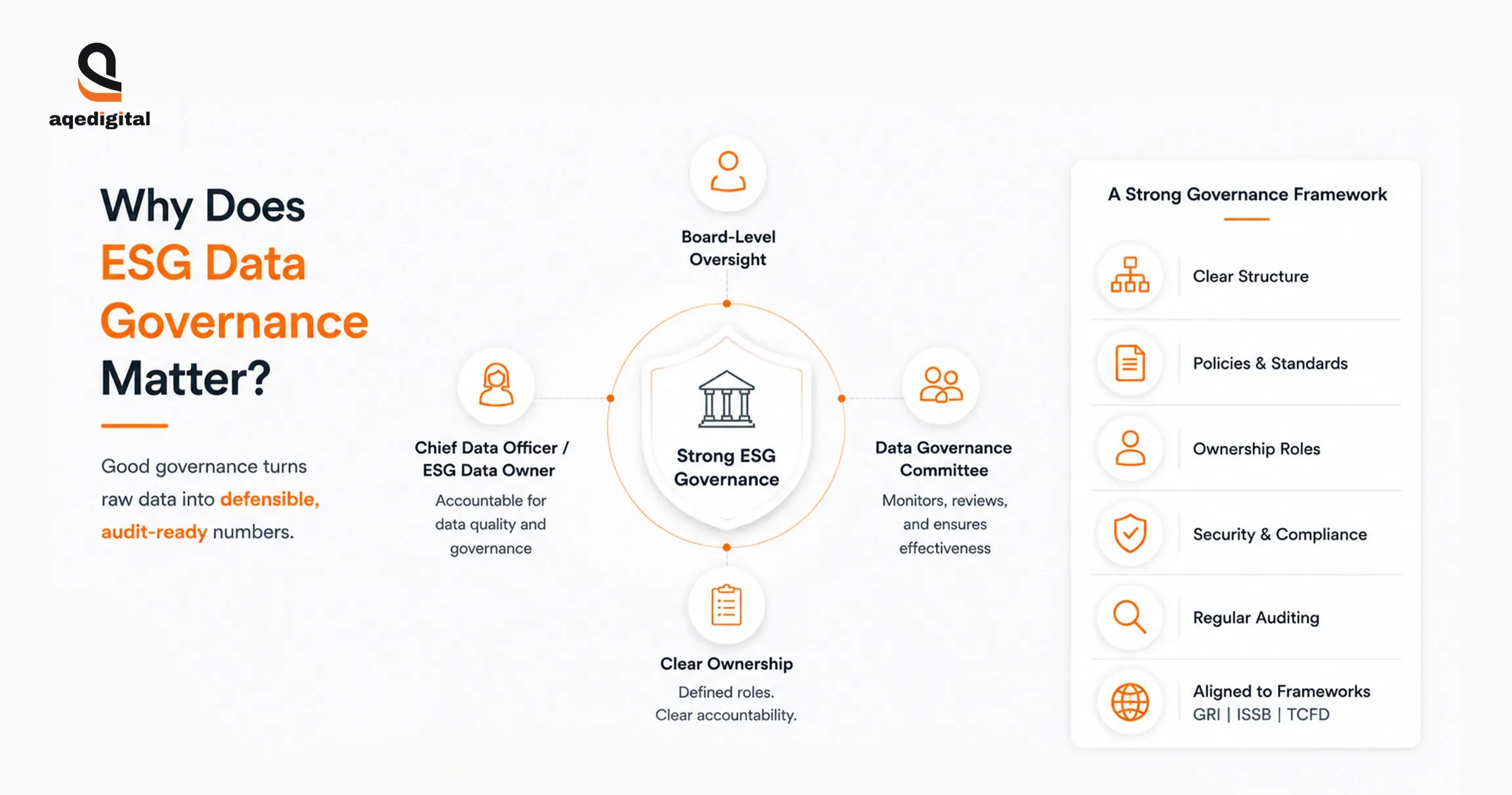
The first step to good governance is good accountability. It typically involves a Chief Data Officer or a designated set of ESG data owners, whose roles are to lead this effort and to have a board-level data-governance committee responsible for regularly monitoring the effectiveness of the methodology and results.
Whereas if no one owns the data in ESG, it is everyone's problem and no one's responsibility, and that is how it's going to get degraded.
Right Framework and Structure
Some of the common components of effective governance are: a clear structure, recorded data policies and standards, ownership roles, regular auditing, and security protocols that are compliant with standards. Having this framework aligned to known frameworks such as GRI, ISSB and TCFD is not only good practice, it is what will enable your numbers to be comparable to peers and credible to regulators.
This is a much more serious game than some teams realize. Less than 30% of firms are confident, and at least as many are not confident, in the accuracy of their own ESG data. Governance is not about increasing reporting; it is about increasing controls and closing the confidence gap.
Why ESG Data Integration is Complex?
Centralized ESG platforms can be created to integrate ERP, HR, CRM, procurement, building management, and IoT systems from both the supply chain and third-party vendors into a single place.
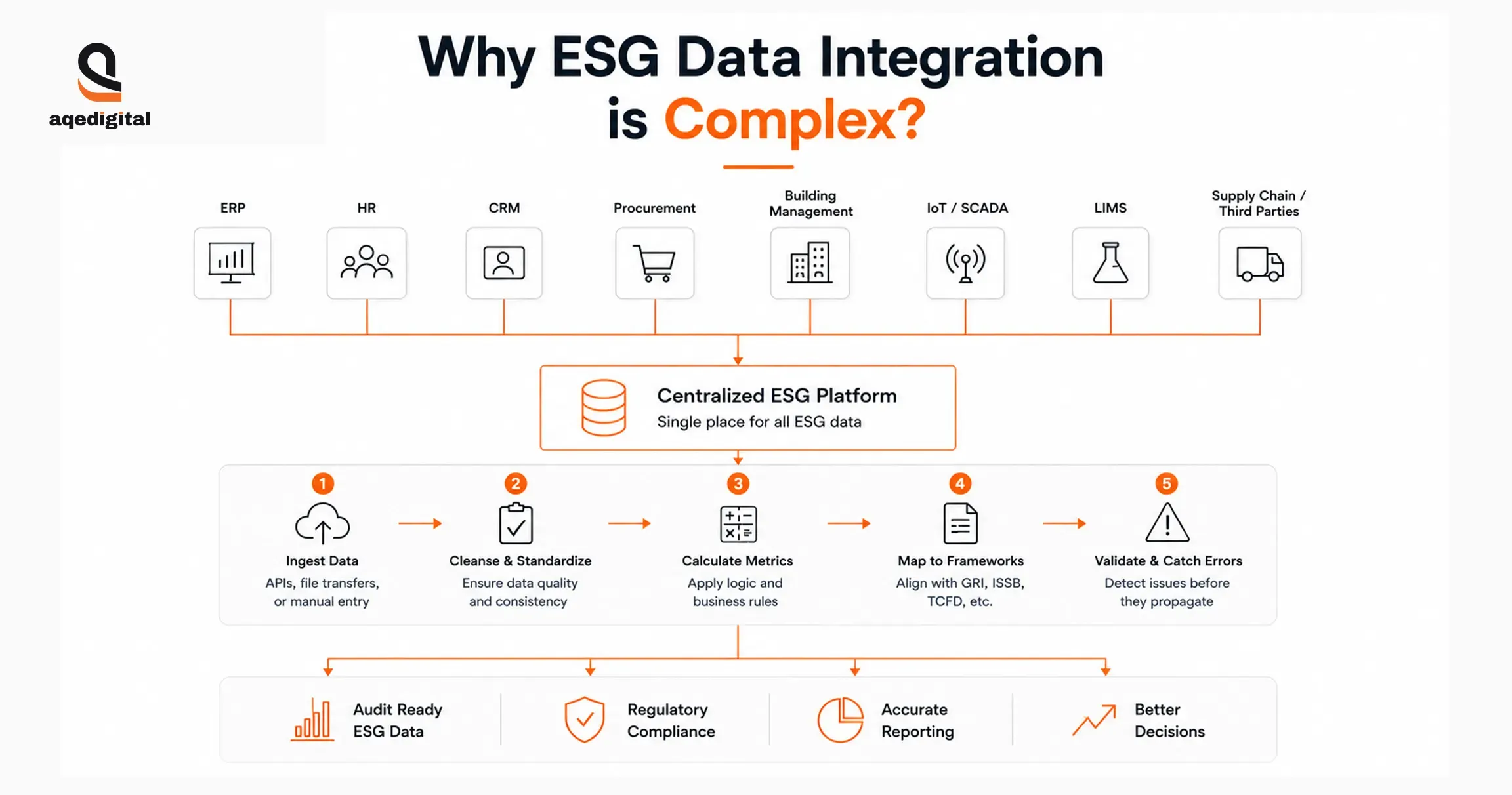
It generally has multiple phases:
- Ingesting the data via APIs
- File transfers, or manual entry
- Cleansing and standardizing the data across units
- Calculating metrics
- Mapping the data to reporting frameworks
- Catching the data errors before they get downstream.
An integration of operational systems, such as ERP (enterprise resource planning), SCADA (the control systems used for industrial equipment), nd LIMS (laboratory information management systems), is one of the largest technical problems in the field of sustainability reporting.
These systems have no intention of communicating with one another, and getting them to communicate requires some engineering work, not a data pipeline.
How to Track Key ESG Metrics with Data Analytics?
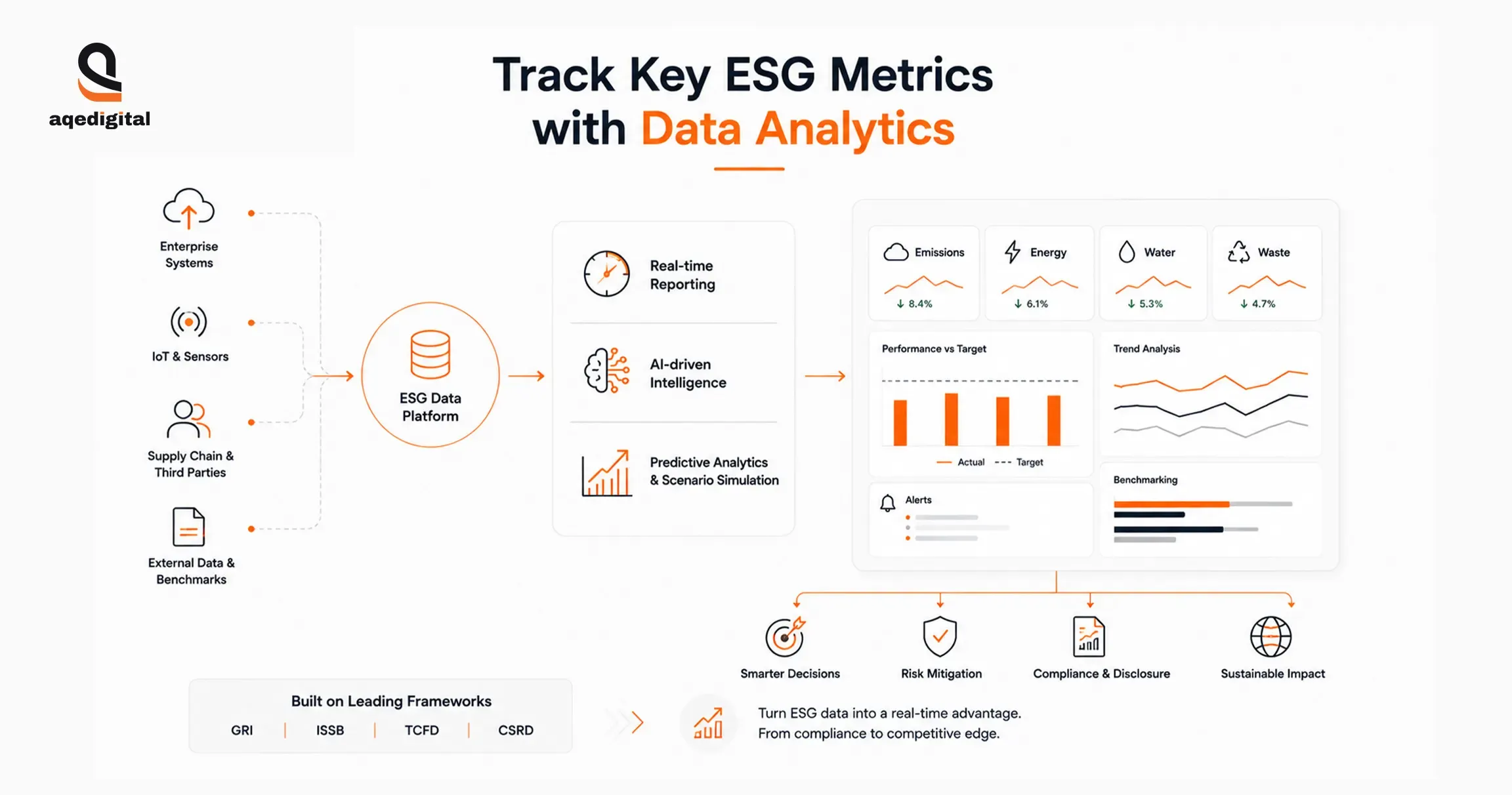
A robust platform for ESG easily transforms raw data into real-time dashboards that identify inefficiencies, compare against targets or other companies, and enable quicker, data-driven decisions. This isn't cosmetic.
Real-time reporting makes annual disclosure into a real-time management tool, so any leader who sees a disclosing metric drift in one quarter, rather than next year's audit, will be alerted. Dashboards make good data available to become usable data. That's the job of visualization.
AI-driven ESG data intelligence
AI now handles much of the heavy lifting: automating data ingestion, flagging anomalies, and modeling risk with a level of accuracy and scale that manual review can't match.
Combined with Data Analytics Consulting Services, these AI capabilities help organizations transform ESG data intelligence from a retrospective compliance function into a real-time risk management strategy.
Predictive analytics and scenario simulation
Predictive analytics pushes this further, forecasting ESG trends so companies can pre-empt risks before they materialize, with climate impact on supply chains being a common example. The payoff is measurable.
Platforms like SAP and Microsoft Sustainability Cloud are increasingly built around this shift, embedding IoT and digital twin capabilities directly into ESG workflows, while frameworks like GRI, ISSB, TCFD, and CSRD continue to define what "good" looks like on the reporting side.
The organizations getting ahead aren't just complying with these standards. They're using the data infrastructure built for compliance to make sharper business decisions.
How to Build Your ESG Data Strategy: A Seven-Step Roadmap
ESG data management isn't a checklist you tick top to bottom. It's a lifecycle. Every stage leans on the one before it, and skipping a step early on, you'll usually end up redoing three of them later. So here's how the whole thing actually runs, from your first raw data point to the disclosure you file.
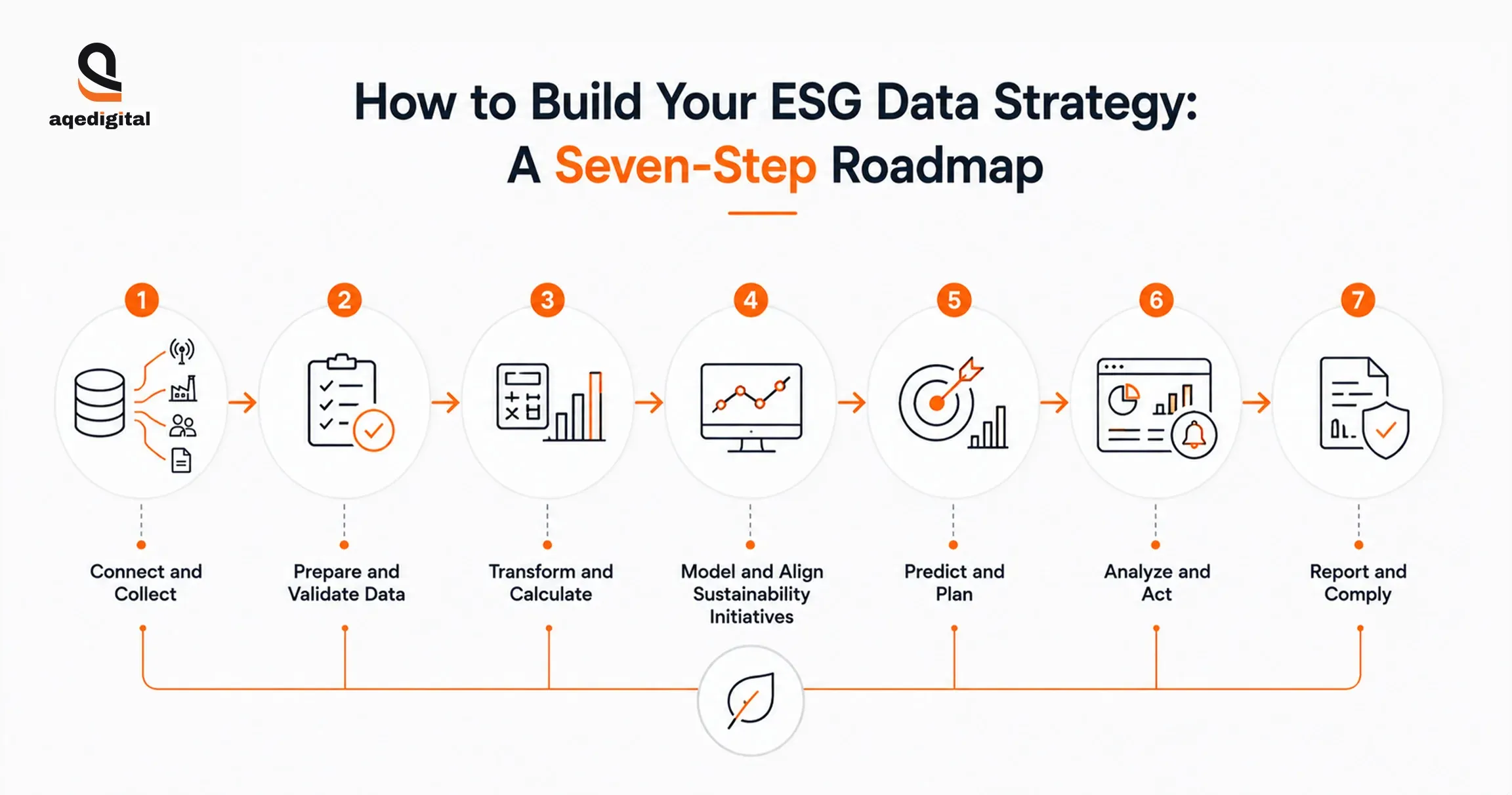
Step 1: Connect and Collect
It all kicks off with pulling data out of the systems where it currently hides, like energy meters, fleet logs, procurement spend, and HR platforms, and moving it into a purpose-built ESG data model. This isn't optional prep work you can bolt on later. It's the floor everything else stands on.
Want to survive an audit eighteen months from now? Then you need unique identifiers that trace back to source documentation, plus a validation log that proves where every single number came from. Build this around recognized standards like IFRS, CSRD, and GRI from day one, and lining up your reporting later gets a whole lot less painful.
Step 2: Prepare and Validate Data
Raw data is rarely usable data. Once it's collected, you have to transform and map it: convert units of measure, reconcile currencies, standardize formats that never matched across sources in the first place.
This is where strict validation rules pay for themselves. They flag the metrics your organization actually needs, catch quality problems before those problems spread, and handle the exceptions so only clean data ever reaches your systems. Skip it? Then every calculation downstream quietly inherits the mess.
Step 3: Transform and Calculate
Now the real conversion happens. Validated data turns into standardized ESG metrics and KPIs. Scope 1, 2, and 3 emissions get mapped to adjustable emission factors, which means carbon accounting runs on its own instead of someone eyeballing it in a spreadsheet.
Built-in process management matters more here than most people expect. It gives you the transparency to drill back into any KPI you've reported, trace where a calculation went wrong, and reconcile the gaps before an auditor turns them into findings.
Step 4: Model and Align Sustainability Initiatives
No two business units carry the same sustainability pressure. That's why scenario modeling earns its place. It lets you see how a specific line-of-business decision ripples out into company-wide goals.
The more advanced models push further. They fold in internal carbon fees and carbon accounting, so environmental risk and financial performance stop being two separate conversations and start showing up as one picture.
Step 5: Predict and Plan
If it does not involve operational planning, then it is like a poster on the wall; it is not a sustainability goal. This step will take those goals into action and roll them into the short- and long-term plans spanning the business.
Predictive planning and machine learning glean information from the outside and from the inside, test your assumptions, and project where things will end up, and warn you to come out of the corner if you're off track, before you miss your target and you don't know it.
Step 6: Analyze and Act
A spreadsheet is a decision-making tool, and data in a spreadsheet is not a decision. Integrate ESG performance into interactive dashboards, and at a single click, those who must take action can see the real-time impact in front of them.
Extend the time for management to resolve an issue by adding AI-powered alerts that detect patterns and anomalies, or material variance that arises on its own, that becomes a disclosure headache.
Step 7: Report and Comply
The last step ties it all together. Live data, visual dashboards, narrative context, all folded into one collaborative reporting process instead of four disconnected ones. Regulations move constantly, so your reporting setup has to bend with them rather than break.
Get this right, and you can generate disclosures across CSRD, TCFD, IFRS, and CDP without rebuilding the whole process every time a framework shifts. One coherent sustainability story. Not four that contradict each other.
Why AQe Digital: Building ESG Data Infrastructure That Survives an Audit?
Most vendors sell you a dashboard. That's the easy 20% of ESG data management. The hard 80% is everything sitting underneath it: reconciling a SCADA reading against an ERP entry, proving where a Scope 3 number came from a year and a half after you filed it, keeping the methodology steady when four different teams have all touched the same figure. That underlying layer is where we work.
We don't treat ESG data like a reporting plug-in. We treat it as a data-engineering problem because that's what it actually is.
Our teams have spent years wiring together systems that were never designed to talk to each other, like ERP, HR platforms, IoT sensor networks, procurement, and third-party supplier feeds, into a single governed source of truth. The dashboard is the last mile. The pipeline, the validation logic, the audit trail: that's the moat.
Three Things Set an AQe Build Apart From an Off-the-Shelf ESG Tool.
Engineering-first integration. We won't force your data through a rigid template. We map the system landscape you actually have, then build ingestion and transformation pipelines that hold up when your stack changes, not just on demo day.
Governance baked in, not bolted on. Every metric traces back to source documentation with a validation log attached. So when a regulator or an investor challenges a number, you defend it in minutes. Not weeks.
Framework-agnostic reporting. CSRD today. ISSB tomorrow. Whatever lands after that. We architect the reporting layer to flex across GRI, TCFD, IFRS, and CDP, so a new mandate becomes a configuration change instead of a rebuild.
The organizations pulling ahead didn't buy a tool and cross their fingers. They built infrastructure. That's the work we do, and it's why a CFO can certify what comes out the other end without flinching.
Build an Audit-Ready ESG Data Foundation
ESG data is audit-grade data now, whether your systems are ready for that or not. And fewer than 30% of organizations feel confident in the numbers they're already filing. That gap is the whole game.
Collection, governance, integration, analytics: these aren't four projects fighting each other for budget. They're one connected ESG data strategy, and the payoff only compounds when you build all four, in order. Do one, and you get a tidier spreadsheet. Do all four, and you get a forecasting engine that pays for itself.
The companies pulling ahead started before any mandate forced their hand. That window is still open.