Drive Agility and Efficiency With Our Ensured Enterprise Software Testing Process

Joy Chauhan

Software quality management is the foundation that ensures and paves the way for enterprises to achieve better operational efficiencies, productivity, user experience, user engagement, accessibility, and overall performance. As enterprises heavily rely on software solutions to drive business workflows and operations, having the best quality software is crucial. But why is having up-to-the-mark software quality important? As per the report published by CISQ, poor software quality costs approx $2.41 trillion to US businesses due to operational failures, defects, and security breaches.
At AQe Digital, we don’t limit our software quality assurance process just to detecting bugs or defects. We deliver reliable, secure, scalable, and high-performing software followed by stringent QA processes. Our team ensures that delivered software is in adherence to business objectives, goals, and requirements.
But why does our team emphasize the quality assurance of software? Because the significance of software quality extends beyond the limitation of functionalities and performance. It directly impacts user trust, brand image, engagement, and long-term business growth. Poor software quality eventually results in financial losses, legal consequences, and operational inefficiencies for the businesses.
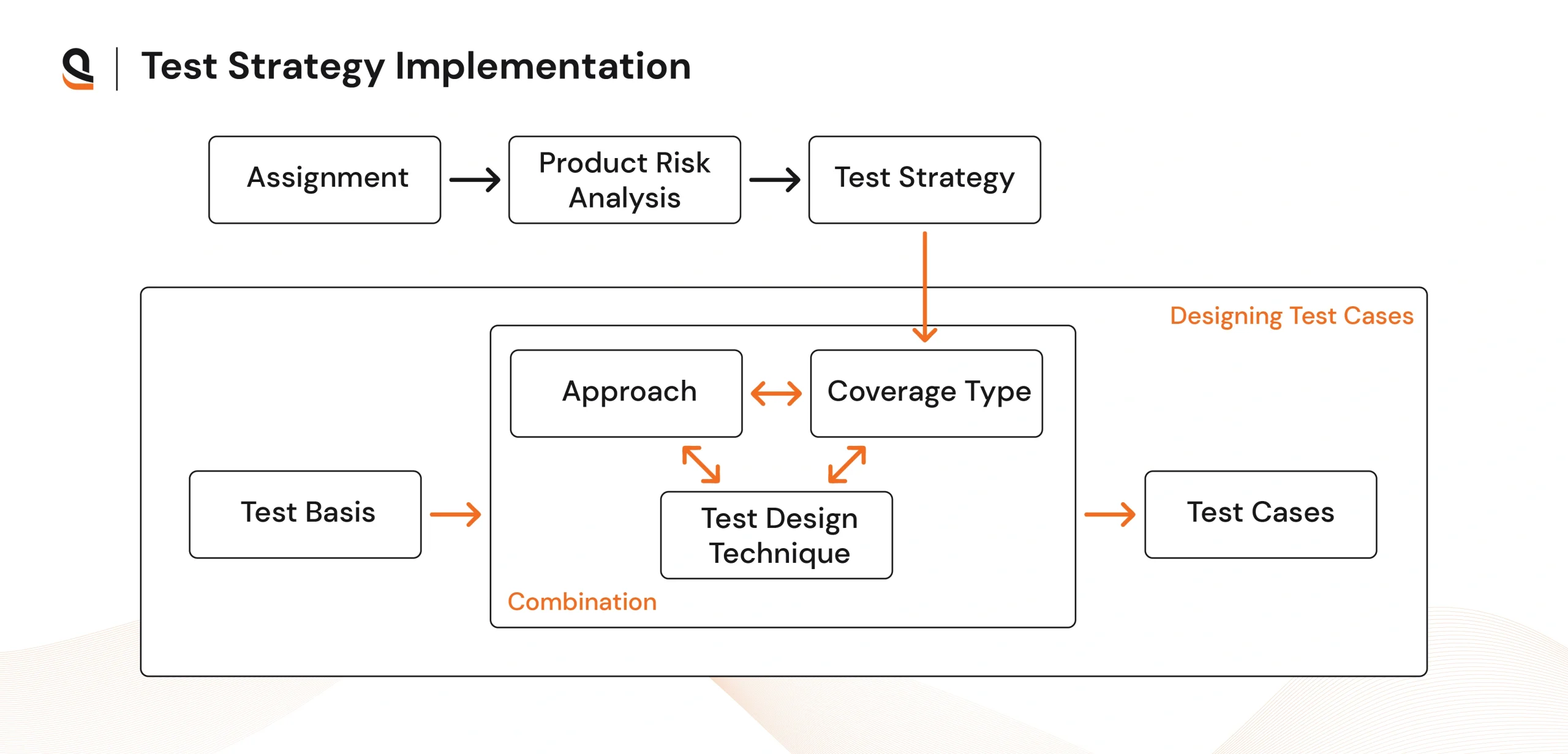
A well-planned enterprise software testing can help minimize these risks, ensuring successful deployment and robust performance of the software.
What Are the Common Challenges in Maintaining Software Quality?
Software quality management is a multifactorial approach that faces certain challenges listed below:
Rapid development cycles: The demand for faster product releases and evolving development processes puts teams under pressure. It leads to compromised or incomplete testing and rushed deployments, sometimes which may result in poor-performing system.
Lack of proper test coverage: Inadequate test cases and insufficient testing efforts result in undetected defects that can surface in production. Sometimes, inadequate knowledge of the system requirements or the requirement traceability adds up as a major contributor to improper quality.
Complex Integration: Software quality assurance can be challenging as modern contemporary systems need to integrate with third-party apps, legacy systems, and APIs.
Security: Safeguarding the software and its data during the development process from cyber threats and data breaches without proper security measures.
Inefficient Collaboration: Missing project requirements and irrelevant functionalities due to communication gap and inefficient coordination.
Human Error: Lack of automated testing increases the chances of human error and software defects. Additionally, resorting completely to manual testing may slow down the QA process or consume more time.
Significance Of Software Quality Assurance
Software quality management is crucial in the software development lifecycle (SDLC) which helps identify defects during the development phase. It also helps the team ensure they are on the right track, eradicating financial and time loss for the client as well as the development team. Having a well-planned enterprise software testing strategy and its proper execution enhances software reliability, security, and performance. Software quality assurance also helps stakeholders ensure the product functions as intended under varying conditions.
Having good quality software helps businesses in multiple ways, such as:
- Reduced system failures and downtime for better operational efficiency.
- Better user experience, engagement, loyalty, and retention.
- Decrease in maintenance and support costs by early defect detection.
- Ensured compliance and security.
- Facilitates scalability, flexibility, and agility, driving business growth.
- Brand awareness and brand building.
- Strengthening security proactively.
What is Software Quality Assurance and What Are Its Objectives?
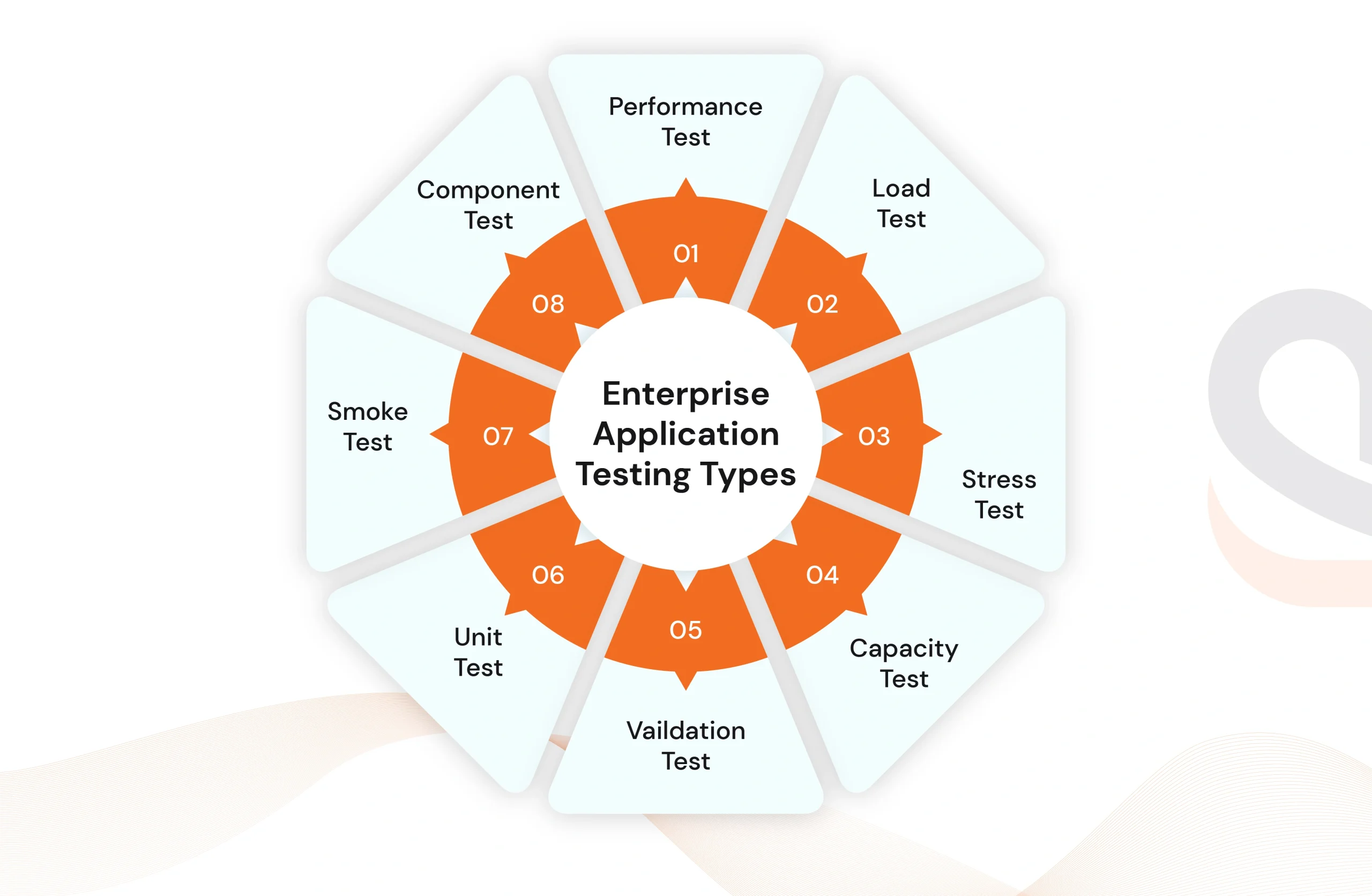
Software quality assurance is about ensuring the software quality through processes, procedures, and standards, with a focus on preventing errors in every phase of software development. The reliability, functionality, security and the user experience of the software is ensured systematically with the enterprise software testing.
Key Objectives of QA Are as Per the Below List:
- Identify the defects or issues in the early development stage and eliminate it to keep the production unimpacted from these issues.
- To ensure compatibility with multiple devices, browsers, and platforms, and to provide an enhanced user experience.
- Detecting vulnerabilities, security threats, and potential breaches to mitigate cyber threats and validate security measures with stringent testing.
- Maintain standard regulatory compliance with GDPR, HIPAA, and other regulations.
- Assess scalability and optimize software performance and reliability by conducting stress testing and load testing.
- Checking navigating, accessibility, and responsiveness of the product for best user experience.
- Synchronizing the functionalities, interfaces, and performance of the software with business goals and end-user expectations.
Test Planning and Strategy- In this first step of the software quality assurance process, our team defines the scope, objectives, and test methodologies, laying the foundation for a systematic and effective QA approach. In this initial phase, our team understands the project requirements to set clear goals for the testing phase. We select appropriate tools and technologies in this stage that align with the project’s lifecycle and business goals.
Test Case Development- To ensure comprehensive coverage and cover a wide range of scenarios during development, our team creates detailed test cases to validate various aspects. The test cases cover multiple aspects like requirements, performance benchmarks, security protocols, usability standards, and others. Having well-documented test cases ensures thorough coverage, validating specific functionalities or features of the software. It also provides a basis for evaluating the software’s behavior under different conditions.
Test Execution- This phase is crucial as our team runs the developed test cases to identify defects and verify software functions as programmed or intended. We follow manual as well as automated testing strategy to maintain consistency and speed, using a detailed and nuanced approach. This multi-approach test execution encompasses functional, integration, system, and regression testing.
Defect Management- Our team identifies, reports, and tracks defects, maintaining software quality during test execution. The identified defect gets documented in detail, and the development team is notified to resolve it. As part of the regression cycle, we revalidate fixed defects to ensure they do not introduce new issues and that the software functions as expected. Clear communication and collaboration are essential between QA and development teams to prioritize and resolve these issues promptly and effectively.
Performance & Security Testing- To assess how software behaves or responds under various load conditions, our team conducts performance testing for better software quality management. It is essential to ensure that the software can manage real-world usage scenarios by assessing stress, load, and scalability evaluations. Given the sensitive nature of the data managed by enterprise software, security best practices are our key focus. Our security testing process focuses on identifying vulnerabilities, potential breaches, cyberattacks, and other potential security concerns.
User Acceptance Testing (UAT)- This process is crucial to validate and confirm that the software meets the business needs and expectations. Business teams and stakeholders are involved in this QA process to confirm the functionalities developed and their adherence to business goals. UAT provides an opportunity to gather feedback from users before final deployment and ensure the software aligns with the overall business objectives. With this process, stakeholders can also identify usability challenges or areas for improvement, ensuring the final product is robust, user-friendly, and ready for real-world use.
Tools and Techniques for Software Quality Assurance
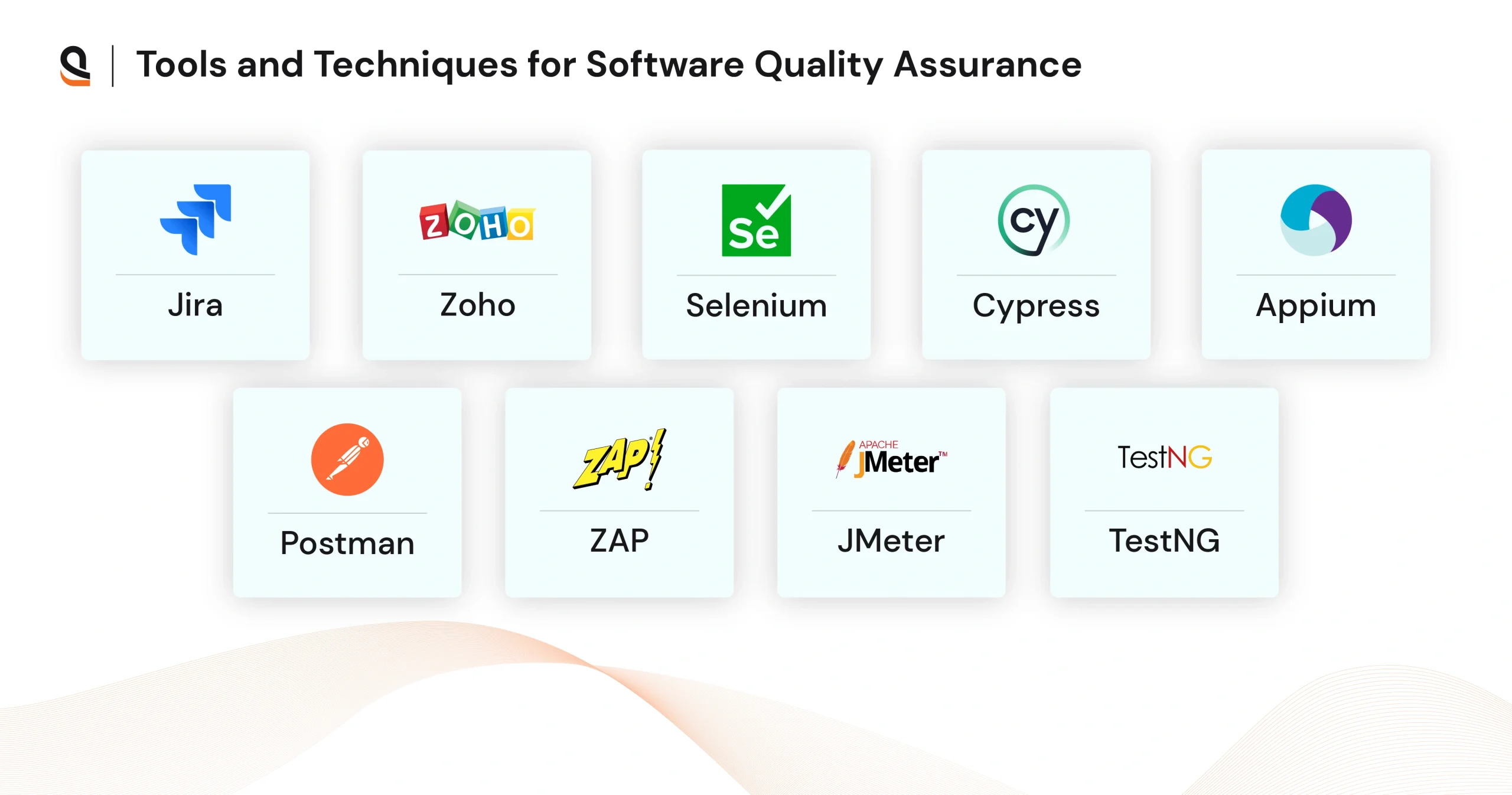
The QA tools and techniques help QA teams enhance testing efficiency, improve defect tracking, and ensure robust software quality. Following are the various tools and techniques used for testing and quality assurance of the software.
- Jira & Zoho: These are widely used project management and issue-tracking tools that help QA teams log, track, and resolve defects efficiently. They enable collaboration between development, testing, and management teams.
- Selenium & Cypress: Automation testing frameworks used for web applications. Selenium is ideal for cross-browser testing, while Cypress helps with rapid execution and debugging.
- Appium: It facilitates automation across different devices, ensuring smooth performance.
- Postman: It helps developers ensure seamless backend communication. It is an API testing tool that helps validate functionality and performance.
- ZAP: Zed Attack Proxy (ZAP) acts as a penetration testing tool used to identify any potential security issues and vulnerabilities like SQL injection, cross-site scripting (XSS), insecure cookies, and more.
- JMeter: Analyze how the software responds or behaves under diverse loading conditions, using this advanced performance testing tool to ensure scalability and reliability.
- TestNG: Leverage the advanced automation capabilities for unit, functional, and integration testing with this Java-based testing framework.
Testing Techniques
Static & Dynamic Testing:
- Our team resorts to static because it is an ideal testing approach to avoid errors and defects during the development cycle. With this technique, testing can be done without executing the code and without running the program or software.
- Our team validates and tests the dynamic nature of the software with the code base execution using dynamic testing. We execute it with dynamic inputs that include both positive and negative testing. This testing technique focuses on the software’s functionalities and how it behaves under dynamic conditions, detecting runtime errors.
Functional & Non-Functional Testing:
- With functional testing, our team validates all the features, functionalities, and system behavior, ensuring that the software meets all business requirements.
- Our quality experts verify the behavior and quality of the application, contributing to the end-user experience with non-functional testing. With this testing approach, we conduct tests related to performance, loading, usability, and security to improve the overall efficiency of the product.
How Does AQe Digital’s Quality Assurance Process Help You Get The Best Quality Software?
At AQe Digital, our team follows a stringent enterprise software testing process using advanced tools and technologies to deliver the best quality custom software.
Comprehensive Testing Approach: Our team implements a comprehensive QA framework covering functional, performance, security, usability, and automation testing to deliver robust software.
Industry-Specific Expertise: With experience across manufacturing, healthcare, retail, and more, AQe Digital tailors its QA strategies to meet the unique business requirements across multiple industries.
Expert QA Team: Our highly skilled QA engineers understand business-specific challenges and craft tailored testing solutions to deliver the best quality software.
Seamless Integration & Continuous Testing: Our QA process integrates seamlessly with CI/CD pipelines, ensuring real-time testing and faster releases without compromising software quality.
Proven Track Record with 93% Client Retention: Our commitment to delivering high-quality custom software solutions has resulted in long-term partnerships and collaborations with global clients.
Conclusion
The software quality assurance process is crucial to ensure the functionality, performance, and quality of the software. It is not limited to detecting defects and bugs- indeed, it ensures how software will respond, react, and perform in dynamic conditions and real-world scenarios. Compromising software quality is compromising your business goals, objectives, growth, and overall business outcomes. Contact us to make your software excel beyond expectations, leveraging our 27+ years of experience and domain expertise.
