Enterprise Asset Management Software: A 2026 Buyer's Guide for Asset-Intensive Enterprises

Cheta Pandya
By 2026, 79% of manufacturers still report recurring unplanned downtime. That number should be uncomfortable reading for anyone who has signed a maintenance technology cheque in the last five years. Sensors got cheap. Condition monitoring matured. Roughly seven in ten plants already run a maintenance or asset platform of some kind.
The tools arrived, and the outcomes did not follow. Enterprise asset management software sits right in the middle of that gap, which is why choosing one has quietly stopped being a software decision and become a data and process decision.
This guide covers what EAM software actually controls, how it differs from a CMMS and your ERP's asset module, what the current benchmarks show, and how to decide between buying, extending, and building.
What is EAM, and What Does an Enterprise Asset Management System Actually Control?
An enterprise asset management system is a controlled network of software and services for maintaining physical assets and infrastructure across their full lifecycle. It collects and analyses data from asset procurement through end-of-life disposal. That last clause is the whole distinction.
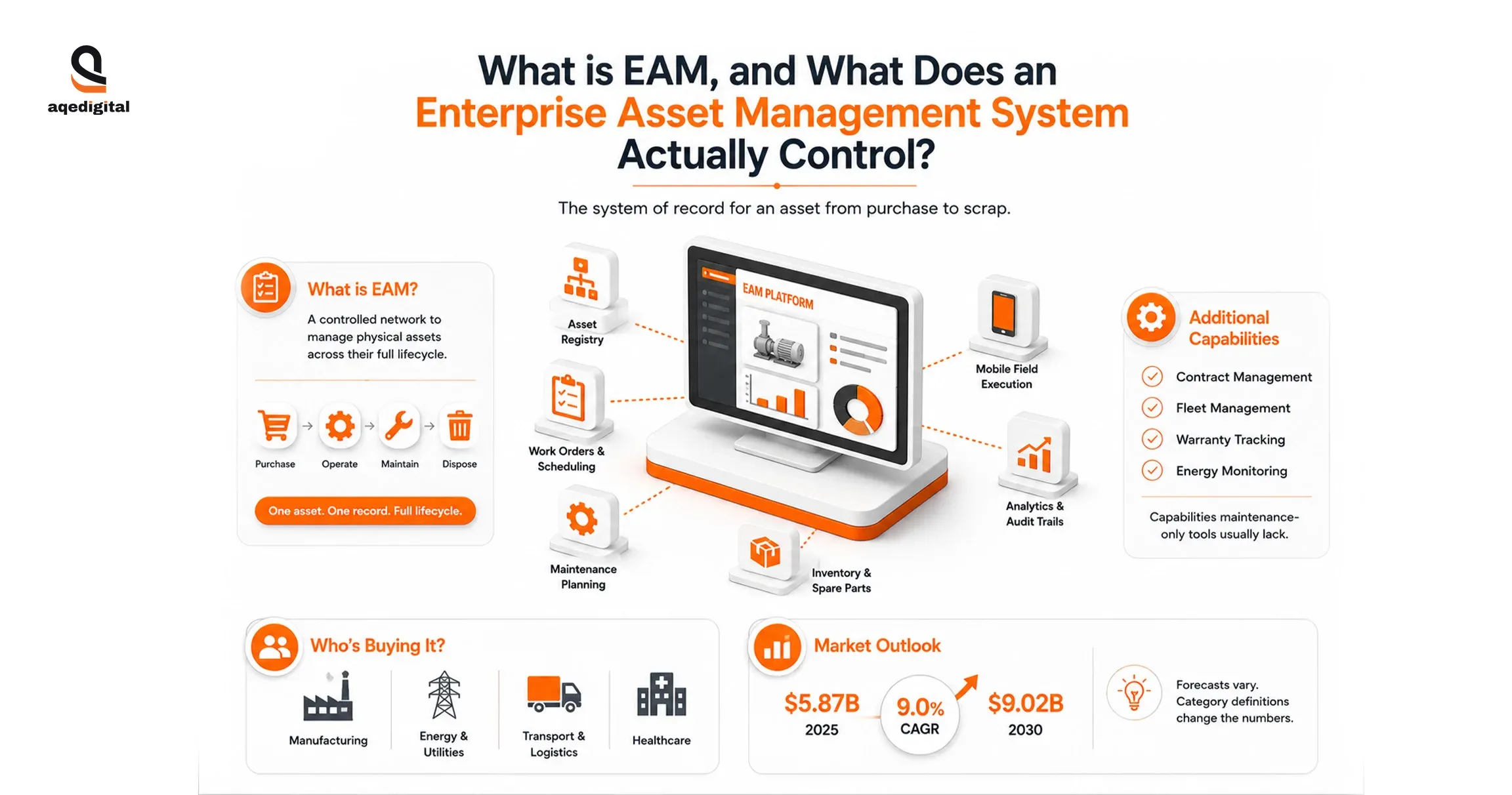
So when a plant team asks what EAM is in practical terms, the shortest honest answer is that it is the system of record for an asset from purchase order to scrap value. EAM software is not a repair-tracking tool with a bigger license fee.
What sits inside the platform?
A working enterprise asset management system carries an asset registry with a modeled hierarchy, work order management and scheduling, preventive and condition-based maintenance planning, MRO inventory and spare parts control, mobile field execution, and the analytics and audit trails your compliance team will eventually ask for. EAM adds contract management, fleet management, warranty tracking, and energy monitoring on top of that, capabilities a maintenance-only tool usually does not carry.
Who is actually buying it?
Manufacturing leads adoption in the market, followed by energy and utilities, transport and logistics, and healthcare. The market itself is projected to move from $5.87 billion in 2025 to $9.02 billion by 2030 at a 9.0% CAGR.
Treat that forecast as directional. Research houses disagree materially on EAM market sizing because they draw the category boundary in different places, and anyone quoting a single figure as settled fact has not read two reports.
EAM Software vs CMMS vs ERP: Where the Lines Actually Sit
This is the comparison your evaluation committee will spend the most time arguing about, so it is worth being precise rather than diplomatic.
| CMMS vs EAM vs ERP Asset Module | |||
| Dimension | CMMS | EAM Software | ERP Asset Module |
| Primary scope | Operational maintenance of assets in service | Full asset lifecycle, procurement through disposal | Financial control of the asset as a balance sheet item |
| Multi-site support | Single site or limited multi-site | Multi-site across geographies | Enterprise-wide, but weak on field execution |
| Functional breadth | Work orders, PMs, parts | Adds contracts, fleet, warranty, energy monitoring | Adds depreciation, procurement, finance integration |
| Field mobility | Usually strong | Strong, with offline capability | Typically the weakest of the three |
| OT and sensor ingestion | Limited | Native or well-supported | Rare without middleware |
| Implementation cost | Lowest | Highest | Already sunk, extension cost varies |
| Best fit | One site, maintenance-only mandate | Multi-site, capital-intensive, regulated | Asset accounting, not asset operations |
Now the part most vendor content avoids. If you run one plant, your asset base is under a thousand items, and nobody is asking you for lifecycle cost forecasts, a CMMS is the correct answer and EAM software will be expensive shelfware.
The threshold where EAM earns its cost is multi-site operations with capital assets whose replacement timing affects the balance sheet. Your ERP will not close that gap on its own, because ERP asset modules are built to depreciate an asset.
Buying up a category you have not outgrown is the most common and most expensive EAM mistake.
The Asset Management Tools That Move Your KPIs, and the Ones That Just Demo Well
Every platform demo covers the same eight modules. Only some of the asset management tools inside them change a number your CFO tracks.
Work order management and mobile execution
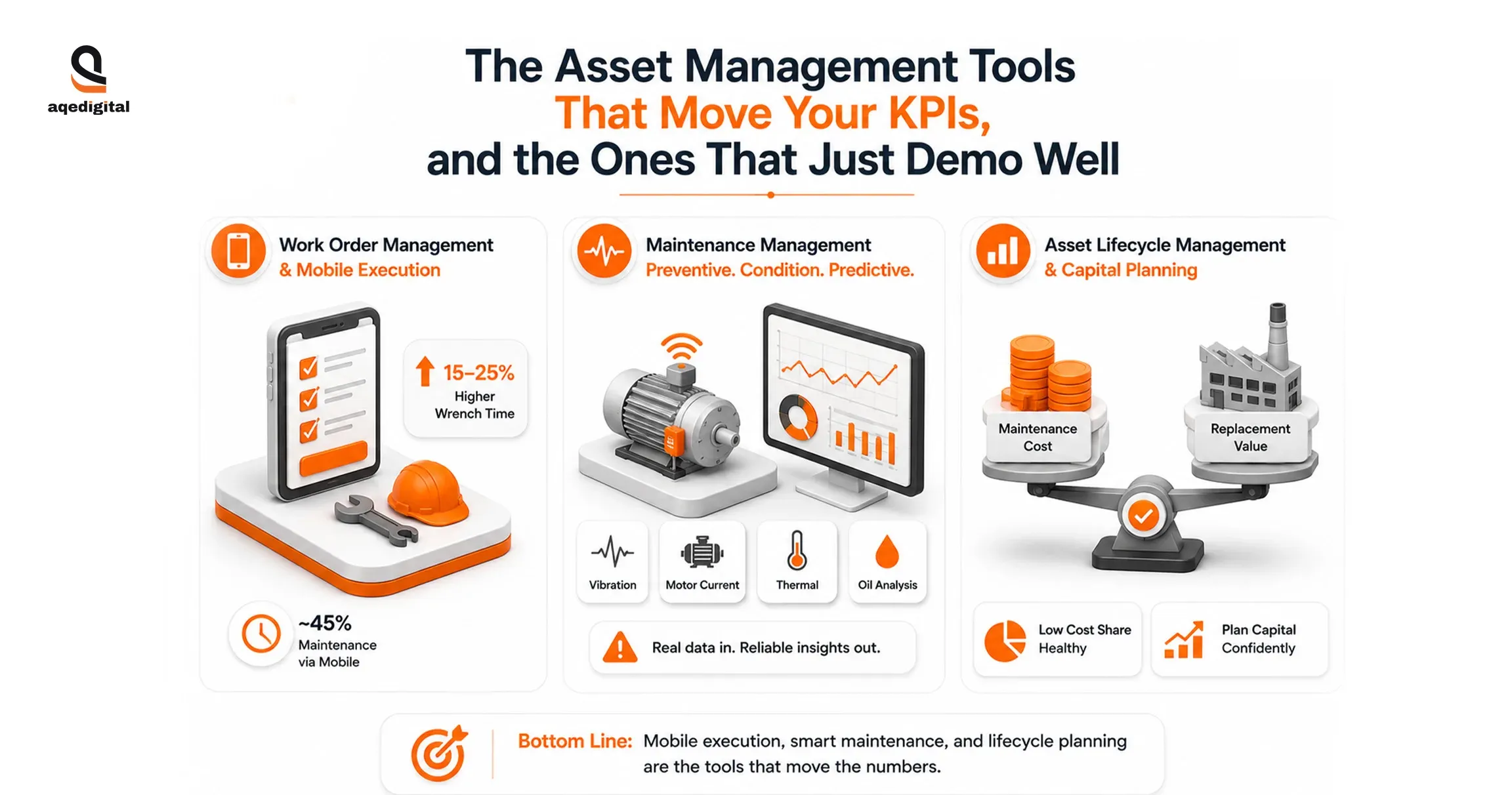
Mobile is where execution quality actually improves. Around 45% of maintenance is now executed through mobile applications, and mobile-first deployment lifts wrench time by 15 to 25 percentage points by removing the round trip to the maintenance office. That is the single largest execution-quality gain available in most plants, and it requires no sensors at all.
Asset maintenance management software: preventive, condition-based, predictive
Most factories now fix machines on schedule, not after breakdown. But reactive work still eat big slice.
Predictive maintenance hype bigger than reality. Few plants run real AI predictive. Fewer still close loop, where system decide and act on own. Many teams say they deploy AI soon. Saying not doing.
Software where these plans live or die. Bad failure-mode data in = confident garbage out. Model no smarter than labels you feed it.
Sensor detail before you buy
One sensor type not enough. Combine vibration + motor current signature analysis + thermal + oil analysis into single health score. False alarms drop hard. Fault-type accuracy climb high.
Single-sensor programs die after year and half. Reason: nuisance alarms. Team stop trusting, team switch off.
Asset lifecycle management software and capital planning
Money argument not "repair faster." Money argument is defensible capital planning.
Key metric: maintenance cost as share of replacement asset value. Low share = healthy. High share = you not running maintenance programme, you funding emergencies, rush freight, long stoppages.
Preventive work pay back several dollars per dollar spent.
Lifecycle software let you show Finance two things: which assets eat the budget, and which assets near point where rebuild cost more than buy new.
Cloud-Based Asset Management Software: Deployment Is Now an Integration Decision
If your assets sit behind a segregated OT network, hybrid is still the correct architecture, and the security case has strengthened rather than weakened.
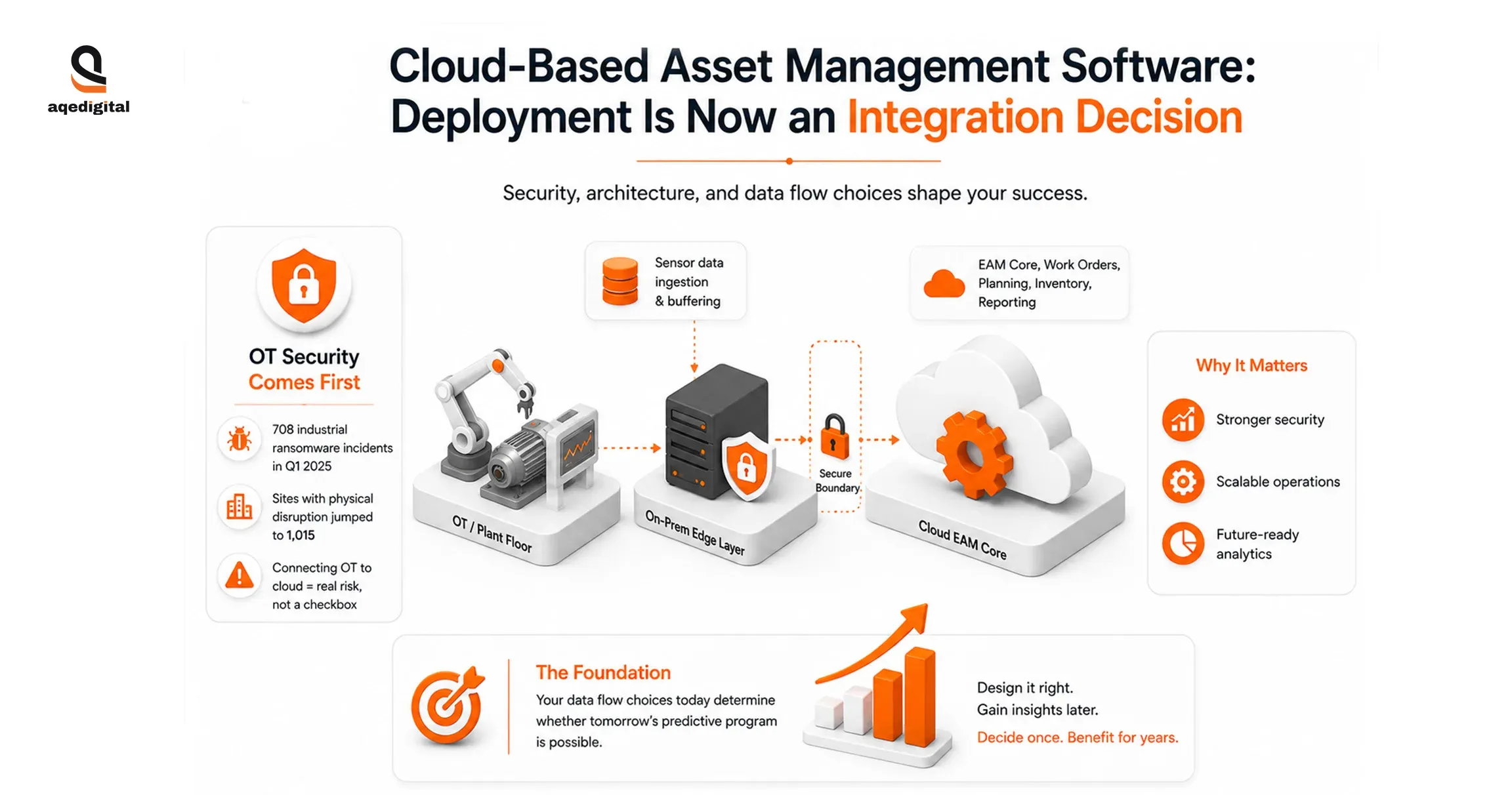
Industrial ransomware incidents reached 708 in Q1 2025, and the number of sites suffering physical disruption from cyber attacks rose from 412 to 1,015 in a single year. Connecting a SCADA historian to a cloud asset platform is an architecture decision with an OT security blast radius, not a checkbox on an implementation plan.
The practical shape most enterprises land on: cloud for the EAM core, work orders, planning, inventory, and reporting, with an on-premise edge layer handling sensor ingestion and buffering before anything crosses the boundary.
That structure is also what makes a future analytics layer possible, because the decisions you make about data flow in year one determine whether a predictive program in year three is even feasible.
Buy, Extend, or Build: The Decision Most EAM Guides Skip
The top three causes- inadequate change management, poor data migration, and inexperienced teams- account for more than 75% of failures. Not one of those three is a software selection problem.
That reframes the question. You are not choosing a product. You are choosing which of those three risks you are best equipped to absorb.
- Buy a packaged suite when your processes are close to industry-standard, you need vertical templates and audit trails out of the box, and you have the internal capacity to change your process to fit the software rather than the reverse.
- Extend your ERP when asset accounting is the real requirement, field execution is light, and the integration cost of a separate platform exceeds the functional gain.
- Build or heavily configure when your asset model, regulatory reporting, or OT integration is genuinely non-standard, and a suite would need enough customization to inherit the upgrade debt anyway.
Seven criteria separate platforms once you get past feature lists: asset hierarchy depth and multi-site modeling, the ERP and finance integration path, OT and IoT ingestion, offline mobile capability, configurability versus customization debt, vertical audit and compliance requirements, and five-year total cost of ownership including migration and change management.
The last one is where most business cases quietly fail, because license cost is the number everyone models and data migration is the number nobody does
Final Thoughts
Your job is not to pick the platform with the longest feature list. Your job is to work out which of the three failure causes behind 68% of ERP-class projects your organization is least prepared for, and to buy, extend, or build in a way that neutralizes it. Asset data quality is the constraint. Integration architecture is the constraint.
Change capacity is the constraint. The license is rarely the constraint. The decision is not whether you will manage assets in software. That decision is already made. The decision is whether you fix the data before the deployment or after the overrun.
Not sure whether your asset data can carry the platform you are about to buy? Book an asset data and integration readiness assessment with AQe Digital, and we will map your current asset hierarchy, integration points, and migration risk before you commit to a license.