eCommerce Personalization: Architecture, Data & Implementation

Nirav Oza
Customers increasingly expect eCommerce brands to understand what they need, recognize their Intent, and reduce the effort required to find the right product. That expectation has moved personalization beyond marketing campaigns and recommendation widgets into the core architecture of digital commerce.
McKinsey reports that 71% of consumers expect personalized interactions, while 76% become frustrated when those interactions are absent. Its research also found that faster-growing companies generate 40% more revenue from personalization than slower-growing peers.
That creates a technical challenge for eCommerce organizations operating across large catalogs, multiple channels, changing inventory, anonymous traffic, and fragmented customer data.
The real challenge is not adding personalization features; it is building the data, decisioning, and delivery architecture capable of making personalization reliable at scale.
This article explains how that architecture should be designed, where machine learning and real-time data fit, and how eCommerce teams can implement personalization without creating another disconnected technology layer.
Why eCommerce Personalization is Becoming an Architecture Problem
Early personalization programs often began with relatively simple rules, such as recommending products based on previous purchases or displaying recently viewed items.
Those approaches remain useful, but modern eCommerce environments introduce significantly more variables.
A customer may arrive anonymously from organic search, browse several categories, search for a specific product, compare alternatives, add an item to the cart, leave the site, return from another device, and complete the purchase days later.
Meanwhile, the product catalog itself continues changing through:
- New product launches and discontinued products
- Inventory and availability changes
- Price and promotion updates
- Product attributes and taxonomy changes
- Seasonal demand patterns
- Geographic assortment differences
- Merchandising priorities
A personalization system therefore needs to understand customers, products, context, and business constraints simultaneously.
| The architecture has four major responsibilities | ||
|---|---|---|
| Layer | Primary responsibility | Typical capabilities |
| Customer data | Understand the shopper | Profiles, events, identity, preferences |
| Product data | Understand available products | Catalog, attributes, inventory, taxonomy |
| Decisioning | Determine relevance | Rules, models, ranking, segmentation |
| Experience delivery | Surface decisions quickly | APIs, caching, frontend integration |
When these layers operate independently, personalization becomes inconsistent and makes it difficult to deliver a personalized shopping experience across different customer journeys.
The Data Foundation Determines Whether Personalization Can Scale
A sophisticated model cannot compensate for incomplete, delayed, duplicated, or poorly structured data.
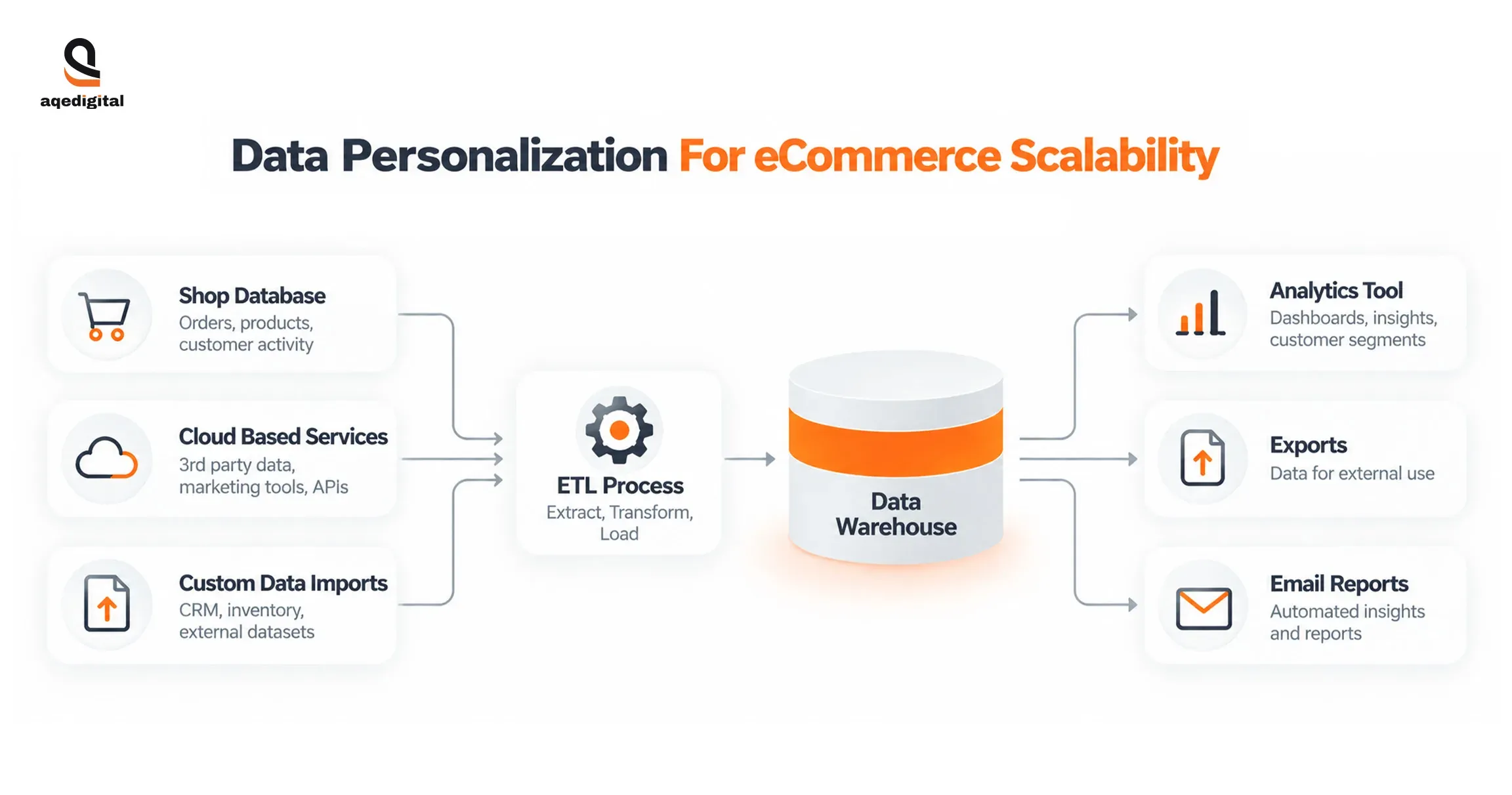
A personalization engine for eCommerce needs to evaluate customer behavior, product relevance, context, availability, and business constraints before determining what the shopper should see.
What should the data layer capture?
A mature eCommerce personalization architecture commonly brings together several categories of information.
Behavioral signals
Clicks, searches, product views, cart activity, purchases, returns, wishlist activity, and engagement provide direct evidence of customer intent.
Contextual signals
Device type, location, session context, referral source, time, channel, and campaign context help interpret behavior more accurately.
Customer information
Account attributes, loyalty status, preferences, purchase history, and customer lifecycle information provide longer-term context.
Product information
Category, brand, attributes, price, availability, product relationships, margin, and merchandising metadata determine what can actually be recommended.
Operational signals
Inventory availability, fulfillment constraints, promotions, pricing rules, and business priorities prevent theoretically relevant recommendations from becoming commercially unsuitable recommendations.
The most useful eCommerce personalization examples are not limited to product recommendations; they include search, merchandising, content, promotions, and customer engagement.
Product Information Has Equal Importance to Customer Information
Personalization discussions frequently focus on customer behavior while underestimating product data quality.
That creates a major architectural weakness.
A model may correctly understand that a shopper prefers lightweight running shoes, but the recommendation becomes useless if the product catalog does not contain reliable information about weight, terrain, size availability, gender, or intended use.
Product intelligence should include more than catalog metadata
A scalable product data layer can incorporate:
- Product attributes and variants
- Category and taxonomy relationships
- Brand relationships
- Product compatibility
- Price and promotional status
- Inventory availability
- Historical sales performance
- Customer ratings and reviews
- Product descriptions and semantic representations
- Margin or commercial priority
This matters beyond recommendations because product information influences search, filtering, ranking, merchandising, and content discovery.
Baymard's research shows that product-list usability strongly affects product discovery, while its latest benchmark reports that 58% of desktop eCommerce sites and 78% of mobile sites have poor-to-mediocre product-list performance.

How a Product Recommendation Engine Should Work at Scale
A product recommendation engine should not simply answer, “Which products has this customer bought before?”
It should answer a more commercially useful question:
Which available products are most relevant to this customer, in this context, at this moment?
That requires multiple stages of decisioning rather than one model making every decision.
Candidate generation narrows the product universe
Large eCommerce catalogs can contain thousands or millions of products.
Evaluating every product against every customer request in real time is usually unnecessary and inefficient.
Candidate generation therefore creates a smaller pool of potentially relevant products using methods such as:
- Collaborative filtering
- Content similarity
- Popularity signals
- Category relationships
- Product embeddings
- Recently viewed products
- Similar customer behavior
- Business-defined eligibility rules
Where Machine Learning Adds More Value Than Static Rules
Rules remain valuable because some eCommerce decisions should be deterministic.
For example, an unavailable product should not normally appear as a recommendation simply because a model considers it highly relevant.
However, rules become limiting when thousands of behavioral combinations need to be interpreted simultaneously.
Machine learning becomes particularly valuable when the system needs to discover relationships that are difficult to express manually.
Machine learning can improve decisions involving:
- Affinity prediction: Estimating how strongly a customer is likely to engage with a product, category, or brand.
- Next-product prediction: Identifying products that may become relevant based on current and historical behavior.
- Personalized ranking: Ordering the same product set differently for different customers.
- Demand and trend recognition: Identifying emerging product interests before they become obvious through aggregate reporting.
- Context-aware recommendations: Adjusting recommendations according to current session behavior, device, location, or shopping context.
Why Feature Engineering Often Matters More Than Model Complexity
A sophisticated model trained on weak features can perform worse than a simpler model trained on meaningful signals.
For eCommerce teams, feature engineering therefore deserves as much attention as algorithm selection.
Useful features may include:
- Recency of interaction
- Frequency of interaction
- Purchase frequency
- Category affinity
- Brand affinity
- Price range preference
- Discount sensitivity
- Product popularity
- Inventory status
- Session depth
- Search-product similarity
- Time since last purchase
These features can be aggregated at different time horizons.
A customer's lifetime purchase behavior may matter differently from their behavior during the previous thirty minutes.
How Generative AI Fits Into the Personalization Architecture
Generative AI creates new possibilities for personalized content, but it should not automatically become the decision engine.
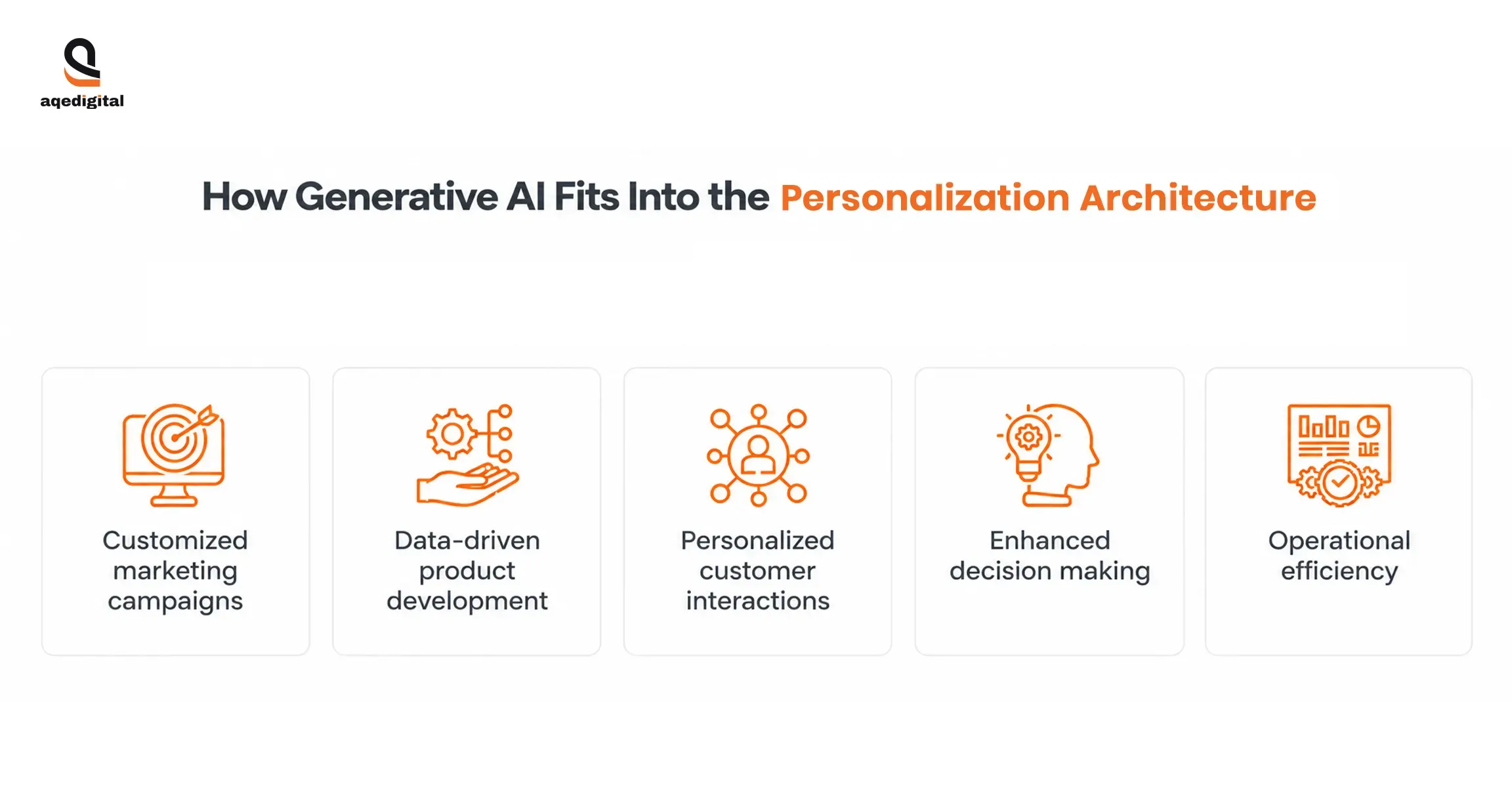
Recommendation and ranking systems are generally responsible for deciding what is relevant.
AI personalization in eCommerce becomes valuable when machine intelligence can interpret intent without compromising product relevance, business rules, or customer trust.
Useful generative AI applications include:
- Personalized product explanations
- Natural-language shopping assistance
- Contextual merchandising copy
- Conversational product discovery
- Personalized email content
- Dynamic comparison summaries
- AI-assisted product discovery
- Customer-facing shopping assistants
This distinction matters because generative systems can produce fluent outputs without necessarily producing commercially optimal recommendations.
Generative AI should enhance the decisioning ecosystem rather than replace disciplined retrieval, ranking, governance, and measurement.
How Personalization Can Support Search Visibility and AI-Mode Visibility
Personalization and SEO should not operate as competing priorities.
The more important question is how personalized experiences can coexist with a crawlable, indexable, authoritative public website.
Google states that AI Overviews and AI Mode continue to rely on foundational SEO practices, with no separate technical optimization required for inclusion. Google specifically emphasizes crawlability, internal linking, textual content, page experience, and accurate structured data.
Its 2026 guidance also emphasizes valuable, unique, non-commodity content as generative AI changes how people discover information.
Personalization should therefore preserve the SEO foundation
- Keep important product information available in crawlable content.
- Avoid making essential product details accessible only through client-side personalized interfaces.
- Maintain stable product URLs and clear internal linking.
- Ensure structured data reflects the visible content presented to users.
- Separate individualized experiences from the core content required for search discovery.
This distinction is particularly important for eCommerce organizations that want both personalized shopping experiences and strong organic visibility.
A Practical Implementation Roadmap for Enterprise eCommerce Teams
Personalization projects become expensive when organizations attempt to solve data, identity, machine learning, APIs, experimentation, and frontend experiences simultaneously.
A phased approach reduces that risk.
Phase 1: Establish the data foundation
Audit customer, product, event, identity, and operational data sources before selecting algorithms.
Priority: data quality, event consistency, taxonomy, identity, consent, and governance.
Phase 2: Select high-value use cases
Begin with experiences where personalization can produce measurable commercial impact.
Strong starting points include:
- Product recommendations
- Personalized search ranking
- Cross-sell and upsell
- Recently relevant products
- Category personalization
- Personalized merchandising
- Retention-oriented experiences
Phase 3: Build the decisioning layer
Introduce candidate generation, filtering, ranking, business rules, and model serving according to the complexity of the selected use cases.
The architecture should remain modular enough to replace or improve individual components later.
Phase 4: Introduce real-time signals
Once the foundation is stable, incorporate current session behavior and event streams to improve responsiveness.
This is where the system begins moving from historical personalization toward intent-aware personalization.
Phase 5: Establish experimentation and observability
Create control groups, business KPIs, model monitoring, data-quality checks, and service-level monitoring before scaling across the customer journey.
Phase 6: Expand intelligently
After proving value, extend personalization into search, content, promotions, customer service, email, mobile applications, and other channels.
Scale the capability after proving the decisioning system, rather than scaling the technology before proving the business case.

How AQe Digital Can Help Build the Architecture Behind Personalization
Enterprise personalization requires more than a machine-learning model because the final experience depends on the quality of the entire data and technology ecosystem.
AQe Digital brings together AI, machine learning, data engineering, real-time analytics, AI platform engineering, and enterprise integration capabilities to help organizations move from fragmented data toward production-ready intelligent systems.
Data Engineering
Our data engineering teams can design scalable pipelines that connect customer events, product catalogs, transactional systems, analytics platforms, and operational data.
AI and Machine Learning
Our AI and ML capabilities can support recommendation models, predictive analytics, ranking systems, behavioral modeling, and continuous model optimization. The emphasis remains on measurable business outcomes rather than introducing machine learning simply because it is technically possible.
Real-Time Decisioning
We can design event-driven architectures that process customer signals and expose personalization decisions through scalable APIs. This helps organizations move from periodically refreshed customer profiles toward experiences that respond to current intent.
AI Platform Engineering
Our platform engineering approach can bring together data pipelines, models, APIs, cloud infrastructure, monitoring, security, and governance into an architecture that can evolve as personalization requirements mature.
Generative AI Integration
Generative AI can be integrated where it adds genuine value, including conversational discovery, personalized explanations, content generation, and intelligent customer interfaces.
Continuous Optimization
We can support experimentation, observability, model monitoring, data-quality controls, performance optimization, and iterative improvements as customer behavior changes.
Conclusion
eCommerce personalization is becoming a strategic capability that connects customer understanding, product intelligence, and real-time decision-making. Businesses investing in reliable data foundations, scalable architecture, and continuous experimentation can deliver relevant shopping experiences while improving operational efficiency and long-term growth.
AQe Digital helps businesses build scalable AI, machine learning, and data engineering solutions that turn fragmented customer data into intelligent, measurable outcomes.
Contact us to build a personalization architecture that adapts to customer needs and supports sustainable business growth.
Frequently Asked Questions
What is eCommerce personalization?
eCommerce personalization uses customer, product, behavioral, and contextual data to adapt shopping experiences according to individual or group-level relevance. It can influence recommendations, search rankings, merchandising, promotions, content, navigation, and customer communication throughout the buying journey.
How does a product recommendation engine work?
A product recommendation engine typically combines customer behavior, product information, contextual signals, business rules, and machine-learning models to identify and rank relevant products.
What data is required for effective personalization?
Effective personalization generally requires customer interactions, product information, transaction history, identity signals, contextual information, and operational data such as inventory or pricing. The quality, consistency, freshness, and governance of this information often matter more than simply increasing the volume of collected data.
Should eCommerce businesses build or buy personalization technology?
The right approach depends on the complexity of the use case, available data, internal engineering capabilities, and need for proprietary decisioning. Managed platforms can accelerate standard use cases, while custom or hybrid architectures provide greater control over identity, ranking, business rules, integrations, and differentiated customer experiences.
How can personalization support SEO and AI search visibility?
Personalization should enhance the customer experience without hiding important product or content information from search engines. The strongest approach is therefore to build personalized experiences on top of a technically sound, indexable, authoritative content foundation.