Digital Transformation in Manufacturing: From Connected Operations to Smart Factories

Nirav Oza
Manufacturing businesses are under pressure to produce faster, maintain consistent quality, control costs, respond to changing demand, and operate with fewer disruptions.
Yet many factories still depend on disconnected machines, spreadsheets, manual reporting, legacy applications, and siloed operational data.
A production manager may know that a machine is underperforming, but discovering why can require information from maintenance systems, machine sensors, operators, quality records, and production schedules.
That fragmentation creates a visibility problem.
Modern manufacturing is moving toward connected operations where machines, people, production systems, and business applications continuously exchange information.
This transformation is at the core of Industry 4.0, where connectivity, automation, advanced analytics, artificial intelligence, robotics, cloud computing, and industrial data work together to create more intelligent production environments.
Deloitte's 2025 Smart Manufacturing and Operations Survey found that manufacturers implementing smart manufacturing initiatives reported average improvements of 10% to 20% in production output, 7% to 20% in employee productivity, and 10% to 15% in unlocked capacity.
What Is Digital Transformation in Manufacturing?
It is the process of using digital technologies, connected data, automation, and intelligent systems to fundamentally improve how manufacturing operations are designed, managed, optimized, and scaled.
A meaningful transformation connects the physical production environment with the digital systems responsible for planning, execution, quality, maintenance, inventory, supply chain, and business decision-making.
For example, a connected production line can capture machine performance data through sensors. An analytics platform can interpret that information, identify unusual behavior, and alert maintenance teams before a failure disrupts production.
The same data can potentially support production planning, quality analysis, energy optimization, and management reporting.
This is why what digital transformation in manufacturing is should not be answered simply as “using new technology.”
It is a business transformation enabled by technology.
Why It Matters
Manufacturers that successfully connect operations can move from reactive decision-making toward more predictive and data-driven management.
Instead of asking what happened after production is complete, teams can increasingly understand what is happening while production is running and identify what requires attention next.
From Traditional Factory to Smart Factory
A traditional manufacturing environment typically operates through several separate layers.
A smart factory changes the entire traditional manufacturing structure by connecting these layers through shared data, automation, analytics, and intelligent decision-making.
Traditional Manufacturing:
- Machines operate with limited connectivity
- Production information is often captured manually
- Maintenance is largely reactive or schedule-based
- Quality problems may be discovered after production
- Management receives information through periodic reports
- Decisions depend heavily on individual experience
Smart Manufacturing:
- Machines continuously generate operational data
- Production information becomes available in near real time
- Predictive models identify potential equipment problems
- Quality systems detect patterns earlier
- Dashboards provide continuous operational visibility
- Data supports faster and more consistent decisions
Technology-integrated manufacturing processes give operators and managers better information so they can spend more time making decisions and less time collecting data.
What Is a Smart Factory?
A smart factory is a connected manufacturing environment where machines, systems, people, and data work together to monitor operations, automate processes, generate insights, and improve production decisions.
A smart factory typically combines technologies such as:
- Industrial IoT sensors
- Cloud and edge computing
- Artificial intelligence
- Machine learning
- Robotics
- Computer vision
- Advanced analytics
- Digital twins
- Automation platforms
- Manufacturing software
The important characteristic is not the number of technologies installed.
It is how effectively those technologies work together.
A factory with thousands of sensors but disconnected data can still operate inefficiently. A smaller facility with well-integrated data, automation, analytics, and workflows may create significantly greater business value.

The Role of IoT in Manufacturing
IoT in manufacturing creates the connectivity layer required for modern industrial operations.
Sensors installed on machines, production lines, equipment, and facilities can capture information such as:
- Temperature
- Pressure
- Vibration
- Energy consumption
- Machine speed
- Production volume
- Equipment status
- Environmental conditions
- Cycle time
That information becomes useful when it can move into systems that analyze and act upon it.
Why IoT Alone Is Not Enough
Installing sensors does not automatically create a smart operation.
The real value of IoT in manufacturing comes from connecting sensor data with applications, analytics, automation, and business workflows.
The progression therefore looks like this:
Sensors → Connectivity → Data → Analytics → Decision → Automation
An industrial IoT platform can help provide the infrastructure connecting these stages.
What Is an Industrial IoT Platform?
An industrial IoT platform provides the technology foundation for collecting, connecting, processing, managing, and analyzing data generated by industrial equipment and connected assets.
Instead of building separate connections between every machine and every application, manufacturers can use an industrial IoT platform to create a more standardized architecture for industrial data.
A capable platform may provide:
- Device connectivity
- Data ingestion
- Device management
- Real-time monitoring
- Edge processing
- Cloud integration
- Data visualization
- Analytics
- API connectivity
- Alert management
- Security controls
This becomes particularly important when manufacturers operate multiple facilities containing different machines, controllers, protocols, and software systems.
The Business Benefit
A centralized industrial data layer can reduce information silos and make operational data more accessible across production, maintenance, quality, supply chain, and management teams.
Without this foundation, manufacturers often create isolated digital solutions that work well individually but fail to create enterprise-wide visibility.
The Core Technologies Behind Industry 4.0
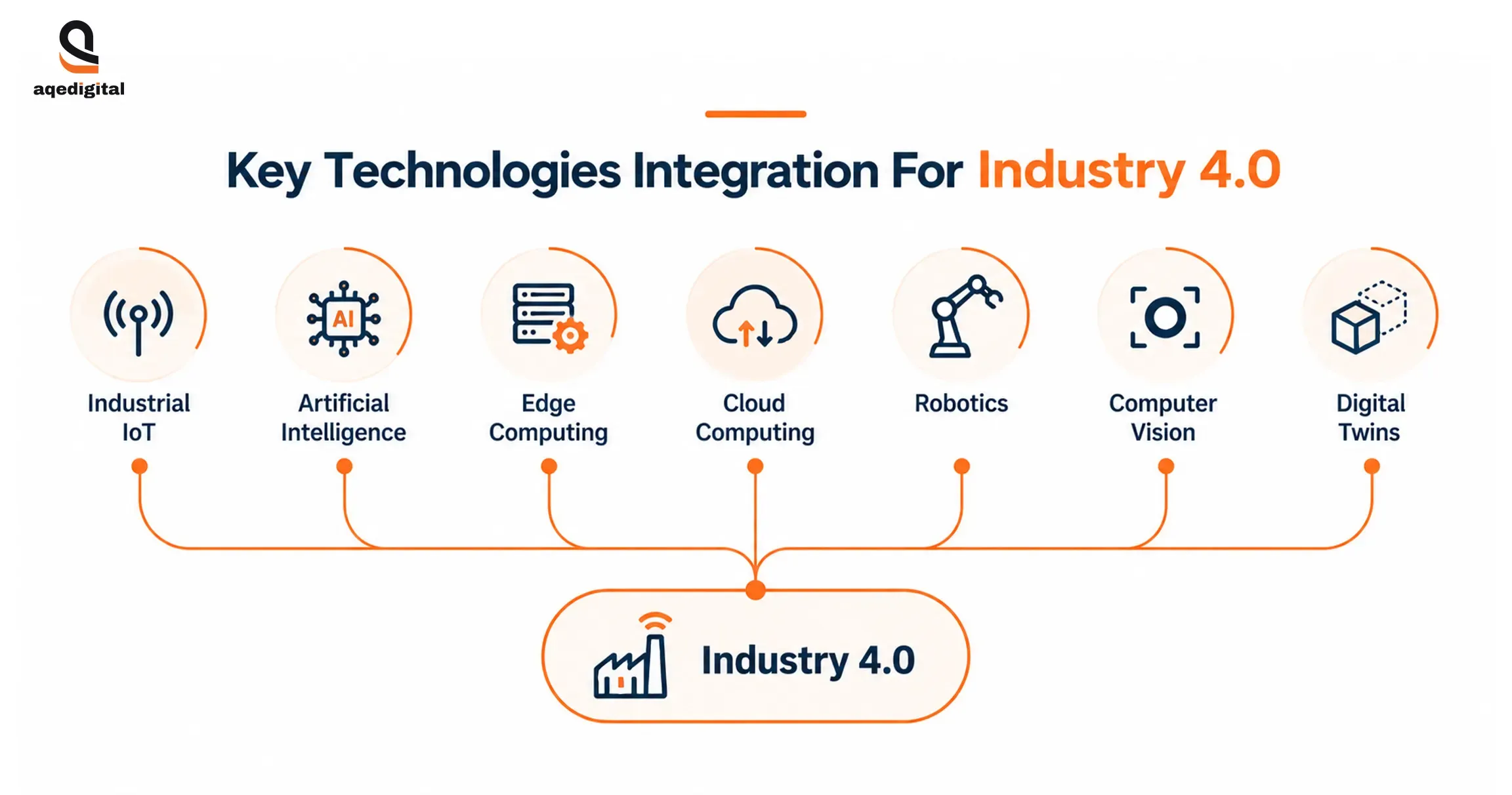
Industry 4.0 is not one technology.
It represents the convergence of several technologies that allow physical production environments to become increasingly connected, automated, and intelligent.
- Industrial IoT: Industrial sensors connect machines and assets to digital systems, creating continuous streams of operational data.
- Artificial Intelligence: AI helps manufacturing organizations identify patterns, automate decisions, optimize processes, and generate predictive insights from large datasets.
- Edge Computing: Edge computing processes selected data closer to machines and production environments, reducing latency and supporting time-sensitive applications.
- Cloud Computing: Cloud infrastructure provides scalable environments for data storage, analytics, application development, and multi-site manufacturing visibility.
- Robotics: Connected robotics can automate repetitive, dangerous, or highly precise manufacturing activities while generating operational data.
- Computer Vision: Vision systems can inspect products, identify defects, monitor processes, and support automated quality control.
- Digital Twins: Digital models can represent physical assets, production lines, or processes and help manufacturers simulate, diagnose, predict, and optimize operations.
Together, these technologies form the foundation of Industry 4.0 and help move factories from isolated automation toward connected intelligence.
Digital Twin Manufacturing: Creating a Digital Representation of Operations
Digital twin manufacturing uses synchronized digital representations of physical products, machines, processes, or production environments.
The objective is to create a digital model that reflects relevant conditions in the physical environment and can be used for analysis, simulation, prediction, or optimization.
For example, manufacturers can create digital representations of production equipment and use operational data to understand how different conditions may affect performance.
Where Digital Twins Can Help
- Production Optimization: Simulate process changes before applying them to physical production.
- Equipment Monitoring: Compare expected and actual equipment behavior.
- Quality Improvement: Analyze relationships between process conditions and product outcomes.
- Maintenance Planning: Identify patterns associated with potential equipment degradation.
- Factory Planning: Evaluate proposed layouts, capacity changes, or production scenarios.
Effective digital twin manufacturing therefore goes beyond creating a 3D visualization. The model becomes valuable when it is connected to reliable operational data and used to support actual business decisions.
Manufacturing Execution Systems in the Connected Factory
A manufacturing execution system sits between production operations and broader business systems, helping manufacturers manage and monitor production activities.
It can support areas such as:
- Production tracking
- Work orders
- Quality management
- Production scheduling
- Material tracking
- Labor tracking
- Performance monitoring
- Traceability
A manufacturing execution system becomes particularly powerful when connected with IoT devices, ERP systems, analytics platforms, and production equipment.
Predictive Maintenance: Moving Beyond Reactive Repairs
Equipment failures can create cascading consequences.
A single machine failure may stop a production line, delay shipments, increase overtime, create quality problems, and affect customer commitments.
Traditional maintenance strategies generally rely on scheduled servicing or reactive repairs.
Predictive maintenance in manufacturing uses equipment data and analytical models to identify patterns associated with potential failures or performance degradation.
For example, a model may combine vibration, temperature, operating hours, load, and historical maintenance information to identify abnormal behavior.
Why Predictive Maintenance Matters
The objective of predictive maintenance in manufacturing is to predict failures and improve maintenance decisions.
A useful system can help teams answer:
- Which equipment requires attention?
- How urgent is the issue?
- What evidence supports the alert?
- Which component may be responsible?
- When should maintenance be scheduled?
- What production impact could occur?
This enables maintenance teams to prioritize resources rather than treating every asset equally.
Connected Factory Solutions: Breaking Operational Silos
Connected factory solutions bring together equipment, production systems, data platforms, analytics, enterprise applications, and people.
Instead of allowing each department to operate from separate information sources, connectivity creates a shared operational picture.
A disconnected organization may need separate conversations between production, maintenance, quality, inventory, and supply chain teams.
Connected factory solutions can therefore improve:
- Production visibility
- Equipment monitoring
- Quality management
- Maintenance coordination
- Inventory visibility
- Energy management
- Production planning
- Management reporting
What Business Value Does Industry 4.0 Create?
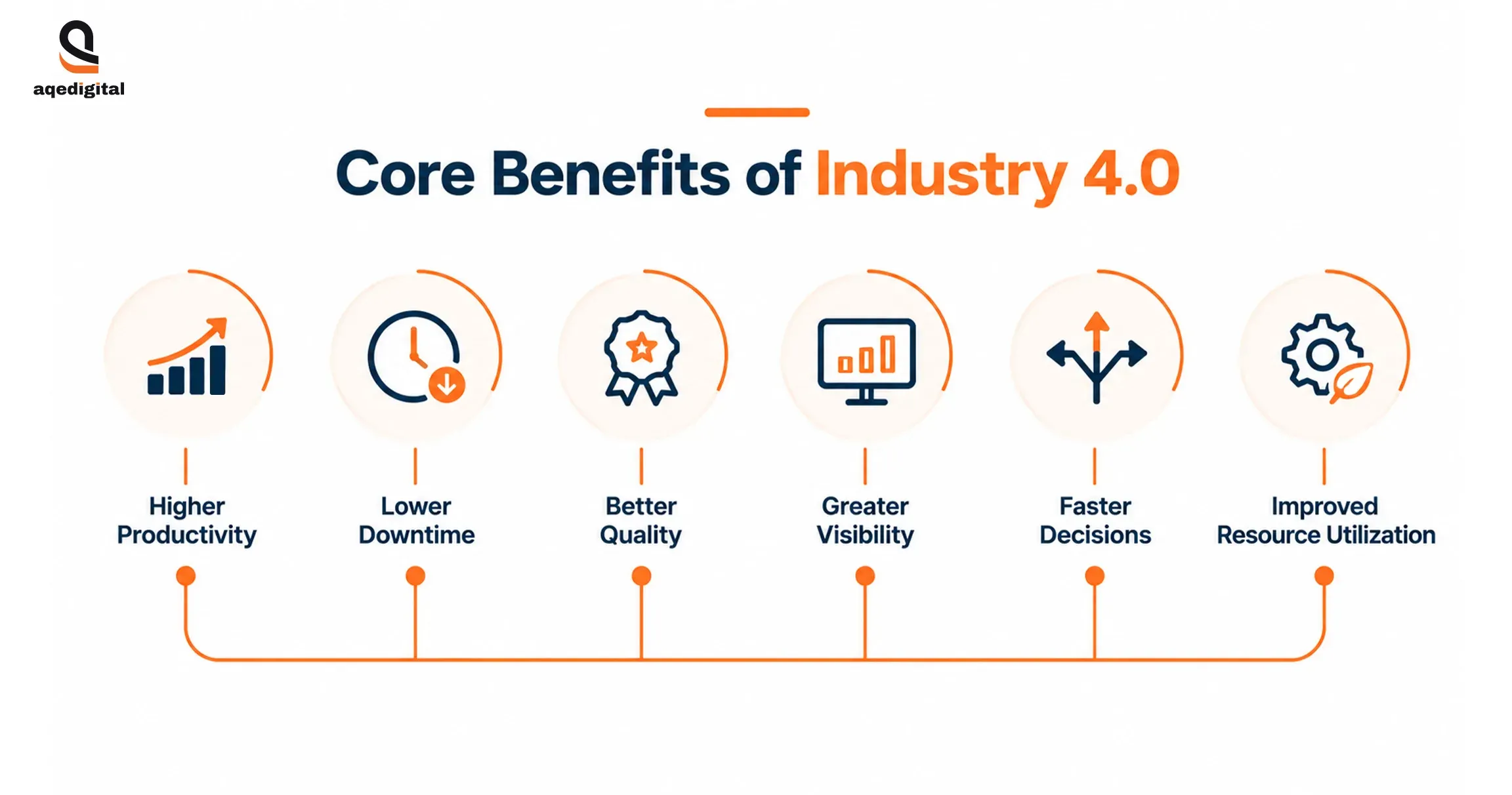
Technology investment needs to produce measurable operational or commercial outcomes.
The strongest Industry 4.0 programs therefore begin with business objectives rather than technology shopping lists.
Higher Productivity
Connected data can identify bottlenecks, equipment constraints, and production inefficiencies that are difficult to see through periodic reporting.
Lower Downtime
Predictive insights can help maintenance teams address potential equipment problems before they create major production interruptions.
Better Quality
Real-time process monitoring and analytics can identify deviations earlier, reducing the likelihood of defective products moving further through production.
Greater Visibility
A smart factory can give managers access to more timely information about production, equipment, quality, and capacity.
Faster Decisions
When operational data is available closer to real time, managers can respond to problems without waiting for end-of-shift or end-of-day reports.
Improved Resource Utilization
Manufacturers can use data to understand how effectively machines, materials, labor, and energy are being utilized.
The World Economic Forum's 2025 Global Lighthouse Network reported that its latest cohort achieved an average 53% improvement in labor productivity and a 26% reduction in conversion costs through digital technologies including AI, machine learning, and advanced analytics.
The Challenges of Moving Toward a Smart Factory
The business case may be compelling, but manufacturing transformation is not technically straightforward.
Legacy Infrastructure
Many manufacturers operate equipment and software that were introduced years or decades apart.
Connecting these environments requires careful consideration of protocols, APIs, data structures, security, and operational constraints.
Data Quality
Machine data can be incomplete, inconsistent, duplicated, or difficult to interpret.
Advanced analytics cannot compensate for fundamentally unreliable data.
Cybersecurity
Connecting previously isolated industrial environments increases the importance of IT and OT security.
Manufacturers need appropriate controls for devices, networks, applications, identities, and data.
Workforce Skills
Digital transformation changes the skills required across production, engineering, maintenance, IT, and management.
Employees need training and support rather than simply being given new software.
Scaling Beyond Pilots
One of the biggest challenges is moving from a successful proof of concept to multiple production lines or facilities.
McKinsey has highlighted this “pilot purgatory” problem, where manufacturers struggle to scale successful Industry 4.0 initiatives across factory networks.
Operational Risk
Digital transformation can disrupt production if technology changes are introduced without adequate testing and fallback processes.
Deloitte found that 65% of surveyed manufacturers ranked operational risk among their top priorities for mitigation during smart manufacturing transformation.
Common Mistakes Manufacturers Should Avoid
Digital transformation initiatives often struggle because organizations focus on technology deployment without addressing the operating model required to sustain it.
- Starting with technology instead of a measurable business problem
- Connecting machines without creating a usable data strategy
- Building isolated pilots that cannot scale across facilities
- Ignoring cybersecurity until systems are already connected
- Underestimating legacy integration and operational complexity
- Treating employee adoption as an afterthought during transformation
- Measuring technology deployment instead of actual business outcomes
How AQe Digital Can Help Manufacturers Accelerate Digital Transformation
Manufacturing transformation requires more than individual technology implementations.
AQe Digital can help manufacturers design and build connected digital solutions that bring together operational data, enterprise applications, IoT capabilities, analytics, automation, and modern application architectures.
IoT Development
AQe Digital can develop IoT solutions that connect industrial equipment, sensors, devices, and applications to create more accessible and actionable operational data.
Industrial IoT Platforms
We can help design and develop an industrial IoT platform capable of collecting, processing, visualizing, and integrating industrial data across machines, production lines, and enterprise systems.
Smart Manufacturing Solutions
Our teams can develop smart factory solutions that connect production data with dashboards, analytics, automation, and business workflows to improve operational visibility.
Data & Analytics
AQe Digital can build data pipelines, analytics applications, dashboards, and reporting systems that turn manufacturing data into practical operational insights.
Digital Twin Solutions
We can support digital twin manufacturing initiatives by developing digital representations and connected applications that help organizations monitor, analyze, simulate, and optimize physical operations.
AI & Machine Learning
AI and machine learning capabilities can be incorporated into manufacturing applications for predictive analysis, anomaly detection, quality monitoring, optimization, and intelligent decision support.
Enterprise Integration
AQe Digital can integrate manufacturing solutions with ERP, CRM, manufacturing execution system, warehouse, supply chain, and other enterprise applications.
Application Modernization
We help manufacturers modernize legacy applications and architectures so existing technology investments can work more effectively with modern cloud, IoT, analytics, and AI capabilities.

Conclusion
Manufacturing transformation is moving beyond isolated automation toward connected environments where machines, people, applications, and data continuously work together.
Industry 4.0 provides the broader framework, while IoT in manufacturing, analytics, AI, digital twins, and automation provide the capabilities needed to build a more responsive smart factory. The strongest results come when technology is connected to measurable operational priorities rather than deployed simply because it is available.
AQe Digital helps manufacturers design, develop, integrate, and scale digital solutions that turn connected operations into sustainable business value.
Contact us to know more about digital transformation in manufacturing can help you achieve your business objectives and address challenges beyond expectations.