Digital Transformation Framework Explained: Strategy, Structure, and Execution for Enterprises

Nirav Oza
Global enterprises are spending heavily on digital transformations, and are expected to spend close to $4 trillion by 2028. However, without a robust structural model, navigating the complexities of modernizing operations becomes difficult. Many organizations grapple with strategic misalignment, cultural resistance, fragmented legacy systems, data silos, and a lack of clear ROI.
The constant anxiety about finding a roadmap to help organizations overcome these issues is real. This is where the digital transformation framework comes into play. These frameworks are fully aligned with your business objectives, providing a blueprint for planning, execution, and integration to deliver sustainable value and technical depth you can trust.
Many organizations struggle to decide between rigid governance models and autonomous, people-centric approaches. This guide helps your organization with a comprehensive overview of the top digital transformation frameworks and how to choose the right one.
What is a Digital Transformation Framework?
A digital transformation framework is a blueprint or structured process that businesses use to integrate technologies across different areas of their operations. It serves as a roadmap for your organization, ensuring that everything from planning through execution, integration, and launch of a service or product aligns with your business goals.
This is not just limited to the adoption or integration of a software. It also includes creating sustainable value for your business. A digital transformation framework also helps you rethink strategies, operating models, mindsets, and customer interactions.
Now that you know what a digital transformation framework is, let’s understand what’s
Core Functions of a Digital Transformation Framework
A framework helps organizations reduce the risk of failures, especially for their digital transformation objectives. In fact, most companies fail to meet their transformation objectives because they lack a framework for executing such projects.
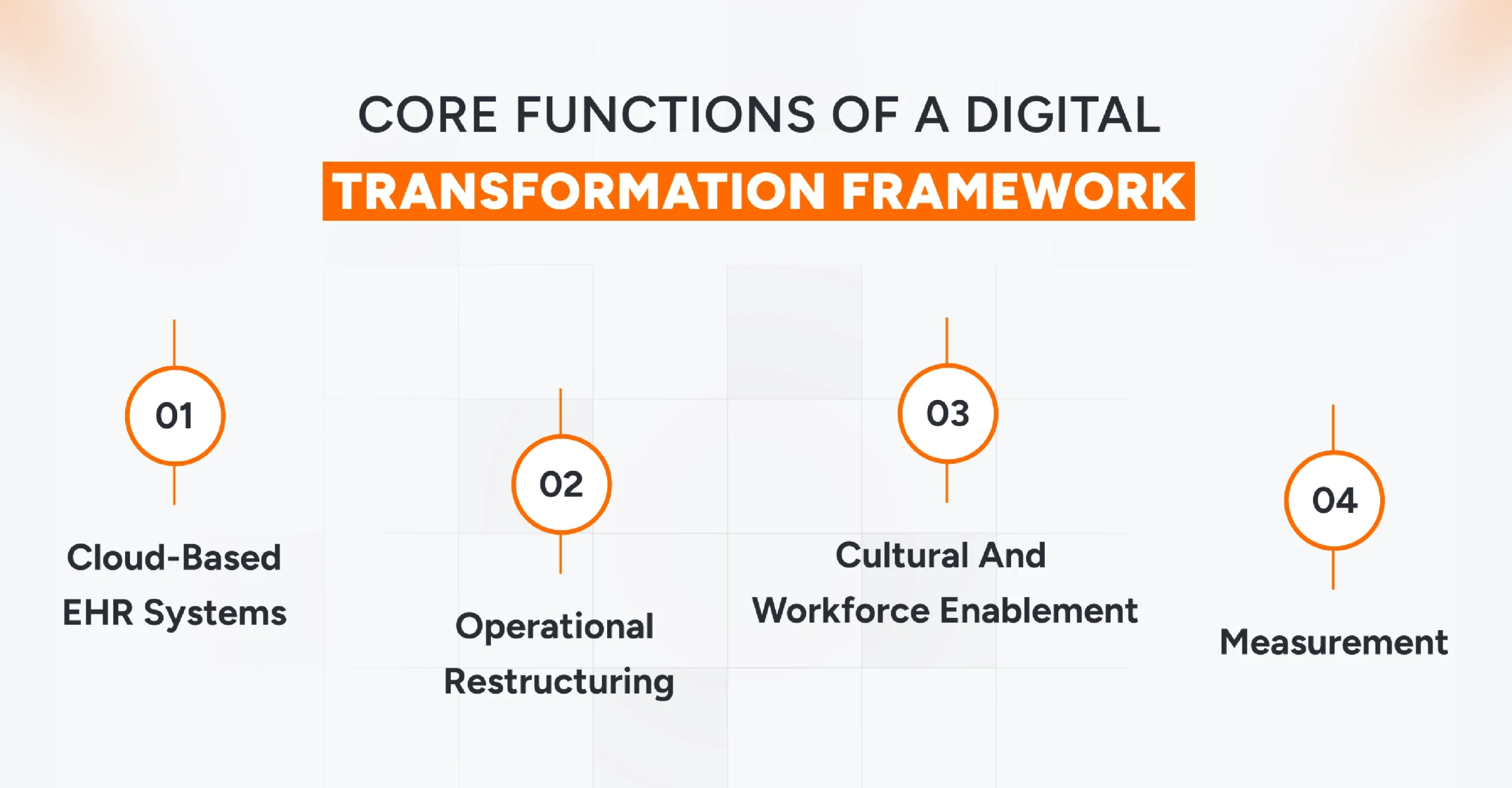
- Strategic Alignment: It aligns digital investments (like AI and cloud migration) with long-term business objectives, preventing “scope errors” where companies invest in technology that does not drive competitive advantage.
- Operational Restructuring: It provides a method for identifying and prioritizing “digital bets” within specific business domains (such as a customer journey or supply chain process) that offer the most significant potential value.
- Cultural and Workforce Enablement: It outlines how to manage the “people side” of change, including upskilling employees, managing resistance, and redefining leadership roles to ensure technology adoption.
- Measurement: It establishes KPIs (Key Performance Indicators) to track progress across operational efficiency, financial impact, and digital maturity.
What are the top Digital Transformation Frameworks?
There is no single “right” way to evolve. Organizations often require different archetypes depending on their maturity and market position. A robust digital transformation framework is not a rigid template but a flexible ecosystem that coordinates technology, people, and strategy.
While some models prioritize rigid governance, others emphasize speed and autonomy. The key is selecting the right digital transformation strategy frameworks that align with specific business needs, ranging from deep organizational culture shifts to rapid technical scaling.
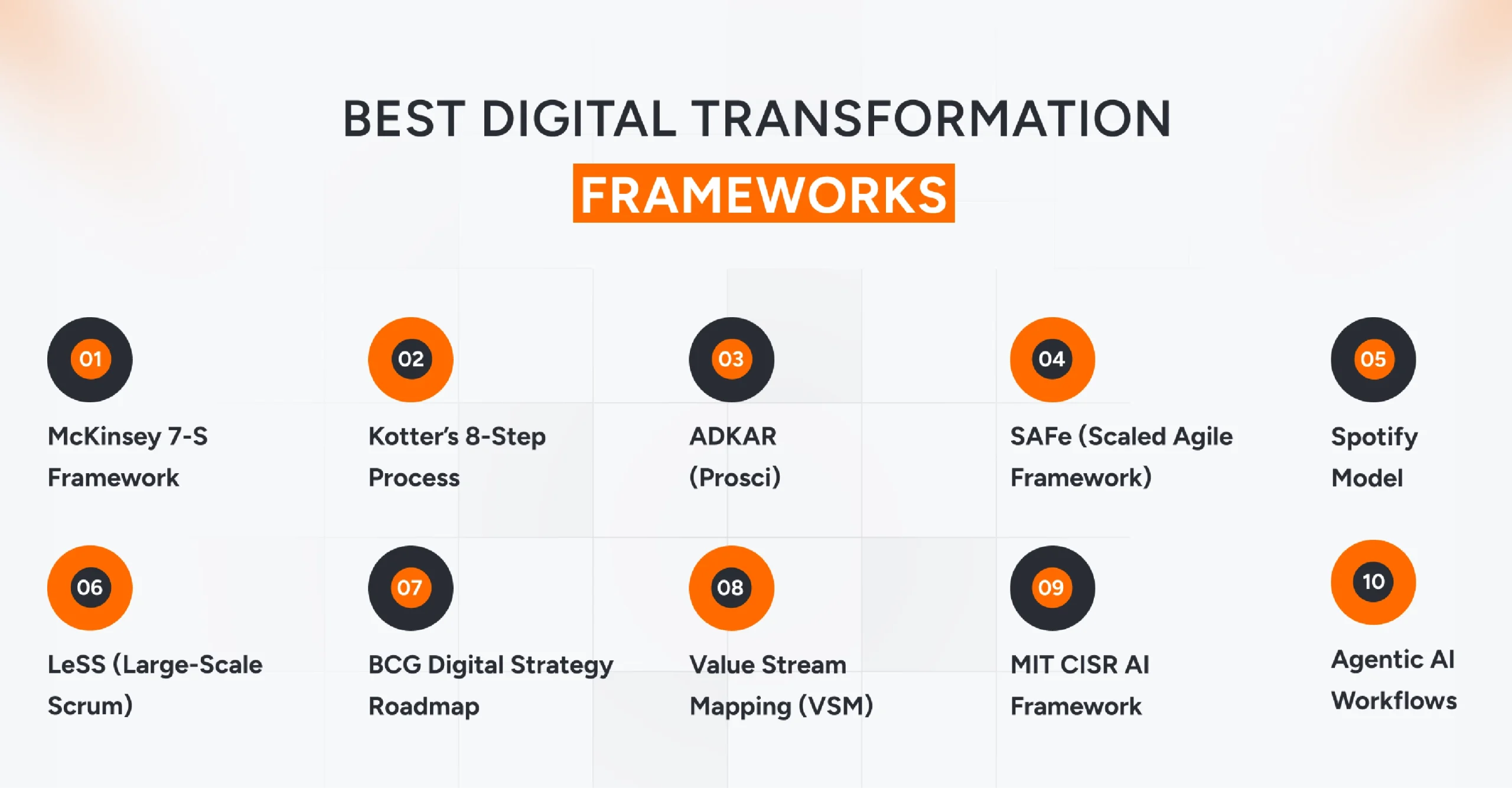
1. McKinsey 7-S Framework
This is a digital transformation framework for analyzing organizational effectiveness by examining seven interconnected elements that must align with business goals. This framework is best suited to complex transformations, such as mergers or digital shifts.
It divides the organization into “Hard S’s” (Strategy, Structure, Systems) and “Soft S’s” (Shared Values, Style, Staff, Skills), which are easier to identify and manage and harder to change, respectively.
If you implement a new AI tool (System) but your culture values intuition over data (Shared Values), the transformation will fail. 7-S helps you spot that misalignment early.
2. Kotter’s 8-Step Process
Created by Dr. John Kotter, this digital transformation framework is more of a change management framework. Unlike other frameworks, this model focuses on the technical structures. So, if you are looking to use Kotter’s approach, you need to focus on the psychology of people and leadership. Often characterized as the “top-down” approach, this framework helps you mobilize the momentum across teams by creating a sense of urgency.
Here is how it works,
- Create a Sense of Urgency: Leaders must articulate a compelling reason why change must happen now, fostering an environment where employees understand the risks of inaction.
- Build a Guiding Coalition: Assemble a powerful group of stakeholders and leaders who have the influence and authority to lead the change effort as a team.
- Shape a clear strategic vision and action plan: Define how the future will differ from the past, then outline focused initiatives that turn that direction into measurable progress.
- Enlist a Volunteer Army (Communicate): Communicate the vision frequently and powerfully to mobilize a large number of employees who are willing to drive the change.
- Enable Action by Removing Barriers: Empower employees to execute the vision by removing obstacles, whether they are inefficient processes, rigid structures, or blocking hierarchies, and encouraging risk-taking.
- Generate Short-Term Wins: Plan for and achieve visible, unambiguous performance improvements early in the process to build trust and silence critics.
- Sustain Acceleration: Use the credibility gained from early wins to press harder for change, modifying systems and structures that don’t fit the vision, and reinvigorating the process with new projects.
- Institute Change: Anchor the new behaviors in the corporate culture by articulating the connection between new behaviors and organizational success, ensuring they persist after the initial transformation project ends.
3. ADKAR (Prosci)
While Kotter focuses on the organization, ADKAR focuses on the individual employee. It recognizes that an organization changes only when its individuals change. Unlike the top-down approach, which focuses on organizational strategy, ADKAR focuses on personal change.
ADKAR is an acronym for the five outcomes an individual needs to achieve for change to be successful:
- Awareness: The individual must understand the need for change. This involves explaining why the change is happening and the risks of not making the change.
- Desire: The individual must have the will to participate and support the change. This step addresses personal motivations and barriers to build enthusiasm or, at a minimum, acceptance.
- Knowledge: The individual requires information on how to change. This includes training on new behaviors, processes, or tools
- Ability: The individual must be able to implement the change and demonstrate the required skills or behaviors in a real-world context. This distinguishes theoretical understanding (Knowledge) from actual competence (Ability).
- Reinforcement: Measures must be in place to sustain the change. This involves recognition, rewards, and feedback loops to ensure the individual does not revert to old habits.
4. SAFe (Scaled Agile Framework)
SAFe is the “enterprise” version of Agile. It brings structure to the Agile framework’s flexibility, making it safe for large, risk-averse corporations. SAFe is one of the most widely adopted digital transformation frameworks globally. The framework helps you organize teams into “Agile Release Trains” (ARTs) groups of 50–125 people who plan, commit, and release together on a fixed schedule.
For industries like banking or aerospace, you cannot just “move fast and break things.” SAFe adds layers of governance and portfolio management, ensuring that “Agile” doesn’t turn into “Chaos.” It synchronizes alignment, collaboration, and delivery for large numbers of teams.
5. Spotify Model
This is a people-centric, autonomous digital transformation framework that focuses on culture rather than rigid rules. It treats the organization like a series of startups to maintain agility at scale. Unlike frameworks that prioritize central control, this model focuses on empowering individuals and decentralized decision-making.
- Squads: Small, cross-functional teams (like a mini-startup) that own a specific feature end-to-end.
- Tribes: A collection of squads working in a related area to ensure strategic alignment.
- Chapters & Guilds: Horizontal groups that share knowledge to ensure “Soft S’s” like Skills and Shared Values are maintained across “Hard” structures.
If you want to move fast, you must decouple dependencies. Squads can release updates whenever they are ready without waiting for permission. This creates massive speed but requires highly skilled, autonomous employees who can manage the responsibility of “moving fast without breaking things.”
6. LeSS (Large-Scale Scrum)
LeSS is a digital transformation framework focused on descaling complexity. While models like SAFe add layers of governance, LeSS removes them to apply the rules of Scrum to multiple teams working on a single product. It is ideal for product companies that want to focus purely on value, not meetings.
Instead of adding more managers, LeSS promotes a “one product owner, one product approach across the backlog” across many teams’ backlogs. It forces the organization to simplify its structure to match its technical goals. If you have 50 developers, LeSS aims to have them work as effectively as a single team of 5. It is a “bottom-up” technical shift that demands a high degree of organizational maturity to execute correctly.
7. BCG Digital Strategy Roadmap
This is a high-level strategic planner used to analyze organizational effectiveness. It answers the critical question: “Of all the things we could do, what should we do?” This framework is best suited to complex shifts in which a company needs to balance short-term optimization with long-term reinvention.
- Digital Bets: Identifying the 2–3 massive opportunities that could change the company’s future.
- Gap Analysis: Rigorously assessing what technical capabilities (Systems) or talent (Staff) are missing to achieve those bets.
This framework prevents “shiny object syndrome,” where companies invest in trending tech without a clear path to ROI. It ensures that every technical initiative is anchored in a strategic vision.
8. Value Stream Mapping (VSM)
VSM is a Lean management method and digital transformation framework used to visualize the flow of value. It recognizes that digitizing a bad process just makes it faster. VSM ensures you fix the process (remove waste) before applying technology to automate it.
You map out every step of the process, from “Customer places order” to “Order ships.” You then categorize steps as “Value-Adding” (essential) or “Non-Value-Adding” (waste). By identifying these bottlenecks early, leaders can create a compelling reason for change and build a strategic vision for a leaner, digital future.
9. MIT CISR AI Framework
As AI becomes a core “System” in the 7-S model, this framework helps companies decide how much agency to give to their algorithms. It forces leaders to be intentional about how AI aligns with their organizational Style and Shared Values.
- Existing: AI serves as a tool to help humans perform their current jobs faster (Individual Ability).
- Orchestrator: AI takes over coordinating the business, connecting data and decisions autonomously.
The goal is to determine if you are building better calculators or building autonomous managers. Misalignment here, such as implementing an “Orchestrator” in a culture that values human intuition, will cause the transformation to fail.
10. Agentic AI Workflows
This moves beyond “chatbots” to “agents” that can plan, reason, and execute tasks. It represents a rapid shift in technical scaling that requires a new layer of “Governance of Autonomy.” It involves designing workflows where AI agents interact across different software systems without human intervention.
Because this shifts the “Staff” element of an organization from humans to digital agents, it requires a “Volunteer Army” of employees who understand how to work alongside these agents rather than fear them. It necessitates setting clear guardrails, reinforcing that while an AI can draft the strategy, a human must still own the Shared Values of the outcome.
How to Choose the Right Digital Transformation Framework?
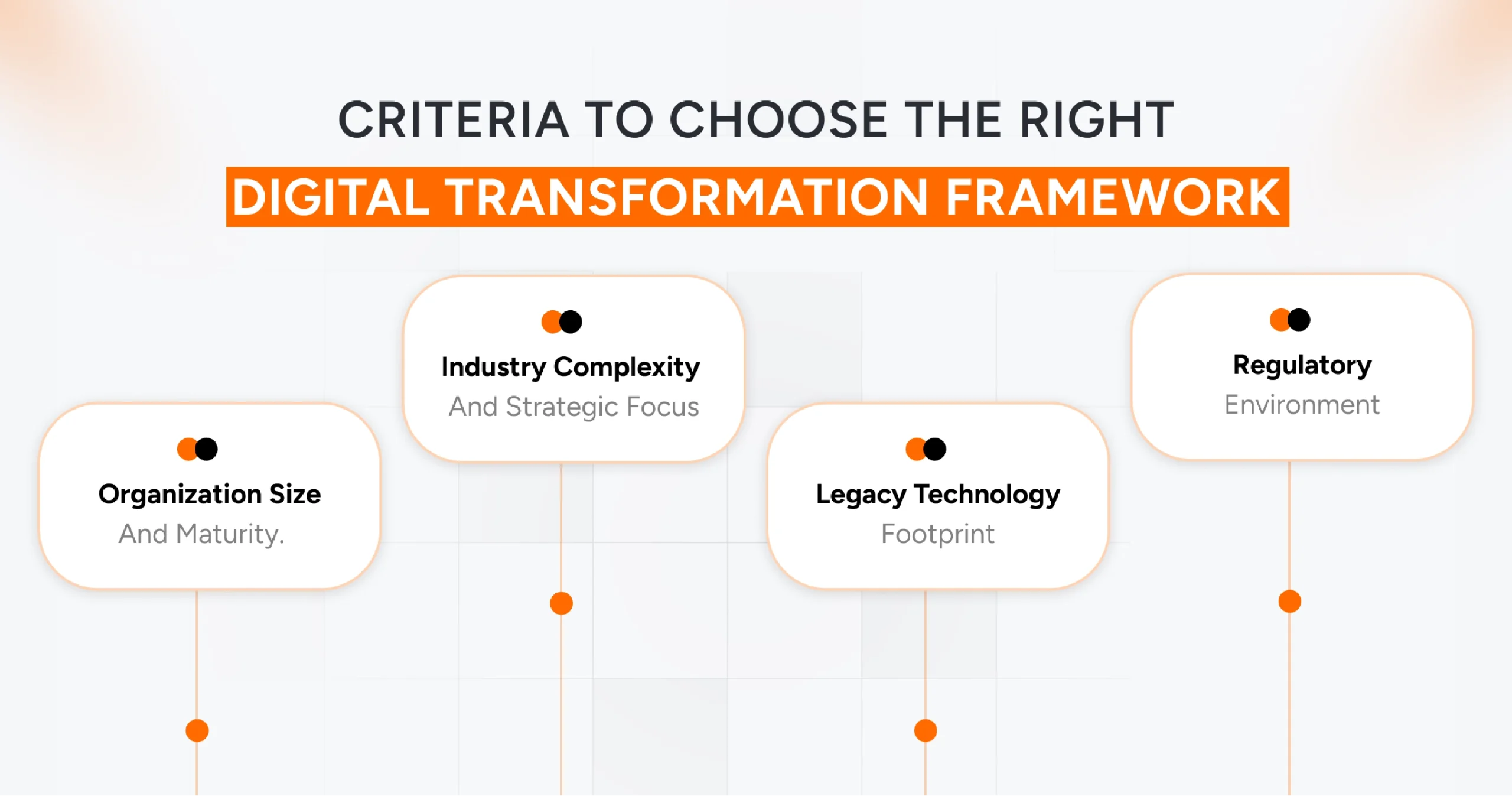
Choosing a digital transformation framework is not about finding the “best” model, but rather selecting the one that aligns with an organization’s specific constraints, culture, and strategic objectives. A robust digital transformation framework is not a rigid template but a flexible ecosystem.
The key is selecting the right digital transformation strategy frameworks that align with specific business needs, ranging from deep organizational culture shifts to rapid technical scaling.
Decision Lens 1: Organization Size and Maturity
The scale of the enterprise and its current level of agile maturity are primary determinants in selecting a framework. This involves examining the “Hard S’s” (Structure) and “Soft S’s” (Skills) to ensure they can sustain the shift.
- Large Enterprises (500+ employees): For large organizations that require strict coordination across hundreds of teams, SAFe (Scaled Agile Framework) is often the default choice. It provides a highly structured, prescriptive hierarchy that aligns strategy with execution. Alternatively, the McKinsey 7-S Framework is ideal for large-scale diagnostics, ensuring that Strategy and Structure align with Shared Values during complex shifts.
- Small to Mid-Sized Organizations: Smaller setups often find SAFe overwhelming and bureaucratic. LeSS (Large-Scale Scrum) is better suited for organizations with 2–8 teams, as it focuses on descaling complexity and removing management layers.
- Agile Maturity: Organizations with low maturity benefit from SAFe’s rigid governance to establish habits. Conversely, highly mature organizations often prefer the Spotify Model, which relies on high autonomy and decentralized decision-making rather than top-down prescription.
Decision Lens 2: Industry Complexity and Strategic Focus
The framework must match the primary strategic driver, whether it is customer experience, operational excellence, or product innovation.
- Customer-Centric Industries (Retail, Telecom): For industries where user experience is the main differentiator, frameworks like Bain’s Elements of Value are superior. These models prioritize delivering emotional and functional value. The Capgemini Digital Transformation Model is also strong here, balancing customer delight with back-office optimization.
- Data-Driven Sectors: Industries that rely heavily on analytics should look to frameworks that center on data maturity. This is where the MIT CISR AI Framework becomes essential, helping leaders decide how much agency to give to their algorithms.
- Operational Excellence: In manufacturing or logistics, process-centric frameworks such as Value Stream Mapping (VSM) are essential. VSM ensures you fix the process, removing “Non-Value-Adding” waste before automating it.
Decision Lens 3: Legacy Technology Footprint
The depth of technical debt dictates the execution strategy. If you implement a new system but your legacy infrastructure is too rigid, the transformation will fail.
- High Technical Debt: Organizations burdened by monolithic systems should utilize the Strangler Fig Pattern. This reduces risk by incrementally replacing specific functionalities with new microservices rather than attempting a high-risk “big bang” rewrite.
- Modernization Strategy: Leaders should apply the “7 Rs” of modernization (Retain, Retire, Rehost, Replatform, Refactor, Re-architect, Rebuild) to categorize applications based on value and risk.
- Risk Aversion: For mission-critical systems, the Leave-and-Layer pattern allows organizations to build new capabilities alongside the legacy core, minimizing disruption to the existing “Systems.”
Decision Lens 4: Regulatory Environment
Compliance requirements can fundamentally alter the choice of framework, particularly regarding governance and documentation. For industries like banking or aerospace, you cannot just “move fast and break things.”
- Highly Regulated (Finance, Healthcare): SAFe is strongly favored here because its built-in compliance and architectural governance requirements provide necessary audit trails. The Deloitte Digital Transformation Framework is also utilized for its emphasis on risk sensitivity.
- Innovation-First (Tech, Media): In environments where speed trumps compliance, rigid frameworks can stifle creativity. LeSS, or the Spotify Model, allows rapid iteration and experimentation, prioritizing speed and autonomy over strict control structures.
Emphasis on Tailoring vs. Copying
Successful transformation requires treating frameworks as flexible toolkits rather than rigid rulebooks.
- Avoid the “Copy-Paste” Trap: Many companies fail by blindly copying the Spotify Model, failing to realize it is a cultural philosophy based on high trust. You must focus on people’s psychology (the “Soft S’s”) rather than just the matrix organizational chart.
- Hybrid Approaches: Effective leaders often blend models. Use SAFe for high-level portfolio governance, and use Kotter’s 8-Step Process to mobilize momentum and create a sense of urgency across teams. Others combine organizational shifts with ADKAR to ensure individuals achieve the necessary Awareness and Desire to change.
- Identity Alignment: The chosen framework must preserve the organization’s “soul.” If a framework prioritizes speed (Ability) while your culture prioritizes craftsmanship (Shared Values), you must reconcile this misalignment early to prevent failure.
How AQe Digital Helps You with Robust Digital Transformation Solutions?
Choosing a framework is only half the battle, and execution is where most transformations fail. At AQe Digital, we bridge this gap by acting as your strategic partner, moving beyond rigid templates to build a flexible ecosystem for your technology and people.
With 27+ years of expertise, we specialize in:
- Strategic Roadmapping: Aligning your systems with organizational goals.
- Legacy Modernization: Utilizing Strangler Fig patterns to reduce risk.
- Agile Orchestration: Implementing Squad-based models that foster autonomy.
- Process Optimization: Leveraging Value Stream Mapping to eliminate operational waste.
- AI Integration: Deploying agentic workflows to drive autonomous decision-making.
We don’t just digitize processes and optimize them to ensure measurable ROI and long-term resilience.