Why UAE Car Rental Operators Are Investing in Digital Fleet Platforms to Reduce Operational Costs?

Priyanka Wadhwani
One of the most immediate financial concerns for most of the UAE car rental operators is the uncovered cost of road tolls and automated traffic violations. Manual operations often fail to capture the charges that are only visible after a customer returns the vehicle or leaves the country. What this means for a rental agency is to absorb the costs as a business loss.
Integrated digital platforms connect car rental operations directly with government APIs. What this means to a car rental business is automatic matching of toll crossings and traffic fines to the exact rental contract with real-time timestamping. It also helps car rental businesses in the UAE to route charges directly to the customer’s invoice.
These platforms also help car rental businesses in the UAE track effective wear on their fleet and ensure minimal disruptions. Fleet management software has moved from a competitive edge to a direct operational necessity for UAE car rental companies.
This blog examines why operators are making that fleet management software investment, what the platforms actually fix, and what you should scrutinize before committing to one.
The Maintenance Cost Problem That Compounds Quietly
One of the most compounding problems for most car rental businesses in the UAE is the “maintenance blindness.” This occurs because most of the rental car businesses rely on reactive and calendar-based servicing. It fails to capture the hidden, real-time issues in the fleet.
Summer Heat Creates a Different Maintenance Reality
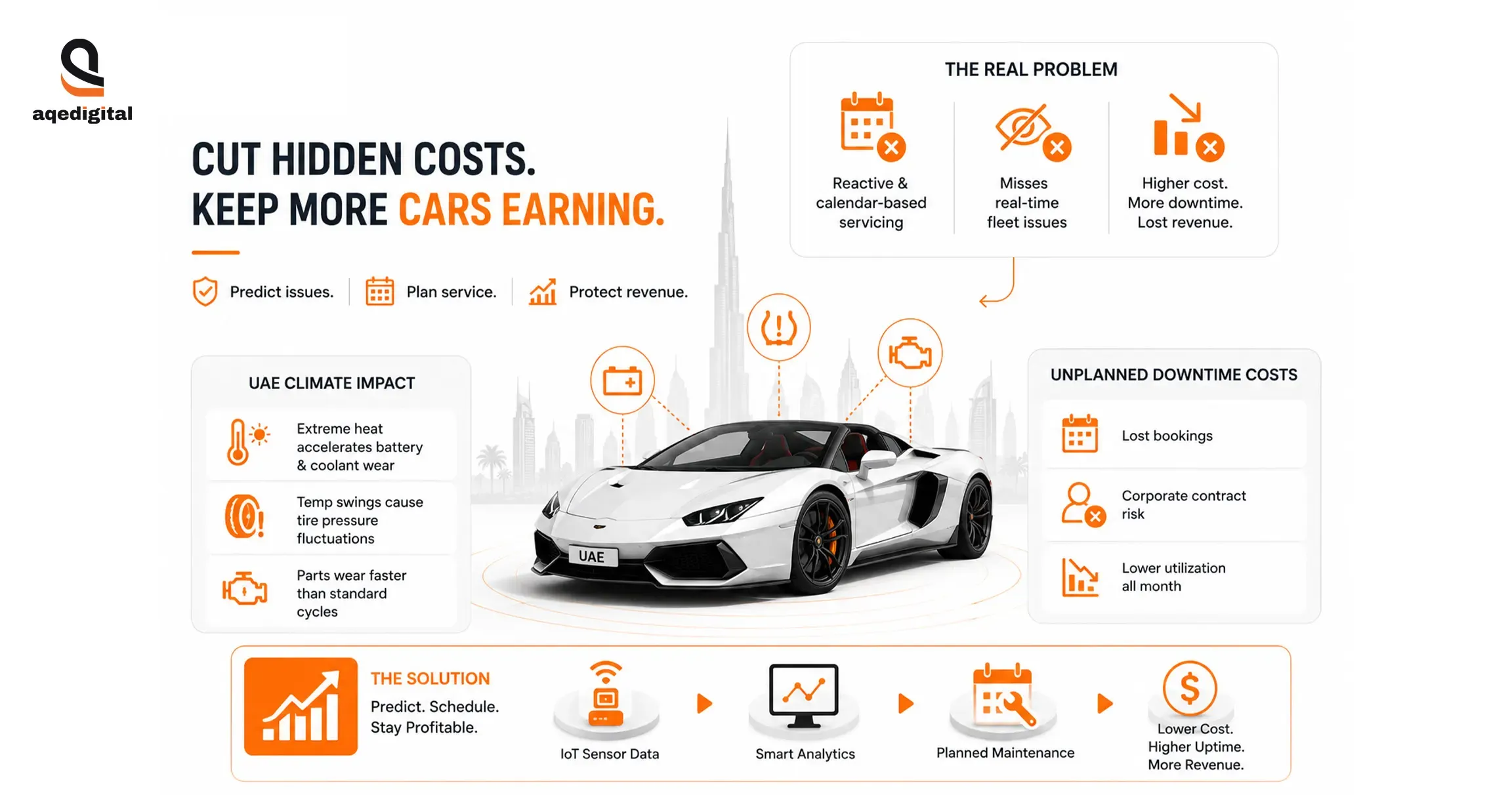
UAE fleet operators deal with a physics problem that most fleet software vendors in temperate markets have never had to think about. At 45 degrees Celsius, battery degradation runs two to three times faster than in moderate climates.
Daily temperature swings create tire pressure fluctuations that produce blowout risks RTA compliance checks don't catch between mandatory inspection cycles. Coolant systems that last 24 months in a European fleet may need replacement at 14 months in Dubai.
Operators running fleet management software with sensor-integrated predictive scheduling report 20% reductions in maintenance costs within the first year, based on documented outcomes from Dubai-based implementations.
What Unplanned Downtime Actually Costs
A vehicle sitting in a service bay isn't just a maintenance expense. Without fleet management software flagging the issue early, that bay visit is also a lost booking, a potential contract breach for corporate accounts, and a utilization hit. It disrupts the fleet's revenue-per-asset metric for the entire month.
Integrated digital systems integrate service scheduling, IoT sensor feeds, and telematics data, shifting maintenance from reactive to planned.
Manual Processes Are the Invisible Bottleneck
When manual systems break down, the resulting inefficiencies silently erode profits, impact customer experience, and lead to administrative chaos for UAE car rental providers.
The digital methods of storage and tracking, such as spreadsheets, phone calls, paper folders and WhatsApp messages, are known by industry experts as ‘death by a thousand small cuts’, with operators losing money with hidden inefficiencies, instead of any one clear-cut failure.
The Friction of Manual Handovers and KYC
One of the most administrative aspects of a car rental business is the vehicle check-in and check-out system. A customer's experience is much longer when staff use photocopied IDs, paper agreements, and handwritten condition reports, which causes human error and makes it hard to locate physical records in case of a dispute.
Manual identity verification imposes an important "trust tax" on operators, where they are forced to either wait for customers to go through a burdensome onboarding process that entails filling out a lot of paperwork or to issue checks quickly and risk non-insurable fraud.
Moreover, the use of front-desk agents handing over photos of the vehicle to be damaged using WhatsApp at 2 am in an unstructured manner makes it extremely inefficient to solve the damage claims.
Billing Inefficiencies and Revenue Leakage
Manual billing is an inefficient use of time that forces staff to spend hours creating bills and chasing security deposits, additional mileage, and late fees. This is a serious issue that only the UAE suffers from, given the automated tolls and fines for infractions of traffic rules using cameras.
When operators rely on manually checking municipal portals for fines when a vehicle is returned, it demands substantial back-office staffing, slows down check-in times, and drastically reduces customer throughput. If an operator misses these fines for months on an Excel sheet, or if a toll posts after a tourist has left the country, the rental agency is forced to absorb the cost, wiping out their profit margins.
Fragmented Data and Double-Booking Risks
Using disconnected systems such as a front-desk booking log, a separate GPS fleet tracker, and manual accounting spreadsheets creates a data gap at every point of operational hand-off. Because fleet availability is not synchronized in real time, operators face the constant risk of double-booking vehicles, which severely damages brand reputation and customer trust.
Without a centralized digital dashboard, identifying idle vehicles becomes an exercise in guesswork, leading to lost revenue when cars sit unrented in lots for days simply because someone forgot to update a spreadsheet.

Why Fleet Infrastructure Modernization is Happening Now
The timing isn't coincidental. Three pressures converged in the UAE market between 2024 and 2026, and each one independently would have pushed Fleet Infrastructure
Modernization onto the active budget. Together, they made waiting expensive.
Tourism recovery drove rental demand well past pre-2020 levels. A market at AED 2.2 billion, growing in the double digits, demands operational infrastructure that can handle volume. Operators who can't manage booking velocity at scale aren't just leaving money behind. They're quietly damaging relationships with the corporate accounts that matter most.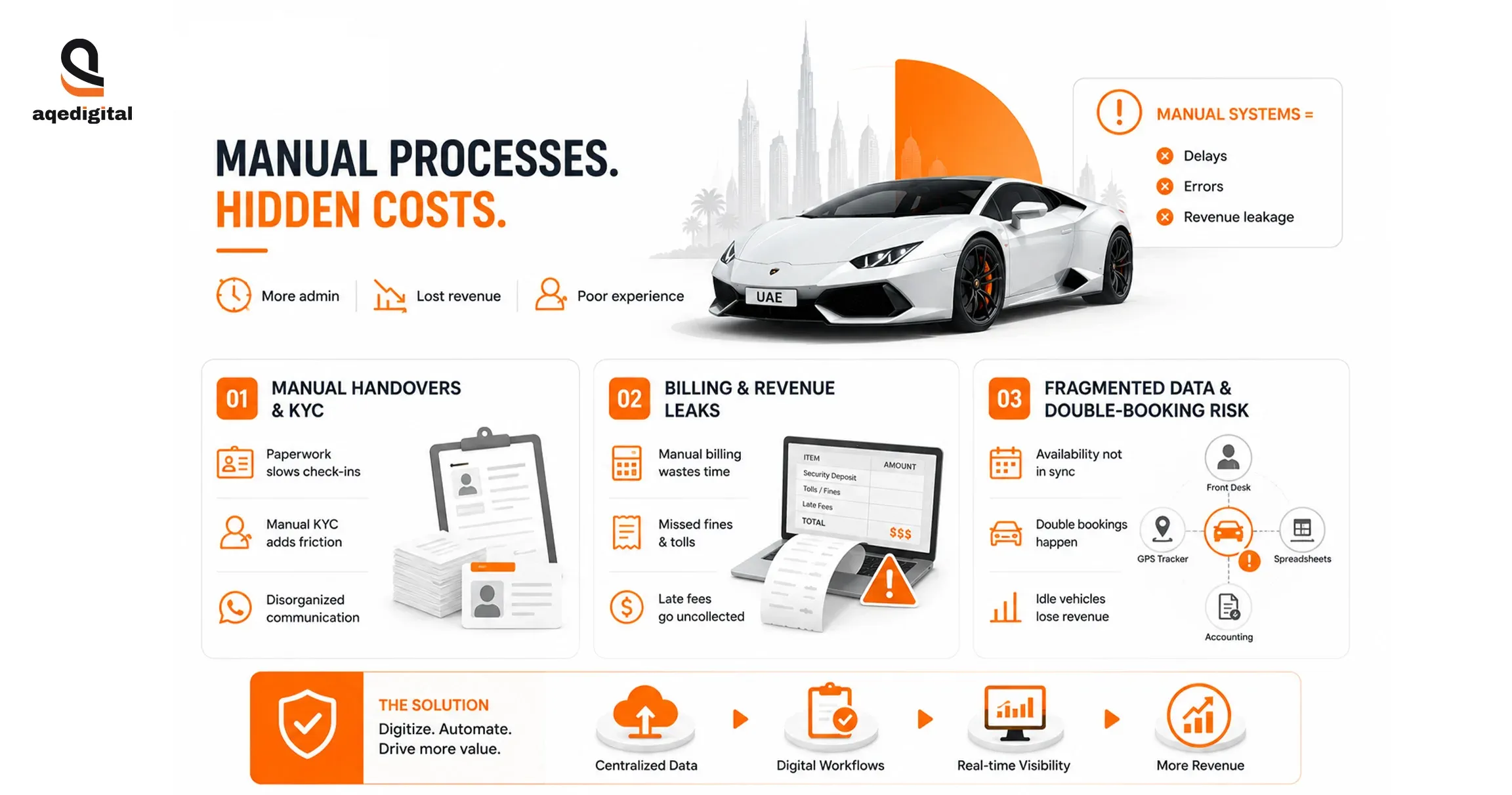
The competitive set has also shifted. New entrants are deploying Car Rental Solutions and fleet management software built digital-first from day one. They don't carry the manual habits that established operators spent a decade building. The fleet operators gaining share in Dubai and Abu Dhabi in 2025 are largely the ones who completed their
Fleet Infrastructure Modernization 18 to 24 months earlier.
And the adoption curve is compressing fast. Middle East fleet digital adoption hit 58% in 2023, up 25% from 2022. Operators treating fleet management software as a 2027 decision aren't being cautious. They're being overtaken.
AQe Digital's AI and data engineering capabilities cover fleet telematics integration, predictive maintenance modeling, and operational dashboard development for UAE mobility operators.
What Does Effective Fleet Management Software Actually Do?
Effective fleet management software serves as the central nervous system for rental car business operations in the UAE. It replaces fragmented tools such as spreadsheets, paper contracts, and disconnected GPS trackers with a single, integrated cloud platform.
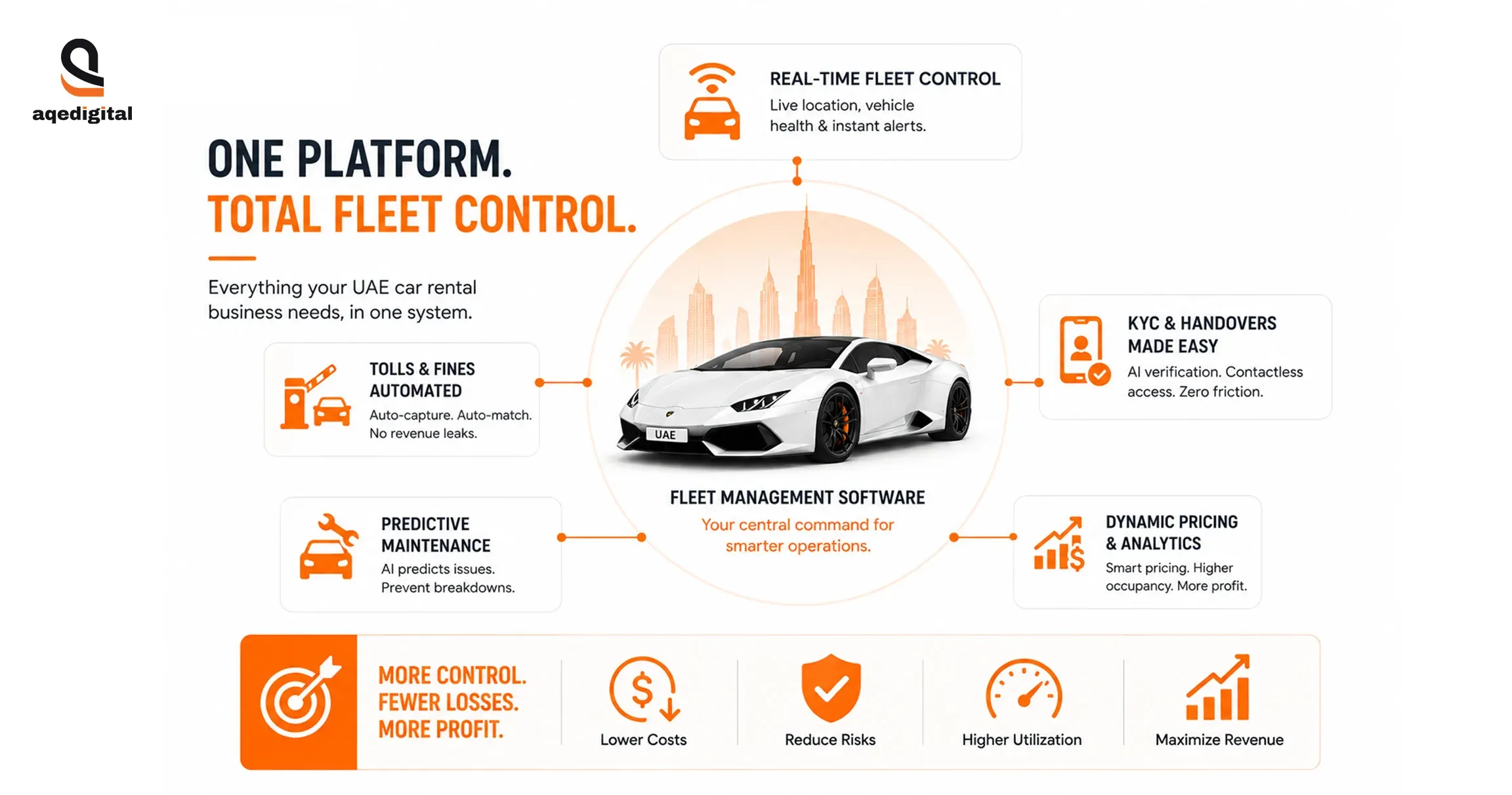
Some of the key functions are,
1. Real-Time IoT Telematics and Fleet Control
Modern software uses sub-second IoT architecture, MQTT protocols, agentic AI capabilities, and edge computing to track exact vehicle conditions. This includes data on engine status, lock status, and the vehicle's location, tracked in real time.
It allows rental car business owners to establish strict geofensive rules. These rules trigger instant alerts if a vehicle enters a restricted zone. It helps rental car businesses reduce risks and ensure optimal speeds to reduce the chances of overspeeding through engine immobilization remotely.
2. Automated Toll, Fine, and Fuel Reconciliation
Manual billing for tolls and traffic violations is a massive bottleneck. Especially when this affects car rental business revenue, it’s important to ensure real-time data capture and charge realization. Using a fleet management solution, businesses can directly integrate government portals like Dubai’s Salik and Abu Dhabi’s Darb to get automatic toll crossing and camera-issued traffic fine data. It also provides the exact active rental contract and timestamp.
3. Frictionless KYC and Contactless Handovers
Eliminating the front-desk queues and preventing uninsurable frauds, a fleet management software handles the entire customer onboarding process. It uses AI-powered know your customer pipelines to extract data through OCR from IDs and passports, cross-referencing driving licenses from government databases.
Once cross-referenced from the government database, the software performed a biometric facial recognition in under 60 seconds. Once approved, customers can unlock vehicles using a mobile app via one-time passwords (OTP) or Bluetooth, entirely removing physical keys from the equation.
4. AI-Driven Predictive Maintenance
Leveraging AI-based predictive maintenance, fleet management software helps car rental businesses avoid disruptions due to vehicle breakdowns and monitor vehicles’ health continuously. It analyzes engine diagnostic codes, battery voltage drops, and data from heavy-duty tire pressure monitoring systems to predict component failures 48 to 72 hours prior to breakdowns.
5. Dynamic Pricing and Analytics
Advanced AI-based revenue management systems analyze historical booking data, local event demand, and competitor pricing to offer real-time insights. Based on the insights, fleet management software can adjust pricing by the hour and maximize profit margins for car rental businesses in the UAE.
What to Evaluate Before Choosing a Fleet Platform?
Most operators who have gone through a fleet management software selection and regretted it share one thing: they evaluated the demo, not the integration. The platform looked clean in the sales presentation. The data migration took four months.
 The vendor had never touched UAE regulatory compliance logic. The Salik attribution workflow they promised as standard became a customization that cost more than the annual license fee.
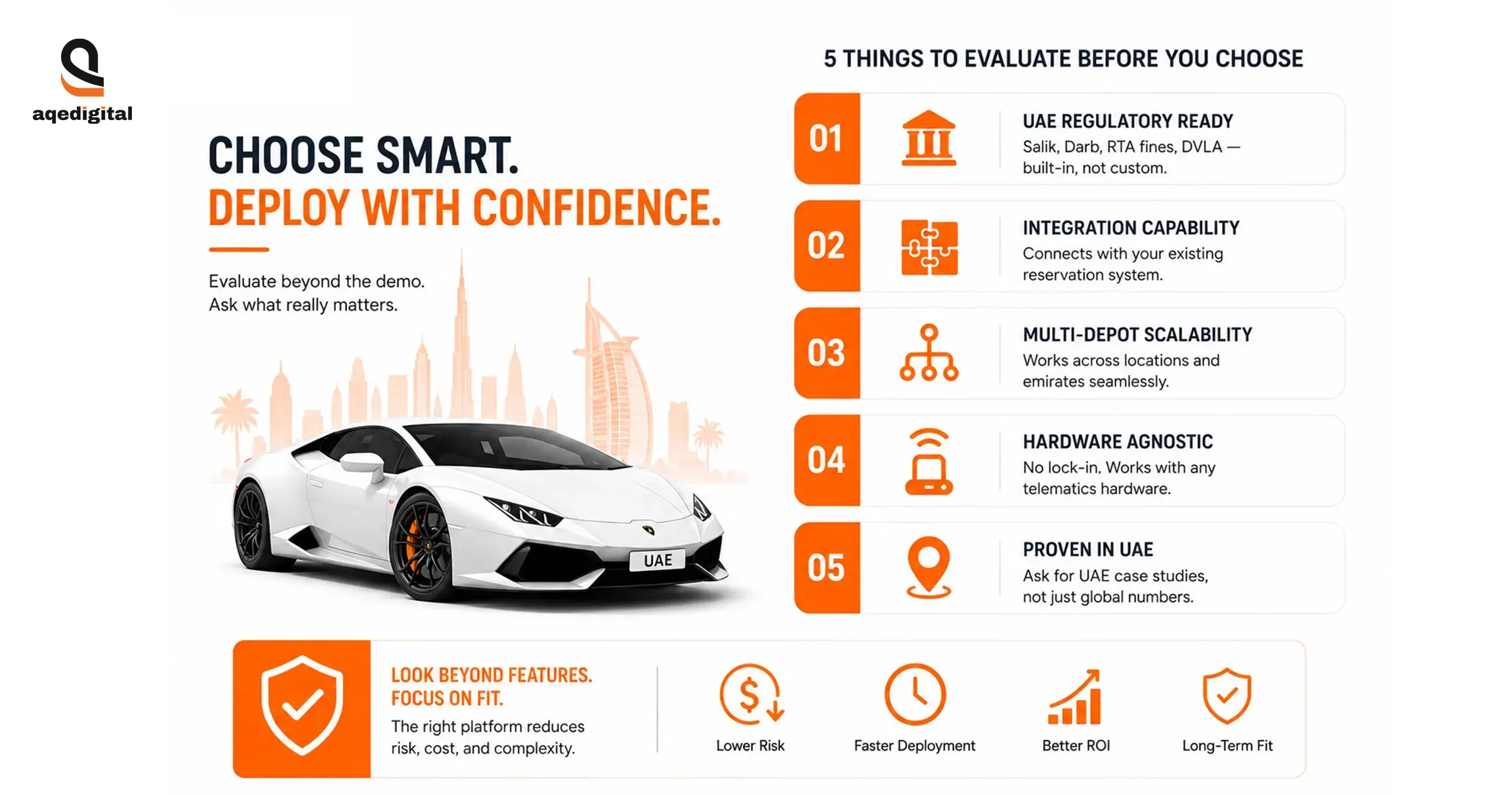
There are five things vendor demos are not built to answer, and all five matter more than anything shown on screen.
- Vendor demos answer zero of the five questions that actually determine whether the platform survives implementation.
- UAE regulatory logic: Salik, Darb, RTA fine attribution, DVLA compliance must ship in the standard product; a "scoping call" answer tells you the vendor has never worked this market.
- If the platform can't read your existing reservation software, you've bought a reporting tool, not an operations tool.
- Multi-depot, multi-emirate operations expose single-location software immediately; it doesn't reduce coordination overhead, it adds a layer on top of it.
- Proprietary telematics hardware is a vendor lock-in contract disguised as a product feature; for mixed-fleet UAE operators, hardware agnosticism is a procurement condition, not a preference.
- 200 UK deployments with zero GCC implementations is a different risk profile; the climate, compliance environment, and operational context are distinct enough that it matters; ask for UAE case studies specifically.
AQe Digital brings product engineering expertise to fleet platform integrations, covering booking system connectors, hardware-agnostic telematics, and UAE regulatory workflow customization. The team's work across automotive technology solutions for enterprise mobility clients means the operational complexity UAE operators deal with isn't unfamiliar territory.
Start Your Fleet Modernization Journey
Demand isn't the problem. At AED 2.2 billion and still accelerating, the UAE car rental market has room for operators who get fleet management software right. What separates the ones who'll grow profitably from the ones who'll grow and bleed is execution.
Fleet Infrastructure Modernization isn't a technology project. It's a decision about how an operator intends to compete. Waiting until 2027 to invest in fleet management software doesn't buy time. It surrenders ground to competitors who moved earlier. Rather, partner with AQe Digital and transform car rental operations for maximum profits.