

Cloud-based app development is not just a trend to follow; it is crucially needed given how drastically data is generated and technologies are advancing. Business mobile applications are expanding unprecedentedly, resulting in challenges related to storage capacity and performance with the traditional approach.
To address these challenges, cloud computing is the best solution organizations can resort to. Cloud-based app development helps businesses streamline data collection, enhance security, and simplify management processes. Businesses can develop productivity-driven applications that improve customer experience, data management, security, performance, and revenue streams.
Cloud-based app development empowers organizations to scale without friction, collaborate in real time, and make data-driven decisions faster than ever before.
What is Cloud Application Development?
Cloud application development is the process of designing, building, and deploying software applications that run entirely on cloud infrastructure rather than on local servers or on-premises hardware. In this model, all data processing, storage, and key functionalities occur on remote servers, while users interact with the application through web browsers or mobile interfaces.
This approach allows applications to be accessible from anywhere, scalable on demand, and secure, without being tied to a single device or location. Cloud apps also leverage APIs to connect different services seamlessly behind the scenes, enabling real-time collaboration, analytics, financial management, and other complex tasks that traditional local systems could not handle efficiently.
Today, businesses can design, develop, and deploy applications through cloud application development, achieving unmatched speed and flexibility. From real-time collaboration to analytics to financial management, cloud solutions power tasks that were once restricted by local systems.
What are The Major Different Types of Cloud-based Applications?
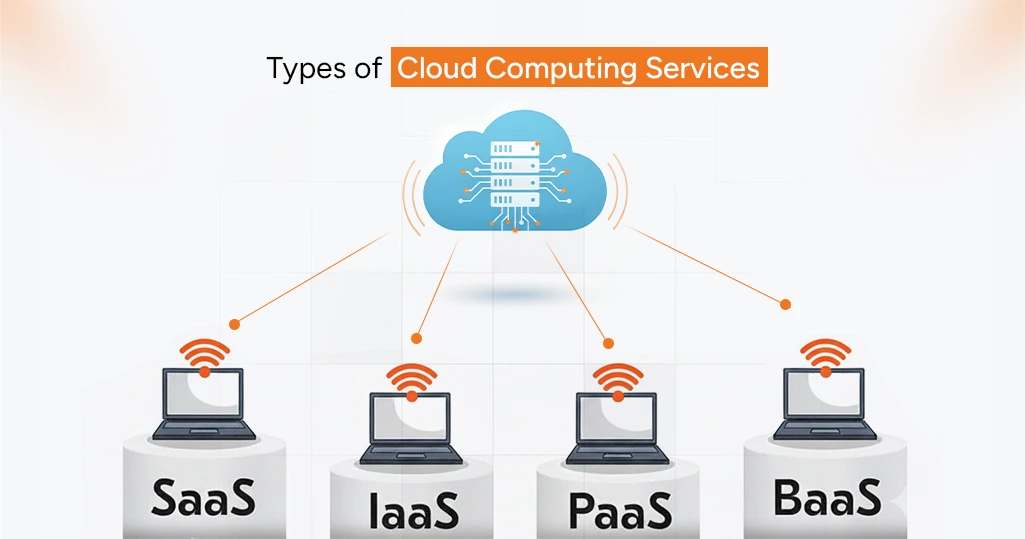
When we talk about application development in cloud computing, it’s not a one-size-fits-all process. Businesses have different needs, and the cloud is flexible enough to meet them all.
There are three major types of development solutions that organizations can resort to depending on whether they need software, development tools, or a full-scale infrastructure.
Software as a Service (SaaS)
Organizations can deploy tools instantly across teams, with all processing, storage, and updates handled in the cloud. This makes SaaS the go-to model for businesses that want instant access to tools without worrying about setup or maintenance. SaaS eliminates the burden of managing infrastructure, reduces IT overhead, and allows businesses to scale quickly, streamline operations, and focus on core objectives.
Examples of SaaS: Salesforce, Zoom, Google Workspace, HubSpot, etc.
Features of SaaS:
- Manage CRM systems and customer data with ease
- Automate service sign-ups and product workflows
- Access email tools, auditing, and reporting features
- Share calendars and agendas across teams instantly
- Collaborate on files and documents in real time
Platform as a Service (PaaS)
PaaS provides a complete cloud-based environment for developers, including servers, operating systems, databases, and development tools, all managed by the provider. This allows developers to focus on writing code and building features, rather than worrying about infrastructure. Platforms like Azure, Heroku, and OpenShift enable faster and more scalable app creation.
Examples of PaaS: AWS Elastic Beanstalk, Google App Engine, Microsoft Azure Web Apps, Heroku, Red Hat OpenShift, etc.
Features of PaaS:
- Access ready-to-use operating systems
- Leverage cloud-hosted databases for scalability
- Use development tools to speed up app creation
- Integrate middleware to connect services seamlessly
Infrastructure as a Service (IaaS)
Businesses can access IT infrastructure, including servers, networking, storage, and virtualization, on demand with the help of IaaS. Instead of investing in costly hardware, rent resources from providers and scale them up or down as needed. This flexibility makes IaaS ideal for businesses with fluctuating workloads or those needing complete control over their IT environment.
Examples of IaaS: Amazon Web Services (AWS), Microsoft Azure, and Google Cloud Platform (GCP) etc.
Features of IaaS:
- Get detailed invoices and usage tracking
- Use resiliency tools for backup, recovery, and replication
- Enable advanced security with encryption and compliance standards
- Balance workloads with clustering and load distribution
- Maintain visibility through logs and monitoring tools
Each model serves a different purpose, but together, they make cloud apps powerful, scalable, and accessible for businesses of all sizes.
Benefits of Cloud-Based Applications
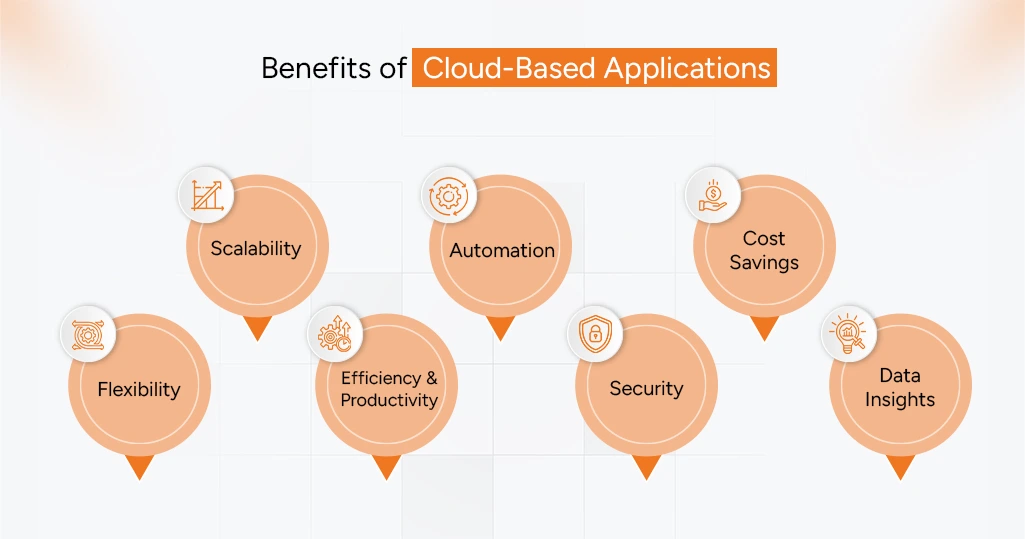
One of the primary reasons businesses are migrating to the cloud is the numerous benefits it offers. From flexibility and scalability to enhanced security and informed decision-making, cloud technology breaks down the old barriers of IT.
Let’s examine how cloud-based app development revolutionizes the game.
1. Flexibility
Cloud apps adjust to your needs without the hassle of manual upgrades or hardware limits. Whether you’re scaling up resources during peak demand or scaling down to cut costs, everything happens on demand.
How does cloud-based app development make it happen?
- Resources like storage and memory are allocated dynamically
- Cloud environments allow easy vendor switching without disruption
Impact on business
- Reduced IT costs with pay-as-you-go flexibility
- Ability to adapt instantly to changing business needs
- No downtime during provider or service transitions
2. Scalability
Legacy IT systems often buckle under heavy traffic or growing datasets. Cloud apps, on the other hand, are designed to scale automatically. If one server crashes, another takes over instantly, ensuring your app never skips a beat. This makes the cloud the smarter choice for businesses that expect growth.
How does cloud-based app development make it happen?
- Auto-scaling balances workloads across multiple servers
- Failover mechanisms guarantee uptime even during failures
Impact on business
- Consistent performance even with user spikes
- Greater reliability with zero service interruptions
- Confidence to expand globally without infrastructure risks
3. Efficiency and Productivity
When you develop a cloud application, you cut through IT roadblocks that slow businesses down. No more worrying about buying servers or patching hardware because with cloud computing in place, your team can focus directly on delivering value to customers. This efficiency fuels productivity at every level of your organization.
How does cloud-based app development make it happen?
- Providers handle updates, infrastructure, and maintenance
- Cloud resources scale up or down automatically
Impact on business
- Faster time-to-market for new apps and features
- Lower operational overheads with less hardware management
- Teams are free to focus on innovation instead of routine fixes
4. Automation
Managing applications traditionally requires repetitive, manual tasks. With application development in cloud computing, automation is baked in. From capacity management to continuous integration, the cloud handles the heavy lifting, reducing the workload for IT teams. Our solutions extend to specialized industries, offering tailored IT services for manufacturing that leverage cloud scalability and automation for operational efficiency.
How does cloud-based app development make it happen?
- Automated orchestration of resources
- Continuous integration and delivery pipelines for faster roll-outs
Impact on business
- Fewer manual errors during app management
- Agile development cycles with faster release timelines
- IT teams freed up to focus on strategy instead of routine tasks
5. Security
Modern cloud platforms implement multi-layered security measures to protect applications, data, and infrastructure. This includes Role-Based Access Control (RBAC) to restrict user permissions, Identity and Access Management (IAM) tools for strong authentication and authorization, and multi-factor authentication (MFA) to prevent unauthorized access. Beyond user access, cloud security also covers network and infrastructure protection, such as firewalls, intrusion detection and prevention systems, and secure API gateways.
Data is safeguarded with encryption both at rest and in transit, while continuous monitoring, threat detection, and automated alerts help prevent breaches before they occur. Endpoint security measures, including device authentication and secure connections, further protect the environment from vulnerabilities at the user level.
How does cloud-based app development make it happen?
- Industry-standard encryption and compliance protocols
- Regular monitoring by dedicated security teams
Impact on business
- Stronger protection against cyber threats
- Easier compliance with government and industry regulations
- Peace of mind for both customers and stakeholders
6. Cost Savings
Cloud application development empowers businesses to cut costs by removing the need for physical servers, ongoing hardware maintenance, and large in-house IT teams. With a flexible pay-as-you-go model, companies pay only for the resources they actually use, reducing waste and improving budget efficiency. It also offers scalable resource allocation, allowing infrastructure to automatically adjust based on demand.
Overall, the cloud transforms heavy CapEx into flexible OpEx, driving long-term savings and allowing businesses to reinvest in innovation and digital growth.
How does cloud-based app development make it happen?
- Providers host, maintain, and upgrade infrastructure
- Flexible pricing ensures costs match usage patterns
Impact on business
- Significant savings on IT infrastructure
- Lower staffing costs for maintenance and upgrades
- Predictable budgeting with scalable pricing models
7. Data Insights
Cloud-based applications make it easier to collect, process, and analyze data in real time, uncovering patterns and opportunities you’d otherwise miss. By integrating cloud-powered data analytics, organizations can transform raw information into actionable insights, enabling smarter decision-making across marketing, operations, finance, and other key business functions.
How does cloud-based app development make it happen?
- Built-in analytics tools to process large data volumes
- Seamless integration with AI/ML solutions for deeper insights
Impact on business
- Smarter, data-driven decision-making
- Identifying trends, risks, and growth opportunities faster
- Continuous optimization of operations, marketing, and finance
Together, these benefits prove that cloud apps aren’t just another IT option; they’re the foundation of modern business growth.
Step-by-Step Process for Developing a Cloud Application
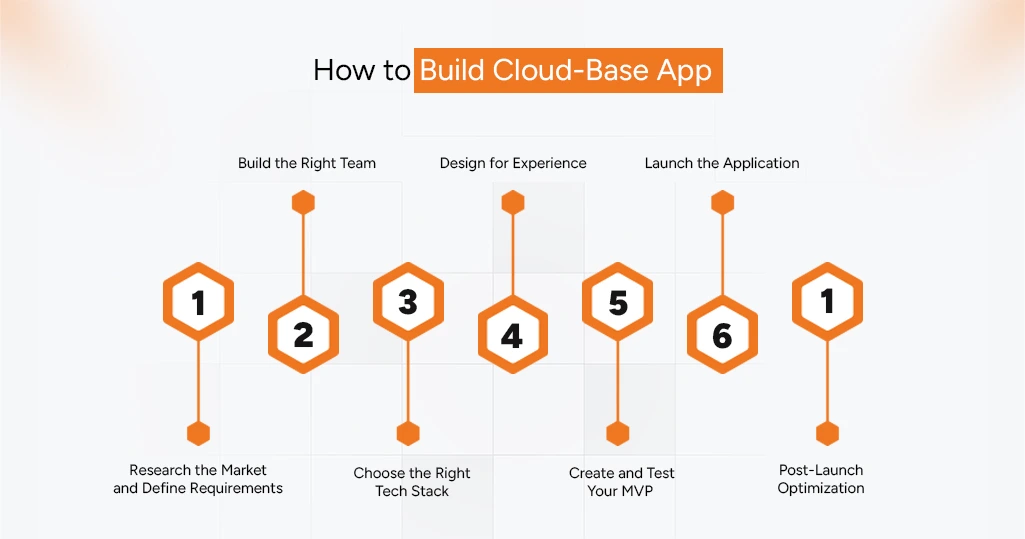
Building in the cloud isn’t just about writing code; it’s about creating something that delivers value, scales with demand, and actually solves a problem for users. The process may appear complex on the surface, but with the right strategy, you can avoid costly mistakes and accelerate your progress toward launch.
Let’s discuss the steps you should follow to develop a cloud application that’s both reliable and future-ready.
Step 1: Research the Market and Define Requirements
Start with comprehensive market and technical research to identify your target users, the problems your app will solve, and how cloud technology can give you a competitive edge. Analyze competitors’ architectures, deployment models, and scalability limitations to uncover opportunities.
This stage defines your cloud environment (public, private, or hybrid), integration requirements, and feature priorities, ensuring your solution is cost-efficient, scalable, and aligned with user expectations.
Essential Considerations
- Conduct competitor benchmarking to identify feature gaps and oversaturated areas.
- Create detailed user personas and customer journey maps.
- Collect feedback through surveys, interviews, and focus groups.
- Define core use cases and user scenarios for your cloud application.
- Outline platform requirements (web, mobile, hybrid) based on target audience behavior.
Step 2: Build the Right Team
Talent is the fuel behind every successful product. When building large-scale solutions, hiring the right talent is crucial for enterprise software development, ensuring your cloud apps meet organizational needs efficiently.
You have three options here:
- In-house developers give you long-term support and alignment with your company’s vision.
- Freelancers offer flexibility and lower costs, but availability can be a problem when you need urgent fixes.
- Outsourcing partners bring verified expertise and speed, but can introduce communication gaps if time zones or work cultures clash.
- There’s no one-size-fits-all. The key is choosing the model that fits your resources, timeline, and long-term goals for application development in cloud computing.
Essential Considerations
- Assign dedicated project managers to coordinate tasks and timelines.
- Ensure team members have experience with cloud application development platforms.
- Define clear roles and responsibilities for UI/UX, backend, frontend, and QA.
- Implement communication and collaboration tools for smooth workflow.
Step 3: Choose the Right Tech Stack
Think of your tech stack as the foundation of your cloud app. It decides how scalable, secure, and flexible your solution will be in the long run. While your Dev team should guide this decision, stay involved.
Popular options span programming languages, frameworks, databases, containers, and cloud application development platforms. The right mix can reduce costs, speed up development, and make future updates easier.
Essential Considerations
- Evaluate cloud providers for reliability, security, and cost-efficiency.
- Decide on a database type (SQL vs. NoSQL) based on data requirements.
- Choose frameworks that support scalability and cross-platform compatibility.
- Integrate containerization tools, such as Docker/Kubernetes, for enhanced deployment efficiency.
- Plan CI/CD pipelines for faster, automated deployments.
Step 4: Design for Experience
Design isn’t just about how your app looks; it’s about how users feel when they interact with it. Great design comes down to responsive layouts, intuitive navigation, accessibility for all users, and seamless performance across devices. Prior market research helps you nail the first iteration, so you’re not stuck with endless redesign cycles later.
Essential Considerations
- Apply A/B testing for UI/UX validation.
- Use responsive design to ensure compatibility across devices.
- Implement accessibility standards (like ARIA) for inclusive design.
- Optimize visual hierarchy for faster task completion.
- Incorporate real-time feedback and error handling for smoother interactions.
Step 5: Create and Test Your MVP
This is where ideas turn into something real. An MVP (Minimum Viable Product) lets you validate your concept with actual users. Focus solely on the core features that address the primary issue.
Use agile methods, automated testing, and feedback loops to make fast improvements. By leveraging cloud-based app development, you also get built-in scalability, making it easier to roll out updates as your user base grows.
Essential Considerations
- Define core features that directly address primary user pain points.
- Conduct user testing sessions to validate usability and functionality.
- Implement automated testing tools to catch bugs early.
- Use cloud infrastructure to enable on-demand scaling.
- Gather analytics and monitor system performance in real time.
Step 6: Launch the Application
The launch stage is where preparation pays off. Go live only after thorough QA, performance testing, and security checks. Pair your launch with a marketing strategy that builds anticipation. If possible, consider a soft launch to gather feedback before scaling to a broader audience. And remember, the launch isn’t the finish line, it’s the beginning of real user adoption.
Essential Considerations
- Set up monitoring tools for uptime, errors, and user interactions.
- Implement backup and disaster recovery solutions.
- Ensure compliance with security and privacy regulations.
- Conduct beta testing to identify last-minute improvements.
- Prepare user support channels for smooth onboarding.
Step 7: Post-Launch Optimization
Once your app is live, the real work begins. Monitor performance, track user behavior, and keep a close eye on security. Regular updates based on user feedback will help you stay competitive. Establish KPIs such as churn rate, cost per acquisition, and revenue per user to measure success. The most successful apps are the ones that evolve, not the ones that stay static.
Essential Considerations
- Set up automated reporting dashboards for KPIs and metrics.
- Plan regular feature updates based on analytics insights.
- Continuously monitor and patch security vulnerabilities.
- Use A/B testing to optimize UI/UX over time.
- Collect user feedback consistently for iterative improvements.
How AQe Digital can Help you Build Cloud Apps?
At AQe Digital, we craft digital ecosystems designed to scale, perform, and evolve with your business. Our team combines strategic thinking, technical expertise, and a growth-focused mindset to turn your cloud vision into a high-performing, future-ready solution.
Here’s how our team make it happen:
- End-to-End Cloud Development: From ideation and architecture design to deployment and optimization, we manage the entire cloud app lifecycle, ensuring speed, security, and scalability at every step.
- Multi-Cloud & Hybrid Expertise: Our developers are well-versed with AWS, Microsoft Azure, Google Cloud, and other popular platforms, helping you choose and implement the right environment for maximum flexibility and cost efficiency.
- Focus on Growth & Performance: We design cloud applications that are not just technically strong but strategically aligned with your business goals, that help enhance productivity, enable automation, and support rapid innovation.
- Agile Collaboration: At AQe Digital, we believe in partnership, not projects. You’ll work closely with a dedicated team that values transparency, proactive communication, and continuous improvement.
- Post-Launch Support & Optimization: Building the app is just the beginning. We offer ongoing monitoring, performance tuning, and feature upgrades to ensure your cloud solution stays ahead of the curve.
When you collaborate with AQe Digital, you’re not just hiring developers; you’re gaining a technology partner committed to driving your digital transformation, accelerating time-to-market, and delivering measurable ROI through cloud innovation.
Conclusion
By leveraging cloud application development platforms, organizations gain flexibility, cost-efficiency, and the ability to innovate faster. Cloud apps reduce infrastructure burdens, enhance security, and ensure real-time performance. From startups to enterprises, the shift to cloud development empowers businesses to adapt quickly, handle growing user demand, and stay competitive.
At AQe Digital, we help businesses develop a cloud application tailored to their unique needs. Our team offers end-to-end services, from strategy and design to deployment and post-launch optimization. Contact us today to harness the full potential of cloud technology and turn your vision into a high-performing, scalable application.
FAQs
Cloud application development is the process of building software that runs on cloud infrastructure instead of local servers. It allows businesses to access data, resources, and services remotely, ensuring scalability, security, and flexibility.
Cloud platforms provide enterprise software with robust infrastructure, seamless updates, and automatic scalability, reducing operational costs and enhancing productivity across multiple teams.
By integrating cloud-based systems, manufacturers can automate processes, monitor production in real-time, and analyze operational data, enhancing efficiency and reducing downtime.
APIs connect cloud applications to data and external services seamlessly, enabling smooth data exchange, integration, and automation across multiple platforms.
Absolutely. Small businesses gain access to enterprise-level infrastructure, scalability, and analytics without heavy upfront investment, helping them compete with larger organizations.