Data Sovereignty in Cloud Applications: What Enterprises Need to Know

Cheta Pandya
Cloud applications have made it easier for enterprises to operate across markets, scale infrastructure, and access business-critical systems from almost anywhere. But that flexibility comes with a question many organizations can no longer afford to overlook: Where does your data actually belong?
For a growing enterprise, data may move across cloud regions, backup environments, third-party applications, APIs, and analytics platforms within a single workflow.
The application may appear centralized to the user, while the underlying data is distributed across multiple jurisdictions with different legal requirements.
The challenge is already visible at the enterprise level. IBM research found that 68% of surveyed executives consider meeting data residency and sovereignty requirements across geographies challenging.
That is why understanding what is data sovereignty has become increasingly important for modern cloud strategies.
The challenge becomes even more complex when enterprises operate internationally. Data residency requirements, privacy regulations, cross-border transfers, and data sovereignty compliance can all influence how applications should be designed and where sensitive information can be processed.
Why Data Sovereignty Matters More for Modern Enterprises
Enterprise data rarely stays within a single system anymore.
Customer records may be stored in one region, processed by applications operating elsewhere, and accessed by employees across several countries. Cloud providers can also distribute workloads across multiple data centers to improve availability, performance, and resilience.
That flexibility creates business advantages, but it also creates governance challenges.
An enterprise may need to answer questions such as:
- Where is our customer data physically stored?
- Which country's laws govern that information?
- Who can access the underlying infrastructure?
- Can foreign authorities legally request access to the data?
- Where are backups and disaster-recovery copies located?
- Which third-party services process our information?
- Can administrators outside the required jurisdiction access sensitive systems?
These questions become particularly important for financial services, healthcare, government, defense, telecommunications, and other highly regulated sectors.
What Is Data Sovereignty?
So, what is data sovereignty in practical enterprise terms?
Data sovereignty refers to the principle that digital information is subject to the laws and regulations of the jurisdiction where the data is located or processed.
The concept becomes important when cloud infrastructure crosses national or regional boundaries. Different jurisdictions can impose different requirements for privacy, government access, data protection, retention, and information transfer.
For example, an enterprise operating in several countries may have customer information subject to different legal obligations depending on where that information is stored and processed.
Data sovereignty therefore influences more than storage decisions. It can affect:
- Cloud architecture
- Application deployment
- Data processing
- Disaster recovery
- Third-party integrations
- Administrative access
- Security controls
- Compliance documentation
The important point is that sovereignty is ultimately about legal authority and control over data, rather than simply identifying the physical location of a database.
Data Sovereignty vs Data Residency vs Data Localization
These terms are frequently used interchangeably, but they describe different concepts.
| Data Sovereignty vs Data Residency vs Data Localization | ||
|---|---|---|
| Concept | Primary Focus | Enterprise Question |
| Data sovereignty | Legal jurisdiction | Which laws govern the data? |
| Data residency | Physical or geographical location | Where is the data stored? |
| Data localization | Restricting cross-border movement | Must the data remain within a specific country? |
Understanding data sovereignty vs data residency is particularly important when designing enterprise cloud environments.
An organization may satisfy a residency requirement by keeping customer information inside a particular country. However, that does not automatically answer questions about who controls the infrastructure or which external laws could apply.
Similarly, localization can impose stricter restrictions by preventing certain categories of information from leaving a jurisdiction.
Why the Difference Matters
Consider an enterprise that stores sensitive customer information in a local data center operated by a global cloud provider.
The data may satisfy a geographic storage requirement. Yet the enterprise still needs to understand the provider's ownership structure, administrative access model, support operations, and applicable legal obligations.
This is why sovereignty needs to be evaluated as part of the complete cloud operating model.

How Cloud Applications Create Sovereignty Challenges
Cloud applications make data management more distributed than traditional enterprise infrastructure.
A single application can involve databases, APIs, analytics platforms, identity services, payment processors, monitoring systems, backup platforms, and customer-support tools.
Each component may potentially process business or customer information.
1. Distributed Infrastructure
Cloud platforms frequently use multiple regions and availability zones.
This architecture improves resilience and performance, but enterprises must understand where primary and replicated data actually resides.
Backups deserve particular attention because organizations sometimes evaluate production databases while overlooking disaster-recovery environments.
2. Third-Party Processing
Modern applications depend heavily on SaaS platforms and external APIs.
Customer information can move between systems without users realizing that another service has become part of the data-processing chain.
Enterprises therefore need visibility across the complete application ecosystem.
3. Administrative Access
Physical storage location is only one part of the sovereignty equation.
Support engineers, administrators, security teams, and managed-service providers may have different levels of access to enterprise infrastructure.
Organizations need clear policies governing privileged access and operational responsibilities.
4. Cross-Border Data Transfers
International applications often transfer information between countries for analytics, customer support, security monitoring, or operational purposes.
Those transfers may create additional legal and contractual requirements depending on the data involved and jurisdictions concerned.
Understanding Sovereign Cloud
A sovereign cloud is designed to provide stronger controls over data, infrastructure, operations, and jurisdictional exposure.
The exact implementation varies between providers and markets, but sovereign cloud environments commonly focus on requirements such as:
- Local data storage
- Jurisdictional control
- Local operational personnel
- Restricted administrative access
- Regional infrastructure
- Compliance controls
- Data-transfer restrictions
- Customer-controlled encryption
This approach can be particularly relevant for governments and enterprises handling highly sensitive or regulated information.
Sovereignty Is More Than Local Hosting
Simply selecting a local cloud region does not automatically create a sovereign environment.
Enterprises should examine the entire operating model, including infrastructure ownership, personnel access, support operations, encryption management, legal jurisdiction, and data-transfer mechanisms.
A useful evaluation framework therefore looks beyond the physical location of servers.
How Regulatory Requirements Are Changing Enterprise Cloud Architecture
Regulatory requirements are increasingly influencing how enterprises design, deploy, and manage cloud applications. Privacy regulations can establish requirements around personal information, while sector-specific regulations may introduce additional obligations involving security, retention, access, and data processing.

For global organizations, data sovereignty compliance can therefore become an architectural consideration rather than a documentation exercise. Cloud environments need to account for regulatory requirements from the beginning instead of treating them as an additional layer after deployment.
Why Regulatory Requirements Influence Cloud Design
Regulatory obligations can affect where information is stored, how it moves between systems, who can access it, and how long it must be retained. These requirements can influence everything from database architecture and cloud regions to backup strategies and third-party integrations.
For enterprises operating across multiple jurisdictions, understanding these requirements early can prevent costly architectural changes later.
How GDPR Adds Complexity to Cloud Data Management
The relationship between GDPR data sovereignty considerations and cloud architecture illustrates this complexity.
The General Data Protection Regulation establishes requirements concerning the processing and protection of personal data. Organizations operating internationally must understand how their data flows across jurisdictions and whether appropriate safeguards exist for relevant transfers.
Simply hosting data inside Europe does not automatically resolve every GDPR obligation. Enterprises must also consider how information is collected, processed, transferred, secured, retained, and accessed throughout its lifecycle.
What Enterprises Should Evaluate
Before deploying cloud applications across jurisdictions, enterprises should evaluate:
- Where personal and sensitive data is stored and processed.
- Which third-party platforms can access that information.
- Where backups, logs, and replicated data are maintained.
- How data moves between different countries or cloud regions.
- Which access controls govern internal and external users.
This broader assessment helps organizations align cloud architecture with regulatory expectations while avoiding the assumption that geographic data storage alone provides complete compliance.
Data Sovereignty vs Data Localization: What Enterprises Should Evaluate
The distinction between data sovereignty vs data localization becomes especially important for multinational businesses.
Localization generally emphasizes keeping particular information within defined geographic boundaries.
Sovereignty takes a broader view by considering the legal authority and jurisdiction associated with that information and its infrastructure.
An enterprise might therefore satisfy a localization requirement while still needing additional sovereignty controls.
The right architecture depends on the organization's industry, data classification, regulatory environment, cloud provider, and geographic footprint.
A Practical Data Sovereignty Strategy
Enterprises should avoid treating sovereignty as something that gets addressed after applications are deployed.
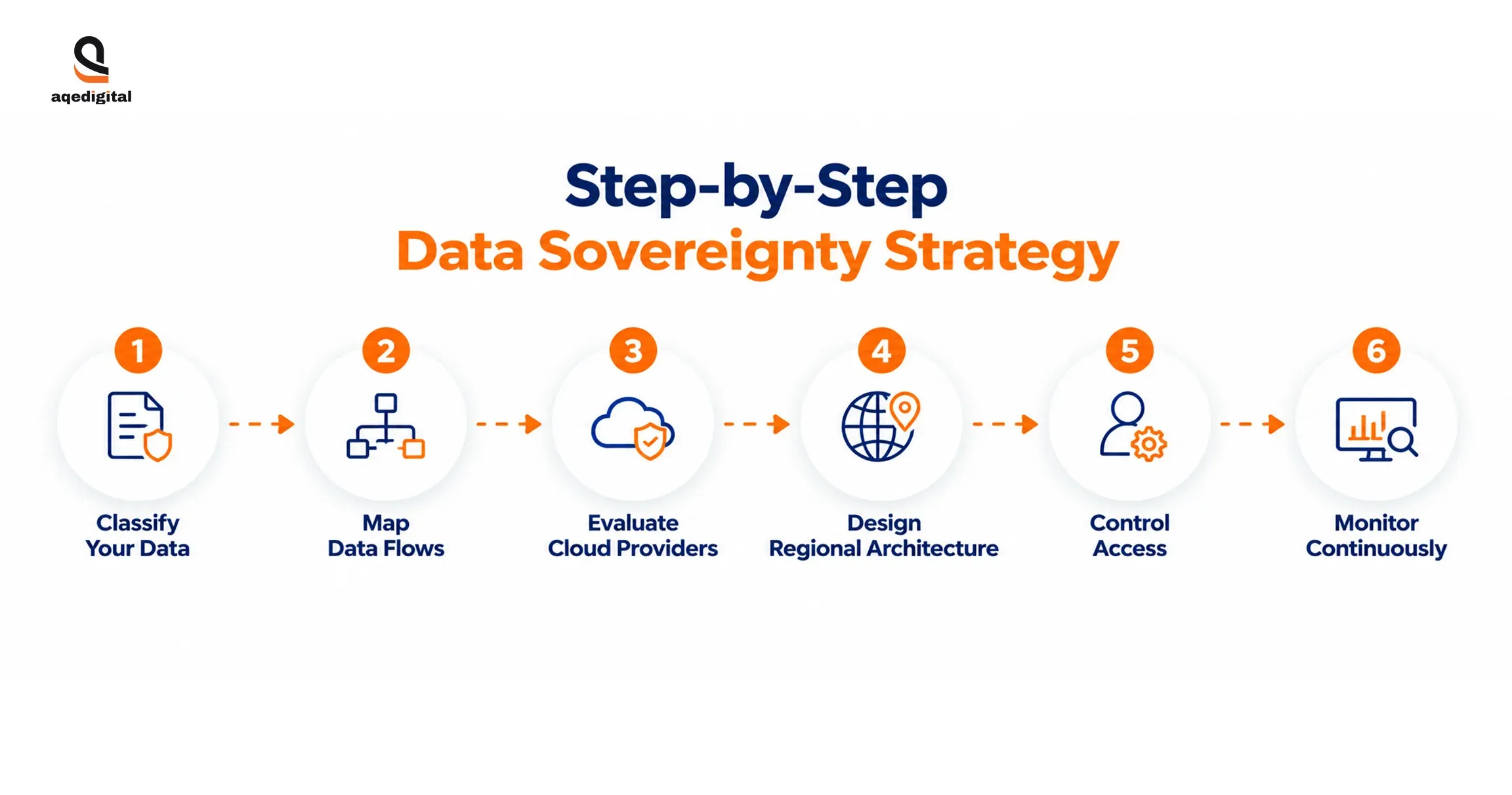
Instead, organizations should incorporate sovereignty requirements into cloud architecture from the beginning.
A practical approach can include the following steps.
Step 1: Classify Your Data
Not every piece of enterprise information requires the same level of control.
Classify information based on sensitivity, regulatory requirements, business importance, and geographic restrictions.
For example:
- Public information
- Internal business information
- Customer information
- Financial information
- Sensitive personal information
- Highly regulated information
Classification helps determine where stronger controls are actually necessary.
Step 2: Map Data Flows
Document how information moves through your applications.
Identify databases, APIs, third-party platforms, analytics tools, backups, and integrations.
Data-flow mapping often reveals unexpected cross-border transfers that are difficult to identify from application architecture diagrams alone.
Step 3: Evaluate Cloud Providers
Cloud providers should be evaluated against specific sovereignty requirements rather than general infrastructure capabilities.
Review areas such as:
- Data-center locations
- Jurisdiction
- Encryption controls
- Administrative access
- Support operations
- Backup locations
- Subprocessors
- Data-transfer mechanisms
- Compliance certifications
The objective is to determine whether the provider's operating model aligns with enterprise requirements.
Step 4: Design Regional Architecture
Enterprises operating across multiple markets may need regionalized application architectures.
This could involve separate databases, regional processing environments, localized backups, or restricted integration paths.
However, regionalization should be driven by actual regulatory and business requirements rather than implemented universally.
Step 5: Control Access
Sovereignty depends partly on who can access enterprise information.
Organizations should implement role-based access, privileged-access controls, audit logging, encryption, and strong identity management.
Administrative access should be documented and regularly reviewed.
Step 6: Monitor Continuously
Cloud environments change constantly.
New SaaS applications get introduced, infrastructure regions change, vendors are replaced, and application integrations expand.
A sovereignty review conducted once during implementation can become outdated quickly.
Continuous monitoring should therefore become part of enterprise cloud governance.

Data Sovereignty Mistakes That Can Create Enterprise Cloud Risks
Even organizations with mature security programs can overlook sovereignty considerations.
Focusing Only on Storage
Companies often verify where production data is stored while overlooking backups, logs, analytics systems, and third-party services.
Treating Compliance as Documentation
Policies and certifications are important, but they do not replace technical controls.
An enterprise needs to demonstrate that its architecture actually supports its stated data-handling requirements.
Ignoring Operational Access
Infrastructure location does not provide the complete picture.
Organizations should also understand who can administer systems and from which jurisdictions that access can occur.
Building One Global Architecture
A single architecture can be efficient, but it may not satisfy different regulatory requirements across markets.
Enterprises should determine where regional separation provides meaningful regulatory or business value.
How AI and Modern Applications Increase the Challenge
AI-powered applications introduce another layer of complexity.
Enterprise AI systems can process customer records, internal documents, transaction histories, support conversations, and proprietary business information.
The underlying AI infrastructure may involve multiple services, models, APIs, and processing environments.
Organizations therefore need to understand where information is sent and how it is processed before integrating AI into sensitive workflows.
This becomes particularly important when enterprises use external AI services rather than operating models within controlled infrastructure.
AI Governance Needs Data Governance
AI governance cannot exist separately from data governance.
If an organization does not know where sensitive information moves through an AI workflow, it becomes difficult to establish meaningful sovereignty controls.
Enterprises should therefore evaluate:
- Model hosting location
- Prompt and input processing
- Data retention
- Training usage
- API infrastructure
- Logging
- Human access
- Third-party subprocessors
This approach connects AI adoption with broader cloud governance instead of treating the two as separate initiatives.
How AQe Digital Helps Enterprises Build More Controlled Cloud Applications
Data sovereignty becomes significantly more manageable when organizations connect regulatory requirements with practical application architecture.
AQe Digital helps enterprises evaluate and modernize cloud applications with a focus on scalability, security, integration, and business requirements.
Our approach can support organizations through areas such as:
- Cloud application assessment
- Data-flow and architecture analysis
- Application modernization
- Regional cloud architecture
- API and integration assessment
- Security and access-control implementation
- Enterprise application development
- Cloud migration planning
For enterprises operating across multiple jurisdictions, this can also mean designing applications that accommodate regional requirements without unnecessarily fragmenting the entire technology ecosystem.
Talk to our experts about building a cloud application architecture designed around your enterprise data requirements.
Conclusion
The enterprises that gain long-term value from cloud adoption will be those that treat data control as part of architecture, not as a separate compliance requirement. This approach can help organizations manage regulatory complexity, strengthen security, and build cloud environments that support sustainable growth across markets.
AQe Digital helps enterprises design, develop, modernize, integrate, and scale cloud applications around their data, security, and business requirements.
For organizations looking to build more controlled and scalable cloud environments, the right technology partner can help turn complex data requirements into practical application strategies.
Contact us to build scalable cloud application solutions for your organization.