What Is Data Profiling and How Can It Be Beneficial To Your Organization?

Jigar Mistry
Data is only as powerful as its quality, but most organizations operate with data they don’t fully understand. Despite growing investments in analytics, a large portion of enterprise data remains inconsistent, incomplete, or underutilized. This disconnect isn’t just a technical issue; it directly impacts decision-making, operational efficiency, and revenue potential. As per the report on data quality assessments, it is revealed that only 3% of organizational data meets basic quality standards.
That’s where data profiling steps in as a critical enabler. It provides a structured way to examine, analyze, and validate datasets before they are used downstream. With the help of modern data profiling tools, businesses can uncover hidden patterns, detect anomalies, and gain clarity into data structures without relying on assumptions with data analytics services.
The evolution of data profiling software has further elevated this process. Today, profiling is not a one-time activity but an ongoing practice embedded into data workflows that includes supporting governance, improving accuracy, and ensuring consistency at scale. This continuous approach is essential for organizations aiming to build reliable data ecosystems.
At a tactical level, applying the right data profiling techniques, from statistical analysis to pattern discovery, enables teams to transform raw, unstructured data into trusted, actionable insights.
What is Data Profiling?
Data profiling is the structured approach to examining, cleansing, and understanding data so organizations can trust what they use for decision-making. Often referred to as data archeology, it goes beyond a basic review and dives into how data is structured, how consistent it is, and whether it meets defined quality standards. The data profiling process typically involves analyzing datasets using statistical methods, business rules, and validation logic to uncover inconsistencies, missing values, and anomalies that can impact downstream use.
It evaluates key dimensions such as accuracy, completeness, consistency, and timeliness, helping teams identify gaps before they become costly issues. Modern data profiling software enhances this by automating analysis across large and complex datasets, making it easier to scale profiling across enterprise environments and integrate it into data pipelines.
Data Profiling vs Data Mining
Understanding data profiling vs data mining is critical for building a strong data strategy. While both deal with data analysis, their intent and outcomes are fundamentally different:
• Data profiling focuses on understanding data structure, quality, and integrity, while data mining is aimed at discovering patterns and trends within the data
• Data profiling works with metadata and statistical summaries to support data management, whereas data mining applies algorithms to generate predictive or descriptive insights
• Data profiling produces a clear snapshot of data characteristics, enabling usability, while data mining extracts hidden relationships that drive business decisions
In simple terms, data profiling prepares the data, while data mining extracts value from it. Profiling ensures the data is accurate and reliable before it is used, making it a foundational step for any analytics, business intelligence, or advanced data initiative.
Key Benefits of Data Profiling for Modern Data Environments
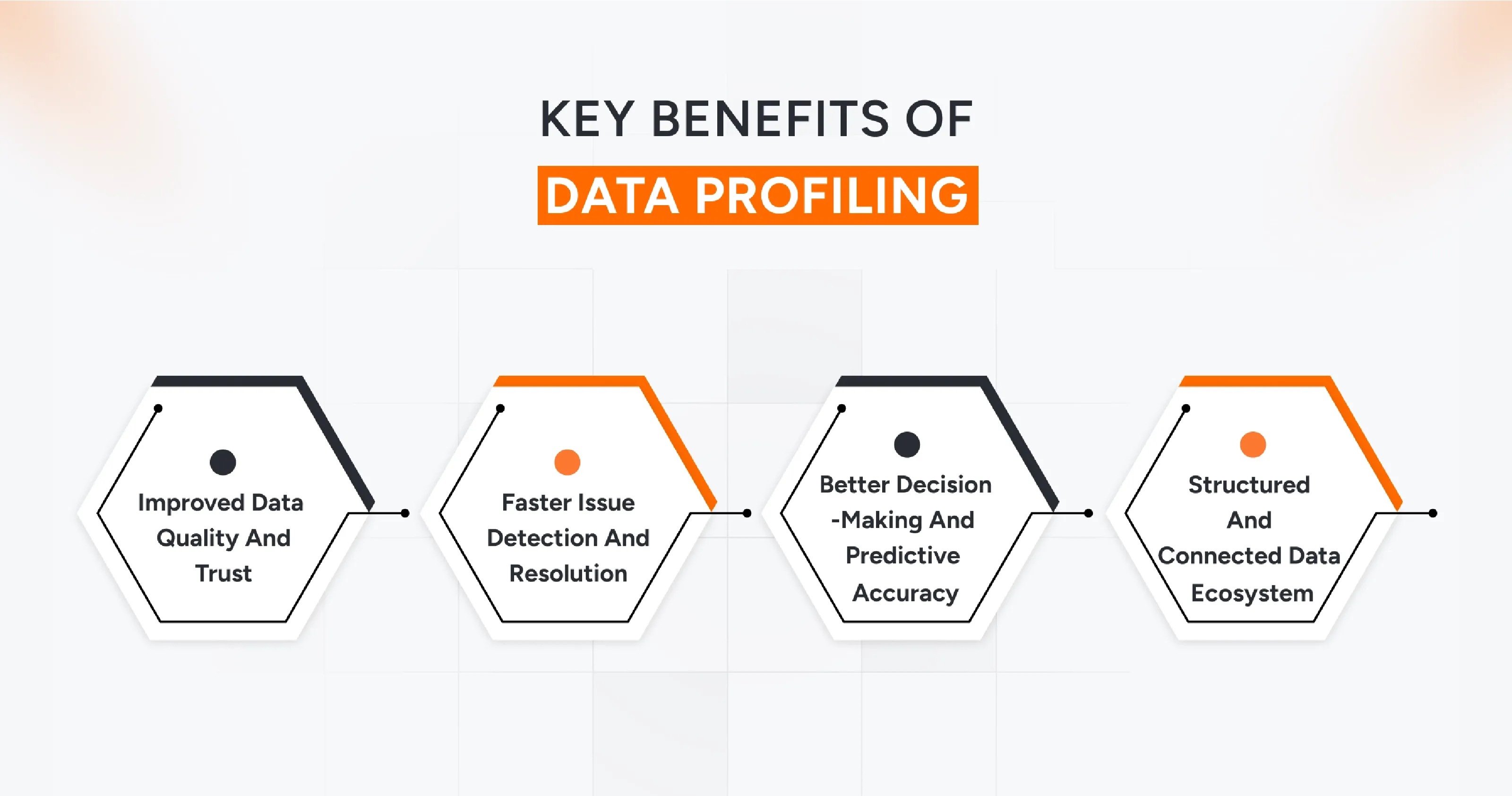
The data profiling process addresses the data management challenges by providing a clear and measurable view of how data behaves, where it fails, and how it can be improved. With the advancement of data profiling software, organizations can now embed profiling directly into their data workflows, shifting from reactive corrections to proactive data management.
Improved Data Quality and Trust
One of the most immediate benefits of data profiling is the enhancement of data quality across systems. By systematically analyzing datasets, it identifies missing values, duplicate records, and inconsistencies that can compromise accuracy. This continuous evaluation ensures that data remains reliable and consistent, building trust among teams that depend on it for analytics, reporting, and operational decisions.
Faster Issue Detection and Resolution
Data profiling enables organizations to detect issues early before they escalate into larger problems. Continuous scanning and analysis of datasets it highlights anomalies and inconsistencies in real time or during data processing. This allows teams to respond quickly, reduce downtime, and prevent errors from impacting downstream systems or decision-making processes.
Better Decision-Making and Predictive Accuracy
Accurate data is essential for making informed decisions and generating reliable insights. Data profiling ensures that the datasets used in analytics are clean and consistent, which directly improves the quality of insights generated. It also strengthens predictive models by minimizing biases and inaccuracies, enabling organizations to identify trends and opportunities with greater confidence.
Structured and Connected Data Ecosystem
Modern organizations operate with data distributed across multiple platforms and formats, making it difficult to maintain consistency. Data profiling brings structure to this complexity by analyzing data sources, relationships, and dependencies. It helps organize information in a way that supports governance, improves accessibility, and ensures that data can be effectively used for planning, integration, and long-term scalability.
Top Data Profiling Tools for Scalable and Intelligent Data Management
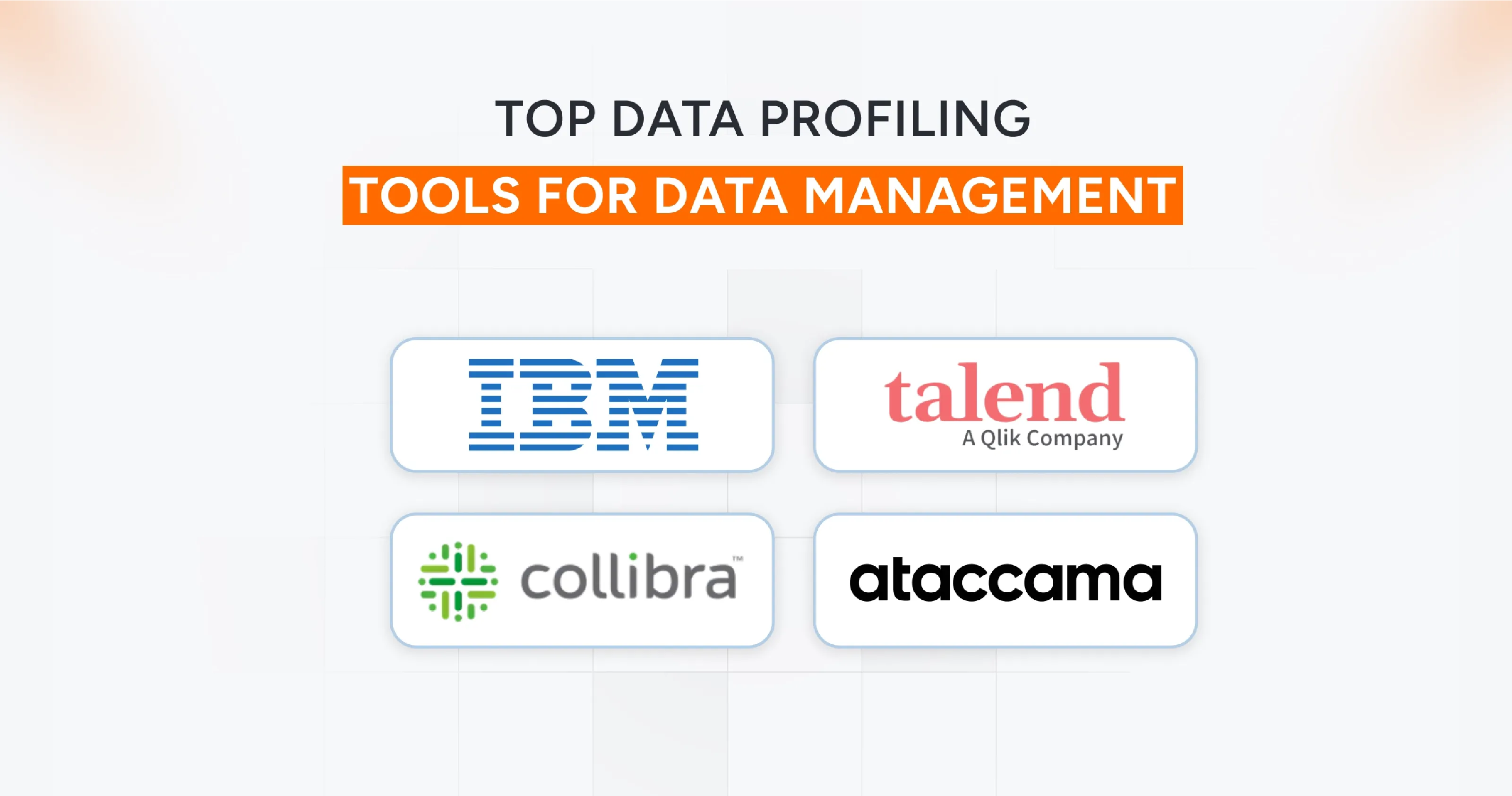
As data ecosystems expand, choosing the right data profiling tools becomes a strategic decision rather than a technical one. Modern data profiling software enables continuous data quality analysis, supports advanced data profiling techniques, and ensures that data remains reliable across analytics, governance, and operational systems.
Alation
Alation positions data profiling as a core capability within its data catalog, allowing organizations to combine discovery, governance, and quality assessment in a single environment. Instead of treating profiling as a separate task, it embeds insights directly into metadata and user workflows. This approach helps teams quickly understand data context, identify issues, and take corrective action without disrupting their processes.
Key features:
• Automated column profiling: Alation evaluates datasets at a granular level, identifying patterns, distributions, and anomalies to provide a clear understanding of data structure and quality.
• Metadata-driven quality insights: Profiling results are integrated into the catalog, enriching metadata with quality indicators that improve data discoverability and usability.
• Integrated stewardship workflows: Data issues identified during profiling are directly linked to governance workflows, enabling faster resolution and consistent data management practices.
IBM InfoSphere Information Analyzer
IBM InfoSphere Information Analyzer is designed for enterprises dealing with highly regulated and complex data environments. It combines in-depth profiling with governance and compliance capabilities, making it particularly valuable for industries where data accuracy and traceability are critical. Its ability to connect profiling outputs with broader oversight processes strengthens control across the data lifecycle. This is especially evident in use cases like pharma data analytics solutions, where compliance and precision are non-negotiable.
Key features:
• Automated column analysis and relationship discovery: The platform examines data structures and identifies relationships such as keys and dependencies, providing a comprehensive dataset view.
• Reusable data quality rules: They allow organizations to define and reuse validation rules, ensuring consistent enforcement of data standards across systems.
• Integration with governance and lineage: Profiling insights are tied to lineage tracking and governance frameworks, enabling better auditability and compliance management.
Talend Data Preparation
Talend Data Preparation focuses on making profiling actionable by integrating it with data cleansing and transformation workflows. It empowers both technical teams and business users to assess and improve data quality in real time. This operational approach ensures that profiling insights are not just observed but immediately acted upon.
Key features:
• Data profiling and assessment: Talend performs continuous analysis across multiple sources, identifying inconsistencies, anomalies, and hidden patterns within datasets.
• Machine learning-powered cleansing: Automated capabilities standardize, deduplicate, and enrich data, ensuring consistency as it moves through pipelines.
• Trust scores: The platform assigns reliability scores to datasets, offering a quick and transparent way to evaluate data readiness.
Collibra
Collibra integrates data profiling within a broader governance framework, bridging the gap between technical quality checks and organizational policies. It provides continuous visibility into data health while ensuring alignment with compliance requirements. This makes it particularly effective for organizations prioritizing accountability and standardized data practices.
Key features:
• Automated profiling and statistical insights: Collibra generates detailed metrics such as distributions, null values, and uniqueness to support ongoing data quality analysis.
• Machine learning-based pattern recognition: It identifies irregular patterns and correlations that may indicate underlying data quality issues.
• Continuous monitoring and enforcement: The platform enables real-time tracking and rule-based alerts to maintain consistent data standards.
Ataccama ONE
Ataccama ONE offers an AI-driven approach to data profiling software, designed for scalability in modern cloud-based architectures. It combines profiling with automation, performance optimization, and visibility, enabling organizations to manage data quality efficiently across distributed systems. Its focus on both technical depth and business accessibility makes it suitable for enterprise-wide adoption.
Key features:
• Statistical and ML-powered data profiling: Ataccama uses advanced models to detect anomalies, patterns, and rule violations, helping organizations address issues proactively.
• Pushdown profiling and performance optimization: It executes profiling tasks directly within cloud data platforms, improving speed and reducing processing overhead.
• Intuitive lineage and workflow visibility: The platform provides clear insights into data movement and transformations, making it easier for both technical and non-technical users to understand data flows.

Expanding the Role of Data Profiling Beyond Basic Data Checks
Data profiling is often perceived as a step focused purely on validation, but its actual scope is far more expansive. By combining algorithmic analysis with contextual evaluation, profiling delivers a concise yet meaningful view of patterns, distributions, and relationships within data. This insight not only supports data quality analysis but also strengthens decision-making, and forms the backbone of enterprise data quality management frameworks.
Reverse Engineering Data for Missing Context
In many organizations, datasets exist without complete or reliable metadata, making them difficult to interpret and use effectively. Data profiling helps bridge this gap by analyzing actual values to infer missing definitions, formats, and domains. It reconstructs a usable metadata layer that supports modeling, migration, and modernization initiatives. This is particularly relevant in complex environments requiring robust engineering data management practices.
• Identifies missing attribute definitions, formats, and domains to rebuild dataset context
• Supports enterprise data modeling, migration planning, and system modernization
• Enables better alignment between legacy data and current business requirements
Detecting Anomalies and Data Inconsistencies
Unreliable data can lead to inaccurate insights and poor decisions if not addressed early. Through structured data quality analysis, profiling evaluates distributions, null values, and inconsistencies within datasets. It highlights outliers and irregular patterns that may otherwise go unnoticed. When combined with strong data validation methods, it ensures that data meets expected standards before being used in analytics or reporting.
• Performs statistical data quality analysis to detect outliers, null values, and inconsistencies
• Evaluates frequency distributions and relationships across datasets for deeper insights
• Strengthens accuracy by combining insights with structured data validation methods
Discovering Hidden Data Rules and Dependencies
Many data rules are not explicitly defined but are embedded within systems and business processes. Data profiling uncovers these hidden dependencies by analyzing relationships across attributes and tables. This helps organizations formalize implicit rules and strengthen governance frameworks. When paired with effective data cleansing techniques, it ensures data consistency while preventing recurring quality issues.
• Uncovers implicit relationships, constraints, and dependencies across attributes and tables
• Enhances governance by formalizing hidden rules into enforceable standards
• Works alongside data cleansing techniques to ensure consistency and prevent recurring errors
By extending beyond basic validation, data profiling becomes a critical driver of data reliability, operational efficiency, and scalable data architecture.
How AQe Digital Can Help You Build a Strong Data Profiling Foundation?
Turning data into a reliable business asset requires more than just technology. It requires a structured approach, the right expertise, and continuous optimization. At AQe Digital, we help organizations design and implement a scalable data profiling process that integrates seamlessly into their data ecosystem, ensuring long-term data reliability and business impact.
• Assess and strengthen your data foundation: We evaluate your existing data landscape to identify gaps in quality, governance, and visibility, creating a roadmap for effective data quality analysis
• Implement and integrate data profiling tools: Our team deploys enterprise-grade data profiling tools that align with your architecture and embed profiling directly into your data workflows
• Leverage advanced data profiling software: We help you select, customize, and optimize data profiling software to automate analysis, improve scalability, and support real-time data monitoring
• Apply proven data profiling techniques: We use advanced data profiling techniques to uncover hidden patterns, validate data integrity, and ensure consistency across datasets
• Enable proactive data quality management: By embedding validation rules and automated monitoring, we ensure issues are identified and resolved early, reducing downstream risks
• Build a sustainable data governance framework: We help establish processes, standards, and controls that keep your data accurate, compliant, and ready for analytics and decision-making
With AQe Digital, data profiling becomes more than a technical step. It evolves into a continuous capability that drives trust, efficiency, and long-term value from your data.
Conclusion
Data profiling is becoming a strategic control layer that determines how effectively organizations scale analytics, automation, and AI initiatives. Without a well-defined data profiling process, even advanced systems struggle to deliver consistent outcomes. What sets high-performing organizations apart is their ability to operationalize profiling continuously using the right mix of data profiling tools, data profiling techniques, and governance practices.
With deep expertise in implementing scalable data profiling software and enabling real-time data quality analysis, AQe Digital helps organizations move from fragmented data environments to structured, insight-ready ecosystems. Their approach combines technical precision with business alignment, ensuring long-term data reliability.
Contact us to build a future-ready data foundation that supports growth, innovation, and confident decision-making.